Esthetic Makeover by Skillful Combination of Tac Aligners Followed with Veneers: A Case Report
Wisdom Dental Clinics ®, Jaipur, India, The Tooth Clinic, Bareilly, Uttar Pradesh, India
ABSTRACT
Aesthetics is a major factor in Orthodontic treatment and it is a primary concern among patients seeking orthodontic treatment. To meet the growing aesthetic desire for an alternative to traditional braces, researchers have created a variety of alternatives, including ceramic or composite braces, lingual orthodontics, and transparent aligners. Clear aligner therapy is a treatment that consists of a set of clear dental appliances that are custom-made to fit the contour of a patient's teeth. Clear Aligners are an alternative to traditional braces that are used to guide teeth into appropriate alignment. Clear aligners, like braces, utilise a progressive force to regulate tooth movement, but without the need of metal wires or brackets. Veneers can be one of the techniques which show excellent aesthetic results and longevity of the treatment. This report highlights the relevant aspects of Tac aligners and veneers in a 54-year-old female with the minimal invasive method where the aesthetics of patient was highly improved.
KEYWORDS: Clear Aligner, Adult patient, Veneers
INTRODUCTION
The orthodontic diagnosis of disharmonies between the skeletal bases of the skull is mainly undertaken by the maxilla and mandible to their reference points. ANB (A point, nasion, and B point) describes the discrepancy between skeletal bases.1
These angles depend on the landmarks that form them. Likewise, variation in the position of nasion due to growth or lack of accuracy while measuring can affect the relationship of skeletal bases, thus, involving the ANB measurement.2
Point A is not a fixed point as it varies with growth, similar to nasion as reported by one author ANB angle not only depends on nasion but also facial divergence.3 Factors affecting ANB are the patient age (ANB decreases with age), nasion position, rotation of SN (Sella- nasion) line, occlusal plane, maxilla, and facial prognathism.1
Tac align is based on sophisticated 3D graphic technology for designing and creating personalized masks for the gradual movement of teeth.4 Since the 1930s, dental veneers have been used for improving the aesthetic and protection of teeth.5 Dental veneers are considered to give expected results in correction cases of anterior teeth.6
The 3D interface and digital designing of restoration allows the clinician to immediately evaluate the preparation for the correction if needed and take new impression.7
The use of laminate veneers resulted in a better aesthetic outcome and less chair time.8
In this case report, we present a case of an elderly 54-year-old female patient where Tac aligners did retraction utilizing the already present spaces, then veneer (CEREC) was given in the upper anterior, which highly improved the aesthetics in a single visit.
CASE REPORT
A 54-year-old female patient reported to the clinic with the chief complaint of an unpleasant smile. On intraoral examination, she had protrusion, irregular anterior teeth. Spacing was distal to the upper right lateral incisor. Extraoral analysis, showed a convex facial profile. (Figure 1)

Figure 1: Intraoral and Extraoral photographs
Her primary concern was the alignment of her maxillary incisors, and she was not willing to have fixed appliances.
Based on her concern, we planned for Tac aligner clear aligners followed with veneers as our treatment plan. Aligners were given to align her teeth and close the spacing in the maxillary arch, followed by veneers to improve the aesthetics. The primary goal was to maintain occlusion, maintaining normal overbite and overjet, achieving a functional occlusion.
Attachments were then placed on teeth to achieve predictable tooth movement using Invisalign aligners. The aligners were given for 3 months, and the treatment was further combined with veneers. Here we opted for CEREC workflow using eMax CAD block to make it convenient and effective for the patient and save time. A single-visit of less than one hour was the time consumed to get the output through the CEREC CAD/CAM chair side system.The system allows scanning, digitally designing, making occlusal adjustments, and calibrating the proximal contacts. [Figure 2]
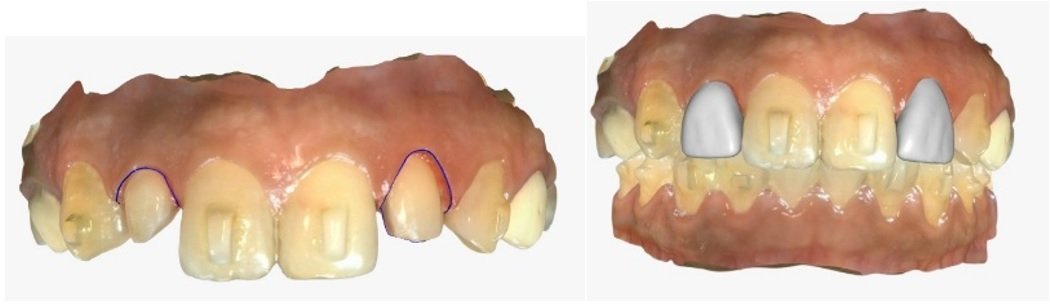
Figure 2: CAD/CAM system scan for digital designing and adjustments
Upper lateral incisors tooth preparation was done based. Minimum thickness helps in achieving structural durability and aesthetics. Round angles were made to improve load distribution through the material. Tooth preparation was avoided from any irregular surfaces. We then read the Morphology of dentition on software, and the data is observed by optical impression once the virtual model was developed to select insertion axis.
The obtained data had to be sent to the milling machine. Both veneers were made from a single block and treatment was done with eMax CAD block. Later final adhesive luting of veneer was done. We then observed before and after treatment images. The patient was very pleased with the final result. [Figure 3]
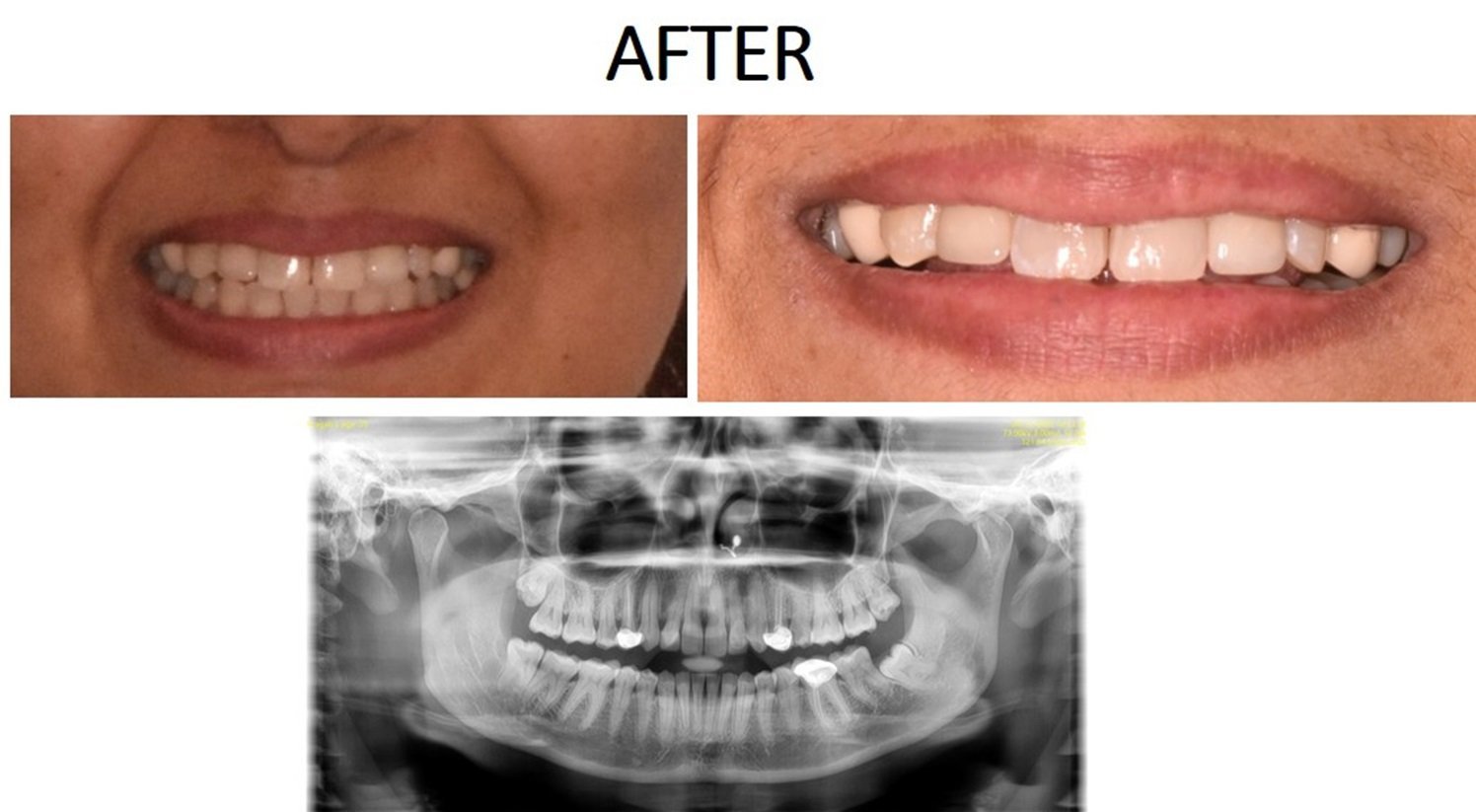
FIGURE 3: AFTER PHOTOGRAPHS
DISCUSSION
According to Ackerman, adult orthodontics is that branch of orthodontics that is concerned with the balance between achieving optimal proximal and occlusal contact of teeth, pleasing aesthetics, normal function with reasonable stability.9 The evaluation of sagittal relationship has been a significant problem in the field of orthodontics, due to the factors affecting the measuring angles which have prime importance in diagnosis and treatment planning of the case. ANB angle has been the most commonly used measurement for assessing sagittal jaw discrepancies. The angle value ranges from 2-4 degrees to 0-4 degrees.10
Adult patients who are above 50-years of age mostly present with complex oral problems which need a multidisciplinary approach of treatment planning. As here, we took a multidisciplinary approach to obtain the desired result. We gave 3 months Tac aligner treatment along with veneer in the upper anterior in a single visit with CEREC workflow using eMax CAD block.
The study stated that IPS Emax CAD resulted in fracture resistant crowns, while hand-layered zirconia crowns resulted in early veneer failures.11 In this case, we also used IPS eMax CAD.
Generally, aesthetic satisfaction is one of the complex processes to obtain from the patient.12,13 However, a few factors may play an important role in securing a patient’s satisfaction, such as durability of final aesthetic result, time duration of teeth preparation, and the cost of treatment. Here we managed all the factors to get a satisfactory outcome by achieving desirable functional and aesthetic results, considering other factors like ANB angle and age.
The CEREC system allows clinicians to independently design and machine ceramic restorations in a matter of hours, thus enabling reconstruction in only a single visit.14
In our present case, we used this system, and work was done in less than one hour in a single visit. Dental veneers improve aesthetics, its indications are:
- Discoloured teeth due to tetracycline staining, age, fluorosis, amelogenesis imperfect
- Restored or worn out teeth
- Abnormal morphology
- Correction of minor malposition
- Intraoral repair of crown and bridges15-17
In the present case, the patient has increased age, discoloured and minor malposition of teeth, hence we opted for veneers in combination with Tac aligners which gave a pleasant smile in an adult patient.
CONCLUSION
The evidence of our clinical practice suggests that CEREC chairside system is one of the valuable tools for clinician for saving time. The numbers of adult patients in orthodontics are usually concerned about aesthetics but adults may have other complications due to age related factors, which could pose a challenge for treatment. The biomechanics must be customized according to the individual’s treatment requirements, and a multidisciplinary approach should be employed to get the maximum result. Therefore, concluding that a skilful combination of Tac aligner clear aligners and veneers can give desirable results in correcting misaligned teeth and aesthetics when planned properly, even in adult patients.
REFERENCES
- Oktay H. A comparison of ANB, WITS, AF-BF, and APDI measurements. Am J Orthod Dentofacial Orthop. 1991;99(2):122–8. doi:10.1016/0889-5406(91)70114-C.
- Rotberg S, Fried N, Kane J, Shapiro E. Predicting the "Wits" appraisal from the ANB angle. Am J Orthod. 1980;77(6):636–42. doi:10.1016/0002-9416(80)90155-4.
- Aylor CM. Changes in the relationship of nasion, point A, and point B and the effect upon ANB. Am J Orthod. 1969;56(2):143–63. doi:10.1016/0002-9416(69)90231-0.
- Align Technology. Available from: http://www.invisalign.com.
- Calamia J. The etched porcelain veneer technique. N Y State Dent J. 1988;54(7):48–50.
- Layton DM, Walton TR. The up to 21-year clinical outcome and survival of feldspathic porcelain veneers: accounting for clustering. Int J Prosthodont. 2012;25(6):604–12.
- Zaruba M, Ender A, Mehl A. New applications for three-dimensional follow-up and quality control using optical impression systems and OraCheck. Int J Comput Dent. 2014;17(1):53–64.
- Toh C, Setcos J, Weinstein A. Indirect dental laminate veneersan overview. J Dent. 1987;15(3):117–24. doi:10.1016/0300- 5712(87)90067-4.
- Proffit WR, Fields HW, Sarver DM. Contemporary Orthodontics. Mosby: St Louis; 2007.
- Steiner CC. Cephalometrics for you and me. Am J Orthod. 1953;39:729–55.
- Guess PC, Zavanelli RA, Silva NR, Bonfante EA, Coelho PG, Thompson VP, et al. Monolithic CAD/CAM lithium disilicate versus veneered Y-TZP crowns: comparison of failure modes and reliability after fatigue. Int J Prosthodont. 2010;23(5):434–42.
- Nalbandian S, Millar B. The effect of veneers on cosmetic improvement. Br Dent J. 2009;207(2):3. doi:10.1038/sj.bdj.2009.609.
- Meijering A. Survival of three types of veneer restorations in a clinical trial: a 2.5-year interim evaluation. J Dent. 1998;26(7):563–8. doi:10.1016/S0300-5712(97)00032-8.
- Mörmann WH, Krejci I. Computer-designed inlays after 5 years in situ: clinical performance and scanning electron microscopic evaluation. Quintessence Int. 1992;23(2):109–15.
- RCSE. National Clinical Guidelines 1997. England: GTA; 1997.
- Ferrari M, Patroni S, Balleri P. Measurement of enamel thickness in relation to reduction for etched laminate veneers. Int J Periodontics Restor Dent. 1991;12(5):407–13.
- Tjan AH, Dunn JR, Sanderson IR. Microleakage patterns of porcelain and castable ceramic laminate veneers. J Prosthetic Dent. 1989;61(3):276–82. doi:10.1016/0022-3913(89)90127-3.
Disclaimer from Guident
The views and opinions expressed in articles published in Guident are solely those of the authors and do not necessarily reflect the views of the editors, the editorial board or the publisher, Ivory India. Guident does not endorse any product, technique or treatment described. Clinical content is intended for qualified dental and medical professionals and is not a substitute for individual clinical judgement. Guident, its editors and the publisher accept no liability for any consequence arising from the use of information published in the journal.
How to cite this article
Dr. Gaurav Gupta, Dr. D.K. Gupta, Dr. Richa Gupta. Esthetic Makeover by Skillful Combination of Tac Aligners Followed with Veneers: A Case Report. Guident. 2026 Feb;19(3). Available from: https://guident.net/articles/aesthetic-dentistry/esthetic-makeover-by-skillful-combination-of-tac-aligners-followed-with-veneers-a-case-report.html