Maxillary Hollow Denture "Light Towards the Other End of the Tunnel"
Department of Prosthodontics Sardar Patel Post Graduate Institute of Dental and Medical Sciences, Lucknow, India
Abstract
Severely atrophic ridges provide decreased retention, support and stability and pose a clinical challenge to the success of complete denture Prosthodontics. Retention stability and support are the basic principles on which the success of complete denture relies. It is the dentist’s responsibility to fabricate a prosthesis incorporating stability retention and support which ultimately provide satisfaction to the patient. But in the critical conditions such as long lip length or severely resorbed ridge with increased inter arch distance, the weight of a maxillary denture is often a dislodging factor hence, a light weight denture is required for better retention. This article describes a case of complete edentulous patient successfully rehabilitated with a hollow denture where a simplified technique of fabricating a light weight maxillary denture was used.
Key words – Residual ridge resorption ,Inter ridge distance ,Hollow maxillary denture, , Light weight denture,.
INTRODUCTION
The severely atrophic maxilla poses a clinical challenge for the fabrication of a successful complete denture. It has also been proved that prosthesis weight can be reduced by making the denture base hollow. Different approaches like using a solid 3–dimensional spacer including dental stone(1-6), cellophanewrapped asbestos(1-7), silicone putty(1-8) or modeling clay(1-9) have been used during laboratory processing to exclude denture base material from the planned hollow cavity of the prosthesis.
CASE REPORT
A 70 year old female patient reported to the our Out Patient Department of Prosthodontics with the chief complaint of difficulty in chewing food and bulky upper denture causing loss of retention.History revealed that patient was edentulous forthe past 16 years and had used many sets of complete dentures. On intra oral examination, it was found that maxillary ridge were severely resorbed. Upper lip was long, the inter ridge distance was more than normal and the previous denture of the patient was heavy with attrited teeth and was under extended .It was decided to fabricate a new set of dentures for the patient with maxillary hollow & mandibular conventional denture technique .
Technique
- The maxillary denture was fabricated up to the try in denture stage in the conventional manner.
- The land area of the cast was indexed using a conical bur and the trial denture was sealed to the definitive cast.
- The trial denture was duplicated in reversible hydrocolloid and poured in die stone.
- A template of the duplicated trial denture was made by adapting 1 mm thermoplastic sheet on the recovered cast using vaccum heat pressed machine.
- A permanent denture base was made on the duplicate maxillary edentulous cast. Using the template, the space to be made hollow, was caliberated with help of endodontic files having silicone stoppers(seen in fig-3).
- The space was filled up with addition silicone putty. This was used during trial closure stage to express out the resindough(fig-4). The denture was processed using the conventional short curing cycle compression moulding technique.
- After finishing the denture, two windows were cut with a bur into the denture base distal to the most posterior teeth. The silicone putty was removed using a sharp instrument(fig-5). After complete removal of putty the windows were sealed using autopolymerizing resin.
- The denture was polished in the usual manner and the seal was verified by immersing the denture in water. (Air bubbles should not be evident after immersing the denture in water) (fig-7).
- The patient was kept on regular recall for 3 months in which she reported high satisfactionwith aesthetic function and comfort.
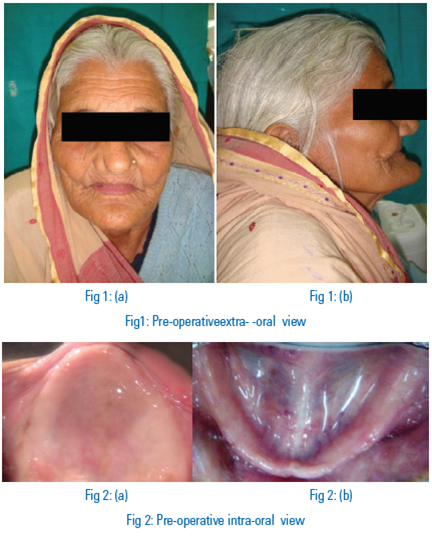

Fig 3: Measuring the hollow space with endodontic files
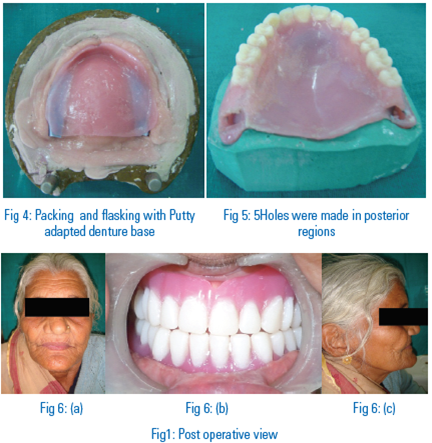

Fig 7: Hollow denture floating in jar
DISCUSSION
Rehabilitation of patient with severely resorbed ridges and long lip length is a challenge to the dentist.
Even though, the choice for rehabilitation can be implant supported overdenture, and ridge augmentation but many a times the patient who come with such a problem are geriatric patients with systemic illness, economic constraints,reluctance for a long duration treatment procedure and unwillingness for any kind of surgical procedure.Hence, the best way is to
rehabilitate them with the conventional way. Apart, from modifying the impression technique to getmaximum denture bearing area, modifying the type of denture may also be better accepted by the patient (Kalavathy et al, 2010).(2)
O Sullivan et al described a modified method for fabricating a hollow maxillary denture.(3) He used two flasks with inter changeable halves.
Holt et al processed a shim of indexed acrylic resin over the residual ridge and used a spacer which was then removed .The primary disadvantage of such technique is that the junction between the two previously polymerized portions of the denture occurs at the border of the denture which increases risk of seepage of fluid into the denture cavity.Another disadvantage is that it is difficult to gauge resin thickness in the cope area(4)
Advantages of The present Technique
- Reduced leakage at the junction of the two portions of the denture.
- Commonly used materials are used for its fabrication .
- Single flask is required for processing.
- Reduces weight of the prosthesis which, in turn ,enhances retention.
Disadvantages
- Time consuming procedure.
- Hollow denture is prone to fracture.
- Removable of putty from the cavity is technique sensitive.
Precautions
- There should be adequate thickness of resin around the cavity.
- Seal around the window should be perfect and should be checked for leakage.
- Denture care instruction should be given to the patient.
- Special instructions regarding handling of the denture should be given as the denture are prone to fracture.(5,11)
SUMMARY
Hollow maxillary denture is the best method of rehabilitating the patient with severely resorbed ridgeand long lip length. It not only reduces the weight of the denture but also the leverage action of the same. This ultimately results in increased retention and stability andupto some extent it is also possible to preserve the existing residual alveolar ridge. This technique is simple to execute and allows control of spacer thickness.
REFERENCES
- Laxman Singh Kaira, maxillary hollow denture : A case series, Journal of Orofacial Research April – June 2012; 2(2): 109-112.
- N Kalavathy, M MithaShetty, Premnath, KarunaPawashe, RKV Patel, Hollow mandibular complete denture - A case report. SRM University Journal of Dental Sciences, Volume 1, Issue 3, October - Decembret 2010
- SaurabhChaturvedi, A.K. Verma, Mariyam Ali, PreetiVadhvani, Hollow Maxillary Denture: A Simplified Approach. People’s Journal of Scientific Research.,Vol. 5(2), July 2012
- Holt RA Jr. A hollow complete lower dentine. J Prosthet Dent 1981; 45: 452 – 54.
- Laxman Singh Kaira ,Krishan Singh Negi , ShaliniParihaar , Rahul Bisht, LIGHT WEIGHT HOLLOW DENTURE – A CASE SERIES.Nitte University Journal of Health Science, Vol. 3, No.2, June 2013, ISSN 2249-7110
- UshaRadke, DarshanMundhe, hollow maxillary complete denture. J Indian Prosthodont SOC (Oct – Dec 2011), 11(4):246-249.
- Nidiffer TJ, Shipman TH, hollow bulb obturator for acquired palatal openings. J prosthet Dent 1957; 7: 126-34.
- Worley JL Kneiejski ME. A method for centrolling the thikness of hollow obturator Prosthesis. J Prosthet Dent 1983; 50: 227 – 29.
Disclaimer from Guident
The views and opinions expressed in articles published in Guident are solely those of the authors and do not necessarily reflect the views of the editors, the editorial board or the publisher, Ivory India. Guident does not endorse any product, technique or treatment described. Clinical content is intended for qualified dental and medical professionals and is not a substitute for individual clinical judgement. Guident, its editors and the publisher accept no liability for any consequence arising from the use of information published in the journal.
How to cite this article
Dr. Archana Singh, Dr. Devika, Dr. Ajay Singh. Maxillary Hollow Denture "Light Towards the Other End of the Tunnel". Guident. 2013 Oct;6(12). Available from: https://guident.net/articles/aesthetic-dentistry/maxillary-hollow-denture-light-towards-the-other-end-of-the-tunnel.html