Aesthetic Management of Midline Diastema Closure: A Case Report
Department of Conservative Dentistry & Endodontics, K.D. Dental College & Hospital, Mathura
ABSTRACT
Adults who have a diastema between their maxillary central incisors are frequently thought to have an aesthetic or malocclusion issue. During the mixed dentition, a midline diastema is typically a normal component of dental development. However, a diastema may need to be fixed due to several circumstances. Most persistent diastemas have traditionally been attributed to an enlarged labial frenum; however, it is now known that this is only the cause of a small minority of instances. Other causes of diastemas include oral habits, muscular imbalances, physical limitations, aberrant maxillary arch anatomy, and different dental malformations. Correct aetiology diagnosis and treatments relevant to that aetiology are necessary for effective diastema treatment.
Keywords: esthetic, midline diastema, composite
INTRODUCTION
A typical aesthetic issue in the dental office is midline diastema or space in anterior teeth.1 Most patients consider maxillary midline diastemas as aesthetic issues, making them an aesthetic liability like crowding or incisor protrusion.2 The aetiology of midline diastema is multifaceted. Midline diastema can be caused by a variety of conditions, including genetics, labial frenum, incomplete coalescence of the interdental septum, pseudo microdontia, presence of a mesiodens, peg-shaped lateral incisors, congenitally absent lateral incisors, pathologies (such as cysts in the midline region), habits like finger or lip sucking, tongue thrusting, and/or lip sucking.3 Any method, including direct composite veneers, indirect composite veneers, porcelain laminate veneers, all-ceramic crowns, and metal ceramic crowns, can be used to restore diastemas. However, the development of composite resins with great polishability and outstanding mechanical qualities allows the dentist to replicate the natural dentition and provide the patient with a long-lasting repair. Composite resins allow for conservative treatment and still providing quick results.4
CASE REPORTS
CASE 1
A 22-year-old male patient reported to the Department of Conservative Dentistry and Endodontics K.D Dental college & hospital, Mathura with the chief complaint of spacing in upper anterior teeth. Patient's medical history did not reveal any systemic diseases and clinical examination revealed a large space between the maxillary central incisors around 3 mm (fig.1) and the patient's oral hygiene was satisfactory. Direct aesthetic midline diastema closure with composite layering technique using putty index for both maxillary central incisors were considered as it is a more conservative, economical, aesthetic, and quicker option.
First, pre-operative model was made and diastema size analysis was done. Next, shade selection was done for the tooth to be restored and shade A1 (Vita Classical Shade Guide) was chosen for the composite restoration. Wax up was also done between 11 and 21 to close the space between them. A palatal silicone index using the material vinyl polysiloxane (having the property of high reproduction of details and high final hardness) was fabricated. Rubber dam was placed and then, 37% phosphoric acid (Prime dental Etching Gel, India) was applied on the mesial surface of both central incisors to be restored for 15 seconds, rinsed for 20 seconds, and dried with air slightly (fig.2). Then a single bottle bonding agent (Te- Econom bond Ivoclar vivadent, Zurich Switzerland) was applied and polymerized for 20 seconds with a LED light (fig.3). Palatal putty index was reseated, and incremental layering of direct composite resin restorative material was done with 11,21(fig.4). The composite was placed, shaped, and cured accordingly. Finishing and polishing of the restoration was done with smooth tapered diamond bur (Shofu preparation set) and polishing kit (Shofu Super Snap Rainbow kit) (fig.5). The patient was satisfied with the results. The patient was instructed to floss regularly and to avoid pigmented liquids that may cause staining of restoration. The patient was asked for regular follow-up visits for 6 months.

Fig 1. Preoperative view of the patient
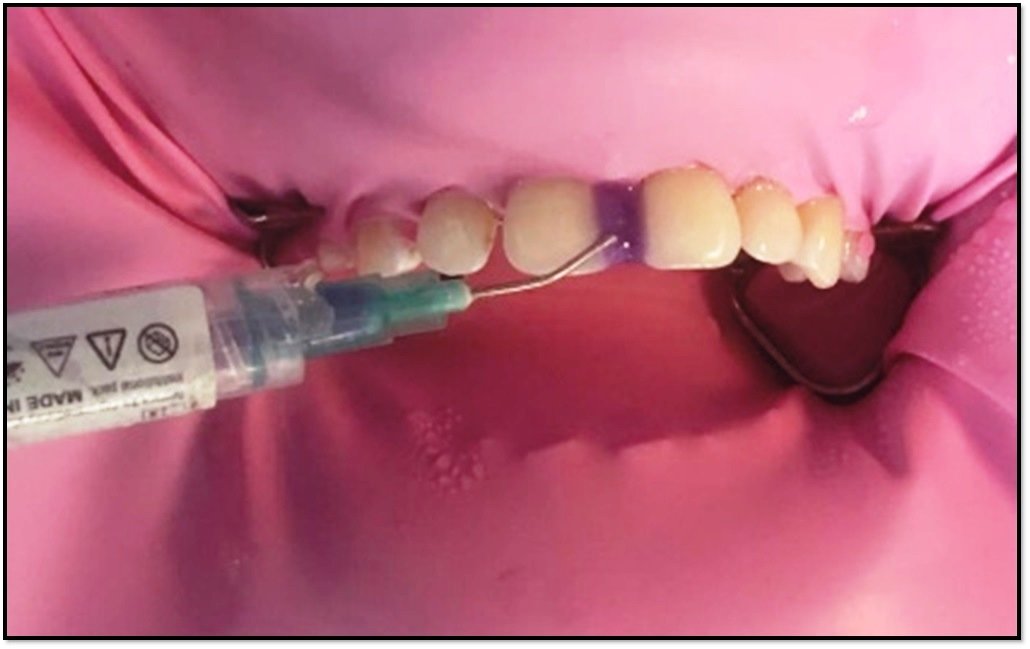
Fig 2. Etchant application

Fig 3. Bonding agent application

Fig 4. Putty index was made
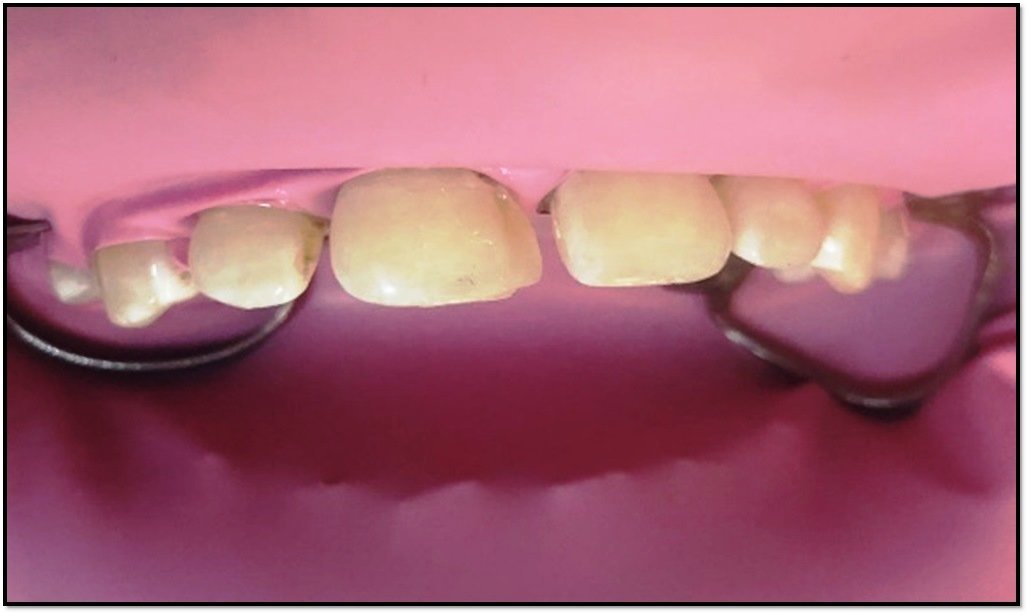
Fig 5. Palatal shelf was made using a putty index
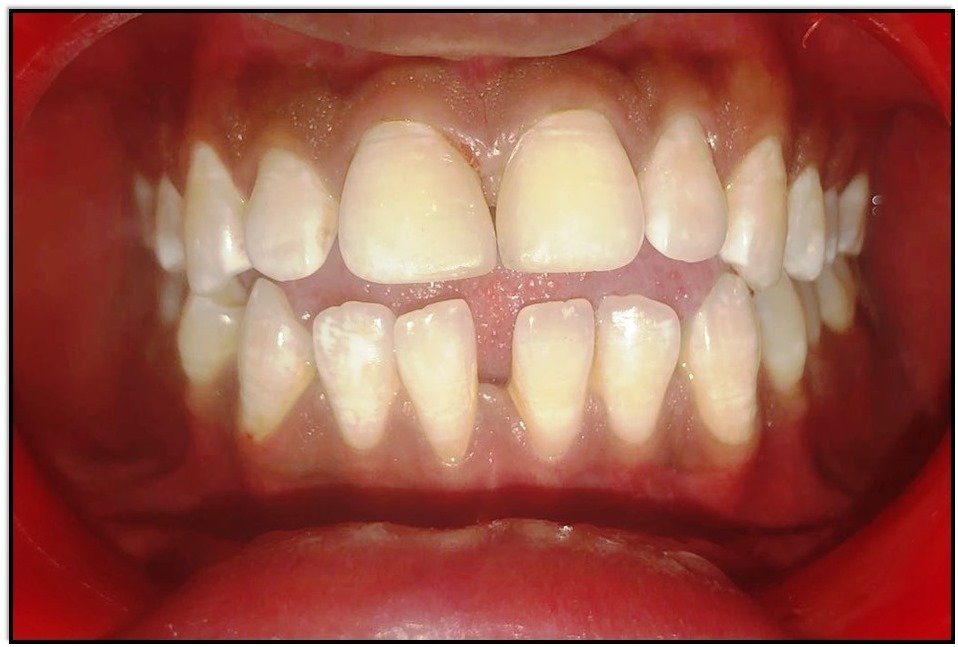
Fig 6. Postoperative view of the restorations just after finishing and polishing
CASE 2
A 23-year-old female came to the department of Conservative Dentistry and Endodontics, complaining about the space in the upper middle of front teeth region. The patient didn ‘t wants orthodontic or prosthodontic treatment options. So, the treatment plan to attain an esthetically favourable relation between the maxillary anterior teeth involved closing the diastema using composite resin restorations.
A clinical examination revealed 2 mm space between maxillary central incisors, with favourable gingival hygiene (fig. 7). The patient had Angle ‘s Class I malocclusion with normal overjet and over bite. Shade selection was done using vita classical shade guide under natural daylight. The central incisors were retracted by using retraction cord. Etching was done using 37% phosphoric acid (Prime dental Etching Gel, India), it was applied on the mesial surface to be restored for 15 seconds and then rinsed off (fig.8).
Te- Econom bond (Ivoclar vivadent, Zurich Switzerland) adhesive was applied and light cured for 20 seconds (fig. 9). The palatal shelf of the central incisors was formed with using mylar strips (fig. 10). Once the boundaries of the restoration had been identified, shade A2 dentin Tetric N ceram composite resin (Ivoclar Vivadent) composite resin was used to build the bulk of the dentine. This was overlaid with a 0.5mm layer of translucent A2 enamel shade of Tetric N ceram composite resin (Ivoclar Vivadent). Finishing and polishing of the restoration was done with smooth tapered diamond bur (Shofu preparation set) and polishing kit (Shofu Super Snap Rainbow kit) (fig. 11). Oral hygiene instructions were given to the patient and finger massaging of the interdental gingival was advised.
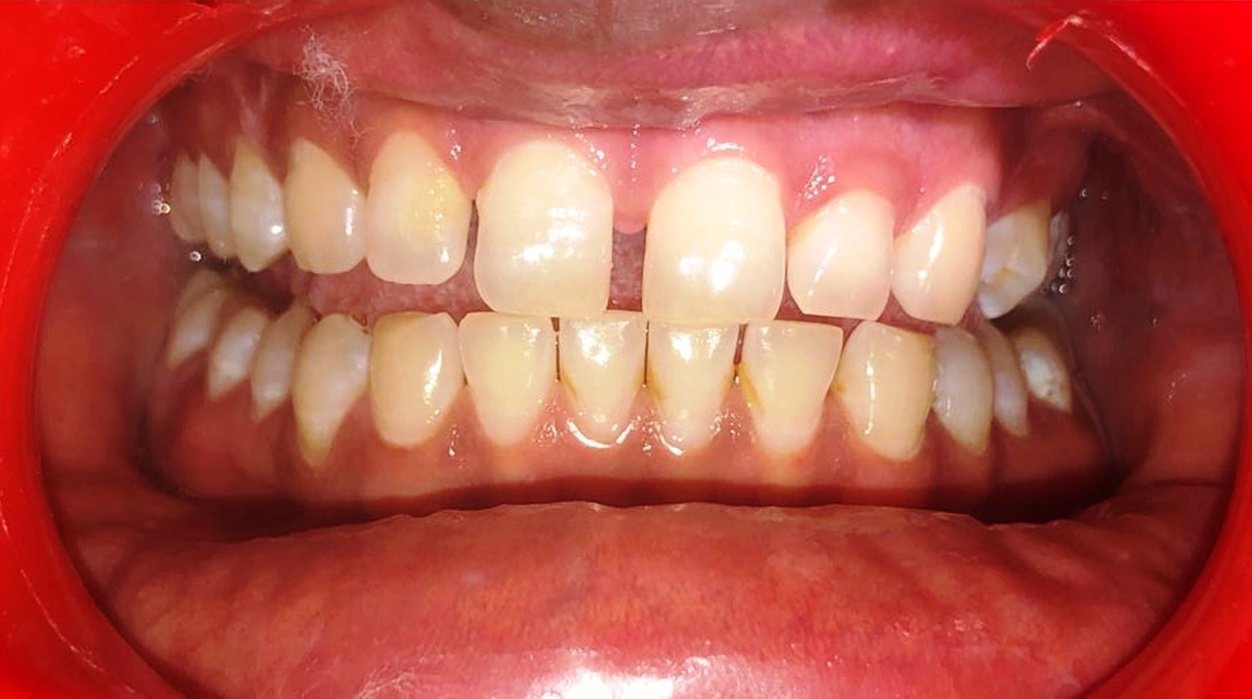
Fig 7. Preoperative view of the patient
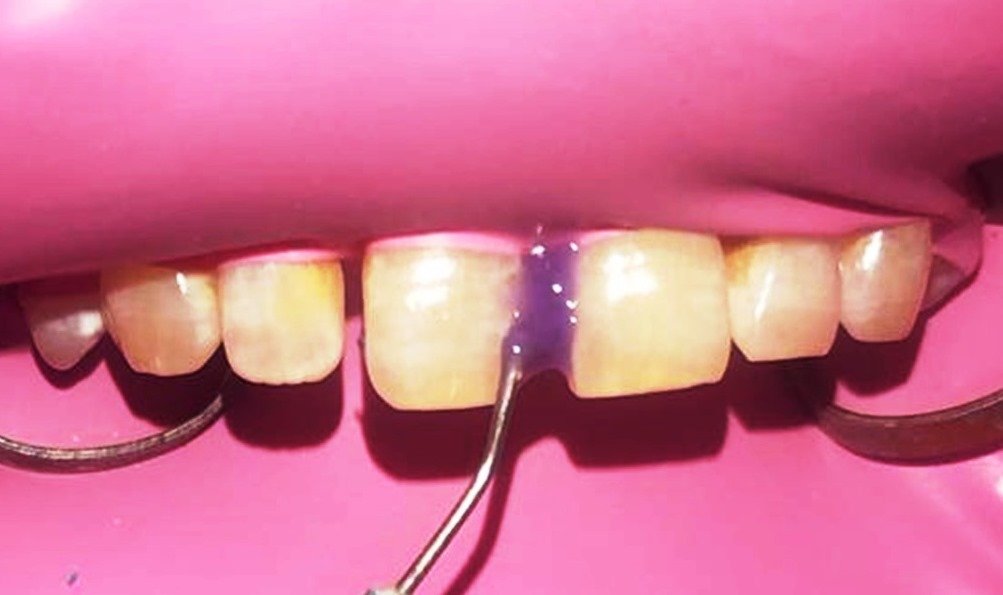
Fig 8. Etchant application
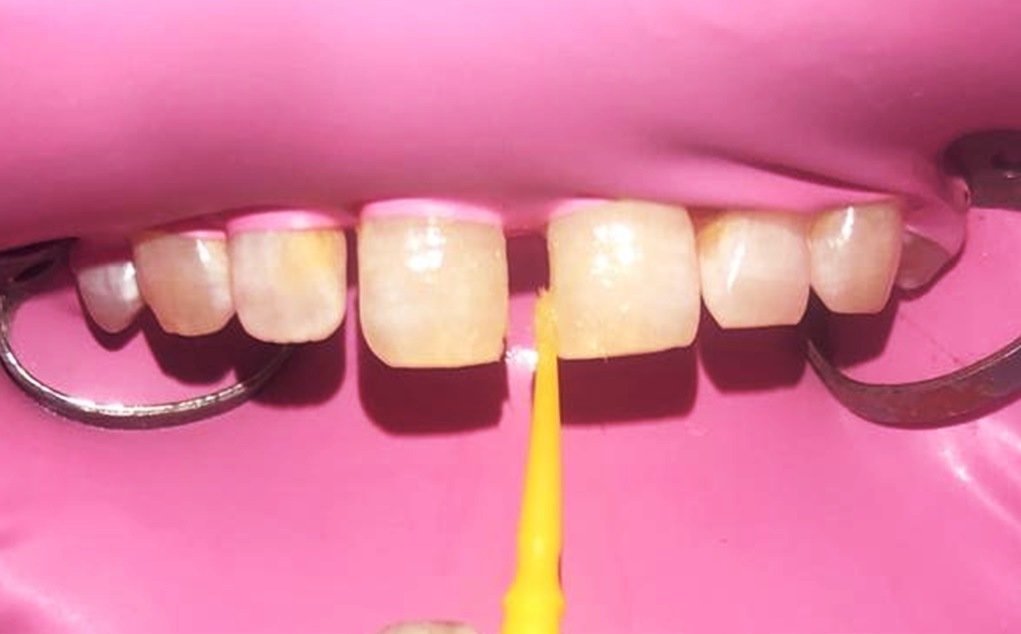
Fig 9. Bonding agent application

Fig 10. Palatal shelf was made using mylar strips
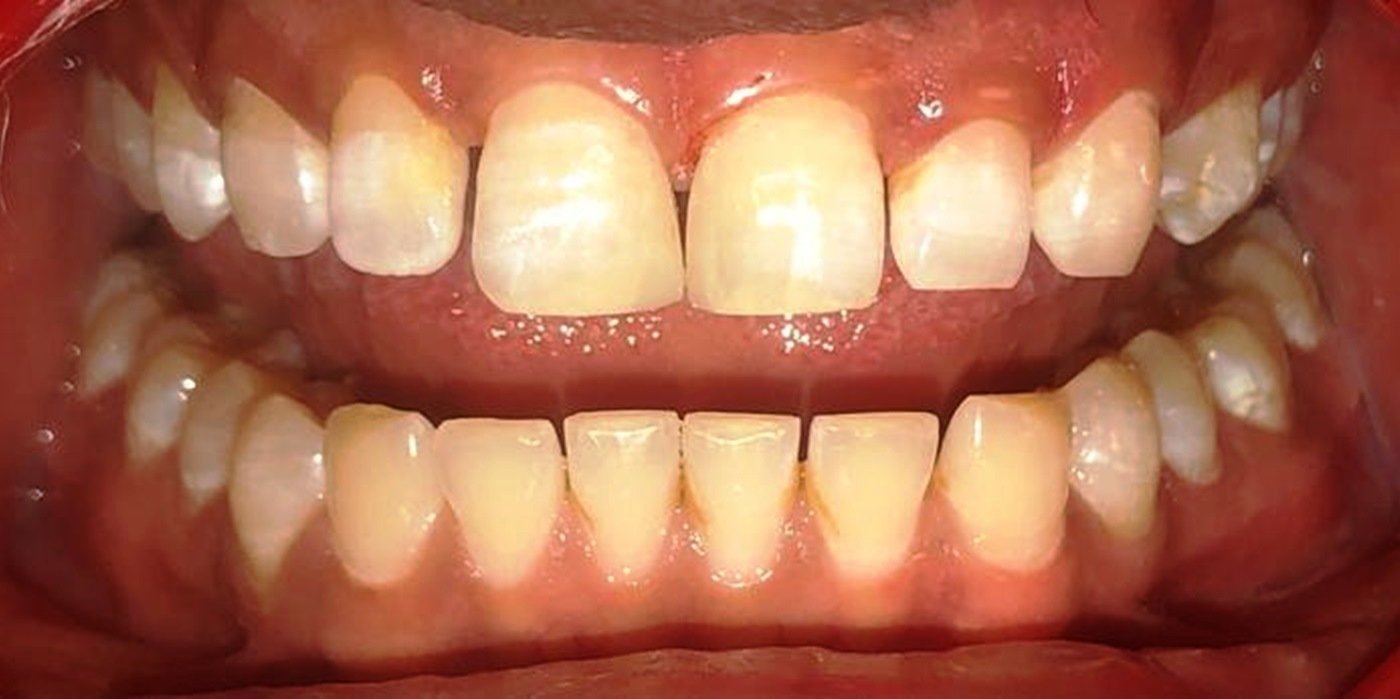
Fig 11. Postoperative view of the restorations just after finishing and polishing
DISCUSSION
Direct composite restoration has given clinicians the added benefit of delivering predictable aesthetic outcomes with swiftly closure and a minimised natural and pleasant solution to the cases where there is a wide space between teeth, which is in line with the current trend towards minimally invasive dentistry. Recent developments in composite resins have enhanced their mechanical and physical characteristics, making them more like natural teeth and giving them an appearance similar to natural dentin and enamel.5 These restorations have several aesthetic dental benefits that other alternative treatment choices like ceramic veneers and orthodontic therapy do not. When compared to ceramic materials, they are gentler on the opposing dentition. Direct composite resin restorations' colour stability is also less stable than that of glazed ceramics, but this depends on how well the finishing and polishing processes are done and can be avoided with recalls. Direct composite resin restorations can have these drawbacks, but as adhesive techniques advance and resin materials improve, dentists are able to make more conservative, practical, aesthetically pleasing, cost-effective, and long-lasting restorations while spending a lot less time in the chair.6
CONCLUSION
The minimally invasive aesthetic procedure used in these situations appropriate the patients' aesthetic needs. It was aimed to recreate the natural tooth structure with the greatest amount of tooth preservation.
REFERENCES
- H. J. Keene, “Distribution of diastemas in the dentition of man,” American Journal of Physical Anthropology, vol. 1963;21:437–441.
- Abdulgani, Mai & Abdulgani, Azzaldeen & Muhamad, Abu-Hussein.. Closing Diastemas with Resin Composite Restorations; a Case Report 2019;18;30-33
- W. J. Huang and C. J. Creath, “The midline diastema: a review of its etiology and treatment,” Pediatric Dentistry, vol. 1995;17:171–179.
- Kovacs BO, Mehta SB, Banerji S, Millar BJ. Aesthetic smile evaluation – A non- invasive solution. Dent Update 2011;38:452-4.
- Sangavi, Tamizharasan & Subbiya, Arunajetasan & Geethapriya, Nagarajan & (alias) Malathi Suresh, S. Mitthra & Sangavi, Tamizharasan. (2019). Closure of Midline Diastema by Composite Resin Build-up: A Case Report. Indian Journal of Public Health Research and Development 2019;10:2845-2847.
- P. Magne and U. C. Belser, “Porcelain versus composite inlays/onlays: effects of mechanical loads on stress distribution, adhesion, and crown flexure,” The International Journal of Periodontics & Restorative Dentistry, vol. 2003;23:543–555.
Disclaimer from Guident
The views and opinions expressed in articles published in Guident are solely those of the authors and do not necessarily reflect the views of the editors, the editorial board or the publisher, Ivory India. Guident does not endorse any product, technique or treatment described. Clinical content is intended for qualified dental and medical professionals and is not a substitute for individual clinical judgement. Guident, its editors and the publisher accept no liability for any consequence arising from the use of information published in the journal.
How to cite this article
Dr. Priya Mishra, Dr. Akhil Mudgal, Dr. Ajay Kumar Nagpal. Aesthetic Management of Midline Diastema Closure: A Case Report. Guident. 2023 Jun;16(7). Available from: https://guident.net/articles/endodontics/aesthetic-management-of-midline-diastema-closure-a-case-report.html