Beyond Conventional Posts: The Ribbond Fiber Advantage: A Case Series
Department of Conservative Dentistry and Endodontics, Seema Dental College And Hospital, Rishikesh
ABSTRACT
Ribbond fiber represents a modern innovation in dental materials, offering enhanced structural reinforcement for composite restorations, particularly in compromised tooth anatomy. Engineered with plasma-treated polyethylene fibers, it achieves superior adhesion to composite resins while maintaining optical translucency, ensuring seamless esthetics. Its flexibility allows it to conform to irregular root canal spaces, providing a customized fit without invasive canal preparation. As a post material, Ribbond acts as a stress-distributing matrix, reducing the risk of root fractures in structurally weakened teeth. This advanced fiber system represents a paradigm shift in post-endodontic rehabilitation, combining mechanical resilience with minimal intervention for optimal patient outcomes.
INTRODUCTION
Ribbond fiber is an advanced dental material made from Ultra High Molecular Weight Polyethylene (UHMWPE) fibers, transforming restorative dentistry since its debut in 1992.1 Its remarkable strength, flexibility, and compatibility with oral tissues make it an essential asset in modern dental care.2 Unlike traditional reinforcement methods, Ribbond does not require extra tooth preparation, simplifying clinical workflows while preserving tooth structure. Its ability to adapt to the natural contours of the tooth reduces microleakage and polymerization shrinkage, contributing to stronger and more durable restorations.3
One of Ribbond's key features is its capacity to evenly distribute stresses during composite resin polymerization, reducing the likelihood of fractures and improving restoration longevity. This versatile material is utilized in various dental procedures, including strengthening composite restorations, splinting, reinforcing post-endodontic restorations etc.4
The translucent nature of Ribbond fibers allows light to pass through, enabling seamless integration with composite resins—an important factor in maintaining aesthetic appeal, especially in anterior restorations.
Its adaptability to the intricate shapes of teeth provides precise reinforcement, enhancing the structural support of weakened teeth and offering an innovative solution for post-endodontic rehabilitation.
In the following case reports the badly broken teeth have been restored using ribbond fibre as a post.
CASE REPORT 1
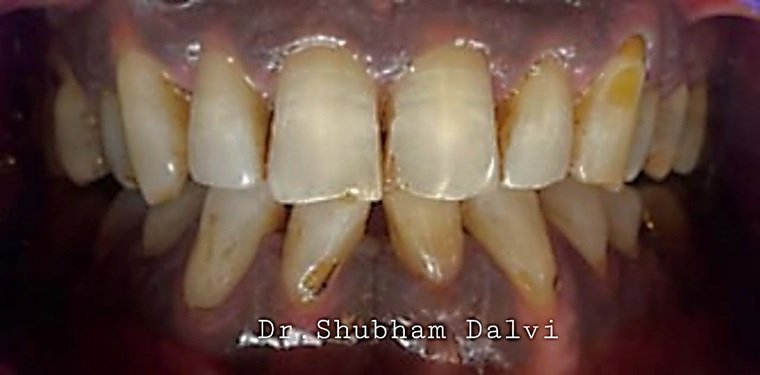
A 52-year-old male patient visited the department of Conservative Dentistry And Endodontics with the complaint of decayed tooth in upper right front region. Based on clinical and radiographic evaluation, diagnosis made was of non surgical root canal treatment irt. 12. The treatment plan then formulated was of restoring tooth with ribbond fibre followed by Emax crown irt 12.


PREOPERATIVE IMAGE & RADIOGRAPH


POST OPERATIVE IMAGE & RADIOGRAPH
CASE REPORT 2
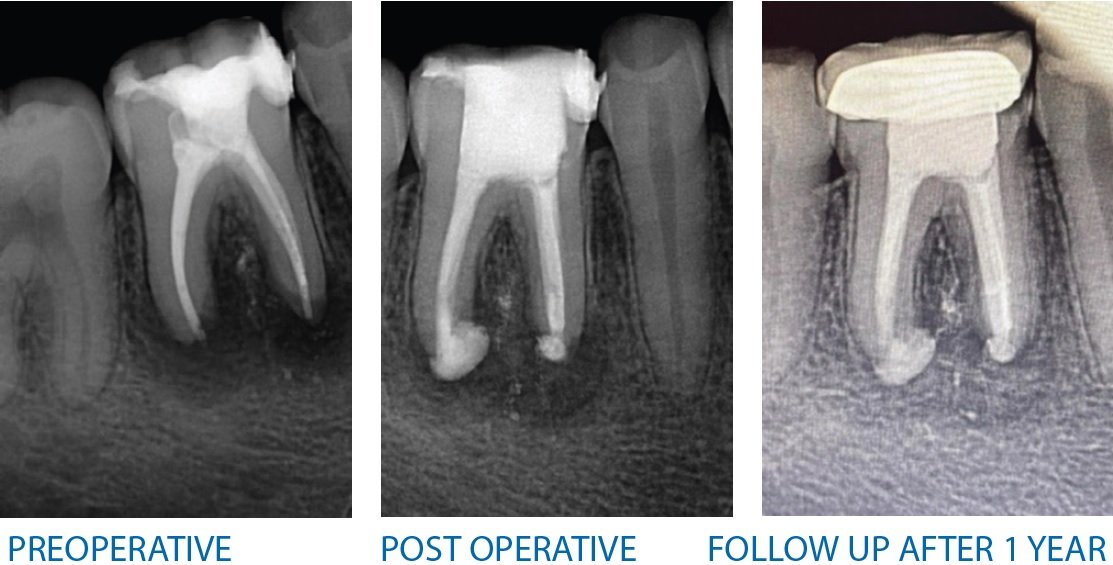
A 32-year-old female patient visited the department of Conservative Dentistry And Endodontics with the complaint of decayed tooth in lower right back region. Based on clinical and radiographic evaluation, diagnosis made was previously endodontically treated teeth irt 46. The treatment plan then formulated was restoring tooth with ribbond fibre followed by crown irt 46.


PREOPERATIVE IMAGE

POST OPERATIVE RADIOGRAPH

POST OPERATIVE IMAGE
DISCUSSION
The distribution of stress within a tooth is a key factor influencing its structural integrity5. Consequently, clinical methods aimed at enhancing the fracture resistance of weakened teeth and increasing the lifespan of dental restorations are essential for improving patient outcomes.6
Ribbond, a material comprising 215 fibers, was developed by Dr. David N. Rudo.7 Research shows that Ribbond fibers enhance the flexural strength and fracture toughness of composite resin restorations. Its unique fiber architecture, featuring a dense network of interlocking nodal points, serves as a crack-arresting mechanism by altering the direction of fracture propagation and dissipating strain energy.8
In addition to strengthening composite resins, Ribbond improves microtensile bond strength in high C-factor cavities. A specialized "gas plasma" treatment reduces internal fiber tension, facilitating a robust chemical bond with composite materials. The translucent nature of Ribbond fibers allows them to blend with the surrounding composite, preserving the natural color and enabling light transmission through restorations and crowns.
The structural integrity of endodontically treated teeth primarily relies on the residual dentin thickness surrounding post and core systems. Fiber-reinforced composite posts, introduced in the 1990s, possess an elastic modulus comparable to dentin. These posts reduce the risk of root fracture and, in cases requiring endodontic retreatment, can be removed predictably without compromising core retention.9,10
Ribbond functions as a "shock-absorber," mitigating strain energy accumulation and preventing stress concentration. This property helps to avert cracks and reduces the likelihood of catastrophic failures within the tooth-restoration interface.
The use of fiber-reinforced systems like Ribbond in restorative dentistry has gained significant traction due to their ability to improve the longevity and functionality of compromised teeth. A primary advantage of Ribbond is its conservative approach to tooth preservation. Unlike traditional post-and-core systems, which often necessitate extensive root canal enlargement and weaken tooth structure, Ribbond fibers allow for the retention of more natural dentin. They are also adaptable to irregular canal shapes, making them suitable for complex cases where conventional dowel systems may not be effective.11
For teeth with thin root canal walls, the use of materials like glass or quartz fiber posts, mineral trioxide aggregate (MTA), Biodentine, and self-adhesive resin cements offers structural reinforcement while creating a monoblock effect. Fiber posts help to evenly distribute stress, while MTA and Biodentine provide bioactivity and strong adhesion to dentin, improving canal wall integrity. When combined with bioceramic or calcium silicate-based sealers, these materials establish a durable bond, minimizing microleakage and reducing the risk of root fractures in structurally compromised teeth.12
CONCLUSION
In conclusion, achieving successful post-endodontic restoration is vital for the prolonged survival of root canal-treated teeth, particularly in cases with weakened tooth structure. Innovative materials like "Ribbond" provide a robust and forward-thinking approach to dental reinforcement. Its unique combination of strength, adaptability, and biocompatibility makes it an excellent choice for reinforcing fragile teeth while maintaining both function and aesthetics. By incorporating advanced solutions such as Ribbond, modern dentistry continues to progress, offering patients improved outcomes and more durable restorations. Ribbond is not merely a reinforcement material—it represents the future of dental innovation, seamlessly woven into every restoration.
REFERENCES
- JM Bae KN Kim M Hattori K Hasegawa M Yoshinari E Kawada Fatigue strengths of particulate filler composites reinforced with fibersDent Mater J200423216674
- MK Hasija B Meena D Wadhwa V Aggarwal Effect of adding ribbond fibres on marginal adaptation in class II composite restorations in teeth with affected dentineJ Oral Biol Craniofac Res20201022035
- V Chaudhary B Shrivastava H P Bhatia A Aggarwal AK Singh N Gupta Multifunctional Ribbond--a versatile toolJ Clin Pediatr Dent20123643258
- N Tuloglu S Bayrak E S Tunc Different clinical applications of bondable reinforcement ribbond in pediatric dentistryEur J Dent20093432934PMCID
- I Kantardzi? D Vasiljevi? L Blazi? O Luzanin Influence of cavity design preparation on stress values in maxillary premolar: a finite element analysisCroat Med J201253656876
- RT AlJarboua RA Alshihry HO Alkhaldi FHA Marar MA Aljaffary ML Almana Effect of Fiber-Reinforced Composite Placement Site on Fracture Resistance of Premolar Teeth: An in vitro StudyClin Cosmet Investig Dent2024162556610.2147/CCIDE.S461134
- S Akman M Akman G Eskitascioglu S Belli Influence of several fiber-reinforced composite restoration techniques on cusp movement and fracture strength of molar teethInt Endod J201144540715
- T Sfeikos D Dionysopoulos P Kouros O Naka K Tolidis Effect of a fiber-reinforcing technique for direct composite restorations of structurally compromised teeth on marginal microleakageJ Esthet Restor Dent202234465060
- B Akkayan T Gülmez Resistance to fracture of endodontically tretaed teeth restored with different post systemsJ Prosthet Dent20028744317
- M L Pitel N L Hicks Evolving technology in endodontic postsCompend Contin Educ Dent2003241329
- J Bijelic-Donova T Myyryläinen V Karsila PK Vallittu J Tanner Direct Short-Fiber Reinforced Composite Resin Restorations and Glass-Ceramic Endocrowns in Endodontically Treated Molars: A 4 -Year Clinical StudyEur J Prosthodont Restor Dent202230428495
- S Akman M Akman G Eskitascioglu S Belli Influence of several fibre-reinforced composite restoration techniques on cusp movement and fracture strength of molar teethInt Endod J201144540715
Disclaimer from Guident
The views and opinions expressed in articles published in Guident are solely those of the authors and do not necessarily reflect the views of the editors, the editorial board or the publisher, Ivory India. Guident does not endorse any product, technique or treatment described. Clinical content is intended for qualified dental and medical professionals and is not a substitute for individual clinical judgement. Guident, its editors and the publisher accept no liability for any consequence arising from the use of information published in the journal.
How to cite this article
Dr. Eva Mishra, Dr. Nikita Gupta, Dr. Anil Dhingra. Beyond Conventional Posts: The Ribbond Fiber Advantage: A Case Series. Guident. 2025 Mar;18(4). Available from: https://guident.net/articles/endodontics/beyond-conventional-posts-the-ribbond-fiber-advantage-a-case-series.html