Management of Discolored Endodontically Treated Teeth
Seema Dental College & Hospital, Rishikesh, Uttrakhand, India
INTRODUCTION
Discoloration of the tooth results from trauma, loss of vitality, endodontic treatment, and restorative procedures.1 The remnants of the blood stain consequent to trauma or incomplete removal of pulp during endodontic treatment lead to hemolysis.2,3 The chromogenic blood degradation products, such as hemosiderin, hemin, hematin, and hematoidin, get deposited in the dentinal tubules.4 The accumulated breakdown products lead to grayishyellow to brown discoloration of the teeth. Other causes such as obturation materials, remnants of pulp tissue in the pulp horns, intracanal medicaments, and coronal restorations may also cause discoloration.5,6 The discolored anterior teeth can cause significant esthetic concerns.7
Over the years, a number of bleaching and restorative techniques have been proposed for managing discolorednonvital incisors.3,8 Walking bleach technique is based on the use of chemicals that release active oxygen such as hydrogen peroxide (H2 O2 ) or sodium perborate (SP). A combination of SP and water or H2 O2 has been used in the “walking bleach” technique.9,10 The outcome of the bleaching depends mainly on the concentration of the bleaching agent, ability of the agent to reach the chromophore molecules, and duration and number of times the agent is in contact with chromophore molecules.11Although H2 O2 exhibited excellent estheticoutcome, the undesirable consequences such as cervical resorption and irreversible damage to the dentin and surrounding tissues led the clinicians to look for alternative methods.
SP has been widely used to bleach nonvital teeth with predictable results.3 SP is an oxidizing agent containing 95% perborate and is available in three forms: monohydrate, trihydrate, and tetrahydrate. In the presence of water, perborate will break down to form sodium metaborate, H2 O2 , and oxygen. SP is also synergistically used with H2 O2 but when used with water released H2 O2 in a controlled manner with remarkable esthetic outcome with little or no side effects.12 The SP releases active oxygen radicals inside the pulp chamber and diffuses to the dentinal tubules.13 It oxidizes and bleaches the iron sulfide and other pigments present in the dentinal tubules and the free radicals induces oxidative effects to lipids, proteins, and nucleic acids.7,14 A case of successful bleaching of discolorednonvital, endodontically treated tooth using walking bleach technique with SP and water was reported. The case was followed up for 1 year with no relapse or side effects.
CASE DESCRIPTION
Case: 1
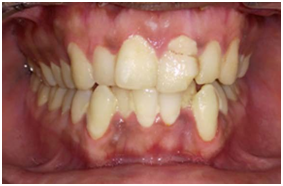
A 22-year-old woman complained discoloration of her maxillary right central incisor [Figure 1a]. She experienced trauma 6-7years ago and visited a local dentist. Clinical and radiographic examination revealed that the tooth had large periapical lesion irt.11 The periodontal ligament was widened with loss of lamina dura.

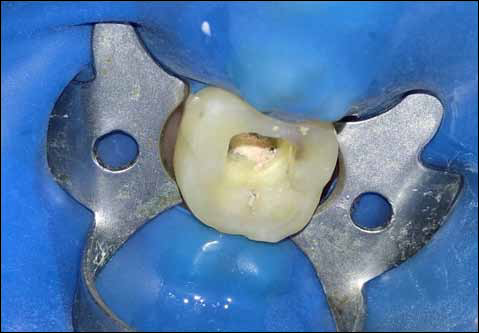
After local anaesthesia administration, the tooth was isolated using a rubber dam, access opening was done. Working length was establish with 15 no. K-file with apex locator[Figure 1b]. Cleaning and shaping was done till #F3, followed by placement of intaracanal medicament (Metapex).Pt was recalled after 4 weeks for follow up. In the next visit obturation was done using single cone of F3[Figure 1c]. After that guttapercha was removed 2mm below the level of the cementoenamel junction[Figure 2a], then glass ionomer cement (Ketac molar) was placed as a sealing of 2mm[Figure 2]. A mixture of Sodium Perborate and Hydrogen Peroxide was inserted as the common effective material for internal bleaching. The color change was satisfactory to the patient 1 week later. At this time, the mixture was flushed out, and a temporary restoration. After 1 week, this temporary restoration was replaced with a permanent composite restoration. At a 1-year follow-up examination, the patient presented with no symptoms, a recall radiograph revealed a continuous periodontal ligament without any signs of root resorption, and the patient was satisfied with the toothcolor.


DISCUSSION
Discoloration of the anterior tooth due to trauma or endodontic treatment can cause considerable esthetic compromise to patients. The management of postendodontic tooth discoloration includes full veneers, laminates, crowns, and noninvasive technique such as bleaching.11,15 Even though laminate veneer or a full porcelain crown is one of the most predictable methods of managing such cases, it involves the removal of tooth structure.8,16Nonvital bleaching has many benefits since it is a noninvasive procedure, economical, and less time-consuming. The three most popular techniques for nonvital tooth bleaching are the walking bleach technique, inside/outside bleaching, and in-office bleaching. The walking bleach technique is a relatively reliable, fairly simple technique. The walking bleach technique is performed by application of a paste consisting of SP and distilled water or H2 O2 in the pulp chamber.17
The pigmentation that causes the intrinsic discoloration of necrotic pulp consists of long-chain organic molecules. Bleaching using H2 O2 will oxidize these long-chain molecules and transform them into carbon while releasing water and oxygen.18 Internal bleaching requires healthy periodontal tissues and a root canal that is properly treated to prevent the bleaching agent from leaking into periapical tissues.19 In vitro studies have concluded that SP in water, SP in 3% H2 O2 , SP in 30% H2 O2 , and 10% carbamide peroxide are efficient agents for the internal bleaching of nonvital teeth.20-22 The use of a bleaching agent with a high concentration of H2 O2 in combination with heating appears to promote cervical root resorption.19,23 This is attributed to the leakage of bleaching agent through dentinal tubules which initiate an inflammatory reaction.24
Cervical root resorption is a potential complication of nonvital tooth bleaching. Studies have shown that the use of a mixture of SP and water showed low potential to cause cervical resorption.21,23 However, in the present case, the use of SP and water as well as proper sealing technique prevented the development of resorption.25,26 The resin-modified glass ionomer was placed as a barrier sealant in the present case to avoid leaching of bleaching agent. SP in tetrahydrate form mixed with distilled water was used instead of H2 O2 to avoid any potential risk of invasive cervical resorption, as shown in prior studies.21,23
CONCLUSION
The case presented highlights the effectiveness of the nonvital bleaching using SP and water to achieve successful and predictable cosmetic outcome. The case was followed up for 1 year with no sign of relapse of the discoloration or cervical root resorption. Hence, it can be concluded that walking bleaching technique using SP can be used as a treatment of choice for nonvital, discolored endodontically treated cases.
REFERENCES
- Ranka M, Dhaliwal H, Albadri S, Brown C. Trauma to the primarydentition and its sequelae. Dent Update 2013;40:534-6, 539-40, 542.
- Rotstein I, Zalkind M, Mor C, Tarabeah A, Friedman S. In vitro efficacyof sodium perborate preparations used for intracoronal bleaching ofdiscolored non-vital teeth. Endod Dent Traumatol 1991;7:177-80.
- Amato M, Scaravilli MS, Farella M, Riccitiello F. Bleaching teethtreatedendodontically: Long-term evaluation of a case series. J Endod2006;32:376-8.
- Arens D.The role of bleaching in esthetics. Dent Clin North Am1989;33:319-36.
- Krastl G, Allgayer N, Lenherr P, Filippi A, Taneja P, Weiger R. Toothdiscoloration induced by endodontic materials: A literature review. DentTraumatol 2013;29:2-7.
- Mohebbi P, Tour Savadkouhi S. Tooth discoloration induced bycalcium-silicate based materials: A literature review. Minerva Stomatol2016;65:378-84.
- Plotino G, Buono L, Grande NM, Pameijer CH, Somma F. Nonvitaltooth bleaching: A review of the literature and clinical procedures. JEndod 2008;34:394-407.
- Beier US, Kapferer I, Burtscher D, Dumfahrt H. Clinical performanceof porcelain laminate veneers for up to 20 years. Int J Prosthodont2012;25:79-85.
- Camps J, de Franceschi H, Idir F, Roland C, About I. Time-coursediffusion of hydrogen peroxide through human dentin: Clinicalsignificance for young tooth internal bleaching. J Endod 2007;33:455-9.
- Holmstrup G, Palm AM, Lambjerg-Hansen H. Bleaching of discolouredroot-filled teeth. Endod Dent Traumatol 1988;4:197-201.
- Dahl JE, Pallesen U. Tooth bleaching – A critical review of the biologicalaspects. Crit Rev Oral Biol Med 2003;14:292-304.
- Valera MC, Camargo CH, Carvalho CA, de Oliveira LD,Camargo SE, Rodrigues CM. Effectiveness of carbamide peroxideand sodium perborate in non-vital discolored teeth. J Appl Oral Sci2009;17:254-61.
- Kawamoto K, Tsujimoto Y. Effects of the hydroxyl radical and hydrogenperoxide on tooth bleaching. J Endod 2004;30:45-50.
- Attin T, Paqué F, Ajam F, Lennon AM. Review of the current statusof tooth whitening with the walking bleach technique. IntEndod J2003;36:313-29.
- Fearon J. Tooth whitening: Concepts and controversies. J Ir Dent Assoc2007;53:132-40.
- Chen YW, Raigrodski AJ. A conservative approach for treating youngadult patients with porcelain laminate veneers. J EsthetRestor Dent2008;20:223-36.
- Zimmerli B, Jeger F, Lussi A. Bleaching of nonvital teeth. Aclinically relevant literature review. SchweizMonatsschrZahnmed2010;120:306-20.
- Zarow M. Nonvital tooth bleaching: A case discussion for the clinicalpractice. CompendContinEduc Dent 2016;37:268-76.
- Baratieri LN, Ritter AV, Monteiro S Jr., Caldeira de Andrada MACardoso Vieira LC. Nonvital tooth bleaching: Guidelines for theclinician. Quintessence Int 1995;26:597-608.
- Rotstein I, Mor C, Friedman S. Prognosis of intracoronal bleachingwith sodium perborate preparation in vitro: 1-year study. J Endod1993;19:10-2.
- Ari H, Ungör M. In vitro comparison of different types of sodiumperborate used for intracoronal bleaching of discoloured teeth. IntEndod J 2002;35:433-6.
- Vachon C, Vanek P, Friedman S. Internal bleaching with 10% carbamideperoxidein vitro. Pract Periodontics Aesthet Dent 1998;10:1145-8,1150, 1152.
- Friedman S, Rotstein I, Libfeld H, Stabholz A, Heling I. Incidence ofexternal root resorption and esthetic results in 58 bleached pulplessteeth. Endod Dent Traumatol 1988;4:23-6.
- Cvek M, LindvallAM. External root resorption following bleachingofpulpless teeth with oxygen peroxide. Endod Dent Traumatol1985;1:56-60.
- Dietschi D. Nonvital bleaching: General considerations and report oftwo failure cases. Eur J Esthet Dent 2006;1:52-61.
- de Oliveira LD, Carvalho CA, Hilgert E, Bondioli IR, de Araújo MA,Valera MC. Sealing evaluation of the cervical base in intracoronalbleaching. Dent Traumatol 2003;19:309-13.
Disclaimer from Guident
The views and opinions expressed in articles published in Guident are solely those of the authors and do not necessarily reflect the views of the editors, the editorial board or the publisher, Ivory India. Guident does not endorse any product, technique or treatment described. Clinical content is intended for qualified dental and medical professionals and is not a substitute for individual clinical judgement. Guident, its editors and the publisher accept no liability for any consequence arising from the use of information published in the journal.
How to cite this article
Dr. Annil Dhingra Dr. Praveen Singhpal Dr. Gazal Bisht Department of Conservative Dentistry and Endodontics. Management of Discolored Endodontically Treated Teeth. Guident. 2018 Feb;11(3). Available from: https://guident.net/articles/endodontics/management-of-discolored-endodontically-treated-teeth.html