Non Surgical Resolution of Periapical Abscess with Esthetic Rehabilitation of Structurally Compromised Teeth
Department of Conservative Dentistry and Endodontics Subharti Dental College, Swami Vivekanand Subharti University, Meerut., India
Abstract
The combined field of Conservative Dentistry and Endodontics makes the clinician accountable for not only treating the lesions but also providing functional and esthetic rehabilitation for the patient.
A good root canal therapy helps in eliminating most of the bacteria of the root canal, with the advent of the newer intracanal medicaments this task has become all the more easy to be accomplished. A non surgical approach is not only a traditional but also the more conservative approach for the healthy restoration of the teeth.
In today’s modern world of fashion, Esthetic and functional rehabilitation is the primary concern for a patient and it is the responsibility of the clinician to provide the same in the best possible manner.
Key Words:Non Surgical, Esthetic Rehabilitation, Periapical Pathology, Compromised teeth.
INTRODUCTION
Pathological events in periapical abscess are mainly characterized by bone destruction and this bone destruction is mediated by osteoclasts which are multinuclear cells derived from macrophages. Most periapical diseases are induced as a result of direct or indirect involvement of oral bacteria. The etiologic factors are oral contaminants through the root canal or degenerating pulpal tissues. Thus without the proper debridement, cleaning and disinfection of the root canal the resolution of periapical pathology remains doubtful.
According to the earlier researchers a good cleaning, shaping and copious irrigation with the introduction of an intracanal medicament would result in the elimination of most of the root canal microorganisms. Seltzer, Soltanoff and Bender(1) observed in a series of studies, that pulpo-periapical lesions have the potential for healing without surgical intervention. Cvek, Heithersay, Messer and Stock (2) have demonstrated successful clinical management of large periradicular lesion by the use of calcium hydroxide used as an interim dressing.
Once the resolution of Periapical pathology takes place, the healing process by the body takes a new course. Osteoblasts lay down new bone and provide a newly found strength to the teeth, making them competent enough to handle functional and esthetic rehabilitation, for the functional and occlusal load.
Fibre post have given a new scope to this field by being more esthetic, especially in case of anterior teeth. With a modulus of elasticity similar to dentin, the fibre post can reduce the concentration of stress and, thus, the rate of catastrophic root fracture compared with cast posts.(3)
CASE REPORT
A 24 year old boy reported to the Department Of Conservative Dentistry And Endodontics, Subharti Dental College with the chief complaint of fractured lower front teeth, due to trauma 4 years back.(Figure 1)
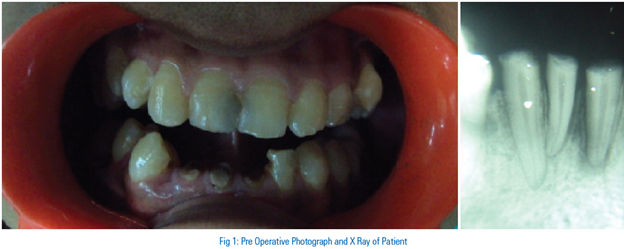
The patient presented with a history of intermittent swelling which was self resolving in nature, associated with pain and a sinus opening with pus discharge. The pain was intermittent, pulsating and moderate in nature, relieved on medication and aggravated on mastication.
On radiographic examination a Periapical pathology involving the lower incisors was present. The vitality testing revealed a delayed response with the lateral incisors and no response with the central incisors.
The treatment was planned with a non surgical approach, an access opening was prepared, pulp was extirpated and the apices were perforated with a 20 number K file, the teeth were left open for a day. Working length was determined and biomechanical preparation was completed the next day followed by the placement of calcium hydroxide in the canals. The calcium hydroxide was left for fifteen days in the canals. After a fortnight the patient was asymptomatic and the canals were dry. However the calcium hydroxide dressing was changed and repeated for another fifteen days.

Fig 2: Fibre Post placement with Composite Build Ups
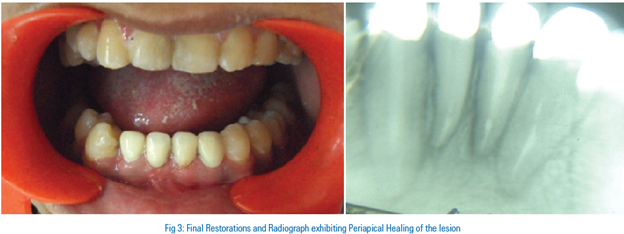
The patient exhibited a healing pattern of response radiographically in the Periapical area. The root canal was completed and the patient was kept on observation for a month.
As the tooth structure remained compromised, fiber posts (Glassix No. 1) were placed in all the four teeth and composite build up was done. (Figure 2)
DISCUSSION
The major goals of root canal treatment are to clean and shape the root canal system and seal it in three dimension to prevent reinfection of the tooth. Although initial root canal therapy has been shown to be a predictable procedure with a high degree of success, failures can occur after treatment in case uninstrumented canals are left, dentinal tubules are not cleaned properly, or in the complex irregularities of the root canal system.
Periapical lesions develop as sequelae to pulp disease. Bacterial infection of the dental pulp may lead to periapical lesions. The ultimate goal of endodontic therapy should be to return the involved teeth to a state of health and function without surgical intervention. All inflammatory periapical lesions should be initially treated with conservative nonsurgical procedures. Surgical intervention is recommended only after nonsurgical techniques have failed.
Calcium hydroxide nowadays is a widely used endodontic material, thanks to its high alkalinity (Tronstad et al. 1981) and bactericidal effect (Sjogren et al. 1991, Siqueira & Lopes 1999). In the presence of large and chronic periapical lesions, the deliberate placement of calcium hydroxide beyond the confines of the root canal and into the peri-radicular tissues has been advocated. Caliskan & Sen4 have reported that treatment with calcium hydroxide resulted in a high frequency of periapical healing showing completed resorption of the periapical defect4. The exact mechanism of action of calcium hydroxide is still speculative. Ghose. et.al. has advocated that direct contact between the calcium hydroxide and the Periapical tissue was necessarily beneficial for osseoinductive reasons. It is suggested that if calcium hydroxide is confined to the root canal, it is possible that the inflammation created by the diffusion of calcium hydroxide through the apical foramen may be sufficient to cause break up of the cystic epithelial lining, thereby allowing a connective tissue invagination into the lesion with ultimate healing.
Fibre Posts are composed of interlaced glass matrix which along with the composite materials and have appreciable esthetic properties, the recently developed posts are radiopaque as well, thus easily seen on radiographs. Modifications in post configuration have been made to achieve better adaptation. The translucent glass-fibre post has a modulus of elasticity similar to that of dentin and offers adequate mechanical properties.
CONCLUSION
A good endodontic treatment is the answer to most of the Periapical infections, Time and again clinicians have proved the power of a good endodontic treatment in the healing of the Periapical infections. In this particular case we treated the Periapical infection of the patient non-surgically, followed by reinforcement of the remaining tooth structure with esthetic rehabilitation.
REFERENCES
- Seltzer, Soltanoff, Bender. Epithelial proliferation of periapical lesions. Oral Surg 1969; 27:111-5
- Heithersay GS. Calcium hydroxide in treatment of pulpless teeth with associated pathology. J.Endod 1975;8:76
- Bergman B, Lundquist P, Sjögren U, Sundquist G. Restorative and endodontic results after treatment with cast post and cores. J Prosthet Dent 1989; 61(1):10–5.
- Bhaskar SN. Nonsurgical resolution of radicular cysts. Oral Surg 1972; 21:458-68
- Caliskan MK & Sen BH. Endodontic treatment of teeth with apical periodontitis using calcium hydroxide a long term study.
- Dental Traumatology 1996; 12:215-21
- Cormier CJ, Burns DR, Moon P. In vitro comparison of the fracture resistance and failure mode of fiber, ceramic and conventional post systems at various stages of restoration. J Prosthodont 2001; 10(1):26–36.
- Malferrari S, Monaco C, Scotti R. Clinical evaluation of teeth restored with quartz fiber-reinforced epoxy resin posts. Int J Prosthodont 2003; 16(1):39–44.
Disclaimer from Guident
The views and opinions expressed in articles published in Guident are solely those of the authors and do not necessarily reflect the views of the editors, the editorial board or the publisher, Ivory India. Guident does not endorse any product, technique or treatment described. Clinical content is intended for qualified dental and medical professionals and is not a substitute for individual clinical judgement. Guident, its editors and the publisher accept no liability for any consequence arising from the use of information published in the journal.
How to cite this article
Dr. Shalya Raj, Dr. Rohit Arora. Non Surgical Resolution of Periapical Abscess with Esthetic Rehabilitation of Structurally Compromised Teeth. Guident. 2013 Sep;6(11). Available from: https://guident.net/articles/endodontics/non-surgical-resolution-of-periapical-abscess-with-esthetic-rehabilitation-of-structurally-compromised-teeth.html