Perforation Repair in Maxillary LEFT First Molar Using Biodentine as a Repair Material
D.J.College of Dental Science And Research, Modinagar, U.P
ABSTRACT
Introduction: Perforation repair is a fairly common endodontic procedure. The aim of this case report was to present a case of perforation repair with Biodentine as a repair material .
Methods: A nonsurgical endodontic case was treated and repaired with BIODENTINE as a root repair material and restored.
Results : Perforation repair was shown to be successful in this case report.
Conclusions: If managed properly, perforation repairs can result in long-term clinical success.
Perforation is a mechanical or pathological communication between the root canal/pulp space and the supporting apparatus of the tooth, which leads to a compromise on the health of the periradicular tissue. They are unfortunate complications that occur in the course of endodontic treatment1, 2. In case of perforation a proper temporal seal should be established to avoid bacterial passage.5. The size of the defect also plays an important role since large perforations do not respond as well as the smaller ones.6.Large perforations can cause problems of incomplete sealing of the defect, thus allowing continual bacterial irritation at the perforation site.7. Smaller perforations are usually associated to lesser tissue damage and inflammation, and are easier to repair. Healing is more predictable and has a better prognosis. Torabinejad informs that an immediate and typical sign is an abundant haemorrhaging emanating from the perforation site.
Biodentine a new repair material by Septodont which comes in powder and liquid form.5,6. It tolerates a moist environment very well and also inhibits the bacterial growth. It has better marginal adaptation and cytotoxicity as compared to other materials.
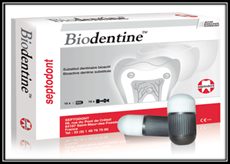
FIGURE I: Biodentine by Septodont
Factors of significance to prognosis for treatment are time, size, and shape of the perforation as well as its location impacts the potentials to control infection at the perforation site.
The aim of this article was to present a case of perforation repair with BIODENTINE as a repair material.
CASE REPORT
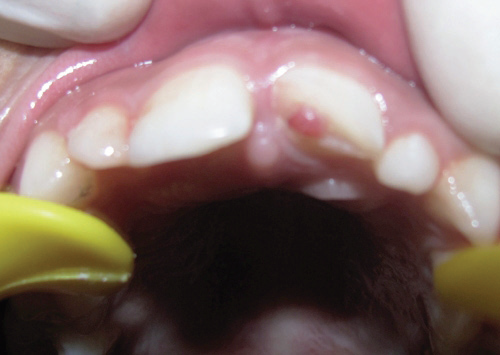
A 33 year old female patient was referred to the Department of conservative dentistry and endodontics at DJ College of dental sciences and research, modinagar, with chief complaint of in upper left back tooth region since 2-3 months. On clinical examination 26 had an old restoration.[Fig. II. A]. On removal of the same, an ovoid shaped perforation was noticed in the furcation area . On probing the area, bleeding was noticed from the perforation site.
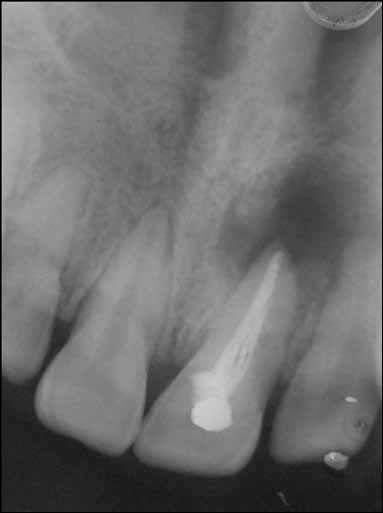
Intra oral periapical radiographic analysis of 26 showed a large radiolucency extending into the furcation area .[Fig. II. B] The root canals were negotiated, biomechanical preparation completed, calcium hydroxide saline paste was used as the intra canal medicament in between appointments and the root canal obturated using AH plus sealer (Dentsply DeTrey GmbH) and Gutta percha cones (Dentsply Maillefer), using a monocone technique. [Fig. II C, D]. The site is cleansed with physiological solution. The perforation site was subsequently sealed using biodentine and finally, radiographic evidence identifies the perforations’ sealing .[Fig. II.D].

Fig. II [a]: Pre Operative

Fig. II [b]: Working Length

Fig. II [c]: Master Cone

Fig. II [D] OBTURATION
DISCUSSION
Perforation is a procedural accident that occurs during root canal treatment, creating an artificial communication between the root canal and the supporting periodontal apparatus. Recently BIODENTINE can also be used as a material of choice for perforation repair. For perforation repairs, it is important to also consider the periodontal and restorative prognosis of the tooth.
Its better consistency, better handling and safety and faster setting time which creates no need for two step obturation. More importantly, the biologic response to this material was excellent, and complete resolution of the alveolar bone lesion.
Prognosis for a perforated tooth depends on the location of the perforation, the time in which the perforation allows entry of contamination, the possibility of sealing it and the accessibility of the main canal.15.
Different materials have been used for endodontic perforation repair and the search for an ideal perforation repair material is a challenge. A repair material has to be placed in intimate contact with hard tissues of the tooth and soft tissues of the periodontium. These materials may pose a threat to endodontic treatment outcome by causing local or systemic adverse effects, either through direct contact with or leaching of chemical components into the periodontal tissues and alveolar bone (Breault et al, 2000).
In this case BIODENTINE by Septodont was choosen to repair the perforation. This material tolerates a moist environment very well and also inhibits the bacterial growth. It has better marginal adaptation and cytotoxicity as compared to other materials.
REFERENCES
- Ng YL, Mann V, Gulabivala K. A prospective study of the factors affecting outcomes of nonsurgical root canal treatment: part 1: periapical health. Int Endod J 2011;44: 583–609.
- de Chevigny C, Dao TT, Basrani BR, et al. Treatment outcome in endodontics: the Toronto study—phases 3 and 4: orthograde retreatment. J Endod 2008;34:131–7.
- Fuss Z, Trope M. Root perforations: classification and treatment choices based on prognostic factors. Endod Dent Traumatol 1996;12:255–64.
- Best S.M., Porter A.E., Thian E.S., Huang J., Bioceramics: Past, Present and for the Future, Journal of the European Ceramic Society 28 (2008) 1319–1913.
- Hench L., Bioceramics: From Concept to Clinic, Journal Amer. Ceram. Soc., 74(7) 1487–1510 (1991).
- Koch K., Brave D., Bioceramic technology-the game changer in endodontics. Endodontic Practice US.2009;12:7–11.
- Koch KA, Brave DG, Nasseh AA, Bioceramic Technology: closing the endo-restorative circle, Part I, Dent. Today, 2010;29:100–105.
- Ghoneim Ag, Lutfy RA, Sabet NE, et al. Resistance to fracture of roots obturated with novel canal-filling system. J Endod,2011;37:1590–1592.
- Koch, K., Brave D., Bioceramic technology — the game changer in endodontics. Endodontic Practice US.2009;12:7–11.
- Seltzer S, Bender IB, Smith J, Freedland I, Nazemov H. Endodontic failures: an analysis based on clinical radiographic and histologic findings. Oral Surg Oral Med Oral Pathol 1967;23:500-30.
Disclaimer from Guident
The views and opinions expressed in articles published in Guident are solely those of the authors and do not necessarily reflect the views of the editors, the editorial board or the publisher, Ivory India. Guident does not endorse any product, technique or treatment described. Clinical content is intended for qualified dental and medical professionals and is not a substitute for individual clinical judgement. Guident, its editors and the publisher accept no liability for any consequence arising from the use of information published in the journal.
How to cite this article
Dr Annil Dhingra, Dr.Harkanwal Kaur, Dr.Bhullar Dr.Saurabh Department of onservative Dentistry & Endodontics. Perforation Repair in Maxillary LEFT First Molar Using Biodentine as a Repair Material. Guident. 2015 Jan;8(2). Available from: https://guident.net/articles/endodontics/perforation-repair-in-maxillary-left-first-molar-using-biodentine-as-a-repair-material.html