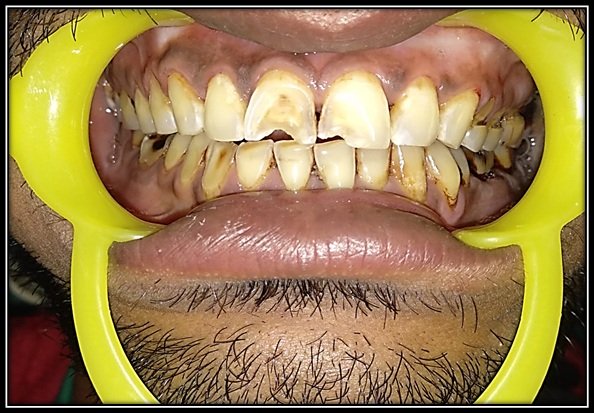
Post Endodontic Restoration with Different Fibers-a Case Series
Department of Conservative Dentistry and Endodontics, Seema Dental College And Hospital, Rishikesh
INTRODUCTION
Endodontically treated teeth are structurally different from vital teeth; major changes include altered tissue physical characteristics, loss of tooth structure, and possibly also discoloration.1
Early post techniques were quick, inexpensive and simple. These posts were usually cast in a precious alloy or prefabricated in stainless steel, titanium or precious alloy. However, they did not take into account the individual shape of the root canal and, as a result, their adaptation was not ideal. A post core system should include components of differing rigidity. Because the more rigid component is able to resist forces without distortion, stress would be transferred to the less rigid substrate. The difference between the elastic modulus of dentin and that of the post material may therefore be a source of stress to the root structures.2
Fibre reinforced composite root canal posts with an elastic modulus close to that of dentin were introduced in the 1990’s. They were found to reduce the incidence of root fracture, and, in the case of endodontic retreatment, they could be removed from the root canal with ease and predictability without compromising core retention. Glass fibre-supported resin dowel systems comprising unidirectional glass fibres in a resin matrix were introduced in 1992. These materials were able to distribute stress over a broad surface area thus increasing the load threshold at which the dowel began to show evidence of microfracture.3
Ribbond is used in combination with composite resin (Ribbond Composite Laminate Endo Post and Cores). The physical properties of this material allow the conservative fabrication of aesthetic dowels and core foundations. As a result, what is produced is an aesthetic post core system that adapts to the root morphology individually. It must be noted that most root fractures occur years after post placement. Minimal cracking occurs in the laminate resin post structure due to the inherent crack-stopping property of fibreres in interfaces. The relative flexibility of the fibre composite laminate post has been reported to minimize microcrack propagation in the root.4
In following cases post endodontic restoration was done using fibers:
CASE 1
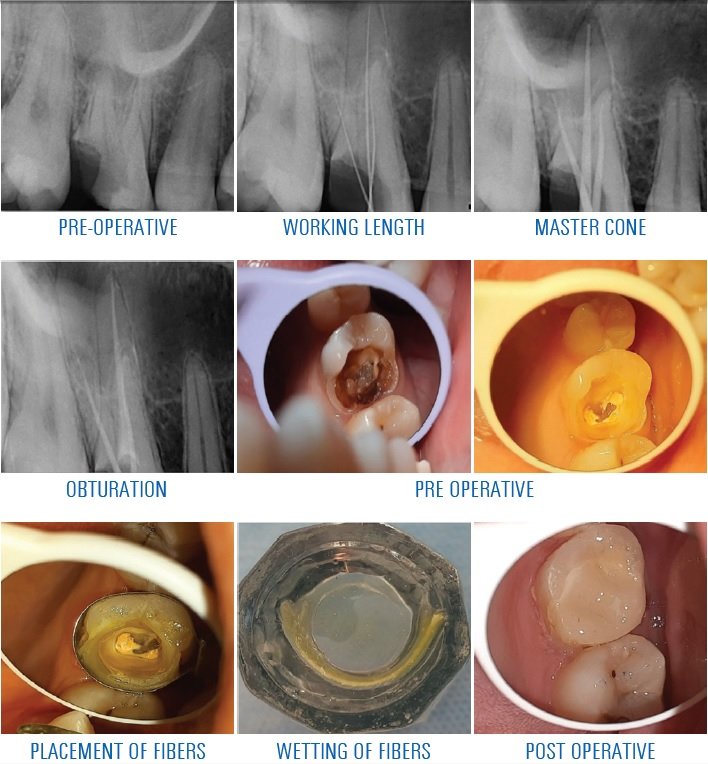
A 40 year old female patient came with chief complaint of pain in upper left back region of mouth since few days. Patient had a history of sudden sharp pain which lasted for long due to cold or sweet food stuff. On clinical examination there was deep proximal caries w.r.t 16. Radiographic examination showed radiolucency involving enamel, dentin and pulp. According to the findings the tooth was diagnosed with chronic irreversible pulpitis w.r.t.16. Treatment plan was to proceed with non surgical endodontic treatment w.r.t 16. In the second visit, the post endodontic restoration was done using Ribbond Fibers. The GP was sheared till 4-5 mm below the CEJ. Interlig fibers (Angelus) were dipped in the bonding agent. After etching and conditioning, the Iterlig fibers were packed in the canal along with flowable and packable composite.
CASE 2
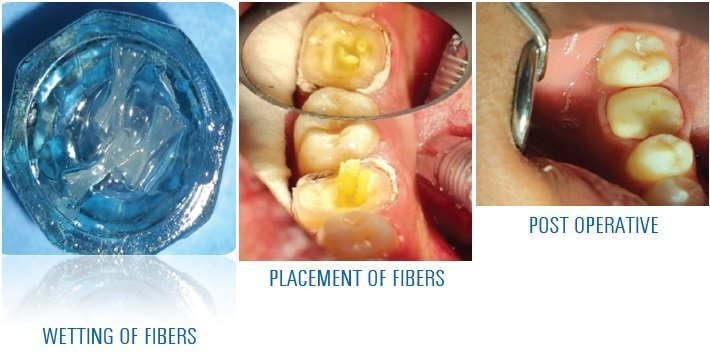
A 25 year old patient reported with a chief complaint of decyed teeth in lower right back tooth region. On clinical examination, grossly decayed 46 was observed. On radiographic examination, periodontal ligament widening was seen irt 46. On the basis of clinical and radiographic findings, a diagnosis of irreversible pulpitis with apical periodontitis was made w.r.t.46. Root Canal Treatment followed by buildup with ribbond fibers was planned. The working length was determined using #15 K-file and confirmed radiographically. Biomechanical preparation was done by K files using step back technique. Irrigation was done using 5.25% NaOCl and saline. Chlorhexidine was used as a final irrigant. Mastercone was selected according to the last apical file used. The canals were dried with paper points and obturated by lateral condensation technique. Sealer used was Roeko, Germany. In the second visit, the post endodontic restoration was done using Ribbond Fibers. The GP was sheared till 4-5 mm below the CEJ. Ribbond fibers were dipped in the bonding agent. After etching and conditioning, the ribbond fibers were packed in the canal along with flowable and packable composite.

CASE 3
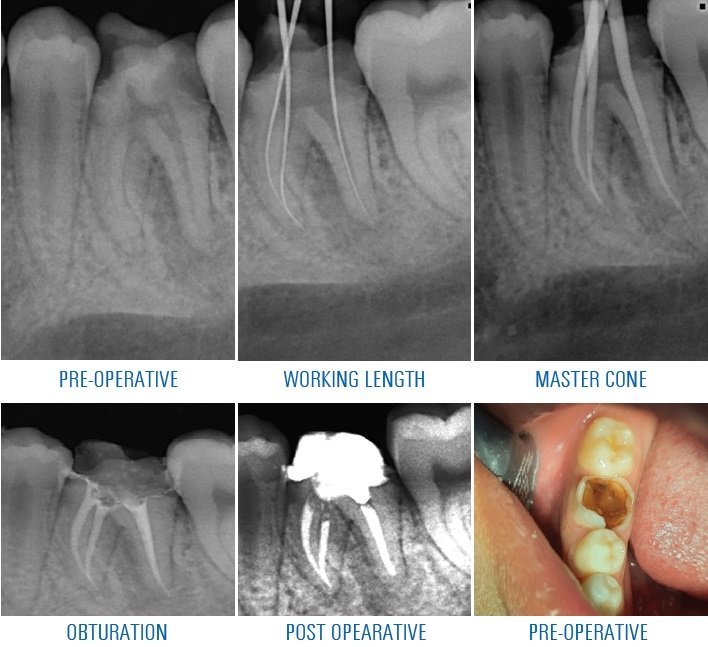
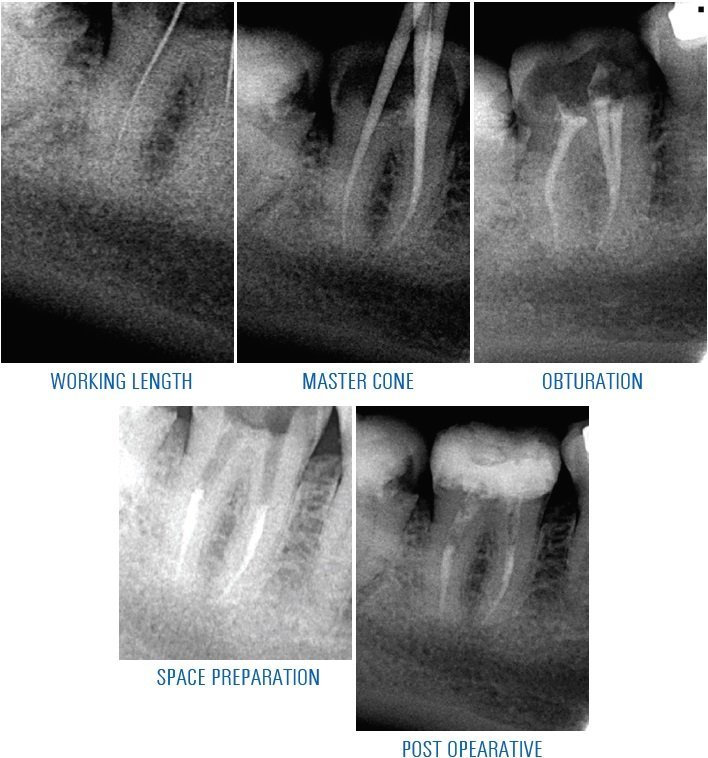
An 18 year old male patient came with a chief complaint of continuous pain in lower left back tooth region of mouth since 1 month. On clinical examination grossly decayed mandibular first molar was observed. Tenderness on vertical percussion was present i.r.t 36. The treatment plan advised was non-surgical root canal treatement i.r.t. 36. On radiographic examination periapical lesion was associated i.r.t. 36. The working length was confirmed radiographically using #15 K-file. Coronal flaring was done using Sx (Protaper Gold File System. The remaining root canal system was prepared with rotary file syste using Protaper Gold File System till F2 with copious irrigation using 5.25% sodium hypochloride solution. Mastercone selection was done using 25.06 guttapercha. The canals were dried with paper points and obturated by laterally condensed guttapercha (Roeko, Germany) root canal sealer. The treatment was completed in 2 visits. The post endodontic restoration was done using Ribbond Fibers, the GP was sheared till 2-3 mm below the canal orifice in mesiobuccal, mesiolingual and distal canals. The cut sections of GC Everstick Post was placed vertically in each canal and cured. The core build up was done using flowable and packable composite, followed by tooth preparation to receive a PFM prosthesis irt 36.

CASE 4
A 40 year old female patient came with chief complaint of pain in lower right back region of mouth since few days. Patient had a history of sudden sharp pain which lasted for long due to cold or sweet food stuff. On clinical examination there was deep proximal caries w.r.t 47. Radiographic examination showed radiolucency involving enamel, dentin and pulp. According to the findings the tooth was diagnosed with chronic irreversible pulpitis w.r.t.47. Treatment plan was to proceed with non surgical endodontic treatment w.r.t 47. In the second visit, the post endodontic restoration was done using GC Everstick Post. The GP was sheared till 4-5 mm below the CEJ. Everstick was dipped in the bonding agent. After etching and conditioning, the fibers were packed in the canal along with flowable and packable composite.
CONCLUSION
According to a study on assessing the mode of failure following load application, it was observed that the Ribbond post system exhibited 100% of repairable failures in all the specimens. On the other hand, the fibre post group had 83.3% of repairable failures which was significantly lower than the Ribbond group. The fracture patterns did not have any influence on the mode of failure in both the post systems. Both the post systems compared in this study were fibre-reinforced composite posts having similar modulus of elasticity to that of dentin. The lower flexural modulus of fibre-reinforced posts can decrease the incidence of root fracture. It was observed that unlike Ribbond group, the Reforpost group exhibited a few modes of ‘non-repairable failures’. The fact that Ribbond produced a majority of repairable failures is in accordance with other studies conducted.2 Ozcopur et al. showed that individual posts such as Ever Stick and Ribbond showed more repairable fracture modes.
When compared to a prefabricated fibre post, UniCore, and a metal post, Para Post. Another in vitro study on the fracture resistance and the incidence of vertical root fracture of pulpless teeth restored with various post-and-core systems found that the polyethylene woven fibre and composite resin without a prefabricated post resulted in significantly fewer vertical root fractures, but mean failure load was the lowest.5 Aggarwal et al. also reported that Ribbond exhibited 100% repairable failure modes, similar to what was noted in the present study, thus proving Ribbond to be a favourable restorative modality.6
In recent times the number of endodontic procedures have increased with exceedingly good results. Therefore, restoration of teeth after endodontic treatment is becoming an integral part of the restorative practice in dentistry even when the teeth are in bad shape. Fibers come as a boon to the esthetic dentistry. Fibre-reinforced composites have also been used for similar cases. This case report has shown to use fibers as a post and core material in a permanent tooth with satisfying esthetic results and improved mechanical properties. Long term follow-up of more cases is required for this material to become more popular.
REFERENCES
- Cohen’s Pathways Of Pulp
- Chan FW, Harcourt JK, Brockhurst PJ. The effect of post adaptation in the root canal on retention of posts cemented with various cements. Aust Dent J 1993; 38:39-45
- Purton DG, Payne JA. Comparison of carbon fibre and stainless steel root canal posts. Quintessence Int 1996; 27:93-97
- Deliperi S, Bardwell DN. Reconstruction of nonvital teeth using direct fiber-reinforced composite resin: a pilot clinical study. J Adhes Dent. 2009;11(1):71–8.
- Ramesh P, Mathew S, Murthy SB, George JV, Hegde S, Premkumar R, et al. Efficacy of Ribbond and a fibre post on the fracture resistance of reattached maxillary central incisors with two fracture patterns: a comparative in vitro study. Dent Traumatol. 2015;32(2):110–5.
Disclaimer from Guident
The views and opinions expressed in articles published in Guident are solely those of the authors and do not necessarily reflect the views of the editors, the editorial board or the publisher, Ivory India. Guident does not endorse any product, technique or treatment described. Clinical content is intended for qualified dental and medical professionals and is not a substitute for individual clinical judgement. Guident, its editors and the publisher accept no liability for any consequence arising from the use of information published in the journal.
How to cite this article
Dr. Unnati Nautiyal, Dr. Anil Dhingra. Post Endodontic Restoration with Different Fibers-a Case Series. Guident. 2022 Apr;15(5-6). Available from: https://guident.net/articles/endodontics/post-endodontic-restoration-with-different-fibers-a-case-series.html