The Anti Reflection Technology its Application in Dental Operating Microscopes
Director, Upskill Dental Academy, Mumbai, India
The Dental operating microscope is a life time investment .It is essential for the operator to know the components and their applications in detail ,this would assist in choosing the microscope most suitable for the operatory as well as utilising the features to the maximum. One such feature is the antireflective coating applied to the surface of the lenses.
History - In the world of physical sciences, the idea of anti-reflective coatings was quite incidentally construed by Lord Rayleigh (John Strutt) in the 19th century when he observed the tarnishingon a glass increasing its transmittance instead of reducing it.
This led to the strategy of achieving anti reflectivity by gradually varying the refractive index. However, the actual anti-reflective coatings were produced by Fraunhofer in 1817 when he noticed that reflection was reduced as a result of etching a surface in anatmosphere of sulphur and nitric acid vapours.1
The anti-reflective coating - An antireflective or anti-reflection (AR) coating is a type of optical coating applied to the surface of lenses and other optical elements to reduce reflection. In complex systems such as telescopes and microscopes the reduction in reflections also improves the contrast of the image by elimination of stray light.2
The concept - The concept behind antireflection technology is to control the light used in an optical device in such a way that the light rays reflect from surfaces where it is intended and beneficial, and do not reflect from surfaces where this would have a deleterious effect on the image being observed. One of the most significant advances made in modern lens design, whether for microscopes, cameras, or other optical devices, is the significant improvement in antireflection coating technology.
Thin coatings of certain materials, when applied to lens surfaces, can help reduce unwanted reflections from the surfaces that can occur when light passes through a lens system. Modern lenses that are highly corrected for optical aberrations generally have multiple individual lenses, or lens elements, which are mechanically held together in a barrel or lens tube, and are more properly referred to as a lens or optical system.
Each air-glass interface in such a system, if not coated to reduce reflections, can reflect between four and five percent of an incident light beam normal to the surface, resulting in a transmission value of 95 to 96 percent at normal incidence. Application of a quarter-wavelength thick antireflection coating having a specifically chosen refractive index can increase the transmission value by three to four percent.
Modern objective lenses for microscopes, as well as those designed for cameras and other optical devices, have become increasingly more sophisticated and complex, and may have 15 or more separate lens elements with multiple air-glass interfaces.
Internet sources
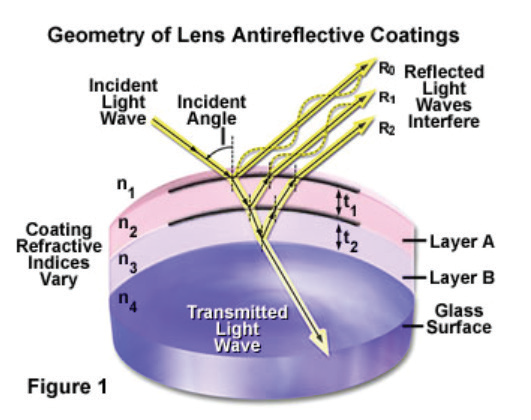
Illustrated in Figure 1 is a schematic drawing of light waves reflecting from and/or passing through a lens element coated with two antireflection layers. The incident wave strikes the first layer (Layer A in Figure 1) at an angle, resulting in part of the light being reflected (R(0)) and part being transmitted through the first layer. Upon encountering the second antireflection layer (Layer B), another portion of the light (R(1)) is reflected at the same angle and interferes with light reflected from the first layer. Some of the remaining light waves continue on to the glass surface where they are again partially reflected and partially transmitted. Light that is reflected from the glass surface (R(2)) interferes (both constructively and destructively) with light reflected from the antireflection layers.
The refractive indices of the antireflection layers differ from that of the glass and the surrounding medium (air), and are carefully chosen according to the composition of the glass used in the particular lens element to produce the desired refraction angles. As the light waves pass through the antireflection coatings and the glass lens surface, nearly all of the light (depending upon the angle of incidence) is ultimately transmitted through the lens element and focused to form an image.
Most microscope and lens manufacturers now produce their own proprietary coating formulations. The general result of these antireflection measures is a dramatic improvement of image quality in optical devices because of increased transmission of visible wavelengths, reduction of glare from unwanted reflections, and elimination of interference from unwanted wavelengths that lie outside the visible light spectral range.
The reflection of visible light is a property of the behavior of light that is fundamental in the function of all modern microscopes. Light is often reflected by one or more of plane (or flat) mirrors within the microscope to direct the light path through lenses that form the virtual images we see in the oculars (eyepieces). Microscopes also make use of beamsplitters to allow some light to be reflected while simultaneously transmitting other light to different parts of the optical system. Other optical components in the microscope, such as specially designed prisms, filters, and lens coatings, also carry out their functions in forming the image with a crucial reliance on the phenomenon of light reflection.3
References
- Anti-reflective coatings: A critical, in-depth review: Hemant Kumar Raut,*a V. Anand Ganesh, a A. Sreekumaran Nairb and Seeram Ramakrishna*acd Energy Environ. Sci., 2011, 4, 3779 : www.rsc.org/ees
- Anti-reflective coating- Wikipedia
- http://olympus.magnet.fsu.edu/primer/java/reflection/antireflection/index.html
Disclaimer from Guident
The views and opinions expressed in articles published in Guident are solely those of the authors and do not necessarily reflect the views of the editors, the editorial board or the publisher, Ivory India. Guident does not endorse any product, technique or treatment described. Clinical content is intended for qualified dental and medical professionals and is not a substitute for individual clinical judgement. Guident, its editors and the publisher accept no liability for any consequence arising from the use of information published in the journal.
How to cite this article
Dr. Pavana Kamath. The Anti Reflection Technology its Application in Dental Operating Microscopes. Guident. 2020 Mar;13(4). Available from: https://guident.net/articles/endodontics/the-anti-reflection-technology-its-application-in-dental-operating-microscopes.html