Infection Control in Dentistry a Review
Department of Public Health Dentistry, K. D. Dental College & Hospital, P.O. Chhatikara, Mathura
INTRODUCTION
Infection is a process of tissue invasion by microorganisms, cross infection can be defined as the transmission of infectious agents between patients and health care provider within a clinical environment. The infective agent can be transmitted through blood, droplets of saliva and contaminated instruments by way of direct contact, inhalation or inoculation.1 The major route of cross infection in dental surgery is via infection through intact skin or mucosa due to accidents involving sharps or direct inoculation onto cuts and abrasions in the skin.2 Among health care professionals, dentists are more prone to infection due to their direct contact with blood and saliva on a daily basis in their offices. Considerable effort and expenses are incurred to accomplish this goal everyday through various methods of sterilization and asepsis.3 Centers for Disease Control and Prevention (CDC)–established infection control precautions protocols which are recognized as a standard care in the United States. The CDC primarily focused on the use of ‘‘universal precautions,’’ or blood and body fluid precautions, to reduce the risk of transmission of blood borne pathogens among health care personnel and patients. Occupational Safety and health Administration (OSHA) had begun enforcing their pronouncement that all health care workers exposed to potentially infectious blood borne disease must practice the Universal Precautions. In 1996, the CDC combined the major components of universal (blood and body fluid) precautions (designed to reduce the risk of transmission of blood borne pathogens) and ‘body substance isolation precautions’ (designed to reduce the risk of transmission of pathogens from moist body substances) into one set of precautions known as ‘‘standard precautions”. Standard precautions assume all patients are potentially infectious with a variety of pathogenic microorganisms. Infection control in dentistry has become a topic of great interest world-wide over the last ten years mainly due to emergence of HIV infection and Hepatitis and more public awareness due to media. The rationale for infection control is to control iatrogenic, nosocomial infections among patients and the potential occupational exposure of care providers to disease causing microbes during provision of care.4
PRINCIPLES OF INFECTION CONTROL
Successful infection control involves some elements, which form the basis for any health care services. These elements are;
1. Basic infection control measures
- Standard precautions are work practices required to achieve a basic level of infection control and are recommended for the treatment and care of all patients.
- Additional precautions are recommended for patients known or suspected to be infected or colonised with disease agents that cause infections in health care settings and that may not be contained by standard precautions alone.5
2. Identifying hazards and minimising the risks of infection
A hazard in a health care setting is defined as an agent (biological, chemical or physical) that has the potential to cause harm to people or the environment. In infection control, a hazard is either an infectious agent or a mechanism that allows the transmission of an infectious agent (e.g. invasive device). The purpose of risk management/control is to minimise people’s exposure to sources of infection, including blood or body fluids, in the health care setting.63. Disinfectants and sterilants
Chemical disinfectants and sterilants act by damaging the structure or impairing the metabolism of infectious agents. The biocidal (inactivation) range of a disinfectant or sterilant varies according to its active chemical structure and the general properties of the group to which it belongs.7
QUALITY MANAGEMENT
Each health care establishment or region/district should have a committee or system of management that is responsible for the development, oversight and evaluation of the infection control program. Infection control management should reflect the spectrum of clinical services and administrative arrangements of the health care establishment so that policy decisions take account of implementation issues.
1. Quality improvement program maintenance:
To be effective, infection control should be a part of an establishment-wide quality improvement program. Continuous quality improvement involves an organised and methodical range of activities and processes to implement practice guidelines and/or standards of care.8
2. Education and training
Universities and training colleges that offer undergraduate and postgraduate courses in health-related areas should ensure that the curriculum includes up to date information on infection control policy, procedures, quality assurance and incident monitoring. This information should include advice about specific measures, including immunization, that reduce the risk of acquiring infection during a course of study.9
EFFECTIVE WORK PRACTICES AND PROCEDURES
The way health care premises are designed is fundamental to infection control and to the implementation of both standard and additional precautions. The design and layout of all new or renovated health care premises should take account of the movement of people and incorporate all necessary physical requirements to minimise the transmission of infection.
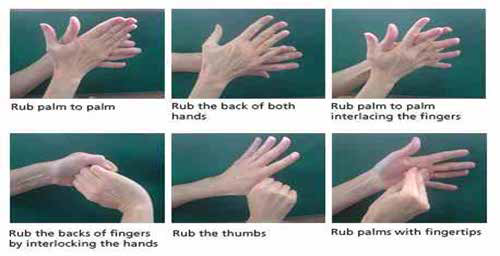
1. Hand washing and hand care
Before wearing personal protective equipment, the dentist and staff need to remove chunky jewellery and wrist watch, and examine their hands for cuts, bruises and hangnails. After hand-washing, the cuts and bruises should be medicated and covered using a band aid/dressing to avoid coming in contact with patient material.10
Some institutions and recommendations advocate the use of alcohol sanitizers in addition to the scrub, but it is not widely practiced. If used, wait till the hands dry before donning surgical gloves.11
2. PERSONAL PROTECTIVE EQUIPMENT
a. GlovesGloves may be single-use-disposable non-sterile exam gloves or single-use-disposable sterile surgical gloves that can be used in a patient’s mouth. Powder-free single-use disposable gloves are Latex glove, Nitrile glove, Polyurethane gloves.
Allergic reactions to latex
Hands show peeling or skin along with inflammation and report of irritation while using latex gloves. There are two types of allergic reactions to gloves or the materials comprising the latex gloves-
- The first type of reaction is the Type IV or delayed hypersensitivity.
- The second variety of allergic reaction is Type I or immediate reaction.12


Face masks use in dentistry are primarily to control the exposure of the clinician’s oral and nasal mucosa to BOPIM ( Blood or other potentially infectious material) and the patient’s blood and oral fluids. They should not be considered respirators as they do not have an air tight fit around the face irrespective of the material’s filtration efficiency.12

c. Protective eyewear:
Protective eyewear are in form of polycarbonate glasses with side-shields, face-shields and prescription glasses with disposable side-shields. Protective eyewear must be worn in conjunction with facemasks. Use of protective eyewear is a must to reduce the probability of exposure to hazardous materials and hard particulate matter that may damage the eyes.13

d. Protective clothing:
A fluid resistant gown that is full sleeved is adequate for use as protective equipment. Gowns are to be changed between patients to control cross contamination between patients.13

3. Collection and disposal of waste
Biomedical waste segregation scheme for dental clinics.144. Instrument reprocessing and sterilization monitoring
Instrument reprocessing is the most important aspect of Dental Infection Control as it deals with items that have the greatest potential for disease transmission during dental care. Any dental instrument that enters the oral cavity is classified as critical or semi critical surfaces as per Spaulding Classification and must be sterilized. Common methods of in-office sterilization in dentistry are Autoclaving, Chemiclaving and Dry Heat. For items that are heat labile chemical immersion methods using an approved chemical sterilant although rare, must be used. Today, all items that are used in dentistry as critical and semi critical items are heat sterilizable or sterile-single-use disposable.15

CONCLUSION
Every member of the Health care Professional/dental team has a duty to ensure that all necessary steps are taken to prevent cross infection to protect both their patients and themselves. While special precautions are recommended when treating patients known to be carrying blood borne diseases or high risk patients or unidentifiable or in case of doubtful patients and only safe approach is to assume that any patient may be a carrier. All dental and medical staff should be trained thoroughly and should understand the policies adopted in the practice for the prevention of cross infection. All procedures should be reviewed from time to time to ensure that they are being carried out correctly. In a country like India, the practice of Infection control in Dentistry is at infancy stage. It is important to change the knowledge, attitude, practice and behaviour of the dental student studying, the practicing dentist and more importantly the individuals involved in framing the guidelines.
REFERENCES
- Girdler NM, Matthews RW, Scully C. Use and acceptability of rubber gloves for out patient’s dental treatment. J Dent 1987; 15: 209-12.
- Verrusio AC, Neidle EA, Nash KD, Silverman S, Horowitz AM, Wagner K S. The dentist and infectious diseases: a national survey of attitudes and behavior. J Am Dent Assoc 1989; 118: 553-62.
- Infection control guidelines for the prevention of transmission of infectious diseases in the health care setting. Department of Health and Aging, Australian Government. January 2004, http://www.icg.health.gov.au, accessed on 1-6-2019: 2-1.
- Tracy B King, Kathleen B Muzzin. A national survey of dental hygienists infection control attitudes and practices. Journal of Dental Hygiene Spring 2005; 79(2): 1-5.
- Centers for Disease Control and Prevention. 1995. HIV/AIDS surveillance reports, http:// www.cdc.gov, accessed on 8-7-2019 : 1-39.
- Coleman GC. Principles of Oral Diagnosis, Mosby Year Book, 1993: 14-29.
- Cottone JA, Terezhalmy GT, Molinari J. Practical infection control in dentistry. Philadelphia: Lea & Febiger, 1991: 167-175.
- Favero MS, Bond WW. Sterilization, disinfection, and antisepsis in the hospital. Manual of clinical microbiology, 5th ed. Washington, DC: American Society for Microbiology, 1991: 183-200.
- Crawford JJ, Young JM, and Stokes L. Proper operatory and instrument recirculation in practical infection control in dentistry. Philadelphia: Lea & Febiger, 1991: 149-166.
- Béatrice Thivichon-Prince, Odile Barsotti, Raphaele Girard, Jean-Jacques Morrier. Hand hygiene practices in a dental teaching center. Eur J Dent 2014 Oct-Dec; 8(4): 481–486.
- Godfrey C, Schouten JT. Infection control best practices in clinical research in resource-limited settings. J Acquir Immune Defic Syndr 2014 Jan ; 15-8.
- Holland MG, Cawthon D. Personal protective equipment and decontamination of adults and children – a review . Emerg Med Clin North Am 2015 Feb; 33(1):51-68.
- Infection control guidelines for the prevention of transmission of infectious diseases in the health care setting. Department of Health and Aging, Australian Government. January 2004: http://www.icg.health.gov.au, accessed on 1-6-2019: 14-1to 14-2.
- Om N. Baghele, Subodh Phadke, Ashish A. Deshpande, Jayant P. Deshpande,Mangala O. Baghele. A simplified model for biomedical waste management in dental practices- a pilot project at Thane, India. European Journal of General Dentistry. September-December 2013; 3(2): 235-240.
- Dr Raghunath Puttaiah, Dr Anil Kohli. Infection control and occupational safety recommendations for Oral Health Professionals in India. Surface Barriers versus Disinfection, Dental Council of India, New Delhi ,2007: 34-36.
Disclaimer from Guident
The views and opinions expressed in articles published in Guident are solely those of the authors and do not necessarily reflect the views of the editors, the editorial board or the publisher, Ivory India. Guident does not endorse any product, technique or treatment described. Clinical content is intended for qualified dental and medical professionals and is not a substitute for individual clinical judgement. Guident, its editors and the publisher accept no liability for any consequence arising from the use of information published in the journal.
How to cite this article
Dr. Bhawana Agrawal, Dr. Navpreet Kaur, Dr. Vivek Sharma. Infection Control in Dentistry a Review. Guident. 2020 Apr;13(5). Available from: https://guident.net/articles/general/infection-control-in-dentistry-a-review.html