
Isolation in Clinical Dentistry: Part-1
MIK Dental, Mumbai, India
INTRODUCTION
Each dental procedure is unique in its set of requirements. While water is essential during tooth preparation, its presence during bonding can result in premature failure. As such, success of various sensitive procedures depends on the presence of a dry working field and control over intra-oral soft tissues. This makes understanding and correct implementation of various isolation techniques essential for achieving a favorable outcome when performing operative or prosthetic treatments.

TYPES OF ISOLATION IN DENTISTRY
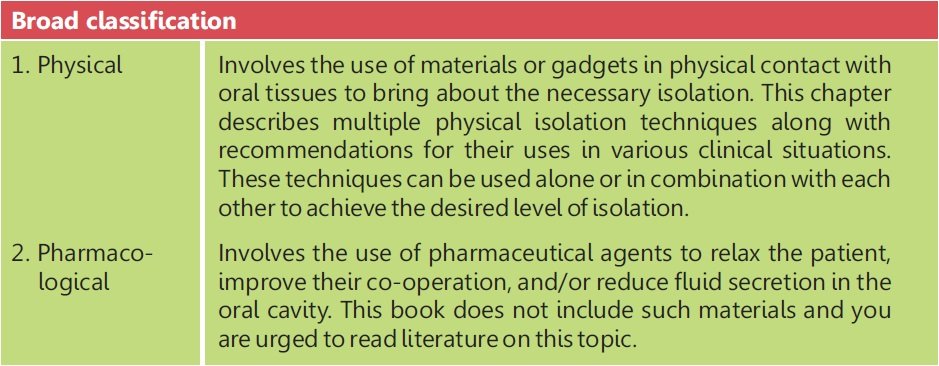
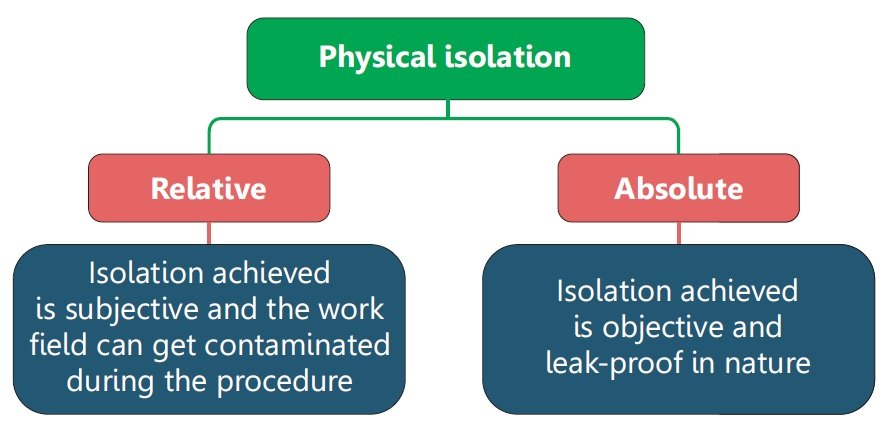
PHYSICAL METHODS OF ISOLATION

A. EJECTORS AND SUCTION DEVICES
1. Saliva Ejector or Suction Tip These are straw-like flexible tubes that are used to isolate the oral cavity from water and saliva during almost all dental procedures.

Fig. 3.1: Saliva ejector in various pleasing colors. Image courtesy, Denmax International, Coimbatore; India.
Advantages
- Compatible with suction unit.
- Placement is simple and quick.
- Comfortable for the patient, especially ones with flexible silicone tips.
- Cheap and easily available.
- Available in disposable as well as autoclavable (metal) variants.
- Manufacturers today provide scented and flavored tips for an improved patient experience.
Indications
- Procedures that require use of air-water spray from the highspeed handpiece or 3-way syringe.
- When working with materials that are not very sensitive to moisture contamination.
Drawbacks
- Provides only relative isolation.
- Cannot provide adequate soft tissue retraction.
- Suction ability depends on the power of the unit being used (pneumatic or motorized).
- Tip can get blocked from clogging.
2. High-Volume Oral Evacuators
This is a stronger variant of the suction system that works on a vacuum principle (similar to that of a household vacuum cleaner).
Advantages
- Same as that of suction tips, with the added ability to retract soft tissues owing to its rigid frame.
- Efficient clearance of water and other debris, along with reduced tendency towards blockage owing to its larger opening.

Fig. 3.2: High vac suction tip (middle) on the assistant side of the dental chair.
Indications
- Similar to that of suction tips.
- Additionally, for instant suction of chemicals, e.g. etchants.
Drawbacks
- Provides only relative isolation.
- Being hard they cannot be bent as required.
- Owing to its larger size, they can be inconvenient for patients with a small mouth opening.
- Positioning of the tip face (bevel) is critical, as incorrect placement can cause accidental ‘suck-in effect’ of delicate soft tissues.
If such a thing were to happen, do not attempt to pull the tip outwards as this can cause tissue injury. Instead, rotate the tip to break the seal and release the trapped tissue or turn off the vacuum unit.
Technique
The oral evacuator can be held using different grasps based on the area being treated and the tissue resistance.
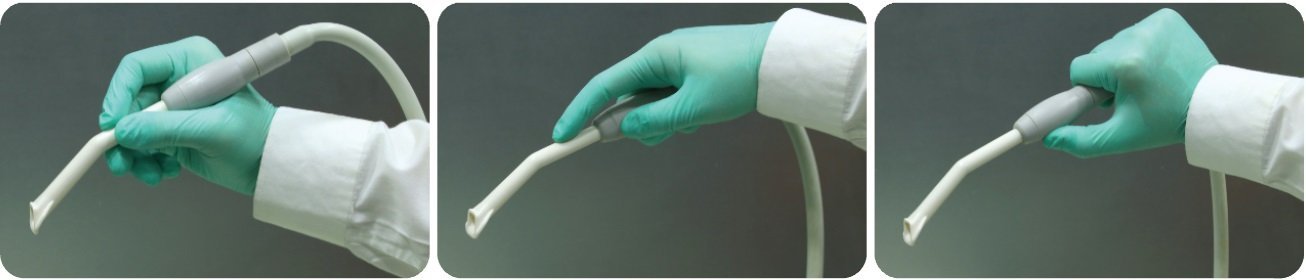
Fig. 3.3-3.5: Methods for holding the oral evacuator tip. Left: Pen grasp; Middle: Thumb-index finger grasp; Right: Thumb-to-nose grasp.
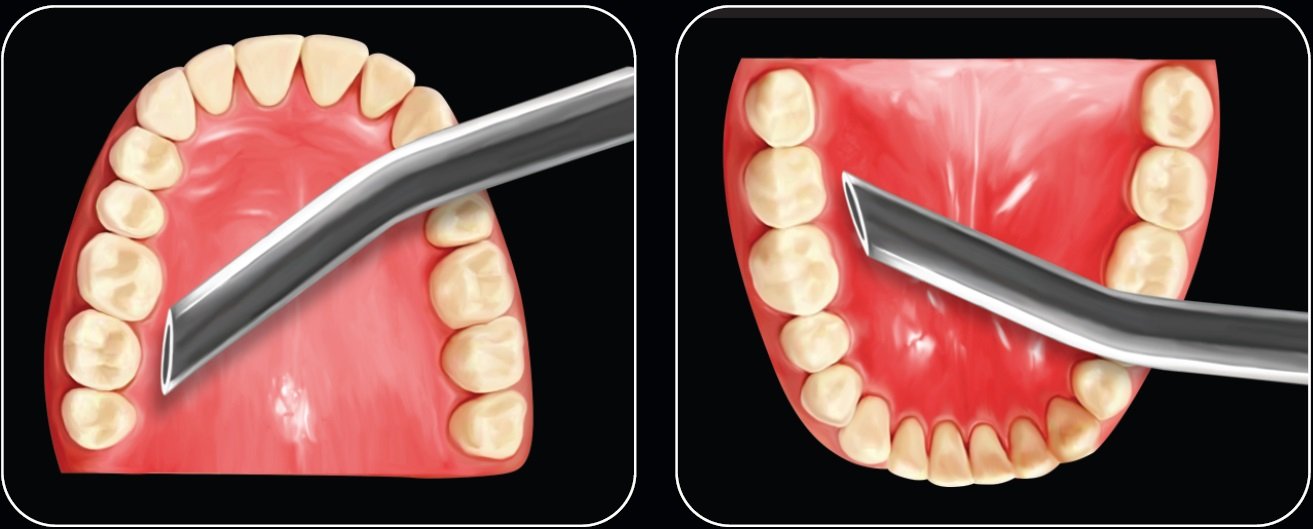
Fig. 3.6, 3.7: The ideal position for the evacuator tip when working on the palatal/lingual side of a posterior tooth. When treating the lower arch, the tip can additionally be used to retract the tongue
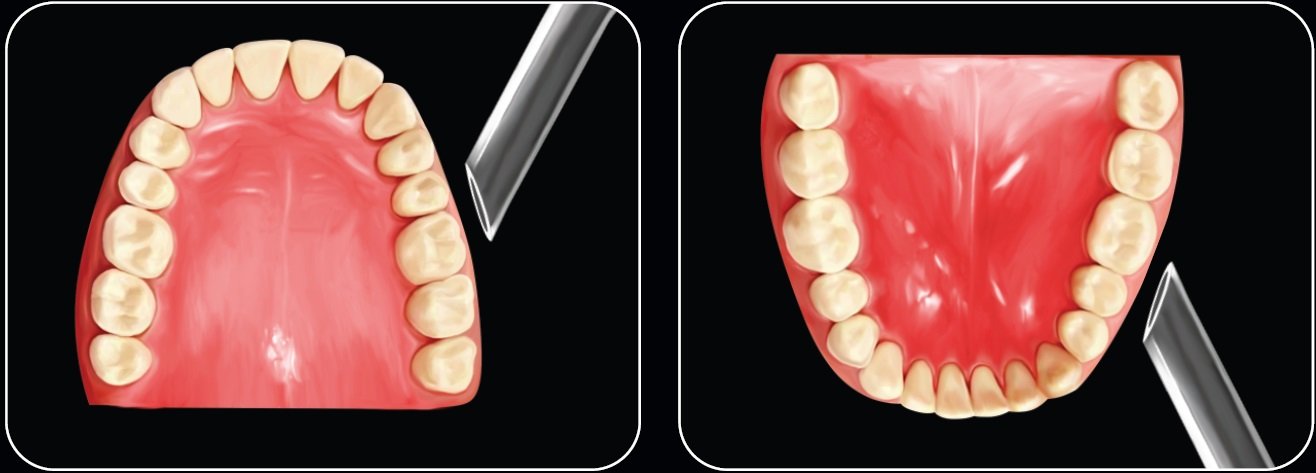
Fig. 3.8, 3.9: The ideal position for the evacuator tip when working on the buccal side of a posterior tooth. Here, the tip can additionally be used to retract the cheek.
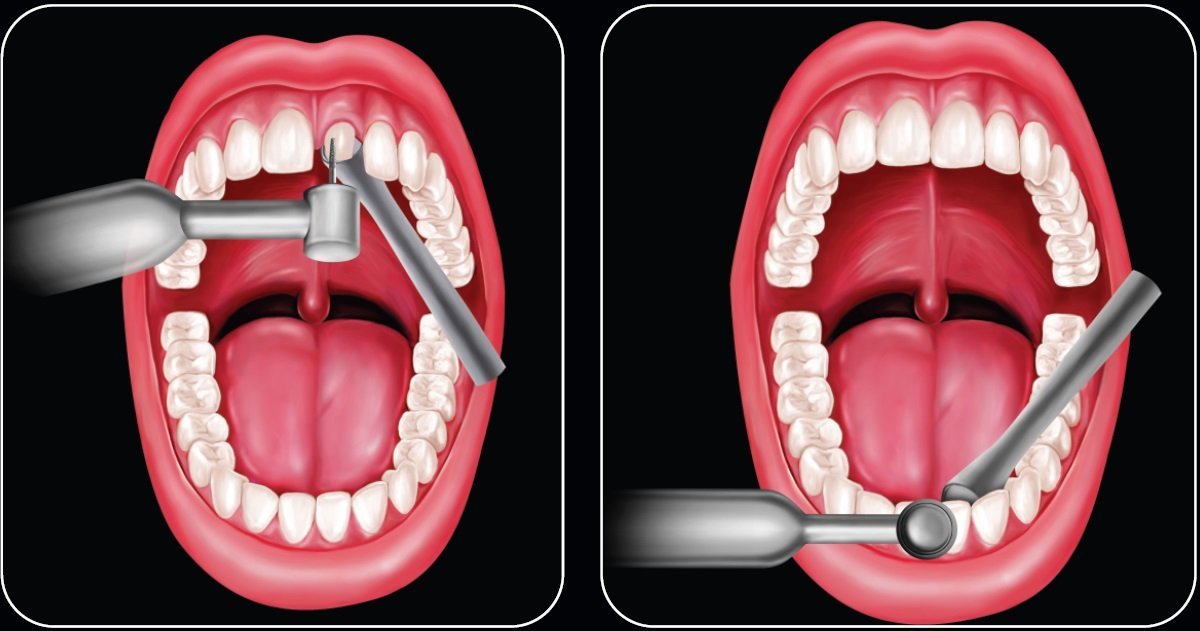
Fig. 3.10, 3.11: The ideal position for the evacuator tip when working on anterior teeth. Note: The tip is to be positioned on the opposite surface of the tooth being prepared.
3. Mouth Mirrors with Inbuilt Suction
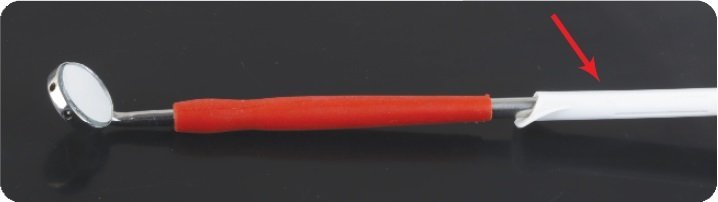
These are mouth mirrors with a hollow handle and small openings (on its periphery and back) that can be attached to a suction unit, as seen in Fig. 3.12, 3.13 below. This allows the mirror to provide a dual function, i.e. retraction and suction simultaneously.

B. ABSORBENTS
1. Cotton Rolls
Compressed cotton rolls are one of the most frequently used material for isolation in dentistry. It is often combined with use of a suction tip to provide a relatively dry field, especially when performing quadrant dentistry.
Advantages
- Placement is quick and easy.
- Comfortable for the patient.
- Cheap and easily available.
- Available in varying lengths that can be bent and adapted to the target area.
Indications
- When working with materials that are not overtly sensitive to moisture contamination.
- For short duration procedures.
- When working on a single tooth or few teeth in a single quadrant.
Drawbacks
- Cotton merely absorbs and does not prevent contamination.
- Can get displaced during procedure, especially on the lingual side.
- Might have to be replaced if it gets soaked with fluid.
- Retraction provided is limited.
- It is common for cotton to adhere to dry mucosal tissue, as shown in Fig. 3.14, 3.15 and improper it’s removal can result in ‘cotton roll burn’.


Water from a 3-way syringe should be used to wet the cotton prior to removal, as shown in Fig 3.16 below. This is synonymous with wetting a band-aid in order to make its removal less painful.

Compressed cotton rolls can be used by themselves or with the help of special holders to isolate posterior quadrants, as shown in Fig. 3.17 below. Such holders reduce the possibility of cotton roll displacement, especially from the lingual vestibule.


Fig. 3.18: Cotton roll covered with a gauze pack to increase its absorptive capacity and reduce the possibility of cotton fibrils coming loose during a procedure.
2. Triangular Absorbent Wafers
These are triangular shaped cotton absorbents designed to be placed on the buccal mucosa, with the purpose of blocking the opening of the parotid gland.

Fig. 3.19: Left: Coated variant; Right: Plain cotton variant.

Fig. 3.20: Wafer seated in its ideal intraoral position.
Advantages
- Placement is quick and easy.
- Comfortable for the patient.
- Cheap and easily available.
- Available in a plain and coated variant.
- Can be used in conjunction with the PanoraView cheek retractor as shown in Fig. 3.23, 3.24.

Fig. 3.21: Dry-Angle from Dental Health Products showing different shapes and coatings. The coating helps prevent saliva from percolating onto the oral-side, while the silver reflector increases illumination over the buccal surface.

Fig. 3.22: Neo-dry from microcopy, a dental absorbent with coating and reflective surface options, also available in two size variants.


Fig. 3.23, 3.24: PanoraView can be adapted over an absorbent wafer, thereby stabilizing the cotton pad while also improving soft-tissue retraction around the area.
Indications
- For use with procedures and materials that are not overtly sensitive to moisture contamination, like crown cementation using RMGIC.
- For short-duration procedures.
- When working on a single tooth or few teeth in a single quadrant.
Drawbacks
- Same as cotton rolls.
3. Polytetrafluoroethylene (PTFE) or Teflon
- Although not an absorbent, teflon tape is an asset for use during isolation.
Advantages
- It is non-sticky and can be adapted around teeth with ease.
- It has an extremely smooth surface with a very low coefficient of friction.
- It is chemically inert and resistant to acids.
- It is available in varying thickness, with the 0.2 mm variant being the most commonly used in dentistry.
- It is cheap, easily available and has no expiration date.
Drawbacks
- It can move from its position upon application of water or air.
- It may sometimes be difficult to retrieve them from tight proximal contacts as they tend to stretch or shred.
Indications
- As a replacement for retraction cord when working with deep cervical margins, as shown in Fig. 3. 25 below.
- To improve soft tissue isolation in conjunction with rubber dam, as shown in Fig. 3.172.
- To protect adjacent teeth or prostheses from the action of chemicals used during composite or porcelain bonding, as shown in Fig. 3.26 below.
- To isolate soft tissues along the pontic bed when luting multi-unit bridge prostheses, as shown in Fig 3.27, 3.28 below.
- It is also used to contour the matrix band and isolate interdental areas for a class II cavity and while performing a matrix-in-matrix technique.
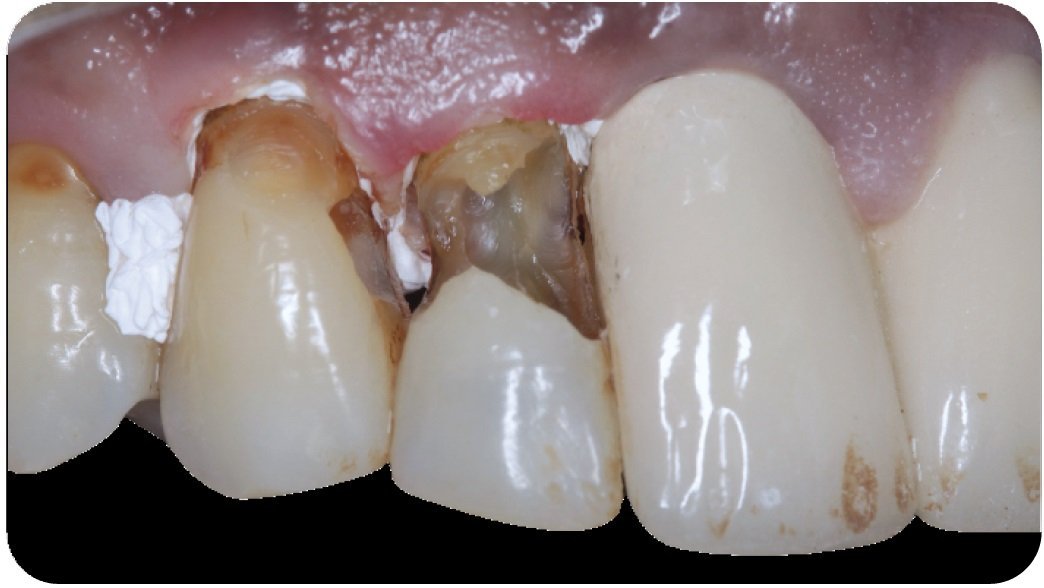
Fig. 3.25: Teflon being used to arrest bleeding and prevent crevicular fluid from compromising the work field. Image courtesy, Dr. Leena Rawal; Mohali, India.
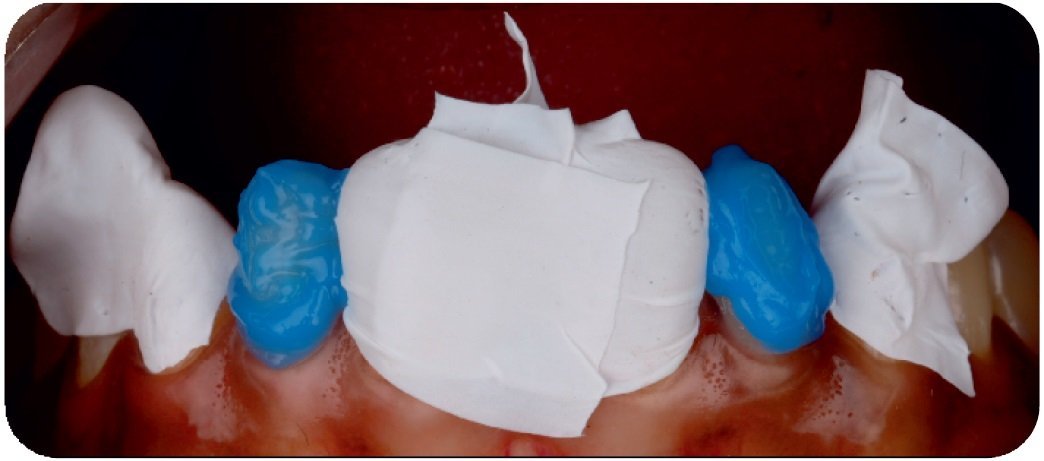
Fig. 3.26: Teflon being used to protect adjacent natural teeth while bonding porcelain veneers.

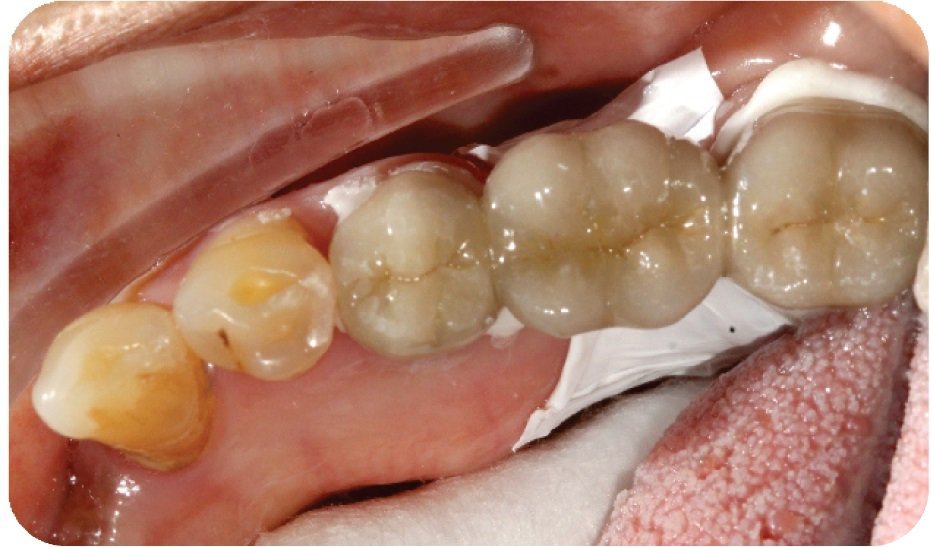
Fig. 3.27, 3.28: Teflon being used to protect the gingival tissue during cementation of multi-unit prostheses.
C. RETRACTORS
1. Retraction Cord
As explained in the starter volume of this book, knitted retraction cords are designed with multi-looped fibrils with a hollow internal channel. This allows the cord to be squeezed into the sulcus with ease using the ‘pack and roll’ technique. Upon soaking the crevicular fluid, the cord opens up, bringing about isolation as well as temporary tissue distraction.
Advantages
- Cords are easily available in multiple sizes to suit varying gingival bio-types and sulci depths.
- Haemostatic agents can be used along with cords to help arrest bleeding around gingival margins.
Indications
Procedures requiring retraction and isolation along the cervical margin of teeth, e.g. impression making.


Fig. 3.29, 3.30: Retraction cord is very helpful in isolating the gingival sulcus, especially when used with the double cord technique. Refer to page 129 of the Starter Volume for further details on this topic.
Drawbacks
- There is a learning curve to master the correct atraumatic technique, especially when using the double cord variant.
- Placement can often be time-consuming, especially for a beginner.
- The process of cord packing can be a traumatic experience for the patient, often requiring the use of local anaesthesia.
- Improper packing technique can traumatize gingival tissues, resulting in bleeding and contamination of the work field.
- When retracting multiple teeth, a significant amount of time may be spent on packing the cord properly.
2. Isolator
This is a quadrant retraction device used to hold the mouth propped open while retracting the tongue simultaneously.

Fig. 3.31: Isolator from MIK Dental. in two sizes, adult and pediatric. Available for purchase on www.mikdental.in
Advantages
- Easy to use.
- Cheap and easily available.
- Isolates a quadrant and protects the tongue from interference or injury during various dental procedures.
- Its bite block prevents the patient from inadvertently closing the mouth, thereby decreasing the strain on the masticatory muscles and TM Joints.
- Its wider edge blocks the parotid opening, improving isolation.
Indications
- Long duration procedures requiring the patient to keep their mouth open for an extended period of time.
- During tooth preparation to protect the tongue from injury.
- During direct composite restorative work.
- When working on a tooth or few teeth in a quadrant.
Design: Isolator consists of 2 components: one bite block and two tongue deflectors, one for Ist and IVth quadrant and another for IInd and IIIrd quadrant.
The bite block has two slots for superior-inferior placement of the tongue deflector, in order to accommodate for differing tongue sizes and varying floor depths.
Technique: The bite block is first oriented such that its wider portion points towards the front along with its taller edge facing the cheek.
The tongue deflector is then inserted into the appropriate slot of st the bite block. When working on the right side of the oral cavity, the Ist and IVth quadrant deflector (mentioned on the piece) should be used and similarly, when working on the left side of the oral cavity, the IInd and IIIrd quadrant deflector is to be used.
The assembly is seated intraorally and the patient is asked to gently bite down onto the block and then slide the tongue forward through the deflector. If needed, the deflector can be pushed further towards the tongue, thereby providing greater retraction.
Cotton rolls along with a suction tip can be used in the lingual vestibule to aid further isolation.

Fig. 3.32-3.35: Protocol for use of the isolator

Fig. 3.36, 3.37: Isolator from MIK Dental. Available for purchase on www.mikdental.in
Indications
- For bite registration, as explained on page 186 of the Starter Volume.
- Ideal for use during dental photography, as it is clear and its handle is designed with a matt finish to reduce flashlight reflection.
- During in-office bleaching.
- During direct composite bonding.
- While bonding orthodontic brackets.
Acknowledgement
All the authors of this article would like to thank Dr. Tousif Iqbal Nathani and Dr. Juan Gonzalo Olivieri for their invaluable contribution in making of this article.
Declaration
This article is a direct extract from the book by Dr. Moez Khakiani, titled Clinical Fixed Prosthodontics- Master Volume. It is a color atlas suited for clinicians who wish to expand their horizons in advanced prosthodontics. It has over 400, pages, and over 2500 color illustrations distributed over 25 chapters. It is a MUST-HAVE guide for clinical prosthodontics, including chapters like master level occlusion, full mouth rehabilitation, porcelain veneers, table top prostheses, implant dentistry, digital dentistry, etc.
Why don’t you give this book a try?
It is available for preview and purchase on www.mikdental.in, or you could connect on +91 9833400664 for the same.
Disclaimer from Guident
The views and opinions expressed in articles published in Guident are solely those of the authors and do not necessarily reflect the views of the editors, the editorial board or the publisher, Ivory India. Guident does not endorse any product, technique or treatment described. Clinical content is intended for qualified dental and medical professionals and is not a substitute for individual clinical judgement. Guident, its editors and the publisher accept no liability for any consequence arising from the use of information published in the journal.
How to cite this article
Dr. Moez I. Khakiani, Dr. Usha Dadlani, Dr. Aatif Iqbal Nathani. Isolation in Clinical Dentistry: Part-1. Guident. 2023 Dec;17(1). Available from: https://guident.net/articles/general/isolation-in-clinical-dentistry-part-1.html


