Platelet-Rich Auto Plasma Application in Dermatocosmetology Plasmolifting Technology
Doctor of Medicine, MD-Dermatologist and cosmetologist, Candidate of Medicine, Maxillofacial Surgeon, Implant- Surgeon
ABSTRACT
Presented are the main stages of the origin and application of Plasmolifting technology, which is an injectable form of platelet-rich auto plasma; theoretical and pathogenetic mechanisms, acquired clinical, indications and recommendations for the technology application in dermatocosmetology, counter indications, method of the procedure fulfillment.
HISTORICAL ASPECTS
The history of autoblood application can be quite interesting and useful for any medical practitioner. In the first place, in the reading matter one can find many references thereof, including those which are traced back to the antique times. Ruling out any cultic and pseudoscientific arguments in favor of autoblood application, a researcher can and sometimes should analyze some facts concerning the matter. Being a steadily developing technology Plasmolifting, as well as any other method is based on the experience of predecessors.
And first of all, it concerns autohemotherapy and PRP therapy based on its gel composition.
The pioneers in the injections of the patient’s own blood are considered to be Swedish doctors Grafstrom and Elfstrom. In 1898 in USA they were the first who made injections of the patient’s own blood saluted in salt brine to cure pneumonia and tuberculosis.
In 1905 a German surgeon August Beer found out that the patient’s own blood injected in his hip serves something like a stimulant for the body, making possible to achieve acceleration of a broken bone consolidation. August Beer discovered that tubular bone fractures with multiple hematomas and ecchymomas are healed in a shorter term. Later the German surgeon applied autoblood injections into tissues at various pathologic conditions. This experience was also supported in prerevolutionary Russia. Domestic surgeons especially value the experience of V.F. Voino-Yasenetsky who successfully applied the similar method to cure inflammatory diseases a hundred years ago.
In 1934 V.F. Voino-Yasenetsky published “Essays on purulent surgery”, where he described the method of autohemotherapy in the form of infiltrating the patient’s whole blood into the focus of inflammation in soft tissues.1
Positive results with minimum side effects have made autohemotherapy and autoserotherapy the most frequently used auxiliary methods of treatment for years to come all the way to the onset of antibiotics era.
It should be noted that the method of soft tissues infiltration with auto blood is extremely painful, that is why the necessity of stupefacient narcosis conventionally applied in the early 20th century was quite justified.
Hereafter the scheme of Rekkevega has become generally accepted in medical community, i.e. the method of step-by-step autohemotherapy with potentiating according to Hanneman system.
Though the name of the homeopathic medicine father is not at all welcomed in scientific reviews, it is worth outlining some conceptual connection between homeopathic methods and autohemotherapy. In the first place, it is proved by the saying Latin “similia similibus curantur”. In the second place, predisposing acute-on-chronic flare sometimes stimulates its curing. The era of antibiotics starting in the 40es has shifted the significance of autohemotherapy to the field of chronic diseases. In the former USSR and Germany autohemotherapy has become a conventional auxiliary method of chronic inflammatory diseases treatment. Alongside with this, the pharmaceutical industry not seeing the possibility ofautohemotherapy commercializing,started developing various preparations of bio-stimulator and immunecorrector class. The situation is continuing today: when a new biostimulator or immune-corrector enters the market, in 5-6 years of its popularity it fades away, but immediately a new one appears. A thorough and critical examination of the new preparations’ properties reveals that most of them are simply ineffective.
The next stage in the development of autoblood application methods has become application of plasma, a part of blood free from erythrocytes and rich in thrombocytes.
The discovery of the fact that thrombocytes contain protein factors (PRP-factors) initiating cellular regenerative processes served as the main reason of platelet rich autoplasma application.
In the late 80-es R.E. Marx and his collaborators began applying autoplasma in the form of gel. The «Harvest» company technology of producing gel with high content of platelets was originally offered for application in dentistry.
The authors of the given work were the first to evaluate the effectiveness of platelet rich autoplasma gel at surgical repair of mandibula after tumor resection with the length of 5 cm and more.2-4
In one group of patients the researchers used autogenous bone mixed with gel and in another control group - only autogenous bone. In consequence of the undertaken study, the researchers proved that accelerated bone regeneration and its best structural form wasstipulated both by use of platelet rich auto plasma gel and by the availability of bodies receptive to growth factors in thrombocytes of autogenous bone.5
And here we are supposed to make an divagation. The truth is that the effect of Plasmolifting technology application greatly depends on the availability of bodies receptive to PRP-factors in tissues. It is the fact that explains invariant nature of tissues biologic response to platelet rich auto plasma injection. For a medical practitioner all that is left - is to defer to his colleagues’ experience and thoroughly analyze the effectiveness of the definite patient’s therapy.
Some researchers applied autoplasma in the form of gel in the area of the extracted teeth sockets. It was found that in the sockets filled with auto plasma gel the volume of better organized bone was formed within shorter terms and wound epithelialization followed more rapidly.6
Creation and application of platelet rich auto plasma injected form developed by Russian scientists, Akhmerov Renat Rashidovich, Professor, Doctor of Medicine, and Roman Feliksovich Zarudiy, Candidate of Medicine, in 2001 opened a new stage in the development of the autohemostimulation method. The same year the technology was given the name of Plasmolifting.7,8
The essential advantage of platelet rich auto plasma lies in its providing comfort of use and possibilities of application not only in surgery but in therapeutic practice. It is the injecting form of platelet rich auto plasma which made it possible to substantially extend the range of the method application.
THEORETICAL FOUNDATION OF PLATELET RICH AUTO PLASMA EFFECT
Optimization and acceleration of tissues revivification appears to be one of the relevant objectives in contemporary medicine.
The problem of tissues oxygenation was in the focus of attention in 1980-s, being considered as the fundamental factor to improve phagocytic index and bactericidal power of organism immune cells to maintain synthesis of collagen and other albumins.9
At present the main goal of the research in wound healing processes is the necessity growth-stimulating factors identification, the mechanisms of their action comprehension and even the possibilities of their application for revivification improvement.10-14 The discovery of the fact that the influence upon oxygen macrophagocytes in general and upon tissue oxygen tension in particular is implemented indirectly through factors of angiogenesis and other factors of growth to stimulate healing and to prevent ingress of infection.15 Nowadays application of plasma rich in thrombocytes presents the opportunity to modulate and improve tissues regeneration. Production of platelet rich auto plasma comprises thrombocytes and erythrocytes separation from plasma according to density gradient with the help of special laboratory filters. The strategy of auto plasma application lies in improvement and acceleration of processes caused by growth-stimulating factors contained in thrombocytes. Being neither toxic nor immune-responsive autogenous platelet rich plasma accelerates genuine mechanisms of wound healing due to identified (and still not identified) growth-stimulating factors controlling genuine mechanisms of regeneration.
Moreover, auto plasma rich in thrombocytes modulates and controls the function of primary growth factors. This feature distinguishes growth factors of plasma rich in thrombocytes from recombinant growth factors each being responsible for the separate regeneration mechanism.16
THROMBOCYTES CONTAIN THE FOLLOWING GROWTH FACTORS
- IGF (insulin-like growth factor),
- PDGF (platelet-derived growth factor),
- EGF (epidermal growth factor),
- FGF (fibroblastic growth factor),
- TGF-ß («family» of transforming growth factor),
- PDEGF (platelet-derived growth factor of endo-theliocytes),
- VEGF or PDAF (vascular endothelial growth factor),
- PLGF-1/-2 (placental growth factors),
- as well as such proteins as thrombo-spondin, osteonectin, “culture shock protein”.
Thus, for example, PDGF (platelet-derived growth factor) initiates proliferation and migration of undifferentiated bone mesenchymal cells and stimulates angiogenesis. And IGF (insulinlike growth factor) stimulates differentiation of young cells, enhances bone tissue formation and collagenation. Moreover, TGF-ß («family» of transforming growth factor) contains signal peptide and 16 domains possessing calcium binding sites, induces differentiation of mesenchymal cells and extracts transforming growth factors of bone morphogenetic proteins, part of which (BMP-2, osteogenin, BMP-3, BMP- 4, -5,-7,-8 and-9) are apparent osteo-inductors.
At administering injecting form of autoplasma growth factors are transported into tissues and are concentrated there under the influence of large auto plasma volume stimulating formation of fibroblasts, connective tissue colony-formations.
The next stage is enhancing fibroblast activity. Fibroblasts in their turn produce collagen, hyaluronic acid and elastin. This process brings to young connective tissue colony-formings, capillary tube growth. Growth factors also block osteoclasts or bone-resorbing cells what restrains loss of bone tissue and promote its regeneration. Finally we observe revival of exchange processes, improvement of microcirculation and metabolism in tissue cells, normalization of tissue respiration and promotion of local immunity.10,17
Triggering all links of natural regeneration processes and simultaneously influencing them synergistically platelet rich auto plasma is a convenient and safe biological tool accelerating the processes of regeneration.
Auto plasma on its own is quite a natural phenomenon for human tissues in such a biochemical proportion that is inherent for the given organism.
Patho-physyiological mechanism of platelet-rich auto plasma can be more simply presented as follows: at thrombocytes coming out from blood channels it changes its form due to loss of contact with endothelium and extracts alpha-granules containing protein fractions which in their turn throw out growth factors into the wound.18,19
Haynesworthetal’ s at al. work showed that the increase in thrombocytes content up to 1 mln/ uL enhances the phase of regeneration.8 Thus, it is necessary not only to produce auto plasma rich in thrombocytes, but to promote the increase in their absolute number in tissues.
Examp le of morphological assessing the eff ectiveness of autoplasma rich in thromb ocytes
MICROSCOPIC EXAMINATION OF GINGIVAL BIOPSY MATERIAL
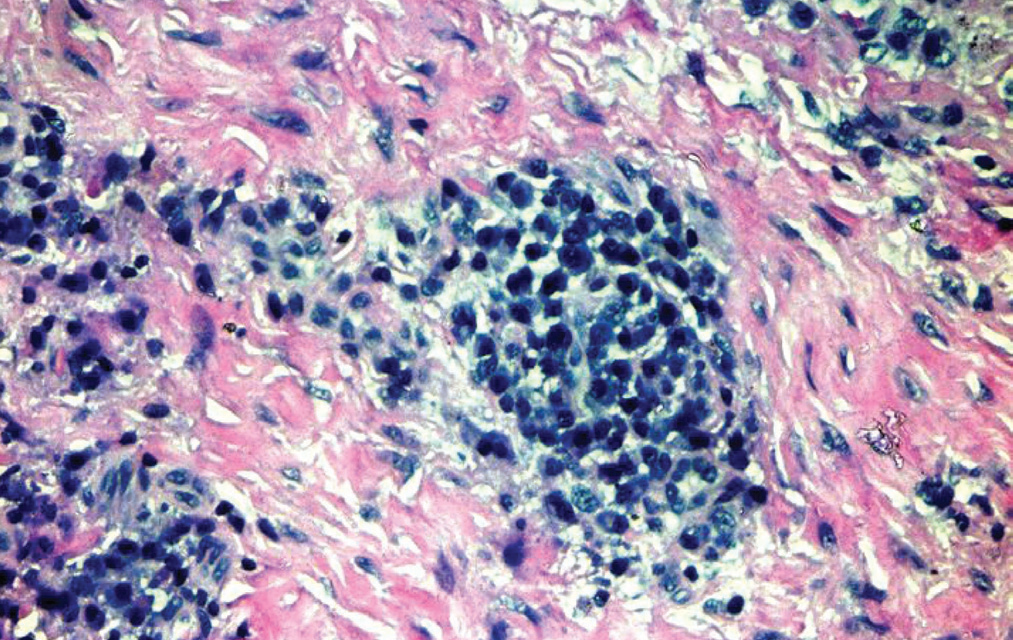
Fig 1: Biopsy specimen of human gum before injections. Recrudescence of chronic gingivitis. Evident lymphoid cell infiltration with formation of follicular structure in sub-epithelial area. The preparation is painted with haematoxylin and eosin.

Fig 2: Biopsy specimen of human gum after 5 days of injecting auto plasma rich in thrombocytes according to technology Plasmolifting. Increase in macro-phagocyte number with granulation growth in sub-epithelial area. The preparation is painted with haematoxylin and eosin.

Fig 3: Biopsy specimen of human gum taken on the 14th day of injecting auto plasma rich in thrombocytes according to technology Plasmolifting. The preparation is painted with haematoxylin and eosin.

Fig 4: Biopsy specimen of human gum in four weeks after treatment according to Plasmolifting technology. Normal structure of gum. The preparation is painted with haematoxylin and eosin.
USE OF PLASMOLIFTING TECHNOLOGY IN DERMATOCOSMETOLOGY
Aesthetic medicine shows rapid growth today especially in part of already existing new conservative methods development of human’s looks improvement.
One of the main manifestations of skin ageing (marantic atrophy) is considered to be papillary dermis atrophy. Apart from paracme there are some other factors aggravating skin presenilation due to antioxidant system malfunctioning: insolation, water depletion, somatic diseases, constitutional peculiarities, genetic determinants. However, apparent atrophic skin changes revealed before the age of 50 should be considered as presenile.
Other atrophic skin damages arise as a result of skin metabolic imbalance and decreased biocatalyst activity.
Contemporary preparations are usually directed to inhibition of skin ageing and atrophy processes: antioxidant system malfunctioning, insolation, water depletion. The most effective means of skin regeneration are direct or indirect biologic stimulators of reparative and revitalizing processes in derma: hyaluronic acid, vitamins, albumin solutions, micro and macro elements, homeopathic preparations. The above preparations (ruling out homeopathic ones) sometimes provoke either allergic reactions or hypernormal inflammatory response after local infusion. Besides, their effectiveness lasts at most 6 months and derma edema remains more than a month. All other similar methods are also ineffective, most of them are aggressive being accompanied by adverse local response and thus requiring multiple visits to a doctor.
As the years go by hair condition gets worse under the influence of genetic, immune, hormone factors and exogenetic impacts (heat and cold, chemical agents and mechanical damages, stresses, deficiency of vitamins and microelements, occupational hazards and intoxications). Atrophic and dystrophic changes in follicles and bulbs make hair get thinner and fragile, loose pigment and come out. Most frequently hair shedding is observed at telogen effluviumwhere a hair passing the phase of development goes over the phase of senility. This happens due to severe stresses, previous seriousdiseases and other reasons.
Modern methods of treatment are represented by various conventional technologies: tropho-stimulating, hormone corrective, metabolic, sedative and sanatorium-resort and other traditional procedures. Such traditional methods as massage of the hairy part of the head, cryo-therapy, oxygen barotherapy and the patient’s own hair transplantation are rather effective but not at all generally available due to their high cost and duration of treatment. As for the effectiveness it often lasts not so long and reduces the therapy to achieving satisfactory hair condition.
Acneiform rash, a widely spread chronic recurrent disease, is characterized by its multi-aspect causation (oil glands hyperactivity, hormone activity, transition to puberty, nutritional disorder, gastrointestinal diseases, vitamin deficiency, endocrine disorders, impact of toxic and medicinal preparations, stress, hereditary background, etc.) The clinical manifestations of acneiform disease is diverse (acne vulgaris, comedonal acne, papulo-pustular acne, infiltrated and apostem acne, depigmented cicatrices) and at damaging skin face bring a patient esthetic discomfort and moral sufferings causing nervous breakdowns and depressions.
At contemporary stage of cosmetology development use of plasma rich in thrombocytes is integrated into complex approach to treatment of the abovementioned conditions.
INDICATIONS
1. Skin and subcutaneous tissue diseases related to the impact of radiation:
- Ageing skin atrophy (atonia) related to general organism insenescence
2. Other skin and subcutaneous tissue diseases
- Atrophic skin damages
3. Coetaneous appendage diseases
- Acne vulgaris
- Alopecia areata
- Other androgenetic alopecia
- Telogen alopecia
- Anagen defluxion
COUNTERINDICATIONS
1. Malignant neoplasms.
2. Systemic blood diseases.
3. Mental illnesses.
4. Allergic response to anticoagulant (heparin sodium) in past medical history.
METHODS OF APPLICATION
At treating ageing skin atrophy platelet –rich auto plasma is injected by sterile intra-dermal syringe in the amount of 0,4 ml per 2 cm2 of skin surface after it has been previously treated with water-based antiseptic. The procedure is implemented according to meso-therapy techniques of solutions administering.
The duration of the procedure depends on skin surface area and can take up to 30-40 minutes. For the course of treatment to achieve permanent effect usually it is required from 2 to 8 injections of auto plasma with regularity of the procedures either once in a week or other (See below).
At treating acne vulgaris (primary non-inflammatory forms: microcomedons, occlusive comedons, open comedons, tertiary postinflammatory dyschromia) auto plasma is administered in a perifocal way intra-dermally with the help of sterile syringe in the amount of 0,1ml per 1 cm of skin surface 2 after it has been previously treated with water-based antiseptic. The procedure is implemented according to meso-therapy techniques of solutions administering. The duration of the procedure depends on the number of elements and can require up to 20-30 minutes. For the course of treatment to be permanently effective 4-7 procedures with an interval 7-14 days are usually enough.
At treating alopecia areata, other androgenetic alopecia, telogen alopecia and anagen defluxion auto plasma is injected according to meso therapy techniques of solutions administering into scalp by means of sterile syringe in the amount of 0,1ml per 1 cm of skin surface 2 after it has been previously treated with water-based antiseptic. The duration of the procedure depends on skin surface area and can require up to 30-40 minutes. As a rule, to achieve permanent effect it takes from 2 to at most 10 auto plasma injections
with regularity once a week.
THE METHOD EFFICIENCY
The age of the patients taking part in the given experiment ranged from 47 up to 57 with their total number 165 that made 26,4% of 624 persons under research. In nosologic aspect 54,8% of the patients suffered different kinds of alopecia: alopecia areata, other androgenetic alopecia, telogen alopecia and anagen defluxion. The patients under experiment were mostly female: 459 or 73,6% of both sexes with different kinds of alopecia and among them 232 or 50,5% of 459 being girls and women.
Male patients suffering different kinds of alopecia among youths and men under research made 110 or 66,6% of the total 165.
At treating ageing skin atrophy and atrophic skin damages the clinical efficiency of auto plasma rich in thrombocytes becomes evident within 7-12 days: skin appears to be greatly improved, its tightness and elasticity being enhanced, epidermis peeling being reduced and facial skin relief looking smoother.
In the course of treatment acne vulgaris within 2-3 days after the first session of injections the patient can observe acute-on-chronic flare in the form of edema and hyperemia round about comedons. But within the term of 7-14 days these symptoms are cut short: edema being smaller, pigment spots being enlightened, complexion getting better and acquiring its natural colour, skin relief looking smoother.
At curing all kinds of alopecia according to Plasmolifting technology consistent results in the form of hair fallout ending can be observed beginning with the treatment term of 5-6 days provided that the effect is possible to be lasting up to 6-8 months. By the end of the treatment course a patient can observe new hair growth, all his/ her hair total consolidation, gloss and silk. The given observations were confirmed by the measurements of hair density and diameter. In case of alopecia the growth of hair can be witnessed within 10-14 weeks after the course of treatment.

Fig 5: Diagnosis: ageing skin atrophy. The result after 4 Plasmolifting procedures with an interval of a week.
Combination of the technology Plasmolif tingTM with other cosmetological procedures
Combination of the technology PlasmoliftingTM with other rejuvenating cosmetology procedures is a matter of no small consequence for effective facial skin correction. In our practice we often combine platelet-rich auto plasma injections with injections of A type botulinum toxin and fillers based on hyaluronic acid, mesotherapy, methods of biorevitalization, intralipotherapy, chemical peeling procedures, thread lifting.
1. Auto plasma combination with A type botulinum toxin
2. Combination of auto plasma with A type botulinum toxin makes possible to synchronously smooth mimic wrinkles and improve skin condition.
However, at combining Plasmolifting with injections of A type botulinum toxin a researcher must be very careful. Due to its regenerative action auto plasma improves tissues blood supply and accelerates innervations but, consequently, the effective period of botulinum toxin lessens. Therefore, Plasmolifting injections should be made at least a week before injections of A type botulinum toxin but not earlier than within 3 weeks after botulinum toxin administering.

Fig 6: Facial skin ageing atrophy. The result after 2 series of Plasmolifting procedures 6 in number with an interval once a year; the first year with an interval once a week, the second year with an interval once a month in combination with botulinum toxin in the amount of 30 units injected into the area of the forehead and nasal bridge.
3. Auto plasma combination with facial contour correction via fillers based on hyaluronic acid: Auto plasma injections according to Plasmolifitng technology promote synthesis of collagen and other albumins. Clinical practice shows that hyaluronic fillers being injected before auto plasma injections stay in tissues longer than usual time. Protocol of complex
rejuvenating program implies such combination of procedures as follows: the course of Plasmolifitng technology (2-4 procedures with an interval of a week) then within a week contour correction with filler.
4. Combination of auto plasma injections with mesotherapy:
Such combination is especially helpful at curing hairy part of the head at different kinds of alopecia. The most positive results can be obtained when combining Plasmolifting with injections of threnthal that helps to achieve microcirculation. We recommend application of the following scheme: 3 procedures of against “the second forehead”, then a maintaining Plasmolifting procedure in a month, and later on 6-8 procedures of meso-therapy within a week.The given course of treatment is acceptable to be repeated twice a year.
5. Combination of auto plasma injections with biorevitalization:
The given combination makes possible not only to prolong the effect of bio-revitalization but to achieve the best results in implementing counterstrategy against photo-ageing of facial, neck and decollate skin. In this case the scheme «a week in a week» is greatly effective. That pattern implies interchange of Plasmolifting and biorevitalization procedures with the interval of a week. The course of treatment comprises 4 procedures of each kind (8 in total). But there is an alternative: after 2 Plasmolifting injections we recommend only 2 bio-revitalization procedures, rather prolonged positive effect being obtained. A medical adviser makes a selection between two schemes on the grounds of the clinical picture and the implied “biological” tissue response.
6. Combination of Plasmolifting with intralipo-therapy:
This coupling reaction is especially justified for areas of “double chin” and thighs. Thanks to thrombocytes auto plasma impact on these zones the skin therein becomes tighter not sagging down after intralipo-therapy has been implemented.
The treatment is recommended to carry out as follows: 2 Plasmolifting procedures with the interval of a week before injections of lipolytic enzymes and 1 -3 procedures within a month with the interval of a week after they have been injected. Auto plasma is administered into subcutaneous fat by method of infiltration.
Combination of Plasmolifting with chemical peelings
Such a scheme is recommended to achieve accelerated recuticularization and to stimulate regeneration.
It is allowed to apply both masks from platelet-rich auto plasma and injections thereof within 5-7 days after peeling.
Combination of Plasmolifting with thread lifting
Thread lifting has proved its worth as an alternative of plastic surgery. Application of well platelet-rich auto plasma before threads administering makes possible to greatly reduce rehabilitation period and to gain supplementary effect of skin rejuvenation. Auto plasma can satisfactorily be used 10-14 days before threads placing.
REFERENCES
- V.F. Voino-Yasenetsky .Study of purulent surgery. Moscow, 2000, p. 128-132
- S. Mohan S, Baylink DJ. Bone growth factors. Clin Orthop Relat Res 1991; 263:30-43.
- Wergedal JE, Mohan S, Lundy M, Baylink DJ. Skeletal growth factor and other factors known to be present in bone matrix stimulate proliferation and protein synthesis in human bone cells. J Bone Miner Res 1990; 5: 179-186.
- Marx RE. Radiation injury to tissue. In: Kindwall ER (ed). Hyperbaric Medicine Practice. Flagstaff, AZ: Best Publishing Company, 1994: 447-504.
- Anitua E. Plasma rich in growth factors: Preliminary results of use in the preparation of future sites for implants. Int J Oral Maxillofac Implants 1999; 14: 529-535.
- Froum SJ, Wallace SS, Tarnow DP, Cho SC. Effects of platelet-reach plasma on bone growth and osseintegration in human maxillary sinus grafts: Three bilateral case reports. Int J Periodontics Restorative Dent 2002; 22: 45-53.
- Zarudiy R.F., Akhmerov R.R. Use of platelet-rich auto plasma in curing photodermatosis. Electronic journal «Regenerative surgery », UDC616.5-085: 615.38, 2005. No3.
- HaynesworthSE, Goshima O, GoldbergVM, Characterization of cells with osteogenic potential from human marrow, Bone, 1992; 13 (1): 81-8.
- Hussain MZ, LaVan F, Hunt TK. Wound micro-environment. In: Cohen IK, Diegelman R (eds). Wound Healing: Biochemical and Clinical Aspects. Philadelphia: Saunders, 1991: 162-196.
Disclaimer from Guident
The views and opinions expressed in articles published in Guident are solely those of the authors and do not necessarily reflect the views of the editors, the editorial board or the publisher, Ivory India. Guident does not endorse any product, technique or treatment described. Clinical content is intended for qualified dental and medical professionals and is not a substitute for individual clinical judgement. Guident, its editors and the publisher accept no liability for any consequence arising from the use of information published in the journal.
How to cite this article
Dr. R. R. Akhmerov, Dr. O.I. Korotkova, Dr. R.F. Zarudiy. Platelet-Rich Auto Plasma Application in Dermatocosmetology Plasmolifting Technology. Guident. 2013 Feb;6(4). Available from: https://guident.net/articles/general/platelet-rich-auto-plasma-application-in-dermatocosmetology-plasmolifting-technology.html