Artificial Intelligence and Augmented Reality in Guided Implant Surgery
Department of Prosthodontics and Crown & Bridge, Sardar Patel Post Graduate Institute of Dental and Medical Sciences, Lucknow, Uttar Pradesh, India
ABSTRACT
In the last few decades implant dentistry has massively changed to encompass computer guided surgery planned in three dimensions. Computer guided implant surgery incorporating artificial intelligence and augmented reality is breaking new grounds in the field of implant dentistry by placing implants with precision comparable to that of stereolithographic guides using 3D prosthetically driven designs. Real time input, a streamlined digital workflow, enhanced surgical visualization and adaptation to intraoperative findings are some advantages of artificial intelligence and augmented reality in guided implant surgery. The technology, its advantages as well its limitations are covered in this article along with how it is used for guided implant placement. Newer developments in this field are also discussed.
Keywords: Artificial intelligence, Augmented reality, Guided implant surgery, Static guided surgery, dynamic guided surgery, dental implant
INTRODUCTION
In contemporary dentistry the advent of dental implants has made a massive contribution in the rehabilitation of individuals who are either edentulous or partially edentulous. These days, the insertion of osseointegrated implants has become a standard clinical procedure in the field of dentistry.1 In addition to identifying and examining areas with sufficient bone quantity and quality for safe implant placement during diagnosis and planning a course of therapy, the surgeon must make sure that the location of implants permits simple and efficient oral hygiene practices as well as an aesthetically and functionally acceptable prosthetic rehabilitation.2 Up until now, radiographs (intraoral, panoramic, and tomographic), study casts, and clinical examinations have been the basis for diagnosing and planning future course of therapy and the digital refining of computed tomography (CT) and its subsequent widespread use in dental CBCT has made it possible to accurately and thoroughly assess bone architecture and anatomy in three dimensions.3
However, concurrent preoperative assessment of prosthetic results during diagnostic and treatment implementation is not achievable using conventional approaches the reason being is because there is no method to add prosthetic information to the CT/CBCT data set that the predefined implant placements deviate from. Consequently, this technology's utility is restricted to diagnostic uses for assessing anatomical features and post-extraction resorptive patterns. Although the placement of implant in a slightly different position from what was planned earlier looks inconsequential during the surgical procedure, the eventual consequence can propose with major problems in designing an acceptable prosthetic replacement. Replicating the implant's specified position, angle, and depth at the diagnostic stage presents the most tedious challenge for the surgeon.4
With the use of three-dimensional interactive imaging software, computer-guided implant placement (CGIP) has become a reality in clinical practice, enabling exact execution of treatment plans and precise implant placement. The programme enables the undeviating relationship between anatomic interpretation, surgical planning, and precise surgical implementation. In order to get the best possible outcome from implant placement in predetermined and prosthetically acceptable settings, patient-specific surgical guidelines have been devised. Bone preparation is guided by computerised digital procedures concerning the position, angle, and depth of the implant. A great deal of work has gone into explaining this new theory in a way that clinicians may comprehend and apply to their routine clinical practice.5
AUGMENTED REALITY AND ARTIFICIAL INTELLIGENCE IN GUIDED IMPLANT SURGERY
A relatively new notion in dental implant surgery is the use of a surgical template to help with implant placement. By defining the optimal implant axis and allowing surgeons to see the entire restorative plan in real time, stereolithographic (SLA) surgical templates enhance implant placement. Computerised tomography (CT) picture data is used by navigation systems to further improve the procedure.
Through monitors, the surgeon can directly see computer-generated graphical data over the surgical field thanks to these computer-aided intraoperative navigation devices which by many people is referred to as Augmented reality visualisation.6
By enabling accurate and authentic 3D design of dental implant in holographic environment the fusion of AI and AR has the potential to revolutionize workflow. Artificial intelligence driven Augmented reality platforms facilitate guided implant surgery for prosthodontists by offering real time navigation and visual aids for implant placement. To accurately plan placement of implants AI algorithms, examine patient imaging data, including intraoral and CBCT scans. AI suggests the best implant locations and angles for each patient’s particular anatomy by recognizing anatomical features and evaluating quality of the bone.
AI generated AR overlays provide real time guidance during surgery by tracking surgical equipment and patient anatomy and identifying proposed implant placements. The AI driven AR system improve workflow efficiency and expedite implant insertion thus saving surgical time. Clinicians can develop immersive virtual stimulations wherein patients can visualise possible treatment outcomes and thus actively engage in decision making bey integrating AR visualisation into treatment planning.7
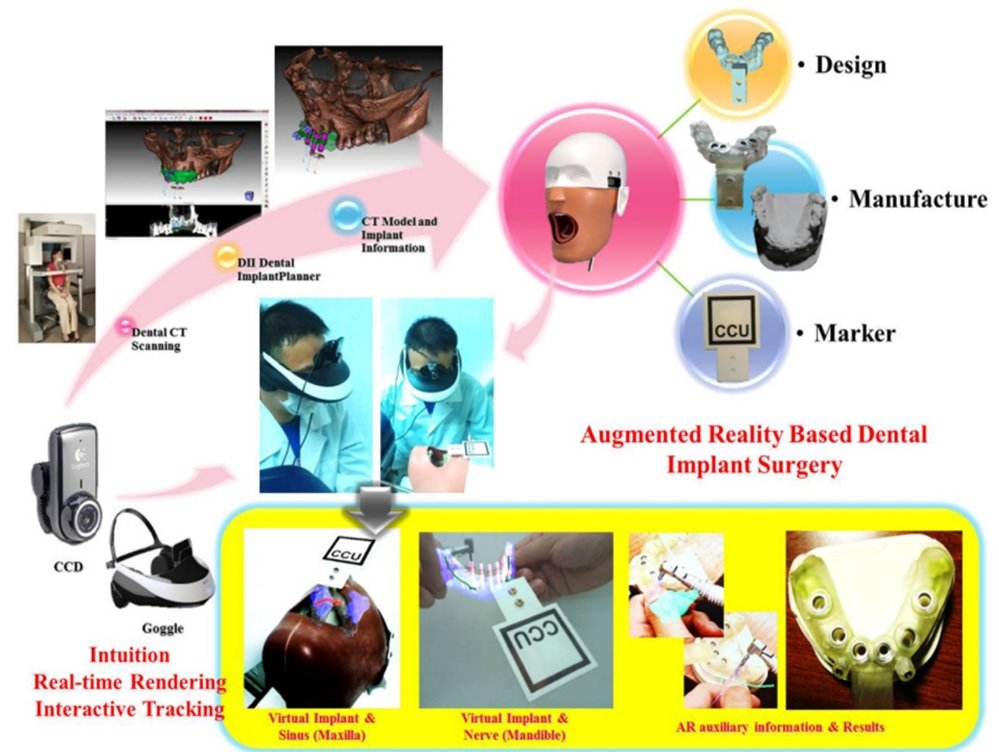
FIG. – FLOWCHART OF IMPLANT GUIDED SURGERY
ADVANTAGES AND LIMITATIONS OF GUIDED IMPLANT SURGERY
While there are many benefits to using guided implant surgery for patients and physicians alike there certainly are some limitations as well. The primary benefit lies in the early involvement of all dental care providers, which guarantees thorough diagnosis, treatment planning and improved outcomes. One of the main possible side effects of implant surgery is damage to important anatomical structures, which can be minimised with guided implant surgery (sinus, nerves, arteries, teeth, etc.). Another benefit is the shorter recovery period, which leads to improved patient-centred outcomes (e.g., less discomfort following surgery), particularly in complicated situations involving many implants.8 Furthermore, guided implant surgery facilitates flapless implant placement by potentially reducing the crestal bone resorption associated with flap elevation and better preserving soft tissue profiles, including gingival edge and interdental papilla positions.
The limitations of GIS abridged by Orenchlioer include errors that arise from the programme, accessibility and affordability of hardware and software support, intraoral restrictions of patients such as limited mouth opening in the posterior area, surgical procedural limitations and human errors.9
NEW DEVELOPMENTS
It is accurate to say that computer guided implant surgery has been impacted by recently emerging technology developments in digital dentistry. Cone-beam computed tomography scans provide a more accurate view of the skeletal and anatomical structures, showcasing the significant advancements in data collection and processing brought about by new hardware and software technologies. For example, data on bone density can be used to forecast implant stability as early as the effective planning phase. Furthermore, scanners can record the anatomy of the tissues in the mouth as well as the anatomy of the teeth. Nearly a complete 3D image of both tissues can be obtained by combining scanning inside the mouth and CT images using combined superimposition plus planning software.
Furthermore, a virtual wax-up of the future prosthetic design can be created using cutting-edge planning software, which can then be reviewed and adjusted as needed. With the use of this comprehensive data collection, computer surgical guide design and production can go forward more precisely, perhaps leading to more precise implant placement than was possible with earlier methods. Moreover, cutting-edge manufacturing methods for creating surgical guides are developing incredibly quickly. Large grit acid-etched and laboratory-based methods have been replaced by milling and three-dimensional printing, which may increase the precision of implant insertion and related procedures.10
CONCLUSION
Current guided technologies enable prosthetic-driven implant planning and placement. A typical digital workflow consists of six processes: (1) patient assessment; (2) data collection; (3) data transformation; (4) virtual implant planning; (5) guide and prosthesis production; and (6) operation execution, which may include the immediate provision of an interim prosthesis. Nevertheless, there's a chance that the procedure will occasionally combine digital and analogue phases. Guided implant surgery is considered to be more exact, accurate, and reliable than free-hand implant surgery. However, discrepancies between an implant's virtual planning and its actual location may result from surgical learning curves and accumulated errors that may occur at different phases of the digital workflow.
It is anticipated that guided implant surgery will be more precise, accurate, and reliable than free-hand implant surgery. However, there can be a discrepancy between the implant's virtual planning and its real position because of the surgical learning curve and cumulative errors that could occur over the various stages of the digital workflow. It is not safe to perform a blind execution using computer-guided surgery. There is definitely a learning curve, but a doctor who is proficient in general surgery, which includes traditional implant dentistry, will be better able to manage any unforeseen problems.10,11
Emerging technologies based on 3D patient evaluation for dental implants have given clinicians more alternatives for accurate and dependable diagnosis, planning, and treatment in a multidisciplinary patient-centred approach. Physicians' capacity to understand these tools and interact with one another is critical to improving case findings and clinical outcomes. Through the examination, comprehension, and application of these technologies, the dental team will be able to broaden their scope and offer patients more consistent outcomes.
When adopting CT-guided implant design and placement, the surgical and restorative team still needs to adhere closely to the principles of prosthetic dentistry and implant surgery. It is crucial to uphold and follow accepted ideas about implant placement, depth, and angulation; case engineering and planning; soft tissue and bone grafting; minimally traumatic soft and hard tissue manipulation; osseointegration healing time; soft and hard tissue healing; heat generation; dental materials; ideal occlusion; and many other topics. CT-guided implant surgery makes it easier and more accurate to insert dental implants in line with a restoratively oriented treatment plan. First, the location of the last tooth is determined.
After the implant has been planned, it is carefully placed into the ideal implant position. Treatment plans should be created with consideration for the needs of each patient as well as the comfort level of the surgical and restorative teams. Healing abutments can be employed, implants can be staged, or cases can be loaded immediately with temporary or, in some circumstances, ultimate restorations. Any good outcome requires careful case selection as well as patient awareness, education, and compliance. There is often a large learning curve when integrating CT-guided surgery into a dental implant practice. For practitioners who are interested in these technologies, continuing education is highly advised.
CT guided implant surgery is distinct from conventional implant surgery. Understanding CT scans, employing proprietary treatment planning software, comprehending the full treatment protocol, and utilising guided surgery devices and surgical techniques are just a few of the variables that affect a successful outcome. It is important for clinicians to consider the extra costs associated with adopting CAD/CAM processing technologies and proprietary software. Selecting the right patients is just as crucial as getting the right diagnosis, planning, and treatment. The best approach to accomplish these goals is for the physician to have a thorough understanding of CT-based technologies, enabling them to adhere to criteria for surgery, prosthetics, and biologics that optimise patient care.11
REFERENCES
- Pellegrino, G., Mangano, C., Mangano, R. et al. Augmented reality for dental implantology: a pilot clinical report of two cases. BMC Oral Health 19, 158 (2019).
- Alqutaibi AY, Algabri RS, Elawady D, Ibrahim WI. Advancements in artificial intelligence algorithms for dental implant identification: A systematic review with meta-analysis. J Prosthet Dent. 2023 Dec 28:S0022-3913(23)00783-7.
- Mangano, F. G., Admakin, O., Lerner, H., & Mangano, C. (2023). Artificial intelligence and augmented reality for guided implant surgery planning: A proof of concept. Journal of Dentistry, 133, 104485.
- Rodrigues, J. A., Krois, J., & Schwendicke, F. (2021). Demystifying artificial intelligence and deep learning in dentistry. Brazilian Oral Research, 35, e094.
- Ekelund, J.A., Lindquist, L.W., Carlsson, G.E. & Jemt, T. (2003) Implant treatment in the edentulous mandible: a prospective study on Branemark system implants over more than 20 years. The International Journal of Prosthodontics 16: 602–608.
- Jemt, T. & Johansson, J. (2006) Implant treatment in the edentulous maxillae: a 15-year follow-up study on 76 consecutive patients provided with fixed prostheses. Clinical Implant Dentistry & Related Research 8: 61–69.
- Johansson, B., Friberg, B. & Nilson, H. (2009) Digitally planned, immediately loaded dental implants with prefabricated prostheses in the reconstruction of edentulous maxillae: a 1-year prospective, multicentre study. Clinical Implant Dentistry & Related Research 11: 1.
- Ozan, O., Turkyilmaz, I., Ersoy, A.E., McGlumphy, E.A. & Rosenstiel, S.F. (2009) Clinical accuracy of 3 different types of computed tomography-derived stereolithographic surgical guides in implant placement. The International Journal of Oral and Maxillofacial Surgery 67: 394–401.
- Suomalainen, A., Kiljunen, T., Kaser, Y., Peltola, J. & Kortesniemi, M. (2009) Dosimetry and image quality of four dental cone beam computed tomography scanners compared with multislice computed tomography scanners. Dentomaxillofacial Radiology 38: 367–378.
- Lee, H., So, J.S., Hochstedler, J.L. & Ercoli, C. (2008) The accuracy of implant impressions: a systematic review. The Journal of Prosthetic Dentistry 100: 285–291.
- Schneider, D., Marquardt, P., Zwahlen, M. & Jung, R.E. (2009) A systematic review on the accuracy and the clinical outcome of computer-guided template based implant dentistry. Clinical Oral Implants Research 20 (Suppl. 4): 73–86.
Disclaimer from Guident
The views and opinions expressed in articles published in Guident are solely those of the authors and do not necessarily reflect the views of the editors, the editorial board or the publisher, Ivory India. Guident does not endorse any product, technique or treatment described. Clinical content is intended for qualified dental and medical professionals and is not a substitute for individual clinical judgement. Guident, its editors and the publisher accept no liability for any consequence arising from the use of information published in the journal.
How to cite this article
Dr. Abhinav Shekhar, Dr. Mahima Seth. Artificial Intelligence and Augmented Reality in Guided Implant Surgery. Guident. 2024 Aug;17(9). Available from: https://guident.net/articles/implantology/artificial-intelligence-and-augmented-reality-in-guided-implant-surgery.html