Interdisciplinary Treatment Approach for Avulsed Anterior Teeth
Department of Orthodontics & Dentofacial Orthopaedics Post Graduate Instiute of Dental Sciences (Rohtak), University of Health Sciences, Rohtak
ABSTRACT
Trauma to anterior teeth is common and requires accurate diagnosis and thorough treatment planning, the labial inclination of the maxillary incisors make them more prone to injuries. Interdisciplinary treatment approach is important for esthetic and functional rehabilitation of avulsed anterior teeth. This report addresses the fundamental considerations related to replacement of avulsed maxillary central incisors by team approach
Key words:esthetics, interdisciplinary, traumatic
INTRODUCTION
Traumatic injuries to the anterior teeth is common and requires accurate diagnosis and thorough treatment planning , Proclination of maxillary central incisors make them more prone to traumatic injuries. Interdisciplinary treatment approach is required for a esthetic and functional rehabilitation of missing central incisors1.
The purpose of this article is to report a case of traumatically avulsed anterior teeth in an adult patient and taking into consideration the biologic , functional , esthetic and economic aspect 2.
CASE REPORT
A 20 year old adult male reported to the Department of Prosthodontics, Post Graduate Instiute of Dental Sciences (Rohtak) with the history of traumatically avulsed maxillary central incisors due to sports injury 6 years back. ( Fig.1 : Pre-treatment photograph ). His medical history was non-significant. Clinical examination revealed Angle’s Class I malocclusion, mesocephalic head form, mesoprosopic facial form and a straight profile. Radiographic examination ( Fig. 2 : Pre-treatment radiograph ) revealed an impacted mandibular right third molar , avulsed maxillary central incisors. Dentally the patient had Class I molar relationship, mandibular midline was matching with the facial midline, mandibular incisors were extruded into the partial edentulous space of the maxillary incisors. During smile the maxillary anteriors appeared unesthetic and unpleasant.
Patient was informed about various treatment alternatives which included removable prosthesis , fixed partial denture and an implant supported fixed prosthesis. Patient did not prefer to use removable prosthesis because of his age and resultant poor esthetic . A six unit fixed partial denture option was accepted as a treatment modality but the absence of sufficient space for the prosthesis made it difficult to restore the incisors, so the patient was referred to the Department of Orthodontics and Dentofacial Orthopedics , Post Graduate Instiute of Dental Sciences (Rohtak) for reduction of deep bite by intrusion of the mandibular incisors so that placement of prosthesis in the maxillary incisor region can be done.
After orthodontic consultation, fixed appliance orthodontic treatment was planned and the treatment procedure included leveling and alignment of arches and preparing space for maxillary incisors. Mandibular central incisor was extracted to increase the overjet and reduce the deep bite present.( Fig 3. Mid treatment photographs ). After correction of the deep bite in the mandibular anterior teeth prosthetic rehabilitation was done to restore the
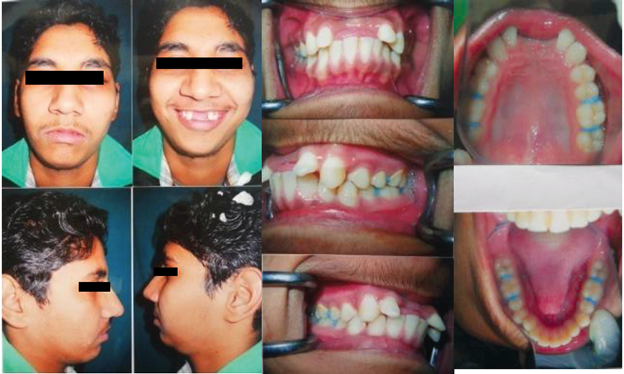
Fig 1: Pre treatment photographs
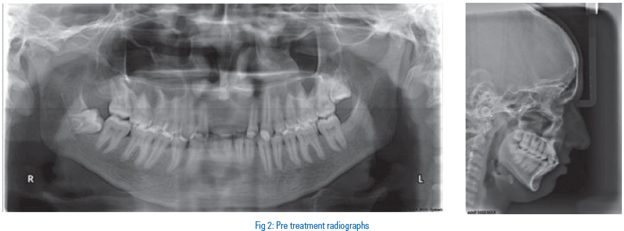
missing maxillary anterior using a six unit metal ceramic fixed partial denture from maxillary right canine to left canine ( Fig 4. Post treatment photographs). The panoramic radiographs were taken after the placement of the fixed prosthesis. ( Fig. 5 : Post-treatment radiograph ) .
RESULTS
The results corresponded well with the treatment goal. Post treatment occlusion was acceptable. Patient self esteem has been vastly improved. Harmonious facial expression and muscle balance was seen, neutral occlusion was established.
CONCLUSION
For successful outcome and patient satisfaction a coordinated ortho prostho treatment with careful consideration of patient expectations and request are critical for the replacement of traumatically avulsed central incisors. FPD restoration should be the treatment of choice.
REFERENCES
- G Akatas , S Canay , A Akatas. Interdisciplinary approach for congenitally missing maxillary lateral incisors. The Internet Journal Of Dental Science , 2009 ; Vol 8 , No 2.
- S Swati et al . Adjunctive Orthodontic Treatment – A case report . IJCD . Jan 2012 , Vol 3 , No. 1 , Pg 19-23
Disclaimer from Guident
The views and opinions expressed in articles published in Guident are solely those of the authors and do not necessarily reflect the views of the editors, the editorial board or the publisher, Ivory India. Guident does not endorse any product, technique or treatment described. Clinical content is intended for qualified dental and medical professionals and is not a substitute for individual clinical judgement. Guident, its editors and the publisher accept no liability for any consequence arising from the use of information published in the journal.
How to cite this article
Dr. Amit Dahiya, Dr. Manisha Kamal, Dr. Arun Kumar. Interdisciplinary Treatment Approach for Avulsed Anterior Teeth. Guident. 2014 May;7(6). Available from: https://guident.net/articles/orthodontics/interdisciplinary-treatment-approach-for-avulsed-anterior-teeth.html