Invisible Orthodontics with Clear Aligners
Departement of Orthodontics and Dentofacial Orthopedics, Departement of Public Health Dentistry, Departement of Periodontics, H.P.Govt. Dental College and Hospital; Shimla, Himachal Pradesh
Abstract
Contemporary orthodontics is seeing a surge of interest in esthetic orthodontic techniques. A recent orthodontic advancement called clear aligners have revolutionised orthodontic treatment by providing beautiful and confident smile to patients with completely inconspicuous appliance. This case report describes invisible single arch orthodontic treatment
of a young patient with clear aligners.
Key-words: Clear aligners, Invisible orthodontics, CAD/CAM.
Key Messages: Contemporary orthodontics is seeing increasing demand of esthetic orthodontic treatment which can be realised by using clear removable aligners.
INTRODUCTION
For a long time now orthodontists and patients have wanted to correct teeth inconspicuously and without the use of brackets and wires. This dream has been turned into reality by a recent advancement in orthodontics called Clear Aligners. This treatment incorporates a series of invisible (clear) plastic aligners that fit comfortably over teeth and are designed to move teeth gradually into their desired position.
In 1945 H.D. Kesling1 suggested that a series of tooth positioners be used to produce tooth movement. Later thermoformed plastic retainers were introduced as invisible retainers by Ponitz.2 Sheridian and others[3] later developed a technique involving interproximal reduction and progressive alignment using clear Essix appliances, and those techniques were further developed by Hillard and Sheridian. [4] However, the tedious laboratory construction limited the widespread application of removable aligners.
In late 1990s, Align Technology Inc. developed the combined computer technology and custom manufacturing processes using computer aided design/ Computer aided manufacturing (CAD/CAM) for aligner fabrication.
This case report presents a single arch orthodontic treatment of a young patient with Clear Aligners.
CASE HISTORY
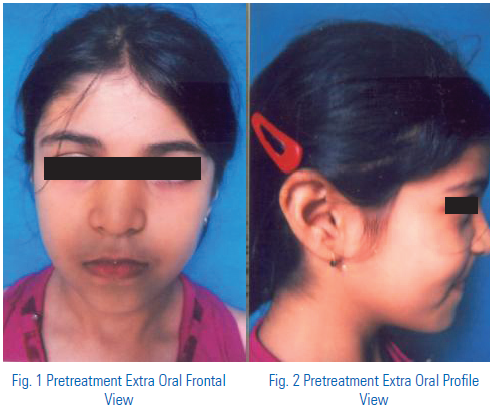
A sixteen years old, female patient reported to our clinic with complaint of irregular upper front teeth. Patient’s records (Fig. 1) revealed that she had Angle’s Class I malocclusion with moderate crowding in maxillary arch, mild crowding in mandibular arch, deep bite and mesial rotation of upper left first permanent molar. Her
profile was orthognathic with adequate soft tissue balance. Our treatment objective was derotation of upper left first permanent molar, correction of deep bite and of crowded arches. Patient insisted on orthodontic treatment of upper arch only and that too without the fixed appliance (labial/lingual). Patient was given option of invisible removable aligners with which she readily agreed. In view of her desire to have invisible treatment in maxillary arch only, we modified treatment objectives to primarily correct the crowding in maxillary arch.

Figure 1
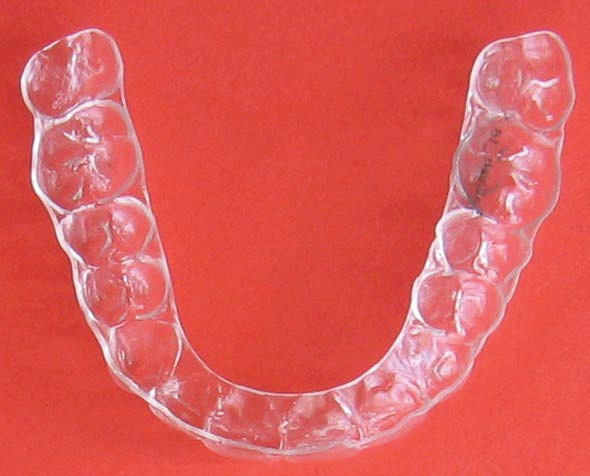
Figure 2
A good quality polyvinylsiloxane (PVS) impression of dental arches along with complete diagnostic record was sent to a clear aligner laboratory. This impression was then scanned by the laboratory using CT scan to produce a 3D virtual model. We advised the lab technicians that our preferred method of relieving crowding would be with interproximal reduction and proclination of maxillary incisors. Technicians at the laboratory then performed virtual setup and staging using proprietary software. After approval of this setup, lab fabricated 16 set of aligners for our patient.
Each set of aligners had to be worn for two weeks (Fig.2,3). Precise interproximal reduction was done on upper incisors before eighth set was used by the patient. Inconspicuous appearance of the aligners ensured her cooperation (Fig.4). Patient was instructed for full time wear of appliance along with maintaining good oral hygiene. After achieving proper alignment of maxillary arch in about eight months, fixed retainer was bonded on maxillary arch (Fig.4, 5). Cephalometric measurements and superimposition shows that changes were limited to maxillary incisors which flared a little (Table 1, Fig.6). Although fixed braces would have allowed us to meet all our objectives, we were able to give our patient a beautiful smile without any psychological trauma and discomforts of wearing braces.
DISCUSSION
Clear aligners offers significant advantages over conventional braces in terms of esthetics, absence of tooth decalcification, hygiene maintenance and freedom to enjoy different foods. In contrasts there are some disadvantages such as high price, complete dependence on patient compliance and limited applicability. The early days of Clear Aligners were wrought with problems because of incomplete understanding of biomechanics, stages of tooth movement, optimal

Figure 3
rates of tooth movement and case selection criteria applicable for use with these appliances. However, once these shortcomings were worked out, the initial spotty professional acceptance of aligners has given way to tremendous enthusiasm regarding their usage into modern orthodontic practice.
Aligners engage natural undercuts of teeth for retention and active force for tooth movement is provided by their elastic deformation. The total desired movement is then subdivided in such a way that aligners remain within this range of elastic deformation and a sequence of aligners is made to accomplish the entire desired movement. The number of aligners or stages is then based on the distance the tooth must be moved (<.25mm/set). As the aligners have a greater inherent ability to undergo elastic deformation in
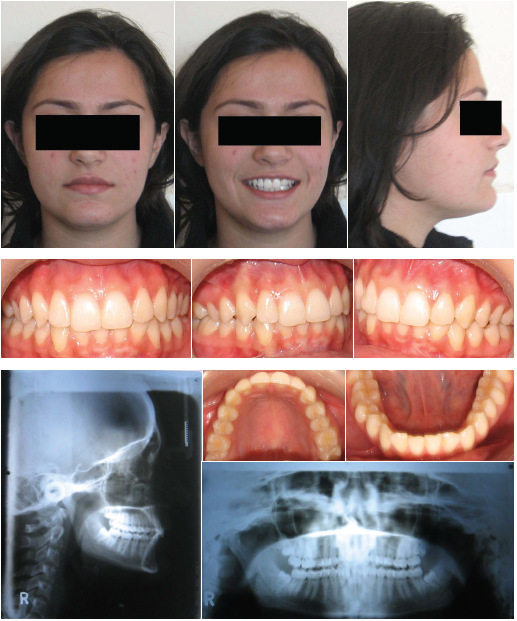
Figure 4

Figure 5
sagittal plane, faciolingual movement with them is fairly predictable.In contrast complex movements like torque, translation, root parallelism, rotation and extrusion are considered difficult. There is an increasing trend towards a combination approach to complex treatment, utilizing fixed appliances or auxiliaries (attachments, power ridges and auxiliaries) as adjuncts before, during or after the aligner treatment.
A satisfactory result depends on careful case selection and patient’s motivation for full time wear. Certain malocclusion like mild to moderate crowding with interproximal reduction or expansion, mild to moderate spacing, intrusion of a few teeth and mild anterior open bite responds well to aligners. Patients must be monitored carefully to verify that tooth movement is tracking with series of aligners. If teeth are not tracking, there are several possibilities: not enough wear of aligners, insufficient inter-proximal reduction, insufficient crown height or shape, faulty bonded attachments or improper movements created in clincheck. A refinement or midcourse correction, with a new intraoral scan or PVS impression and revision of the treatment plan, often is necessary in treatment of complex problems.[5] The ability of patient to remove the appliance for brushing and flossing results in better periodontal health as compared to fixed appliances.[6]
As at present the literature is lacking on the effectiveness and efficiency of aligners, clinicians will have to rely on their clinical experience, the opinion of experts and the limited published evidence when using clear aligners.[7] Understanding both the process of aligner manufacturing along with the biomechanics of tooth movement with aligners and applying that knowledge to treatment planning and clinical execution should enable the clinician to design a treatment plan with aligners alone or in combination with fixed appliances to make both simple and complex treatment predictable and routine.[8]

Figure 6
Table 1 Cephalometric measurementsTable 1 Cephalometric measurements

REFERENCES
- Kesling HD. The philosophy of tooth positioning appliance. Am JOrthod. 1945;31:297-304.
- Ponitz RJ. Invisible retainers. Am J Orthod. 1971;59(3):266-272.
- Sheridian JJ, LeDoux W, McMinn R. Essix retainers: fabrication andsupervision for permanent retention. J Clin Orthod. 1993;27(1):37-45.
- Hillard K, Sheridian JJ. Adjusting Essix appliance at chairside. J ClinOrthod. 2000;34(4):236.
- Proffit WR, Fields HW, Sarver DM. Contemporary Orthodontics, ed 5thSt. Louis: Mosby; 2013.
- Boyd R. Improving periodontal health through invisalign treatment.Access. 2005;24-26.
Disclaimer from Guident
The views and opinions expressed in articles published in Guident are solely those of the authors and do not necessarily reflect the views of the editors, the editorial board or the publisher, Ivory India. Guident does not endorse any product, technique or treatment described. Clinical content is intended for qualified dental and medical professionals and is not a substitute for individual clinical judgement. Guident, its editors and the publisher accept no liability for any consequence arising from the use of information published in the journal.
How to cite this article
Dr. Nishant Negi, Dr.Vinay Bhardwaj, Dr. Pravesh Jhingta. Invisible Orthodontics with Clear Aligners. Guident. 2014 Mar;7(4). Available from: https://guident.net/articles/orthodontics/invisible-orthodontics-with-clear-aligners.html