Different Managing Techniques for Siblings Showcasing Similar Thumb Sucking Habits: A Case Report
(Professor & H.O.D), Department of Pediatric and Preventive Dentistry, K.M. Shah Dental College and Hospital, Sumandeep Vidhyapeeth Deemed To Be University, Piparia, Waghodia (T), Vadodara (D), Gujarat
ABSTRACT
Introduction: Sucking the thumb is considered normal till 3 years of age beyond which it turns out to be a habit. This if not terminated at an early stage, can lead to deleterious effect on both dental and skeletal aspect as well as thumb deformities.
Case report: This paper is about a 9 year old female patient habituated of thumb- sucking due to lack of care by her mother and this act was copied by her brother who was 4 year old. The elder one was given the tongue crib appliance and for the younger one it was thumb guard.
Key words: Oral habits, thumb sucking habit, tongue crib, thumb guard, siblings oral habits.
INTRODUCTION
Anything in excess or deficient can be deleterious. Be it a simple thumb sucking habit itself. Nursing over a long period of time, makes child habituated for the comfort provided by sucking the thumb. Similarly, deprivation of mothers care or the thumb sucking habit in the initial stages of infancy can have an emotional effect on the child and hence the child can resort to thumb sucking habit. Careful management of such kids is very important as it may have negative psychological impact if tried to withdraw the habit with force or with immediate effect. Each kid is different and hence treatment plan is based on the child, the intensity of the habit, the duration it is performed and the frequency at which it is performed.
Right from preventive, psychological, chemical and mechanical methods, there are numerous methods to choose from which can be apt in managing either this act becoming a habit or to limit the deleterious effect caused by repetition of a particular habit.
CASE REPORT
A 9-year- old female patient reported to the department of Pediatric and Preventive Dentistry with a complaint of frequent placement of thumb in the oral cavity. The child was fully aware of the habit and was ready to stop but unconsciously ended up in sucking the thumb. Her parents used to leave her to her grand-parents place who never used to stop her habit of thumb sucking. Her mother had tried all home techniques like applying castor oil, neem paste on the sucking thumb, bandages, full sleeve t-shirts, frequent reminder etc but all in vain. Hence, wanted to consult a dentist regarding the habit and its cessation. The patient had no relevant medical or dental history and no such family history.
Patient was asked to demonstrate the act and she showed Type B of Subtelny classification of thumb sucking. The patient used to suck the thumb at night while sleeping and when sitting idle in the day time. The thumb was examined to confirm the callus formation. On intraoral examination, anterior open bite can be clearly appreciated. (Image 1)
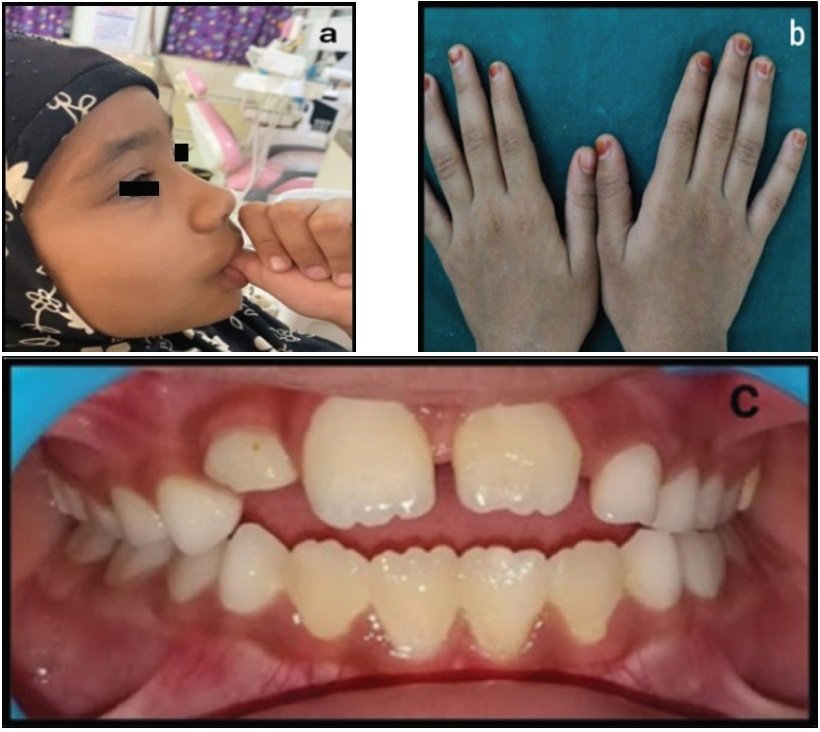
Image 1(a-c): a) Demonstration of the thumb sucking habit by the patient b) The thumb photo showing callus formation in the left thumb c) intra oral front view with anterior open bite.
On further communication, the patient revealed that her younger brother also sucks the thumb, the same manner. The boy used to suck the thumb throughout the day. Patient was asked to demonstrate the act and he showed Type B of Subtelny classification of thumb sucking. The examination of the 4 year old child revealed callus formation around the nail bed and anterior open bite on intra oral examination (Image 2)

Image 2(d-f): d) Demonstration of the thumb sucking habit by the patient e) The thumb photo showing callus formation in the left thumb f) intra oral front view with anterior open bite.
The parents were explained about the habit and the harmful effects it has caused to the patient. The treatment plan was explained to the parent and written consent was taken from the parents.
The elder sister was co-operative for the procedure while the younger one was very uncooperative. Hence, Tongue crib was planned for the 9 year old girl and thumb guard was planned for the 4 year old male patient. (Table 1 & 2)


Table 1 & 2: Procedure for fabrication of tongue crib and thumb guard.
PROCEDURE
The patients were followed up after a week to find out if any discomfort in regard to the appliance delivered was encountered.
After two weeks the parents through tele-dentistry informed that both the children have discontinued the habit of thumb sucking. The patients were reviewed after a month of the delivery of the appliances and were advised to continue with it for a period of 3 months as a retainer post the cessation of habit.
DISCUSSION
The neutral zone of the oral cavity is maintained by the inward pressure of the cheek and lips which is countered by the outward pressure of the teeth and the tongue. Absence of any of the above can lead to shift of the neutral zone. This holds true in the presence of harmful oral habits. The intensity, frequency, duration and the direction of a particular habit can determine its useful/ harmful nature.
Many reasons can result in such habit, among them the lack of parents care and attention is the most common cause for the development of the thumb sucking habit. Various theories have been proposed for thumb sucking out of which the oral drive theory justifies the act of the elder child in this case. With the absence of breast feeding, such act is a way of rechanneling the surplus sucking urge. Whereas the act of the younger one could be co-related with that of the learning theory which states that the younger one on observation of the elder sister learns the act of thumb sucking.
Such non-nutritive prolonged thumb sucking habit can have varied level of adverse effects involoving thumb, lips, face, dental, skeletal abnormalities. (Figure 1)

Figure 1 (a, b): a) Extra oral effect of the thumb sucking habit, b) Intra oral effects of the thumb sucking habit
Based on the severity of the effect of thumb sucking habit and the acceptance of the treatment modality by the patient various methods are there to select from: (Table 3)
|
Management |
Methods |
|
Preventive |
Motive based approach Child’s engagement in various activities Parents involvement Duration of breast feeding Mothers presence and attention during bottle feeding Use of physiological nipple Use of a dummy or pacifier Well timed weaning and beginning of solid foods |
|
Psychological |
Dunlop’s beta hypothesis Thumb sucking books |
|
Reminder therapy- Chemical |
Red pepper dissolved in a volatile liquid medium Quinine Asafetida Castor oil Femite © |
|
Reminder therapy- Mechanical |
Thermoplastic thumb post Ace bandage approach 3 alarm system My special shirt Thumb home concept Hand puppet Ling sleeve night gown |
|
Appliance therapy |
Removable or fixed palatal crib Oral screen Hay rakes Blue grass appliance Quad helix Modified blue grass appliance |
Table 3: Various treatment modalities
First step in such cases should be to know the etiology of the habit and work towards the same. The parents should be made aware of the habit and should be explained about the procedure and the emotional aspect the patient might undergo during an attempt to break the habit.
Counseling done to the child with age appropriate words and examples can lead to positive reinforcement.
Initially reminder therapies both chemical and mechanical are tried before opting for the appliance therapy. But in the above case, the parents have already tried the chemical and mechanical methods of the reminder therapy and were not successful for the elder one. Hence, resorted for approaching a dentist. On contrary, the younger child who has learnt the habit seeing the elder one was not exposed to the mechanical reminder therapy. Hence, a tongue crib was planned for the elder sister and a thumb guard for the younger one.
Tongue crib is an appliance that restricts the placement of the thumb inside the mouth thus interferes the patients sucking satisfaction. It in a way reminds the patient to stop the act by making it a non- pleasurable experience.
A fixed appliance is preferred as there is minimal patient compliance.
Thumb guard is an extra-oral appliance, that is easy to fabricate and can be made more attractive by incorporation of cartoon stickers. This is more acceptable by the child with least discomfort.
Such intraoral and extra oral appliance make the habit non pleasurable and eventually results in withdrawal of the habit. Once the parents suggest the cessation of the habit, the patient is advised to continue the usage of the appliance for another 3 months to check if there is no reversal of the habit that has been stopped.
CONCLUSION
Tongue crib and thumb guard have been an effective options for the correction of thumb sucking. Fabrication is easy for both the appliances and were easily accepted by the patients. Incorporation of cartoon stickers in the thumb guard had an added advantage of acceptance from the child in using the thumb guard.
REFERENCE
- (Berry DC. The buccinator mechanism. J Dent. 1979 Jun;7(2):111-4. doi: 10.1016/0300-5712(79)90004-6. PMID: 379066.)
Disclaimer from Guident
The views and opinions expressed in articles published in Guident are solely those of the authors and do not necessarily reflect the views of the editors, the editorial board or the publisher, Ivory India. Guident does not endorse any product, technique or treatment described. Clinical content is intended for qualified dental and medical professionals and is not a substitute for individual clinical judgement. Guident, its editors and the publisher accept no liability for any consequence arising from the use of information published in the journal.
How to cite this article
Dr. Bhavna Dave Dean, Dr. Deepika N. Chari, Dr. Bhavana I. Different Managing Techniques for Siblings Showcasing Similar Thumb Sucking Habits: A Case Report. Guident. 2021 Sep;14(10). Available from: https://guident.net/articles/pedodontics/different-managing-techniques-for-siblings-showcasing-similar-thumb-sucking-habits-a-case-report.html