Hospital Clowns in Paediatric Dentistry: An Introduction to Anxiety Reduction in the Future
Department of Prosthodontics, College of Medicine, Nursing and Health Sciences Fiji National University, Suva, Fiji, Department of Pharmacology & Therapeutics, College of Medicine & Medical Sciences, Arabian Gulf University, Manama, Kingdom of Bahrain.
Abstract
Dental anxiety and fear of impending dental treatment are considered important factors which affect the overall quality of the treatment provided. Clown Doctors play a significant role in anxiety management of paediatric patients in medical practice. Various randomized controlled trials show a significant effect of these clown doctors in behaviour and anxiety management which brings about a positive treatment outcome and significantly improve the quality of treatment provided. Few studies also indicate that the stress levels in treating physicians are also reduced considerably which directly co-relates with the quality of treatment. It has been reported that children who underwent minor procedures in presence of clown doctors were in favour of visiting them more frequently during their hospital stay. As dental treatment related anxiety is one major concern in delivering successful dental treatment, the incorporation of clown doctors into dental practice is to be considered. However this needs to be investigated because of the lack of studies on using clown dentists in dental practice. The “humour stimulus” in the form of clown dentists would definitely be a breakthrough in behaviour management of children and also adults to improve quality of dental treatment. This might also have an effect on the dentists’ anxiety and stress and overall bring about the best possible patient care
Keywords: Clown doctors, dental fear, dental anxiety
INTRODUCTION
“Clown care” also called “Hospital clowns” refers to trained clowns involved in various health care facilities especially in a Paediatrics. In medical practice they are referred to as “Clown Doctors” whose presence has shown to improve the level of co-operation and alleviate or decrease the level of anxiety in children. The outcome of positive mood and behaviour is advantageous in producing effective treatment outcomes.1 Various randomized controlled trials tested the use of clowns in medical practice. More commonly they are used in paediatrics to bring about positive behaviour management in children undergoing investigations for various diseases, diagnostic procedures like x rays and CT scans and major and minor surgical procedures.2, 3 A systematic review and meta-analysis on the use of these clowns in paediatrics concluded that clowns play a significant role in reducing stress and anxiety and improving recovery in patients admitted to hospitals.4 Stress and anxiety in dental practice always are associated with compromised treatment outcomes. Not only patients, but dentists are also associated with increased anxiety and stress levels when treating anxious patients especially in paedodontic practice.5 Since the use of therapeutic clowns have been tested and identified as effective anxiety management protocol in medical practice involving children, the use of these clowns in dental practice needs to be considered and studied. This paper is a comprehensive review on the evolution and current practice of clown doctors. This could probably serve as background information for the evolution of “Clown Dentists” which would definitely improve treatment outcomes in paediatric dentistry.
EVOLUTION AND TRAINING OF CLOWN DOCTORS
The idea of using clowns or masks is not new. History has it that clowns, fools or court jesters entertained people with their humour. The first recorded court jester was a pygmy at the court of Pharoah Dadkeri-Assi in ancient Egypt’s fifth dynasty.6 The well-known Patch Adams Hunter Doherty who worked in hospitals with a red nose is considered the founder of Clown Doctors. He believed that humour created an atmosphere of trust and love which accelerated the healing process.7 In 1986, the Big Apple Circus Clown Care Unit was started in New York. They are involved in training clowns who are sent to work in various hospitals across the country. The Theodora Foundation trains clowns for hospitals in Europe, Asia and Africa. The Humour Foundation in Australia and Le Rire in France are a few others to mention.
ROLE OF “CLOWN DOCTORS” IN HOSPITALS
Trained clowns are specifically called “Therapeutic clowns” and they are integrated and work in conjunction with other professional team members like the doctors, nurses and the support staff at the hospital. They are professional performers with good communication skills, compassion and empathy. Various studies on hospital clowns reported that when clowns entered the outpatient waiting area, the patients around became curious, distracted and relaxed.4 They are more commonly used in paediatric practice in children for procedures like clinical examination, radiographic examination and post-operative care unit. They use magic, music and story-telling as a means to deal with the range of emotions in children in the hospital. They also mimic procedures performing red-nose transplants, kitty-cat scans, chocolate milk transfusions and funny-bone checks. This helps to provide prior information on the procedure and enables patients to take the procedure with ease. They are also scheduled on “clown rounds” whereby clowns do their ward rounds visiting patients.8
EFFECT OF “CLOWN DOCTORS” IN PRACTICAL HOSPITAL PROCEDURES
Routine hospital procedures like anaesthesia, invasive medical procedures like lumbar punctue, venepuncture, intra-muscular injections, medical examination, and in-patients in rehabilitation unit in hospitals have been reported to be more successful and effective with the use of clowns. It has been reported that 50-75% of children undergoing induction anaesthesia before surgery experienced high stress levels. 9 Several studies have reported the effect of the presence of clowns in the anaesthetic room and observed a significant reduction in anxiety control in the pre-operative period. The addition of parental presence with clowns reduced the anxiety even further. Also there was a significant reduction in the anxiety levels of parents as well.4,10,11,12
Studies assessing the role of therapeutic clowns in invasive procedures like venepuncture, lumbar puncture, intra-muscular injections. Though a significant reduction in stress levels of patients was not reported, the doctors and nurses performed the procedures satisfactorily in presence of clowns. The advantage was that the stress and anxiety of doctors, nurses and other staff involved with the procedure was reduced, enabling better patient management.13
Medical examination in presence of clown doctors was tested in various randomized controlled trials. These trials indicate that the child patient has less fear, was more co-operative and overall the presence of clowns created a pleasant and calm atmosphere. This was proved for delicate clinical examination for sexual abuse cases as well.14,15
In-patients in rehabilitation units of hospitals with varied physical and verbal expressive abilities exhibited more positive and fewer negative emotions and vocalizations. This identifies a direct and positive impact of using clowns in hospitals for almost all procedures requiring anxiety and stress control.16
EFFECT OF “CLOWN DOCTORS” IN PATIENTS WITH COMPROMISED MEDICAL CONDITIONS:
The presence of clowns in the progression of existing medical conditions like respiratory pathologies like bronchitis, pneumonia were studied by Bertini et al.17 The results of the study showed a significant health-enhancing effect of clowns in these patients. The effect of clowns on heart rate, blood pressure and temperature also revealed a significant improvement.17 This indicates the benefit of using clowns in treating systemic medical conditions.
EFFECT OF “CLOWN DOCTORS” ON DOCTORS AND STAFF:
The use of clown doctors not only provided benefit with regards to the patient undergoing treatment but also to the doctor and staff providing treatment. This has been tested in various studies. Also studies indicate that patients and doctors favour more frequent clown visits. They also suggest that an interaction between clowns and staffs be encouraged. However the results are to be interpreted with care because the working methods of these clowns differed depending on their training and this might have an influence on the overall benefit.18,19
HOSPITAL CLOWNS IN DENTAL PRACTICE BASED ON COGNITIVE BEHAVIOUR THERAPY:
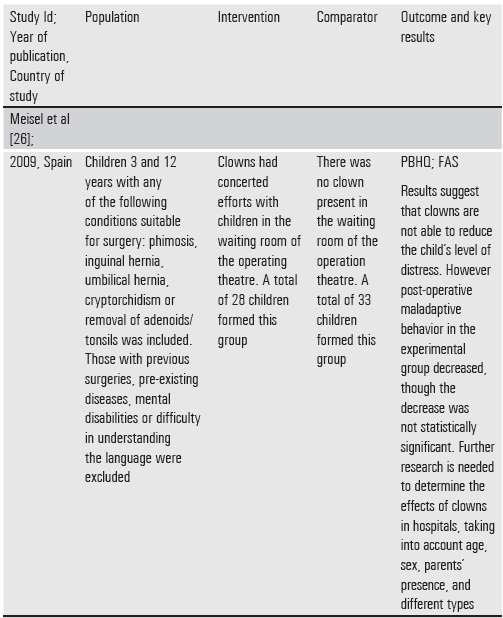
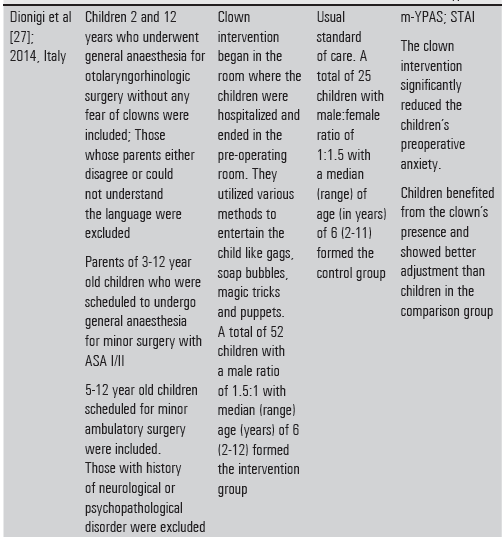
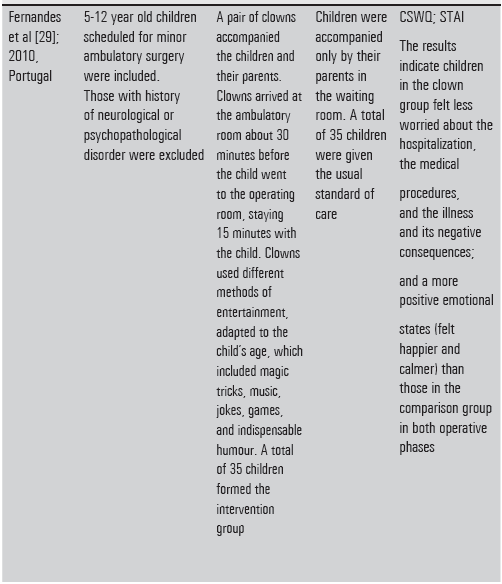
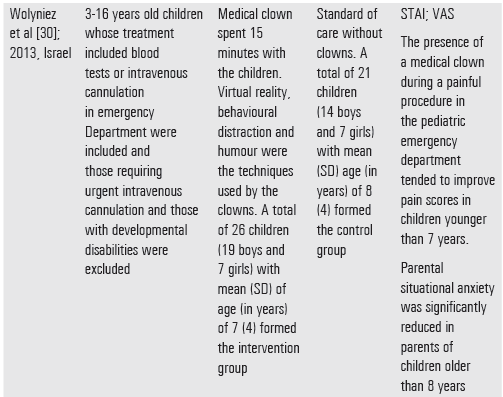
Avoidance of dental care and un-cooperative behaviour during treatment are manifestations of fear and anxiety. Dental anxiety, which defines the anxiety associated with the thought of visiting a dentist for treatment is identified as the fifth-most common cause of anxiety.19 Dental fear is a reaction to known or perceived threat during dental treatment and dental phobia is persistent, unrealistic and intense fear of dental treatment leading to complete avoidance.20 Various questionnaire methods like Corah’s Dental anxiety scale, Modified Dental Anxiety Scale and Kleinknecht’s Dental Fear Survey were used in various studies to measure the level of anxiety.21,22,23 The level of stress varied depending on the procedure. It has been reported that almost 40% of patients experience the viscous cycle of dental fear which is avoiding treatment because of fear leading to exacerbation of the underlying dental problem, requiring intensive treatment which further exacerbates fear and anxiety leading to continued avoidance.24 A review on the current strategies to manage dental anxiety and phobia suggests cognitive behaviour therapy to be the most acceptable strategy. These cognitive treatment strategies aim to alter and restructure the negative thoughts and modify them into positive cognitions. Finally these positive cognitions are used to bring about altered behaviour.25 This cognitive behaviour theory is the basis on which the clowns work. They bring about changes in negative cognition and reinforce positive behavioural outcome. The level of anxiety reduction by Clown Doctors has been shown to be significant from randomised controlled trials in medical practice. The key results of few studies are discussed in Table 126-30. This could serve as a basis for introduction of Clown Dentists. Few studies report no significant effect or negative effect of clown doctors.26,31 This could be attributed to the barriers of clown care which include receptiveness and fatigue, heavily medicated and severely ill patients, barriers at developmental level and also the timing and context of clown doctor intervention.32
Table 1: Key features of studies involving clown doctors and their level of anxiety reduction

CLOWN DENTISTS- FUTURE RESEARCH:
It is always noted that stress and anxiety has been a part of dental practice. Not to forget the pedodontic population where different aspects of anxiety control are being tried and implemented. Therapeutic clowns have been tested and the use of these is completely justifiable in regards to anxiety and stress control in patients as well as the treating physicians. The use of these clowns in dental practice needs to be investigated and studied. Randomized controlled trials on the presence of clowns in dental setting need research to generate evidence. The “humour stimulus” in the form of clown dentists would definitely be a breakthrough in behaviour management of children and also adults. This might also have an effect on the dentists anxiety and stress and overall bring about the best possible patient care.
CONCLUSION
To conclude, the use of clowns in medical practice has produced significant results in terms of improved patient care. The introduction of clown dentists is the need of the hour. High quality research on the use of these clowns is warranted. The evidence from these trials will be used to implement strategies on appropriate training protocols for clowns to be a part of dental practice.
REFERENCES
- Rösner M. The clown doctor: an introduction. Z Gerontol Geriatr. 2010;43:53-7.
- Alverson BK, Wilson KM, Shah SS. A randomized trial of facilitated family-centered rounds. Hosp Pediatr. 2013;3:156-61.
- Viggiano MP, Giganti F, Rossi A et al. Impact of psychological interventions on reducing anxiety, fear and the need for sedation in children undergoing magnetic resonance imaging. Pediatr Rep. 2015;7:5682.
- Sridharan K, Sivaramakrishnan G. Therapeutic clowns in pediatrics: a systematic review and meta-analysis of randomized controlled trials. Eur J Pediatr. 2016;175:1353-60.
- Murray E, Kutzer Y, Lusher J. Dentists' experiences of dentally anxious patients in a specialist setting: An interpretative phenomenological analysis. J Health Psychol. 2016 Sep 8.
- Towson, J. H. Clowns. New York, NY: Hawthorn Books. 1976
- Adams P. The best medicine. Interview by Jim Montague. Hosp Health Netw. 1994;68:6-7
- Finlay F, Baverstock A, Lenton S. Therapeutic clowning in paediatric practice. Clin Child Psychol Psychiatry. 2014;19:596-605.
- Chieng YJ, Chan WC, Klainin-Yobas P et al. Perioperative anxiety and postoperative pain in children and adolescents undergoing elective surgical procedures: a quantitative systematic review. J Adv Nurs. 2014;70:243-55
- Vagnoli L, Caprilli S, Messeri A. Parental presence, clowns or sedative premedication to treat preoperative anxiety in children: what could be the most promising option? Paediatr Anaesth. 2010;20:937-43.
- Golan G, Tighe P, Dobija N et al. Clowns for the prevention of preoperative anxiety in children: a randomized controlled trial. Paediatr Anaesth. 2009;19:262-6.
- Fernandes SC, Arriaga P. The effects of clown intervention on worries and emotional responses in children undergoing surgery. J Health Psychol. 2010;15:405-15.
- Gorfinkle K. S, Slater J. A, Bagiella E et al. Child behavioral distress during invasive oncologic procedures and cardiac catheterization with the Big Apple Circus Clown Care Unit. Pediatr Res. 1998; 43: 12.
- Tener D, Lev-Wiesel R, Franco NL, Ofir S. The use of medical clowns as a psychological distress buffer during anogenital examination of sexually abused children. J Loss Trauma 2012 ;17:12-22.
- Tener D, Lev-Wiesel R, Franco NL, Ofir S. Laughing through this pain: medical clowning during examination of sexually abused children: an innovative approach. J Child Sex Abus. 2010;19:128-40.
- Kingsnorth S, Blain S, McKeever P. Physiological and emotional responses of disabled children to therapeutic clowns: a pilot study. Evid Based Complement Alternat Med. 2011;732394.
- Bertini M, Isola E, Paolone G . Clowns benefit children hospitalized for respiratory pathologies. Evid Based Complement Alternat Med. 2011;2011:879125
- Glasper A, Battrick C, Prudhue G, Weaver K. Service evaluation of clown doctor humour in one english children’s hospital. Available @ http://uk.theodora.org/sites/default/files/media/United-Kingdom/5-News-Event/full_paper.pdf accessed on 21-12-2016
- Agras S, Sylvester D, Oliveau D. The epidemiology of common fears and phobia. Compr Psychiatry. 1969;10:151–156.
- Berggren U, Hakeberg M, Carlsson SG. No differences could be demonstrated between relaxation therapy and cognitive therapy for dental fear. J Evid Based Dent Pract. 2001;1:117–118.
- Corah NL. Development of a dental anxiety scale. J Dent Res. 1969;48(4):596.
- Humphris GM, Morrison T, Lindsay SJ. The Modified Dental Anxiety Scale: validation and United Kingdom norms. Community Dent Health. 1995;12(3):143–150.
- Kleinknecht RA, Klepac RK, Alexander LD. Origins and characteristics of fear of dentistry. J Am Dent Assoc. 1973;86(4):842–848.
- Armfield JM, Heaton LJ. Management of fear and anxiety in the dental clinic: a review. Aust Dent J. 2013;58:390-407;
- Appukuttan DP. Strategies to manage patients with dental anxiety and dental phobia: literature review. Clin Cosmet Investig Dent. 2016;8:35-50. doi: 10.2147/CCIDE.S63626. Review.
- Meisel V, Chellew K, Ponsell E et al. The effect of Bhospital clowns^ in psychological distress and maladaptive behaviours of children undergoing minor surgery. Psicothema 2009;21:604–609
- Dionigi A, Sangiorgi D, Flangini R. Clown intervention to reduce preoperative anxiety in children and parents: a randomized controlled trial. J Health Psychol 2014;19:369–380
- Agostini F, Monti F, Neri E, Dellabartola S, de Pascalis L, Bozicevic L. Parental anxiety and stress before pediatric anesthesia: a pilot study on the effectiveness of preoperative clown intervention. J Health Psychol 2014;19:587–601
- Fernandes SC, Arriaga P. The effects of clown intervention on worries and emotional responses in children undergoing surgery. J Health Psychol 2010;15:405–415
- Wolyniez I, Rimon A, Scolnik D, Gruber A, Tavor O, Haviv E, et al. The effect of a medical clown on pain during intravenous access in the pediatric emergency department: a randomized prospective pilot study. Clin Pediatr (Phila) 2013;52:1168–1172
- M. Pinquart , D. Skolaude , K. Zaplinski , R. F. Maier. Do Clown Visits Improve Psychological and Sense of Physical Well-being of Hospitalized Pediatric Patients? A Randomized-controlled Trial. Klin Padiatr 2011; 223(2): 74-78
- Tan AK, Metsälä E, Hannula L. Benefits and barriers of clown care: A qualitative phenomenographical study of parents with children in clown care services. The European Journal of Humour Research. 2014 ;2:1-0.
Disclaimer from Guident
The views and opinions expressed in articles published in Guident are solely those of the authors and do not necessarily reflect the views of the editors, the editorial board or the publisher, Ivory India. Guident does not endorse any product, technique or treatment described. Clinical content is intended for qualified dental and medical professionals and is not a substitute for individual clinical judgement. Guident, its editors and the publisher accept no liability for any consequence arising from the use of information published in the journal.
How to cite this article
Dr. Gowri Sivaramakrishnan, Dr. Kannan Sridharan. Hospital Clowns in Paediatric Dentistry: An Introduction to Anxiety Reduction in the Future. Guident. 2018 Dec;12(1). Available from: https://guident.net/articles/pedodontics/hospital-clowns-in-paediatric-dentistry-an-introduction-to-anxiety-reduction-in-the-future.html