Mouthwashes: Role in Prevention of Oral Diseases
ABSTRACT
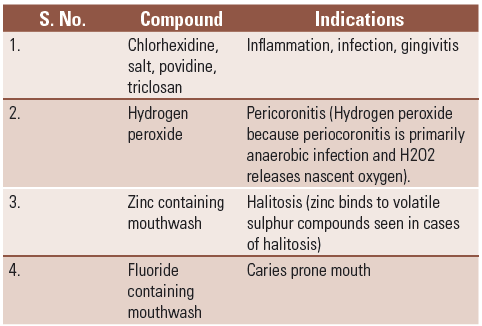
A mouthwash may be recommended as an antimicrobial, a topical anti-inflammatory agent, a topical analgesic, or for caries prevention. Many different mouthwashes are commercially available and patients and health professionals struggle to select the most appropriate product for a particular need. The selection needs to take into consideration factors such as the patient’s oral condition, their disease risk and the efficacy and safety of the mouthwash. Mouthwashes are an adjunct to, not a substitute for, regular brushing and flossing. Agents discussed in this article are those most frequently evaluated clinically and in studies.
Keywords: fluorides, quaternary ammonium compounds, halitosis
INTRODUCTION
Numerous chemical agents have been evaluated for the supplementation of patient-dependent mechanical plaque control and thus the reduction or prevention of oral diseases. Use of agents effective against plaque and gingivitis offers the practitioner a variety of therapeutic considerations. Both mechanical and chemical means helps in reduction of calculus and plaque control.1
Dental plaque forms as a deposit on and around teeth. It is a product of microbial growth, a dense microbial layer consisting of a mass of microorganisms embedded in a matrix, which accumulates on the tooth and adjacent surfaces. A wide variety of microorganisms are found in the oral cavity, some of which can produce acids or toxic materials. In addition to these microorganisms, dental plaque is composed of many other substances, such as mucoproteins and minerals derived from saliva, dead cells, and food residues which are dissolved, or present in particulate form.2
Plaque deposition varies in extent throughout the oral cavity. Larger amounts tend to accumulate on those less accessible and more sheltered areas of teeth which cannot readily be reached with a toothbrush; rinsing with water alone usually will not dislodge such plaque. It is extremely difficult to remove such plaque by mechanical means. With growth and multiplication of the bacteria, the plaque increases in size and becomes more viscous and thicker. Major potential for harm by plaque resides in the bacterial component thereof. Bacterial metabolism can result in the production of acids, toxins and enzymes which are deleterious to the neighboring oral tissues. There is evidence pointing to plaque as being a direct cause of caries due to the generation of acids within its structure. Also, a direct correlation has been observed between the presence of dental plaque and the occurrence of gingivitis.3, 4, 5
Numerous chemical agents vary in dosage form and include mouthrinses, gels, and dentifrices. Some may also be of value as irrigants. Mouthwash or mouth rinse is a product used to enhance oral hygiene. Antiseptic and anti-plaque mouth rinse claims to kill the bacterial plaque causing caries, gingivitis, and bad breath. Anticavity mouth rinse uses fluoride to protect against tooth decay. It is, however, generally agreed that the use of mouthwash does not eliminate the need for both brushing and flossing.6, 7, 8 Mouthwash may also be used to help remove mucus and food particles deeper down in the throat.
Antiseptic and anti-plaque mouth rinse claims to kill the bacterial plaque that causes caries, gingivitis, and bad breath. Anti-cavity mouth rinse uses fluoride to protect against tooth decay. However, it is generally agreed that the use of mouthwash does not eliminate the need for both brushing and flossing. In the absence of a readymade mouthwash, gargling with plain water is preferable, to remove food particles, sugars and other pollutants in the mouth.9
Agents discussed in this paper include the mouthwashes containing chlorhexidine, essential oils, triclosan, sanguinarine, fluorides, oxygenating agents, quaternary ammonium agents, prebrushing rinses, enzymes, and antibiotics.
HISTORY
The first known references to mouth rinsing is in Ayurveda and Chinese medicine, about 2700 BC, for treatment of gingivitis.7, 8 Later, in the Greek and Roman periods, mouthrinsing following mechanical cleansing became common among the upper classes, and Hippocrates recommended a mixture of salt, alum, and vinegar.6 The Jewish Talmud, dating back about 1800 years, suggests a cure for gum ailments containing “dough water” and olive oil.7
Anton van Leeuwenhoek, the famous 17th century microscopist, discovered living organisms (living, because they were motile) in deposits on the teeth (what we now call dental plaque). He also found organisms in water from the canal next to his home in Delft. He experimented with samples by adding vinegar or brandy and found that this resulted in the immediate immobilization or killing of the organisms suspended in water. Next he tried rinsing the mouth of himself and somebody else with a rather foul mouthwash containing vinegar or brandy and found that living organisms remained in the dental plaque. He concluded—correctly—that the mouthwash either did not reach, or was not present long enough, to kill the plaque organisms.
That remained the state of affairs until the late 1960s when Harald Loe (at the time a professor at the Royal Dental College in Aarhus, Denmark) demonstrated that a chlorhexidine compound could prevent the build-up of dental plaque. The reason for chlorhexidine effectiveness is that it strongly adheres to surfaces in the mouth and thus remains present in effective concentrations for many hours (12 hours) which is called as substativity.8
Since then commercial interest in mouthwashes has been intense and several newer products claim effectiveness in reducing the build-up in dental plaque and the associated severity of gingivitis (inflammation of the gums), in addition to fighting bad breath. Many of these solutions aim to control the Volatile Sulfur Compound (VSC)-creating anaerobic bacteria that live in the mouth and excrete substances that lead to bad breath and unpleasant mouth taste.9, 10
USAGE
Common use involves rinsing the mouth with about 20ml (2/3 fl oz) of mouthwash two times a day after brushing. The wash is typically swished or gargled for about half a minute and then spat out. In some brands, the expectorate is stained, so that one can see the bacteria and debris.11, 12 It is probably advisable to use mouthwash at least an hour after brushing with toothpaste when the toothpaste contains sodium lauryl sulfate, since the anionic compounds in the SLS toothpaste can deactivate cationic agents present in the mouthrinse.13
ACTIVE INGREDIENTS AND COMPOSITION
Active ingredients in commercial brands of mouthwash can include thymol, eucalyptol,14 hexetidine, methyl salicylate, menthol, chlorhexidine gluconate,12, 15 benzalkonium chloride, cetylpyridinium chloride,16 methylparaben, hydrogen peroxide, domiphen bromide and sometimes fluoride,17 enzymes and calcium. Ingredients also include water, sweeteners such as sorbitol, sucralose, sodium saccharine, and xylitol (which doubles as a bacterial inhibitor).18 Sometimes a significant amount of alcohol (up to 27% volume) is added,19 as a carrier for the flavor, to provide “bite”,20 and to contribute an antibacterial effect.21 Because of the alcohol content, it is possible to fail a breathalyzer test after rinsing; in addition, alcohol is a drying agent and may worsen chronic bad breath. Furthermore, it is possible for alcoholics to abuse mouthwash. Recently, the possibility that the alcohol used in mouthrinses acts as a carcinogen was raised, but there is to date no scientific consensus on the issue.21, 22, 23 Commercial mouthwashes usually contain a preservative such as sodium benzoate to preserve freshness once the container has been opened. Many newer brands are alcohol-free and contain odor-elimination agents such as oxidizers, as well as odor-preventing agents such as zinc ion to keep future bad breath from developing.
1. CHLORHEXIDINE
Of the products included in this paper, chlorhexidine appears to be the most effective agent for reduction of both plaque and gingivitis. Adverse effects are moderate to severe staining of teeth and soft tissues in some patients, excess formation of supragingival calculus, soft-tissue lesions in young patients, parotid abscesses, allergic responses, dryness of mouth and taste alteration. Chlorhexidine is sold in the United States by prescription in a 0.12% concentration as a mouthrinse. In Europe, chlorhexidine is available in a variety of concentrations, with 0.2% being most often used, and is available as a mouthrinse and gel. Chlorhexidine is dicationic. So one cation binds to tooth and other is free. The free cation gets bound to bacteria or even to stains. That is why staining is a common side effect of Chlorhexidine (called as pin-cushion effect).
2. TRICLOSAN
The chemical name of triclosan is 2,4,4’-trichloro-2’-hydroxydiphenyl ether. It is approximately 65% as effective as chlorhexidine (Muhlemann, 1973; Jenkins et al., 1989). By itself, triclosan does not have good substantivity, but when it is placed in special formulations; its substantivity is increased (Garcia-Godoy, 1989). Unlike chlorhexidine, it is non-ionic, and is compatible with dentifrice ingredients. Clinical studies of six months or longer have shown reductions in plaque ranging between 0 and 30% and reductions in gingivitis ranging between 20 and 75% (Garcia-Godoy et al., 1990; Cubells et al., 1991; Stephen et al., 1990; Svatun et al., 1987, 1989, 1990). No significant adverse effects have been reported. It is available as a mouthrinse and dentifrice.
3. SANGUINARINE
Sanguinarine is an alkaloid extract obtained from the plant Sanguinaria canadensis (Bloodroot). Its chemical name is benzophenathradine. The only adverse effect is a burning sensation in some patients. The marketed products are combined with zinc chloride, the incorporation of which may enhance the efficacy of these products, since metal salts have been shown to have antibacterial properties. Short-term studies of sanguinarine have shown some plaque and gingivitis reduction (Wennstrom and Lindhe, 1985; Klewansky and Vernier, 1984). In two long-term studies of the product in a dentifrice form, no significant reduction in plaque or gingivitis occurred (Lobene et al., 1986; Mauriello and Bader, 1988).
4. FLUORIDES
The most widely used topical fluorides for caries prevention are stannous fluoride, acidulated phosphate fluoride, and sodium fluoride. Short-term studies of stannous fluoride against plaque and gingivitis were promising (Tinanoff et al., 1980; Larson et al., 1985), with efficacy related, most likely, to the presence of the tin ion rather than to fluoride. Two six-month studies, one in abutment teeth of 61 patients and the other in 74 orthodontic patients, showed a significant reduction in plaque and gingivitis (Tinanoff et al., 1989; Boyd et al., 1988). These two studies suggest that there is potential value in stannous fluoride as a preventive agent. The only adverse effect with stannous fluoride is a small amount of tooth staining in some patients (Wolff et al., 1989). They are available as mouthrinses, gels, and dentifrices.
5. QUATERNARY AMMONIUM COMPOUNDS
Quaternary ammonium compounds have been evaluated in a number of short-term studies relative to their effect on plaque and gingivitis. In these studies, an average plaque reduction of 35% has been reported with mixed effects on gingival health. Cepacol and Scope are two well-known representatives of this group, with concentrations of 0.05% and 0.045% cetylpyridinium chloride (CPC), respectively. In addition, Scope contains 0.005% domiphen bromide. The only adverse effect is tooth-staining in some patients (Lobene, 1979). They are available as mouthrinses.
6. OXYGENATING AGENTS
Hydrogen peroxide and other oxygenating agents, such as perborates, are disinfectants which, when acted on by tissue- and bacterial-derived enzymes, release oxygen with an associated effervescence. Oxygenating agents have anti-inflammatory properties. Therefore, less bleeding when gums are probed, a major sign of inflammation would be expected following their use, but the bacteria producing the disease process would not necessarily have been reduced. Safety questions have been raised with chronic use of concentrations of 3% or higher. Since the majority of adverse tissue effects of hydrogen peroxide are based on in vitro and animal models where concentrations of 3% or higher were used, additional studies in humans are needed for its safety to be determined (Weitzman et al., 1984, 1986). It is most likely that concentrations less than 3% would be safe for human use, since no adverse effects have been reported with concentrations in this range. It is available as a mouthrinse and dentifrice.
7. ENZYMES
Several enzymes have been evaluated for their ability to alter plaque. Amylases and proteases were reported (Shayer and Schiff, 1970) to reduce plaque by 34%. Mutanases, which affect the ability of bacteria to adhere to teeth, have shown beneficial effects against plaque but adverse effects on soft tissues (Kelstrup et al., 1973, 1978). Amyloglucosidase and glucoseoxidase (Zendium) have been evaluated, since they have the ability to produce a reaction resulting in a strong oxidizing agent which is antibacterial. However, these study results have not given any exciting results. As a group, the enzymes do not appear to be promising for the reduction of plaque and gingivitis.
8. ANTIBIOTICS
Antibiotics are not indicated for the control of plaque and gingivitis, but may play a definite role as adjuncts to therapy for other periodontal diseases. For reduction of plaque and gingivitis, mainly topical antibiotics used for clinical studies are - niddamycin, vancomycin, and kanamycin. Topical usage has been of limited value due to the development of sensitivity with certain agents, concern about the development of resistant bacteria, and the lack of a prolonged effect.
9. SALTS
A salt mouthwash is a home treatment for mouth infections and/ or injuries, or post extraction, and is made by dissolving a teaspoon of salt in a cup of warm water.
10. POVIDONE-IODINE CONTAINING MOUTHWASHES
Povidone-iodine, an iodophore in which iodine is linked to povidone, displays an affinity for the cell membrane thereby delivering free iodine directly to the bacterial cell surface. It has a broad spectrum of activity against bacteria, fungi, protozoa and viruses. The mouthwash has been shown to be effective in reducing plaque and gingivitis and may be a useful adjunct to routine oral hygiene.
11. LISTERINE
Listerine is a brand of antiseptic mouthwash. The product is marketed under the slogan “Kills germs that cause bad breath”. It was named after Joseph Lister who promoted the idea of sterile surgery by sterilizing instruments. The active ingredients listed on Listerine bottles are menthol, thymol, methyl salicylate, and eucalyptol. In combination all have an antiseptic effect and there is some thought that methyl salicylate may have an anti-inflammatory effect as well. Ethanol, which is toxic to bacteria at concentrations of 40%, is present concentrations of 21.6% in the flavored product and 26.9% in the original gold Listerine Antiseptic. At this concentration, the ethanol serves to dissolve the active ingredients.
Listerine Antiseptic Mouthwash
DRAWBACKS OF MOUTHWASHES
Most mouthwash brands contain alcohol in their mouthwash formula. Rinsing the oral environment with any alcoholic substances make it easier for cancer-causing chemicals (like nicotine) to penetrate the oral tissue which lines the mouth, an extreme hazard for smokers. Some mouthwashes even contain alcohol amounts higher than drinks, up to 26%. Particularly, ethanol contained in some mouthwash rinses dramatically increase the ability of cancer-causing substances to penetrate the lining of the mouth, and other harmful chemicals such as Acetaldehyde – which forms in a person’s mouth after using alcoholic mouthwash – are suspected to be carcinogenic. Some studies show an increased risk of oral cancer, particularly in the larynx, pharynx or oral cavity, of up to 5 times that of a non-alcoholic-mouthwash user, with alcohol and tobacco user risks even higher of up to 9 times, if alcoholic mouthwashes were used twice daily. Alcohol has long been established as a cancer risk; using alcoholic mouthwash, there is much higher level of alcohol in the mouth, and combined with swishing it around, it carries a very harmful effect on the oral mucosa.21, 22, 23
CONCLUSION
Bactericidal potency varies significantly according to the specific chemical components and their concentrations of different mouthwashes. Mouthwashes are not needed by all patients but rather by those who have chronic problems with control of plaque and its associated gingivitis. They can also be used to teach a patient the “endpoint” feeling of teeth with low levels of plaque. This “endpoint” can then be used to motivate a patient to use mechanical methods of oral hygiene so that, in some cases, use of products for the reduction of plaque and gingivitis would not be needed. Mouthwashes can never replace mechanical methods of controlling plaque, calculus and caries. They can only act as an adjunct to mechanical methods. Brushing, flossing and using mouthwash together can limit development of plaque and calculus and thus helps in oral hygiene maintenance.
REFERENCES
1. S.G. Ciancio. Agents for the Management of Plaque and Gingivitis. J DENT RES 1992; 71: 1450.
Disclaimer from Guident
The views and opinions expressed in articles published in Guident are solely those of the authors and do not necessarily reflect the views of the editors, the editorial board or the publisher, Ivory India. Guident does not endorse any product, technique or treatment described. Clinical content is intended for qualified dental and medical professionals and is not a substitute for individual clinical judgement. Guident, its editors and the publisher accept no liability for any consequence arising from the use of information published in the journal.
How to cite this article
Dr. Varun Dahiya, Dr. Pradeep Shukla, Dr. Shreya Hasija. Mouthwashes: Role in Prevention of Oral Diseases. Guident. 2013 Jan;6(3). Available from: https://guident.net/articles/periodontics/mouthwashes-role-in-prevention-of-oral-diseases.html