A Simple Technique of Hollow Maxillary Denture Fabrication
Department of Prosthodontics & Implantology K.D. Dental College & Hospital, Mathura (U.P) India
ABSTRACT
Residual ridge resorption is the reduction in size of the bony ridge under the mucoperiosteum. Prosthetic rehabilitation of severely atrophic ridges has always been an ordeal for the clinician due to decreased support, stability and retention. Extreme ridge resorption also increases the interridge distance. Restoration of the vertical dimension and esthetics thus demands increased height of the prosthesis and in turn leads to an increase in prosthesis weight. This clinical report describes a simple technique of fabricating a hollow maxillary complete denture in a patient with resorbed ridge and increased interridge distance which reduces the weight of the prosthesis and thereby enhances the retention.
CASE REPORT
A 60-year-old male patient reported to Department of Prosthodontics, KD Dental College and Hospital, Mathura, with the chief complaint of difficulty in eating and speaking. Past dental history revealed that patient was a denture wearer for 7 years and the maxillary and mandibular dentures were loose.On intraoral examination, it was seen that maxillary and mandibular edentulous ridges were resorbed with increased interridge distance. Labial mucosa, buccal mucosa, hard palate, soft palate and floor of the mouth were normal. Hence, hollow maxillary complete denture and conventional mandibular denture was planned for this patient.
TECHNIQUE
The maxillary denture was fabricated up to the trial denture stage in the conventional manner (Fig. 1).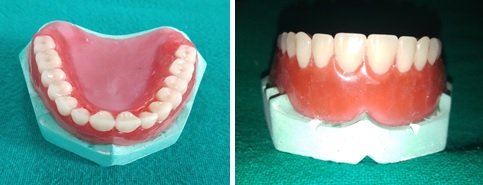
Fig. 1 & 2

Fig. 3 & 4
The trial denture was then processed in the standard manner up-to the wax elimination stage.
Two layers of baseplate wax were adapted to the definitive cast, conforming to the border extensions (Fig. 6). A second flask was used to invest this baseplate wax and processed in conventional manner (Fig. 7)

Fig. 5 & 6

Fig. 7

Fig. 8 & 9
The original cope was reseated on the drag and verified for complete closure of the flask. Then acrylic resin was packed over putty and processed. The processed denture was recovered in the usual manner.
After finishing the denture two openings were cut with a bur into the denture base distal to the most posterior tooth (Fig. 10). The silicone putty was removed using a sharp instrument and thick orthodontic wire.

Fig. 10
DISCUSSION
Tooth loss leads to residual ridge resorption which is a complex phenomenon driven by various anatomic, prosthetic, functional and metabolic factors. Extreme resorption of either ridge will lead to a reduced denture-bearing area, which in turn will affect retention, stability and support for the complete denture. Excessive ridge resorption also results in a large restorative space between the residual ridges. Fabrication of hollow dentures has been tried to decrease the weight of the prosthesis which in turn increases the retention and stability. This technique overcomes the disadvantages of the older techniques.Advantages
- Reduces leakage at the junction of the two portions of the denture.
- Commonly used materials are used for its fabrication.
- Reduces weight of the prosthesis which in turn enhances retention.
Disadvantages
- Time-consuming procedure.
- Hollow denture is prone to fracture.
- Removal of putty from the cavity is difficult.
CONCLUSION
Hollow maxillary complete denture reduces the weight of the prosthesis which in turn prevents transmission of detrimental forces which would otherwise be transmitted from a conventional heavy prosthesis to the underlying tissues. Thus, it helps to preserve underlying tissues and bone.REFERENCES
- Radke U, Mundhe D. Hollow maxillary complete denture. J Indian Prosthodont Soc. 2011;11(4):246-249. doi:10.1007/s13191-011-0082-9
- El Mahdy AS. Processing a hollow obturator. J Prosthet Dent. 1969;22:682–686. doi: 10.1016/S0022-3913(69)80013-2.
- Qanungo A, Aras MA, Chitre V, Mysore A, Da Costa GC. An Innovative and Simple Technique of Hollow Maxillary Complete Denture Fabrication. J Clin Diagn Res. 2016;10(8):ZD23-ZD25. doi:10.7860/JCDR/2016/20383.8264
- Gardner LK, Parr GR, Rahn AO. Simplified technique for the fabrication of a hollow obturator prosthesis using vinyl polysiloxane. J Prosthet Dent. 1991;66:60–62.
- O’Sullivan M, Hansen N, Cronin RJ, Cagna DR. The hollow maxillary complete denture: A modified technique. J Prosthet Dent. 2004;91:591–94.
Disclaimer from Guident
The views and opinions expressed in articles published in Guident are solely those of the authors and do not necessarily reflect the views of the editors, the editorial board or the publisher, Ivory India. Guident does not endorse any product, technique or treatment described. Clinical content is intended for qualified dental and medical professionals and is not a substitute for individual clinical judgement. Guident, its editors and the publisher accept no liability for any consequence arising from the use of information published in the journal.
How to cite this article
Dr. Yashi Garg, Dr. Rahul Nagrath. A Simple Technique of Hollow Maxillary Denture Fabrication. Guident. 2020 Sep;13(10). Available from: https://guident.net/articles/prosthodontics/a-simple-technique-of-hollow-maxillary-denture-fabrication.html