A Simplified and Reliable Technique for Beading and Boxing of Elastomeric Impressions: A Clinical Perspective
Department of Prosthodontics and Crown & Bridge, K.D. Dental College & Hospital, Mathura, UP, India.
ABSTRACT
Beading and boxing are essential steps in complete denture fabrication to preserve the anatomical accuracy of impressions and to obtain a well-formed master cast. Conventional techniques often present challenges when used with elastomeric impression materials due to poor adhesion of wax. This article presents a simplified, efficient, and economical method for beading and boxing elastic impressions using instant adhesive as an intermediary bonding agent. The technique improves accuracy, minimizes distortion, and enhances ease of manipulation while maintaining the integrity of vestibular structures.
INTRODUCTION
Accurate reproduction of oral tissues is fundamental to successful prosthodontic treatment, especially in complete denture fabrication. The final impression must capture not only the denture-bearing areas but also the functional depth and width of the vestibule. Beading and boxing procedures play a crucial role in preserving these anatomical landmarks and in ensuring proper cast formation.2
Beading refers to the process of forming a wax rim around the impression to maintain sulcus depth, while boxing involves enclosing the impression to create a defined base for the cast. These steps help in controlling the thickness of the cast, conserving dental stone, and facilitating laboratory procedures such as mounting and articulation.1
However, traditional wax beading techniques are less effective with elastomeric impressions due to poor adhesion, leading to inaccuracies and technique sensitivity.4 Therefore, modifications in technique are necessary to overcome these limitations.
RATIONALE FOR MODIFICATION
Conventional methods of beading and boxing include:
- Wax beading and boxing
- Plaster-pumice boxing
- Caulking compound techniques
- Denture flask boxing methods
While effective in certain situations, these methods may be:
- Time-consuming
- Technique-sensitive
- Incompatible with elastic impression materials3
Elastomeric materials (e.g., silicone, polyether) present adhesion challenges, making it difficult to secure wax beading. The modified technique addresses this limitation by introducing an instant adhesive as a bonding medium between the impression and wax.
Materials Required
- Final elastomeric impression
- Beading wax or baseplate wax
- Boxing wax
- Instant adhesive (cyanoacrylate-based)
- Dental stone
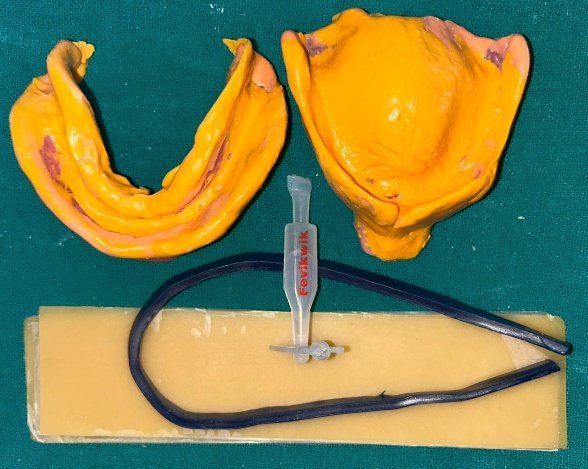
MODIFIED TECHNIQUE (Step-by-Step Procedure)
Step 1: Impression Preparation
- The impression is disinfected and dried thoroughly to remove residual moisture.
- This ensures optimal adhesion of materials1

Step 2: Marking the Border
- A line is drawn approximately 3 mm from the peripheral border to define the desired extent of the cast1
- This step is critical for preserving vestibular depth2

Step 3: Stabilization of Impression
- Wax pieces are adapted to the tray surface to stabilize the impression on the working surface and maintain orientation1
Step 4: Application of Adhesive
- A thin layer of instant adhesive is applied along the marked line.
- Care must be taken to avoid skin contact1
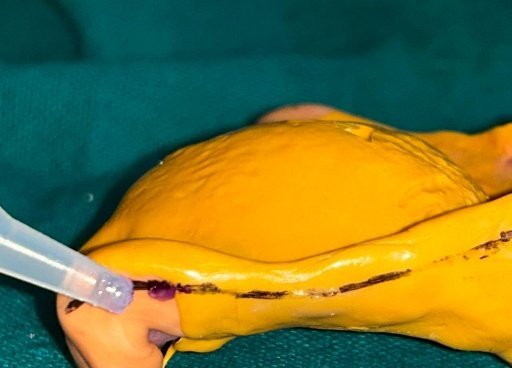
Step 5: Beading
- A wax bead is adapted and attached along the adhesive line.
- The adhesive ensures firm bonding with the elastomeric impression4

Step 6: Reinforcement
- The junction between wax and impression is reinforced by gently softening and adapting the wax1.
Step 7: Boxing
- Boxing wax is applied around the beading to create a vertical wall.
- This defines the base and confines the dental stone during pouring.3
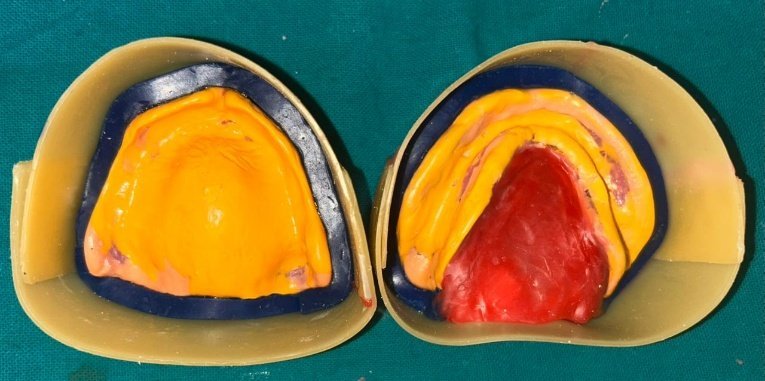
Step 8: Pouring the Cast
- Dental stone is mixed and poured carefully to avoid air entrapment.
- Controlled pouring ensures uniform base thickness.2
Step 9: Retrieval and Finishing
- After setting, the boxing and beading materials are removed.
- The cast is trimmed while preserving the land area2
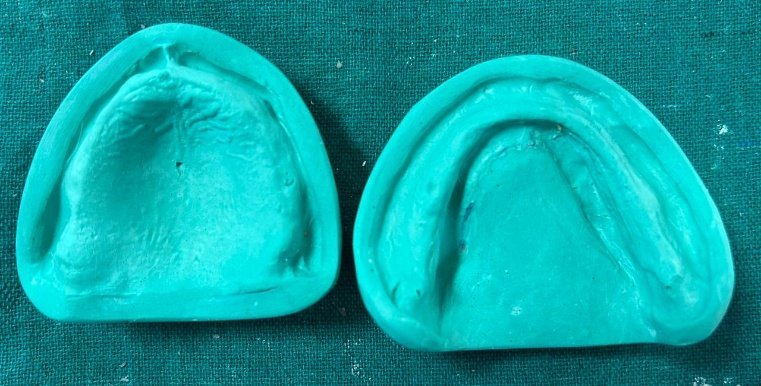
ADVANTAGES OF THE TECHNIQUE
- Universal applicability: Suitable for all impression materials4
- Improved adhesion: Instant adhesive overcomes wax incompatibility1
- Time-efficient: Reduces procedural steps5
- Cost-effective: Uses readily available materials4
- Enhanced accuracy: Preserves vestibular details2
- Reduced distortion risk: Eliminates need for inversion1
CLINICAL SIGNIFICANCE
Accurate beading and boxing directly influence:
- Denture border extension
- Stability and retention
- Patient comfort
The modified technique ensures better reproduction of mucobuccal and mucolingual folds, which is critical in achieving functional dentures.4 Additionally, it simplifies clinical workflow, making it suitable for both teaching institutions and clinical practice.
Precautions
- Avoid direct contact of adhesive with skin
- Ensure uniform application of adhesive
- Maintain proper orientation of impression
- Avoid overheating wax1
DISCUSSION
Beading and boxing techniques have evolved significantly, with multiple methods proposed in literature to address material-specific challenges. Traditional wax methods are effective for rigid impressions such as zinc oxide eugenol but fail with elastomeric materials due to lack of adhesion.7
Alternative approaches like plaster-pumice boxing provide better adaptation but are labor-intensive and technique-sensitive.5 The use of irreversible hydrocolloid or caulking compounds simplifies the procedure but may compromise precision or require additional armamentarium.6
The introduction of instant adhesive represents a practical innovation that bridges the gap between ease of use and accuracy. It allows secure attachment of wax to otherwise non-adhesive surfaces, thereby improving procedural reliability.4
Furthermore, this method reduces the need for complex laboratory procedures and minimizes material wastage. Its simplicity makes it highly suitable for routine prosthodontic practice while maintaining high standards of accuracy and reproducibility.
CONCLUSION
The modified beading and boxing technique using instant adhesive offers a simple, efficient, and reliable alternative to conventional methods. It is particularly advantageous for elastomeric impressions, where traditional wax adhesion is problematic. The technique enhances accuracy, reduces procedural complexity, and ensures optimal preservation of anatomical landmarks, thereby contributing to successful prosthodontic outcomes.
REFERENCES
- Vyas A, Maru K, Bali SK, Jain S, Shukla J, Kataria N. A new simplified beading and boxing procedure for elastic impression. J Indian Prosthodont Soc. 2011;11(1):52–54.
- Rudd KD, Morrow RM, Seldin EE. Dental laboratory procedures: complete dentures. 2nd ed. St. Louis: CV Mosby; 1986.
- Powter RG, Hope M. A method of boxing impressions. J Prosthet Dent. 1981;45(2):224–225.
- Clear KE, Hansen CA. A simplified procedure for boxing elastomeric impressions. J Prosthet Dent. 1996;75(4):449–452.
- Bolouri A, Hilger TC, Gowrylok MD. Boxing impressions. J Prosthet Dent. 1975;33:692–69
- Stipho HD. Boxing impressions with irreversible hydrocolloid. J Prosthet Dent. 1985;53(5):740–741.
- Ansari IH. A quick method for boxing complete denture elastomeric impressions. J Prosthet Dent. 1994;71(6):646–648
Disclaimer from Guident
The views and opinions expressed in articles published in Guident are solely those of the authors and do not necessarily reflect the views of the editors, the editorial board or the publisher, Ivory India. Guident does not endorse any product, technique or treatment described. Clinical content is intended for qualified dental and medical professionals and is not a substitute for individual clinical judgement. Guident, its editors and the publisher accept no liability for any consequence arising from the use of information published in the journal.
How to cite this article
Dr. Rashmi Chahar, Dr. Shubham Chavhan, Dr. Manesh Lahori. A Simplified and Reliable Technique for Beading and Boxing of Elastomeric Impressions: A Clinical Perspective. Guident. 2026 Apr;19(5). Available from: https://guident.net/articles/prosthodontics/a-simplified-and-reliable-technique-for-beading-and-boxing-of-elastomeric-impressions-a-clinical-perspective.html