Digital VS Conventional Impressions – a Narrative Review
ART Dental, Bangalore, Kar. India
ABSTRACT
Background: Accurate impression making is fundamental to the success of fixed and removable prosthodontic rehabilitation. Conventional elastomeric impression techniques have long been considered the gold standard; however, the introduction of digital intraoral scanners (IOS) has transformed contemporary prosthodontic workflows.
Aim: This review aims to evaluate and compare digital intraoral scanning systems with conventional impression techniques in terms of accuracy, clinical performance, patient-centered outcomes, and practice implications.
Materials and Methods: A literature search was conducted using PubMed, Scopus, and Google Scholar databases for studies published between 2013 and 2025. Keywords included “digital intraoral scanner,” “conventional impression,” “accuracy,” “marginal fit,” “trueness,” “precision,” and “prosthodontics.” In vitro studies, clinical trials, systematic reviews, and meta-analyses evaluating impression accuracy and clinical outcomes were included.
Results: Short-span restorations fabricated using digital impressions demonstrate comparable or superior accuracy to conventional techniques. While conventional impressions may retain an advantage in full-arch accuracy in certain clinical scenarios, digital workflows show improved patient comfort, reduced chairside time, and enhanced communication with laboratories. However, limitations remain regarding soft tissue capture and scanning long-span edentulous arches.
Conclusion: Digital intraoral scanners represent a reliable alternative to conventional impression techniques in most prosthodontic applications. Clinical decision-making should consider case complexity, operator experience, and economic factors. Integration of digital workflows is likely to define the future of prosthodontic practice.
1. INTRODUCTION
The accuracy of impression procedures is a critical determinant of the marginal integrity, internal fit, and long-term success of prosthodontic restorations. Conventional elastomeric impression materials such as polyvinyl siloxane and polyether have historically been regarded as the gold standard due to their dimensional stability and fine detail reproduction. However, conventional techniques are susceptible to multiple sources of error, including material distortion, improper tray selection, moisture contamination, and errors during pouring and laboratory processing.
Over the past decade, the emergence of digital intraoral scanners (IOS) has significantly altered the landscape of restorative and prosthodontic dentistry. Digital impressions eliminate several intermediate steps inherent to conventional workflows and allow direct acquisition of three-dimensional surface data. Advances in optical technologies, including confocal microscopy, triangulation, and active wavefront sampling, have enhanced the accuracy and clinical applicability of these systems.
Accuracy in digital dentistry is commonly described in terms of trueness and precision, as defined by ISO standards. Trueness refers to the closeness of agreement between the measured value and the true value, whereas precision refers to the reproducibility of repeated measurements under consistent conditions. These parameters are essential when evaluating the reliability of digital impressions in both short-span and full-arch restorations.
Despite rapid technological advancements, debate persists regarding the comparative accuracy of digital and conventional impressions, particularly in complex prosthodontic scenarios such as full-arch rehabilitations and implant-supported restorations. Furthermore, beyond accuracy alone, clinical decision-making must consider patient comfort, operator efficiency, economic implications, and long-term outcomes.
Therefore, the purpose of this narrative review is to critically analyze existing literature comparing digital intraoral scanning systems with conventional impression techniques in prosthodontics, focusing on accuracy, clinical performance, and future practice implications.
2. MATERIALS AND METHODS
A comprehensive literature search was conducted using electronic databases including PubMed, Scopus, and Google Scholar. Articles published between January 2013 and January 2025 were considered. The search strategy incorporated combinations of the following keywords: “digital intraoral scanner,” “conventional impression,” “prosthodontics,” “accuracy,” “marginal fit,” “trueness,” “precision,” and “clinical outcomes.”
Inclusion criteria comprised:
- In vitro studies evaluating marginal and internal fit
- Clinical trials comparing digital and conventional impressions
- Systematic reviews and meta-analyses
- Studies involving fixed prosthodontics and implant prosthodontics
Exclusion criteria included:
- Case reports
- Studies not available in English
- Studies lacking quantitative accuracy evaluation
The selected studies were analyzed and categorized based on study design, type of prosthesis, and measured outcomes.
3. ACCURACY OF DIGITAL VERSUS CONVENTIONAL IMPRESSIONS
3.1 Concept of Accuracy: Trueness and Precision
Accuracy in prosthodontics directly influences marginal integrity, internal fit, and longevity of restorations. According to ISO 5725 standards, accuracy is defined by two parameters: trueness and precision. Trueness refers to the deviation of a measurement from the true reference value, while precision reflects reproducibility under identical conditions 1.
In conventional impressions, inaccuracies may arise from:
- Polymerization shrinkage
- Tray distortion
- Material handling errors
- Gypsum expansion during cast pouring
Digital intraoral scanners eliminate several of these intermediate steps, theoretically reducing cumulative distortion. However, digital accuracy is influenced by scanning strategy, stitching algorithms, optical technology, and operator skill 2.
3.2 Short-Span Restorations
Multiple in vitro and clinical studies have demonstrated that for single crowns and short-span fixed partial dentures, digital impressions exhibit comparable or superior marginal and internal fit when compared to conventional elastomeric impressions 3,4.
Reported marginal discrepancies for digital workflows frequently fall within clinically acceptable limits (≤120 μm) and are often lower than those observed with conventional techniques.5 Furthermore, digital impressions reduce variability associated with impression material handling.
Clinical trials evaluating single-unit restorations have reported high survival rates and satisfactory marginal adaptation with digital workflows 6.
Thus, current evidence supports the reliability of digital impressions for short-span prosthodontic applications.
3.3 Full-Arch and Long-Span Restorations
Accuracy discrepancies become more pronounced in full-arch restorations due to cumulative stitching errors inherent to digital scanning systems. Several studies suggest that conventional impressions may demonstrate superior trueness in full-arch scenarios, particularly in edentulous arches 7.
However, advancements in scanner software algorithms and scanning strategies have significantly improved full-arch accuracy in recent years 8.
Factors influencing full-arch digital accuracy include:
- Scanning path
- Arch length
- Surface characteristics
- Presence of saliva and soft tissue mobility
Although digital systems are improving, caution is advised when selecting impression techniques for extensive rehabilitations.
3.4 Implant Impressions and Scan Bodies
Implant prosthodontics demands high accuracy to prevent misfit and biomechanical complications.
Digital implant impressions utilize scan bodies that transfer implant position information into the virtual environment. The accuracy of digital implant impressions depends on:
- Scan body material and design
- Proper seating of scan bodies
- Scanner resolution
- Software stitching capability
Studies comparing digital and conventional open-tray implant impressions have reported comparable accuracy in partially edentulous cases 9,10. However, for multiple implants in full-arch restorations, conventional splinted impression techniques may still demonstrate superior passive fit in certain scenarios 11.
Recent systematic reviews indicate that digital implant impressions are clinically acceptable for short-span implant restorations but require careful technique control for full-arch rehabilitations 12.
This area continues to evolve rapidly with improvements in scan body design and digital calibration systems.
4. CLINICAL PERFORMANCE AND PATIENT-CENTERED OUTCOMES
4.1 Patient Comfort and Acceptance
Conventional impression techniques often induce discomfort due to tray bulk, gag reflex stimulation, unpleasant taste, and extended setting time. These factors can compromise patient cooperation, particularly in medically compromised or anxious individuals 13.
Digital intraoral scanners significantly improve patient comfort by eliminating impression trays and impression materials. Studies evaluating patient perception consistently report higher acceptance and preference for digital impressions over conventional methods.14 Reduced gag reflex incidence and shorter intraoral procedure duration contribute to improved patient experience.
In contemporary prosthodontic practice, patient-centered care has become increasingly important, and comfort plays a decisive role in treatment acceptance and satisfaction.
4.2 Chairside Time and Clinical Efficiency
Several comparative studies demonstrate reduced total clinical time with digital workflows, particularly when laboratory communication and remakes are considered 15.
Although initial scanning may require operator familiarization, digital impressions eliminate:
- Tray selection
- Material mixing
- Disinfection procedures
- Cast pouring
Additionally, digital files can be transmitted instantly to laboratories, reducing turnaround time and improving workflow coordination 16.
However, for inexperienced operators, scanning time may initially exceed conventional impression time, highlighting the influence of the learning curve.
4.3 Remakes and Accuracy-Related Adjustments
Remakes in conventional impressions often result from:
- Voids
- Pulls
- Incomplete margins
- Material distortion
Digital systems allow immediate visualization of preparation margins and occlusal clearance, enabling corrections chairside before submission to the laboratory 17.
Some studies report reduced adjustment time and improved first-time fit for restorations fabricated using digital impressions.18 However, evidence remains heterogeneous, and outcomes may vary based on system type and operator expertise.
4.4 Infection Control Considerations
Conventional impressions require disinfection protocols, and improper handling may pose cross-contamination risks. Digital impressions reduce physical material handling and limit cross-infection pathways 19.
This aspect gained particular relevance during the COVID-19 pandemic, where contact minimization and digital workflows became advantageous.
5. ECONOMIC AND PRACTICE IMPLICATIONS
From a clinical management perspective, the integration of digital intraoral scanners involves significant initial capital investment. However, long-term economic benefits may include:
- Reduced material costs
- Decreased remakes
- Improved laboratory communication
- Enhanced case acceptance due to perceived technological advancement
Return on investment (ROI) depends on case volume, practice model, and integration within a complete digital ecosystem 20.
For prosthodontic practices focused on comprehensive rehabilitation and implant dentistry, digital workflows may enhance interdisciplinary collaboration and predictability.
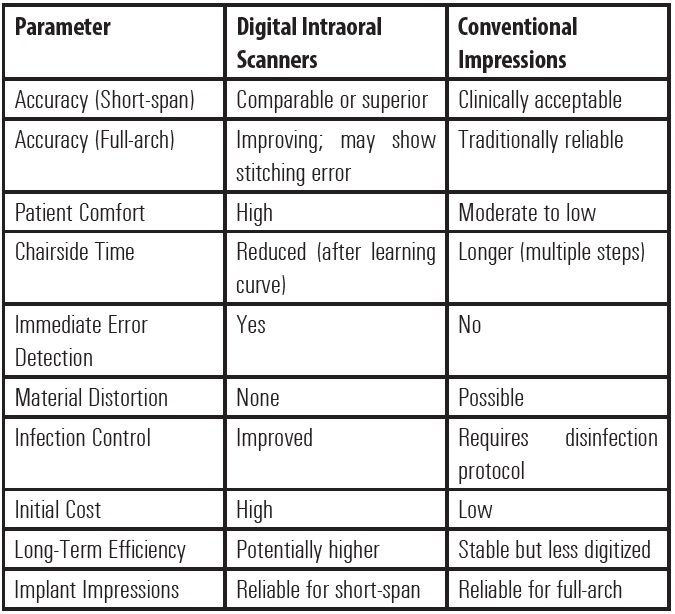
COMPARATIVE SUMMARY TABLE
Table 1: Comparison Between Digital and Conventional Impression Techniques
6. LIMITATIONS OF DIGITAL IMPRESSION SYSTEMS
Despite advancements, digital systems present certain limitations:
- Reduced accuracy in fully edentulous arches due to absence of stable landmarks
- Difficulty capturing subgingival margins without adequate tissue management
- Dependence on operator technique
- High initial equipment cost
- Data storage and software compatibility concerns
Continuous software updates and hardware refinements aim to overcome these challenges.
7. FUTURE PERSPECTIVES
The future of prosthodontics is increasingly aligned with fully integrated digital workflows. Emerging trends include:
- Artificial intelligence-assisted margin detection
- Cloud-based laboratory collaboration
- Integration with CAD/CAM milling and 3D printing
- Improved edentulous scanning protocols
As technology advances, digital impressions are expected to become the primary modality for most prosthodontic procedures .
8. LEARNING CURVE AND OPERATOR EXPERIENCE IN DIGITAL IMPRESSION SYSTEMS
The adoption of intraoral scanners requires a learning curve that may influence the accuracy and efficiency of digital impressions during the initial stages of use. Operator experience plays a significant role in determining scan quality, particularly when capturing complex anatomical areas or full-arch restorations. Studies have shown that inexperienced users may initially demonstrate longer scanning times and increased stitching errors compared with experienced operators.
However, with increasing familiarity and repeated use, clinicians demonstrate significant improvement in scanning efficiency and accuracy. Digital systems also offer real-time feedback, allowing clinicians to immediately identify missing data and rescan specific areas, which is not possible with conventional impressions. This capability contributes to reduced remakes and improved workflow predictability.
Consequently, adequate training and regular use are essential for maximizing the benefits of digital impression systems in clinical prosthodontics
9. CONCLUSION
Current evidence indicates that digital intraoral scanners provide clinically acceptable accuracy for most short-span prosthodontic restorations and implant-supported cases. While conventional impressions may still demonstrate advantages in specific full-arch scenarios, digital workflows offer significant benefits in patient comfort, efficiency, and communication.
Clinical decision-making should be guided by case complexity, operator expertise, and economic considerations. As technology continues to evolve, digital impression systems are likely to redefine standards in prosthodontic practice.
REFERENCES
- Ender A, Mehl A. Accuracy of complete-arch dental impressions: a new method of measuring trueness and precision. J Prosthet Dent. 2013;109(2):121-128.
- Ender A, Mehl A. Full arch scans: conventional versus digital impressions—an in vitro study. Int J Comput Dent. 2011;14(1):11-21.
- Mangano FG, Hauschild U, Admakin O. Full digital workflow in prosthodontics: a systematic review. Int J Environ Res Public Health. 2018;15(11):2367.
- Mangano F, Gandolfi A, Luongo G, Logozzo S. Intraoral scanners in dentistry: a review of the current literature. BMC Oral Health. 2017;17:149.
- Ahlholm P, Sipilä K, Vallittu P, Jakonen M, Kotiranta U. Digital versus conventional impressions in fixed prosthodontics: a review. J Prosthodont. 2018;27(1):35-41.
- Joda T, Brägger U. Patient-centered outcomes comparing digital and conventional implant impression procedures: a systematic review. Clin Oral Implants Res. 2016;27(1):1-7.
- Papaspyridakos P, Chen CJ, Gallucci GO, Doukoudakis A, Weber HP, Chronopoulos V. Accuracy of implant impressions for partially and completely edentulous patients: a systematic review. Int J Oral Maxillofac Implants. 2014;29(4):836-845.
- Güth JF, Keul C, Stimmelmayr M, Beuer F, Edelhoff D. Accuracy of digital models obtained by direct and indirect data capturing. Clin Oral Investig. 2013;17(4):1201-1208.
- Nedelcu RG, Persson AS. Scanning accuracy and precision in 4 intraoral scanners: an in vitro comparison based on 3-dimensional analysis. J Prosthet Dent. 2014;112(6):1461-1471.
- Patzelt SB, Emmanouilidi A, Stampf S, Strub JR, Att W. Accuracy of full-arch scans using intraoral scanners. Clin Oral Investig. 2014;18(6):1687-1694.
- Richert R, Goujat A, Venet L, Viguie G, Viennot S, Robinson P, et al. Intraoral scanner technologies: a review to make a successful impression. J Healthc Eng. 2017;2017:8427595.
- Logozzo S, Zanetti EM, Franceschini G, Kilpelä A, Mäkynen A. Recent advances in dental optics—Part I: 3D intraoral scanners. Opt Lasers Eng. 2014;54:203-221.
- Revilla-León M, Özcan M. Additive manufacturing technologies used for processing polymers in implant dentistry. J Prosthodont. 2019;28(2):146-158.
- Alghazzawi TF. Advancements in CAD/CAM technology: options for practical implementation. J Prosthodont Res. 2016;60(2):72-84.
- Rutkunas V, Ge?iauskait? A, Jegelevi?ius D, Vaitiek?nas M. Accuracy of digital implant impressions with intraoral scanners: a systematic review. Eur J Oral Implantol. 2017;10(Suppl 1):101-120.
- Joda T, Ferrari M, Gallucci GO, Wittneben JG, Brägger U. Digital technology in fixed implant prosthodontics: a systematic review. Clin Oral Implants Res. 2017;28(Suppl 16):178-192.
- Su TS, Sun J. Comparison of repeatability between intraoral digital scanner and extraoral digital scanner: a systematic review. J Prosthodont Res. 2015;59:236-242.
- Sailer I, Mühlemann S, Zwahlen M, Hämmerle CHF, Schneider D. Cemented and screw-retained implant reconstructions: systematic review of survival and complications. Clin Oral Implants Res. 2012;23(Suppl 6):163-201.
- Gimenez B, Özcan M, Martínez-Rus F, Pradies G. Accuracy of a digital impression system based on active wavefront sampling technology. J Prosthet Dent. 2015;114:785-792.
- Ting-Shu S, Jian S. Intraoral digital impression technique: a review. J Prosthodont. 2015;24:313-321.
Disclaimer from Guident
The views and opinions expressed in articles published in Guident are solely those of the authors and do not necessarily reflect the views of the editors, the editorial board or the publisher, Ivory India. Guident does not endorse any product, technique or treatment described. Clinical content is intended for qualified dental and medical professionals and is not a substitute for individual clinical judgement. Guident, its editors and the publisher accept no liability for any consequence arising from the use of information published in the journal.
How to cite this article
Dr. Aroma Reji. Digital VS Conventional Impressions – a Narrative Review. Guident. 2026 Jun;19(7). Available from: https://guident.net/articles/prosthodontics/digital-vs-conventional-impressions-a-narrative-review.html