
Fabrication of Complete Denture Using Neutral Zone Technique in a Patient with Severely Resorbed Alveolar Ridge-a Case Report
Department of Prosthodontics and Implantology, K.D. Dental College & Hospital, Mathura, U.P
ABSTRACT
The loose and unstable lower complete denture is one of the most common problems faced by denture wearers. Prosthetic rehabilitation of a patient with severely resorbed ridge is the most challenging therapy a Prosthodontist can undertake. Masticatory function requires a unique coordination with muscles and oral structures. If the denture is placed in a zone where the displacing forces of tongue, lips, cheeks and modulus are balanced, then the denture during function will be retained more effectively. This zone is known as neutral zone.1,2 It is in this zone that the natural teeth lie, and this is where the artificial teeth should also be positioned. This area is achieved by using the neutral zone technique2
Key Words: Neutral Zone, Poor Neuromuscular Coordination, Resorbed Alveolar Ridges
INTRODUCTION
According to the Glossary of Prosthodontics Terms 9 neutral zone is “the potential space between the lips and the cheeks on one side and the tongue on the other; that area or position where the forces between the tongue and cheeks or lips are equal.1
Complete dentures are primarily mechanical devices but since they function in the oral cavity, they must be fashioned so that they are in harmony with the normal neuromuscular function. All oral functions, such as speech, mastication, swallowing, smiling, and laughing, involve the synergistic actions of the tongue, lips, cheeks, and floor of the mouth which are very complex and highly individual. Failure to recognize the cardinal importance of tooth position and flange form and contour often results in dentures which are unstable and unsatisfactory, even though they were skill-fully designed and expertly constructed.3,4 The coordination of complete dentures with the neuromuscular function is the foundation of successful, stable denture
Incorrect tooth placement and arbitrary shaping of the polished surfaces may have an adverse effect on the success of the prosthesis. This is particularly true for patients with reduced mandibular residual ridges, yielding flat or concave foundations due to severe bone resorption. The unstable lower complete denture is a continuing problem for our profession.5,6 Many materials have been suggested for shaping the neutral zone: modelling plastic impression compound, soft wax, a polymer of dimethyl siloxane filled with calcium silicate7, silicone, and tissue conditioners and resilient lining materials. Many techniques have also been suggested using the materials in conjunction with movements including sucking, grinning and whistling, and pursing the lips.8,9
In this case report Admixed technique was used to record neutral zone.
CASE REPORT
A completely edentulous 52 years old male patient with severely resorbed mandibular ridge reported in the Department of Prosthodontics.
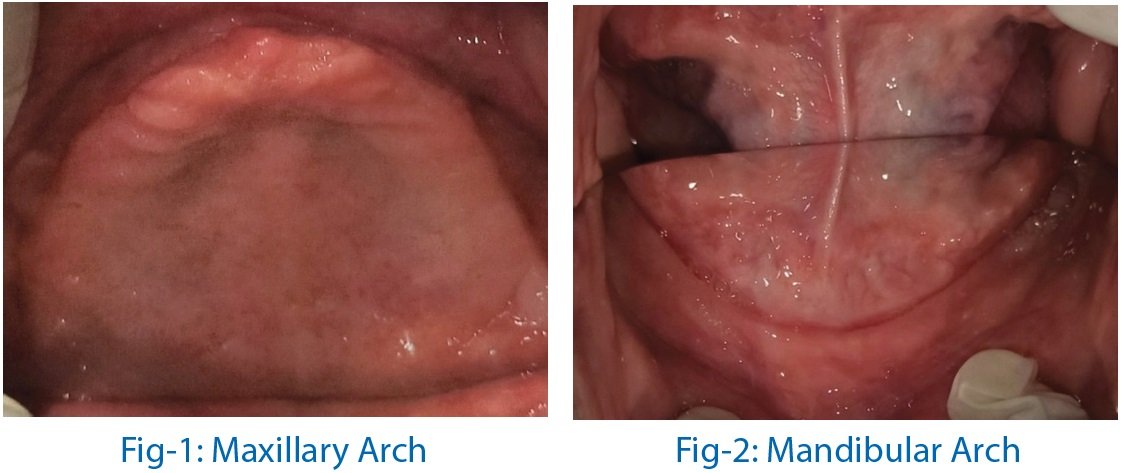
Primary impressions of the upper jaw and lower jaw was made in irreversible hydrocolloid (Alginate) impression material the model was poured in Type-II Gypsum Product (Dental Plaster)
Upper and lower special trays were constructed by autopolymerising acrylic resin material and border moulding was done using low fusing green stick compound. After that secondary impression was made using Zinc-oxide Eugenol paste and poured in Type-III Gypsum Product (Dental Stone).
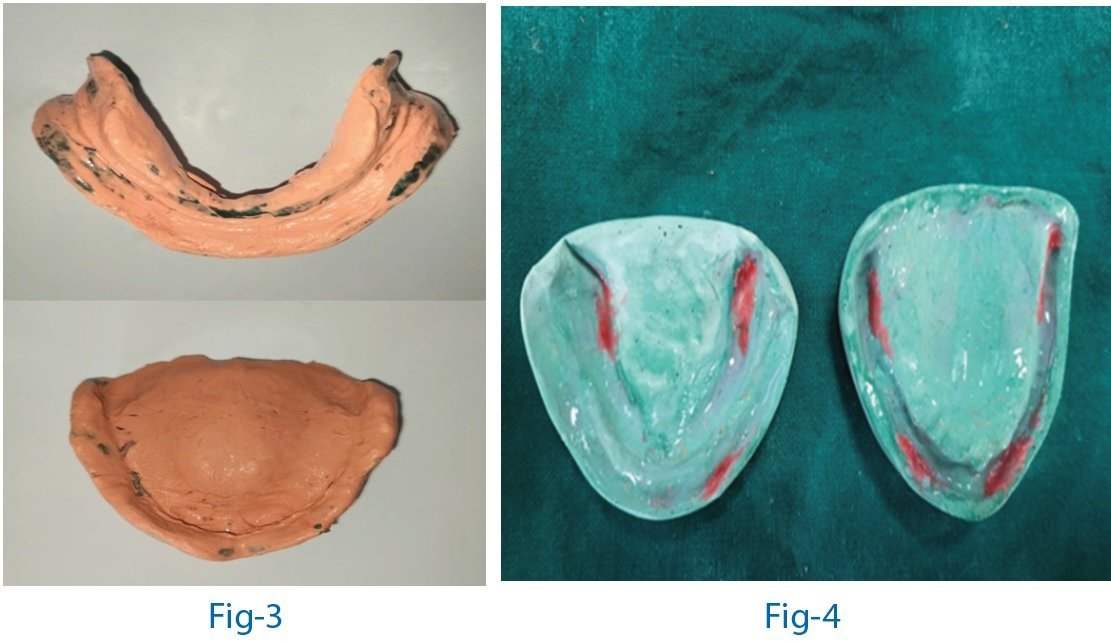
Temporary denture bases were constructed using autopolymerising acrylic resin on master cast.
Another lower denture base was constructed with retentive loops for recording neutral zone. fig 5
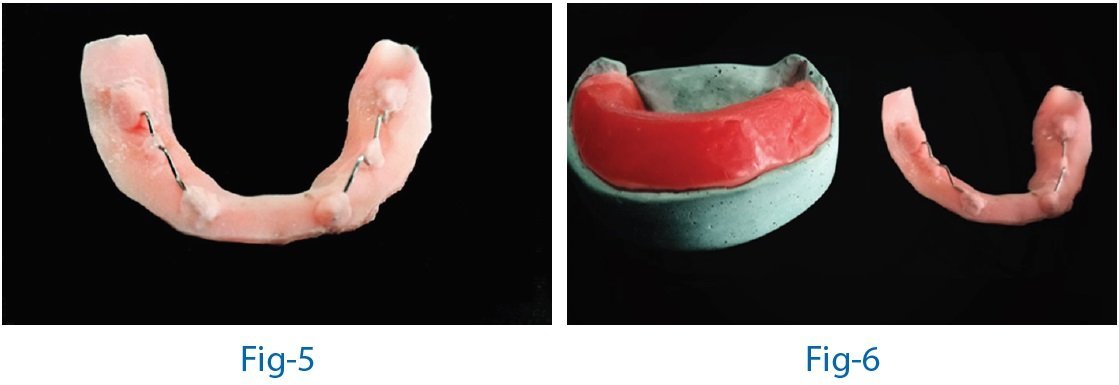
Registration of Tentative Jaw Relations Wax occlusal rims were fabricated and jaw relation was made using tentative method & articulated. Fig 6,7

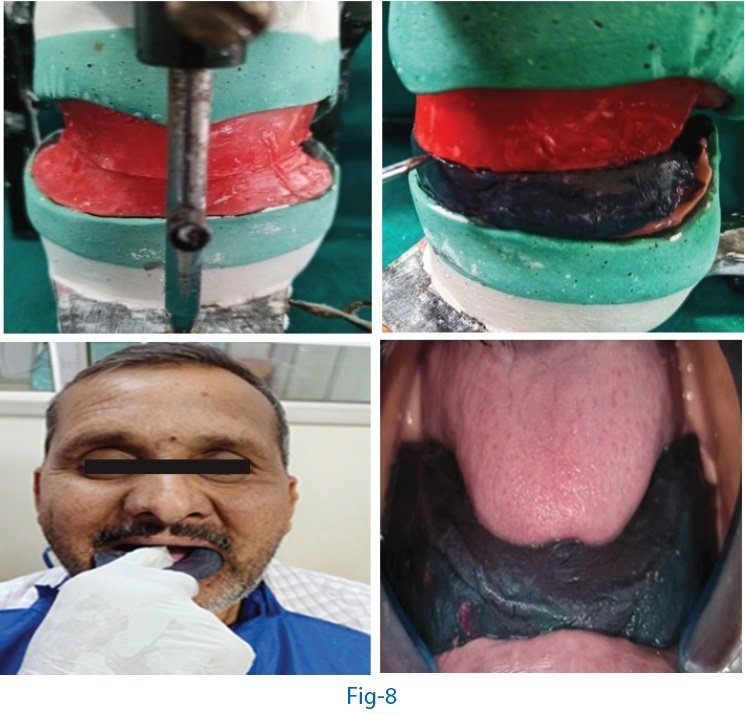
Next, impression compound and greenstick compound (DPI Pinnacle tracing sticks) were combined in a ratio of 7:3 and moulded into a roll. It was then attached to the mandibular acrylic base with retentive loops and adapted according to the arch to form an occlusal rim.
Recording neutral zone
Admixed occlusal rim adjusted according to previously established vertical height in mean value articulator.
After the rim was moulded and cooled for few minutes, the upper rim was tried and vertical height was recorded and registered accordingly. The height of the lower compound rim was maintained to desired level using a sharp knife (BP blade no 15).
The occlusal rim of compound was softened in water bath and firmly seated, the patient was asked to perform a series of actions like swallowing, speaking, sucking, pursing lips, pronouncing vowels and slightly protruding the tongue several times which simulated physiological functioning. Fig 8
The internal (Tongue musculature) and external muscle groups (Buccinator & Orbicularis group of muscles) have been brought into action, moving them through their respective action paths.
The neutral zone impression so obtained was placed on master model, location grooves were cut on the master cast and was covered with Type-II Dental Plaster index around the impression on both the labial and lingual sides.
Plaster index was placed around the neutral zone impression. The Admixed impression was then removed from the base plate . The index has preserved the space of the neutral zone. Wax was then poured into this space giving an exact neutral zone representation. Fig 9

Teeth arrangement was done following the index. During the teeth arrangement their position was checked by putting the index back. Fig 10
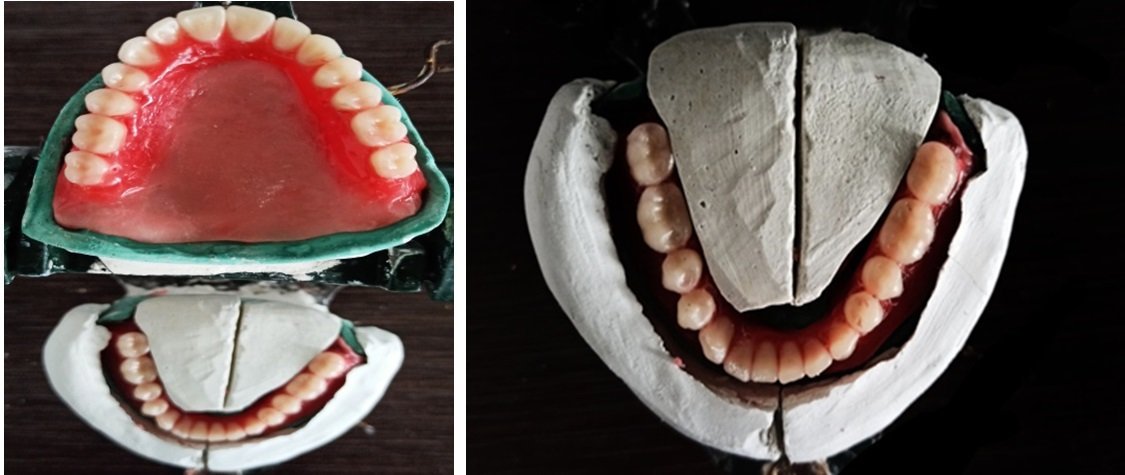
Once the waxed up dentures were ready, they were checked in the patient’s mouth for esthetics, phonetics and occlusion.
Once the try in was deemed satisfactory, the dentures were processed, finished and inserted. Fig 11, fig 12
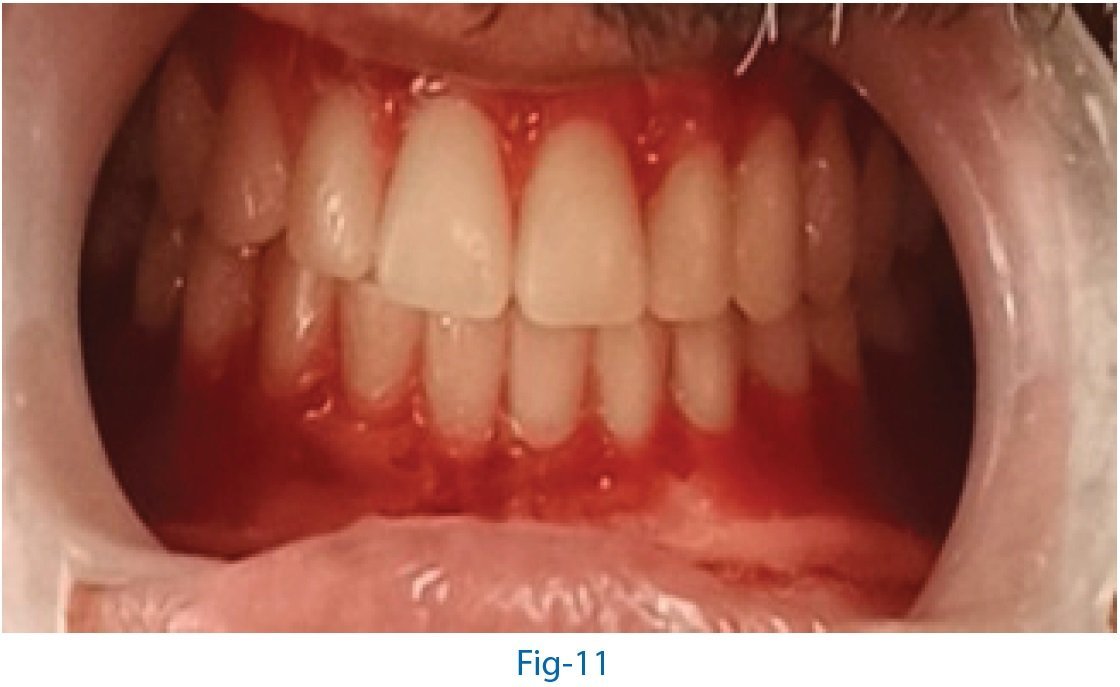

Finished and polished complete denture was inserted in patient’s mouth. (Figure 13) Post denture instructions given to the patient and recall after 24 hours for check up.


DISCUSSION
Among the three surfaces of the denture -the polished surface is bounded by the tongue and the cheeks. These are involved in normal physiologic movements such as speech, mastication, swallowing, smiling, and laughing.
Hence, the fabrication of the denture must be in harmony with these functions because a physiologically unacceptable denture is responsible for poor prosthesis stability and retention, insufficient facial tissue support less tongue space and compromised phonetics. Denture fabricated over a severely resorbed mandibular ridge by neutral zone impression technique will ensure that the muscular forces aid in the retention and stabilization of the denture rather than dislodging the denture during function. The dentures will also have other advantages such as reduced food lodgement, good esthetics due to facial support, proper positioning of the posterior teeth which allows sufficient tongue space.
In contrast to the conventional retentive factors in neutral zone concept it is the muscular force around the denture prosthesis which plays a major role in retention. This takes into consideration a zone of equilibrium that lies between the lingual and facial muscles when in action. This potential space is utilized to be occupied by the prosthesis which will experience equal and opposing force from both sides thereby attaining retention.
To record this neutral zone, many materials and methods have been tried and tested over the years. Initially a pliable and mouldable material is used as an occlusal rim instead of the conventional modelling wax. It has been suggested to use modelling plastic impression compound. Although this advice is widely followed, other materials such as tissue conditioner, wax, zinc oxide eugenol impression material, silicone material, chair side relining material, and acrylic resin are also described for this technique. These materials are either used for the initial recording of the neutral zone or at the evaluation appointment. In this case we used a combination of greenstick and impression compound to get an ideally pliable and workable moulding material. The mixture makes the compound low fusing which can be adequately handled once it has been12 softened in a bath of water at temperature of 60° C.
The techniques most commonly used for recording the13,14 neutral zone were found to be swallowing and 1,15,16 phonetics. However, other techniques such as sipping 15, 14,16,17 water , licking , smiling, pursing the lips, sucking masticating, mouth exercises (including tongue movements, blowing, protruding of the tongue, exercise movements of the lips, cheek, and tongue, facial 1 expression, opening and closing) and whistling have also been reported. Here function of the lips, cheeks, and the tongue, the forces exerted on the soft compound moulds it into the shape of the neutral zone.
Once the neutral zone is recorded, the index is used to replicate it in wax and teeth are arranged in the confounded space.
Arranging artificial teeth within the neutral zone achieves two important objectives:
- Prosthetic teeth do not interfere with normal muscle function; and
- Normal oral and perioral muscle activity imparts force against the complete dentures that serves to stabilize and retain the prostheses rather than cause denture displacement.
Conventional methods used for these patients result in denture contours that may not facilitate prosthesis stability against expected oral and perioral muscle function. This may lead to ill fitted prosthesis which might be improper and uncomfortable for the patient.18
Thus we see that neutral zone concept incorporates the features already present in the form of muscular structures, to compensate for the lost retentive features in case of resorbed ridges.18 This gives satisfactory results when retention is concerned even though the residual ridge condition is compromised.
CONCLUSION
Neutral zone should be recorded in severely resorbed mandibular ridge with altered neuromuscular control18 which involves only one extra clinical step in conventional denture making that is easy to manipulate. This will help in improving denture stability and will provide more comfort to the patient
REFERENCES
- The glossary of prosthodontic terms. J Prosthet Dent 2005;94:10-92.
- Porwal A, Jain P,Birader SP, Nelogi S, Naveen HC. 2. Neutral Zone Approach for Rehabilitation of Severely Atrophic Ridge . International Journal of Dental Clinics.2010;2(3):53-57
- Beresin VE, Schiesser FJ. The neutral zone in complete dentures. J Prosthet Dent 1976;36:356-67.
- Darvell BW, Clark RKF. The physical mechanisms of complete denture retention British Dental Journal 2000; 189: 248–252
- Stanitz J D. An analysis of the part played by the fluid film in denture retention. J Am Dent Assoc 1948; 37: 168-172.
- Moses C H. Physical considerations in impression making. J Prosthet Dent 1953; 3: 449-463.
- Lindstrom R E, Pawelchak J, Heyd A, Tarbet W J. Physical-chemical aspects of denture retention and stability: a review of the literature. J Prosthet Dent 1979; 42: 371-375.
- Barco M T, Dembert M L. Removable Prosthodontics — Cast aluminium denture base. J Prosthet Dent 1987; 58: 179-186.
- Skinner E W, Campbell R L, Chung P. A clinical study of the forces required to dislodge maxillary denture bases of various designs. J Am Dent Assoc 1953; 47: 671-680.
- Brill N, Tryde G, Hvoltz I L. Odontologisk Protetik. Copenhagen: Odontologisk Boghandels Forlag, 1973.
- Beresin VE, Schiesser FJ. The neutral zone in complete dentures. Principles and technique. St. Louis: The C. V. Mosby Co; 1973. p.1.
- Garg S, Mehta M, Goyal S, Garg S. The Neutral Zone Concept: An Alternative Approach For Construction Of Mandibular Complete Denture: A Clinical Case Report, Indian Journal of Dental Sciences. 2012; 4(3)
- Schiesse FJ. The neutral zone and polished surfaces in complete dentures. J Prosthet Dent 1964;14:854-65.
- Miller WP, Monteith B, Heath MR. The effect of variation of the lingual shape of mandibular complete dentures on lingual resistance to lifting forces. Gerodontology 1998;15:113-9.
- Cagna DR, Massad JJ, Schiesser FJ. The neutral zone revisited: from historical concepts to modern application. J Prosthet Dent 2009;101:405-12.
- Wee AG, Cwynar RB, Cheng AC. Utilization of the neutral zone technique for a maxillofacial patient. J Prosthet Dent 2000;9:2-7.
- Fahmy FM. The position of the neutral zone in relation to the alveolar ridge.J Prosthet Dent 1992;67:805-9.
- Philip GB, Thomas V,Rajapur A, Gupta A, Jeetendra. The neutral zone. Dental Impact 2013;5(2)
Disclaimer from Guident
The views and opinions expressed in articles published in Guident are solely those of the authors and do not necessarily reflect the views of the editors, the editorial board or the publisher, Ivory India. Guident does not endorse any product, technique or treatment described. Clinical content is intended for qualified dental and medical professionals and is not a substitute for individual clinical judgement. Guident, its editors and the publisher accept no liability for any consequence arising from the use of information published in the journal.
How to cite this article
Dr. C. Pradeep, Dr. Sumver Jain, Dr. Manesh Lahori. Fabrication of Complete Denture Using Neutral Zone Technique in a Patient with Severely Resorbed Alveolar Ridge-a Case Report. Guident. 2021 Feb;14(3). Available from: https://guident.net/articles/prosthodontics/fabrication-of-complete-denture-using-neutral-zone-technique-in-a-patient-with-severely-resorbed-alveolar.html


