Fabrication of Photo Identification Denture
Ashok Nagar, A.C.Road, Kandivali (East), Mumbai INDIA
Abstract
Positive identification through labeled dentures plays a key role in forensic scenario. Marking dentures has been considered as an important part of forensic dentistry, although no standardized method is followed. A number of labeling systems are available and can be broadly separated into either surface marking methods or inclusion systems. Each of the commonly described techniques is assessed with respect to their strengths and weaknesses. The more contemporary methods, though hi-tech, are expensive and may not be suitable for all dental practitioners to use.
Key words:- denture, rugae prominence, inclusion methods, labeling, surface methods.
INTRODUCTION1,2,3
Over the years various denture marking systems have been reported in the literature and have been broadly divided into surface marking and inclusion methods. The surface marking methods include engraving the casts, scribing the denture or writing on the denture surface while the inclusion methods involve incorporation of metallic or non metallic labels or microchips into denture.
Denture marking is accepted as a means of identifying dentures and persons in geriatric institutions, or post-mortem during war, crimes, civil unrest, natural and mass disasters.
Labeled dentures can be important in identifying the owners in case of an accident, loss of memory, states of unconsciousness, being inadvertently misplaced on admission to a hospital or, in identifying the bodies of those who have died in a calamity.
According to the standards for identification, the requirements for denture markers outlined by
- The Council on Prosthetic Services and Dental laboratory Relations and listed below -
- The strength of the prosthesis must not be jeopardised.
- It must be easy and inexpensive to apply.
- The identification system must be efficient.
- The marking must be visible and durable.
- The identification must withstand humidity and fire.
- The identification mark should be cosmetically acceptable.
- The identification mark should be biologically inert (when incorporated into the denture).
CLINICAL CASE
1)Take the patient’s photograph for denture insertion.
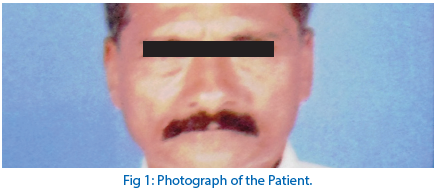
2) An overhead transparency sheet is placed over it. The sheet is cut into adequate size.Cyanoacrylate adhesive (Fevi Kwik, India) is placed over the printed photograph. Care is taken not to rub the adhesive over the printed portion & a same size blank transparency sheet is placed over it. By doing this the printer toner is placed away from the monomer of denture base resin. Thus the detoriation of legibility is reduced. The two joined sheets are cut with sharp scissors for restricting the size of label. Now the photo for identification denture is ready for prefabrication or the postfabrication denture identification technique.
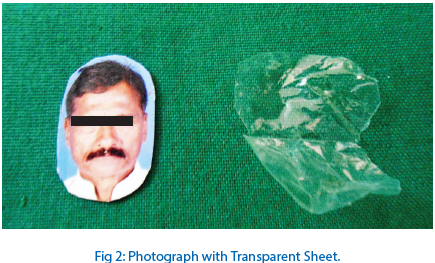
3) In a prefabrication technique, the photo is placed over the denture base resin after trial closure. The denture is processed in a normal way.
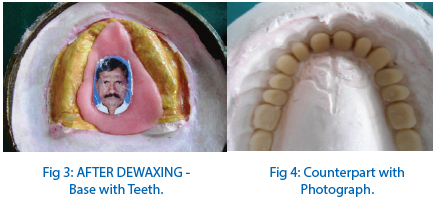
4) In postfabrication technique, a slot of 1 mm deep is prepared on the finished surface of denture base, which is in approximate size of the photo. One drop of cyanoacrylate is placed in slot to properly position the photo. Over the photo, clear autopolymerising acrylic resin is mixed & placed in small increments. After the initial set, the denture is placed in warm water for about 10 minutes. The denture is removed & polished.
5) The denture is then inserted in the patient’s mouth.
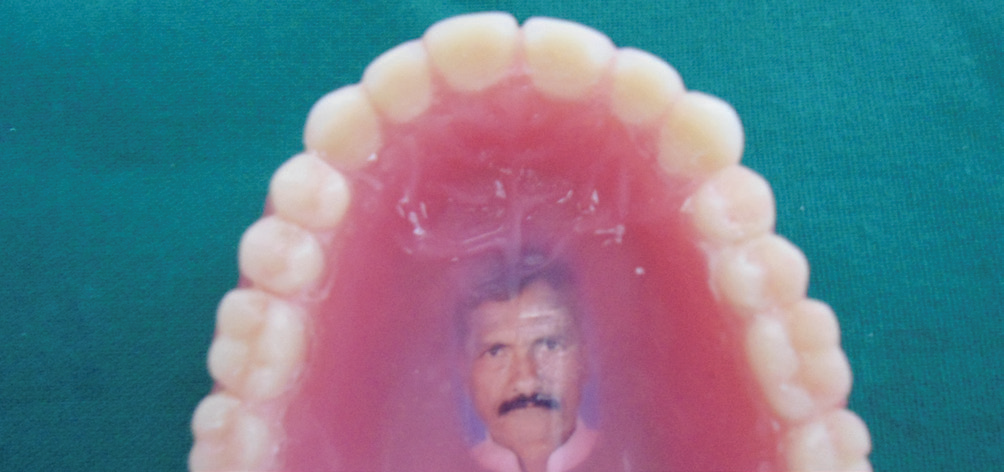
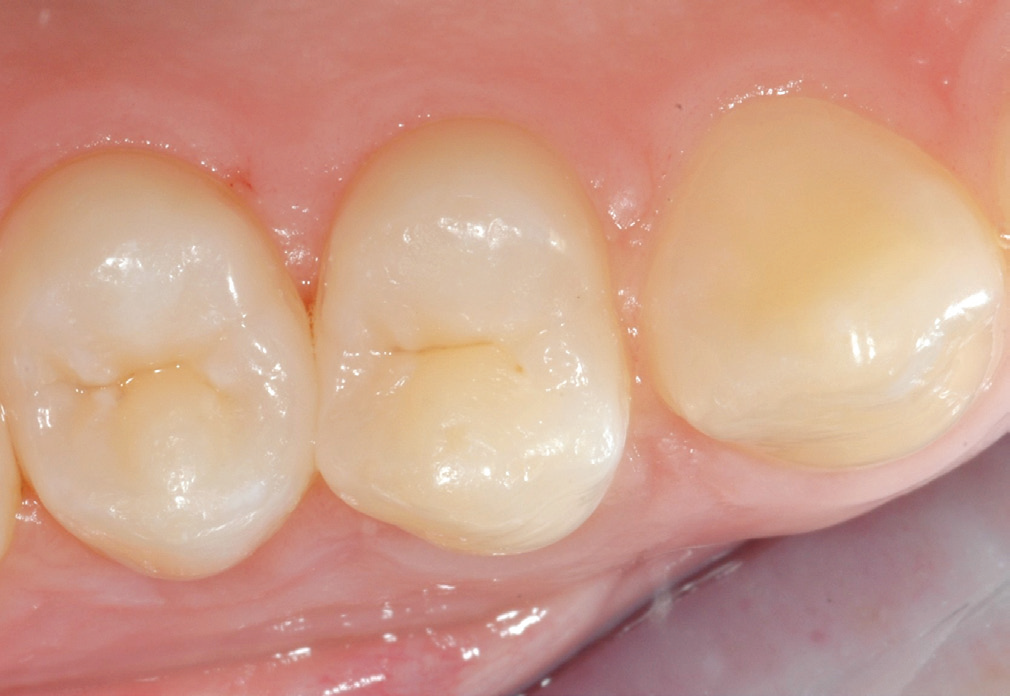
Fig 5: Finished Denture.
DISCUSSION4
International telephone code used for citizenship identification in a denture. An embossed metal plate integrated with the skeleton is embedded in the denture base resin material, the current denture marking technique serves as a simple procedure for insertion of an undegradable denture identification mark which makes it possible to identify the nationality of the denture wearer. A new method of marking dentures using microchips, the procedures involved in inscribing a microchip using the photochemical etching process used in the electronics industry. The resulting microchip was cosmetically appealing, cost effective and was able to satisfy all the forensic requirements for a suitable denture marker. Identification systems for dental prostheses using fluorescence techniques, from a dental-prosthetic point of view, this can be prevented by using denture marking in order to give this registration a more personal character, an application from the fluorescence technique was chosen, enabling to mark the denture base with an adequate and inconspicuous code when fabricating the prothesis. This preventive registration may be read in the visible spectrum with the proper equipment at a specific frequency. In view to an increase in the percentage of old people and inherently an increased use of prosthetic appliances with this population, registration by means of the fluorescence technique will be most useful to the forensic odontologist in his identification research. Clear acrylic resin T-bar used in denture identification,a preformed, T-shaped, clear acrylic resin bar can be utilized as a vehicle for identification of an existing removable dental prosthesis. A printed label attached to the T-bar makes a convenient vehicle for embedding the label in the prosthesis with light-cured acrylic resin. The resultant finished surface of the T-bar assembly provides a protective cover and an exceptionally clear window for viewing the label. The procedure is time-effective and relatively easy.
SUMMARY
By his method denture labeling could be done in existing prosthetic devices which were not labelled previously. The procedure could be easily performed by dental auxiliary personnel thereby reducing workload for the dentist.
RECOMMENDATIONS
Considering the social and practical value of denture marking, there is an urgent need for marking dentures by members of the dental team involved in the provision of dentures to the public. The following recommendations to achieve this are offered:
- Education at undergraduate level is urgently needed regarding the social and forensic value of marking dentures.
- The practice of denture marking in all teaching institutions should be initiated immediately.
- Further research should be carried out into improving and simplifying methods of labeling dentures.
- Dental associations should find more effective ways of promoting the practice of denture labeling within the dental profession and the community.
REFERENCES
- Borrman HI, DiZinno JA, Wasén J, René N. On denture marking. J Forensic Odontostomatol. 1999;17:20–6.
- Stavrianos CH, Petalotis N, Metska M, Stavrianou I, Papadopoulos CH. The value of identification marking on dentures. Balk J Stom. 2007;11:212–6.
- Stavrianos C, Stavrianou I, Kafas P. Denture identification system based on Swedish guidelines: A forensic aspect. Internet J Forensic Sci. 2008;3
- Thomas CJ. The role of the denture in identification: A review. J Forensic Odontostomatol. 1984;2:13–6.
- Richmond R, Pretty IA. Contemporary methods of labeling dental prostheses—A review of the literature. J Forensic Sci. 2006;51:1120–6.
Disclaimer from Guident
The views and opinions expressed in articles published in Guident are solely those of the authors and do not necessarily reflect the views of the editors, the editorial board or the publisher, Ivory India. Guident does not endorse any product, technique or treatment described. Clinical content is intended for qualified dental and medical professionals and is not a substitute for individual clinical judgement. Guident, its editors and the publisher accept no liability for any consequence arising from the use of information published in the journal.
How to cite this article
Dr.Sejal Shah. Fabrication of Photo Identification Denture. Guident. 2014 Dec;8(1). Available from: https://guident.net/articles/prosthodontics/fabrication-of-photo-identification-denture.html