Rehabilitation of Severely Mutilated Anterior Teeth Using Custom - Made Post and Core
Department of Prosthodontics, H.P. Government Dental College & Hospital, Shimla Himachal Pradesh, India
ABSTRACT
Grossly mutilated anterior teeth cause psychological and esthetic problems for patients. Successful rehabilitation of such severely decayed teeth need prosthetic reconstruction following endodontic therapy. Keeping most of the remaining tooth structure intact, aid in longevity of endodontically treated tooth, which is possible with custom made post and core. In this article, we presents a case report showing esthetic rehabilitation of badly mutilated maxillary incisors using custom-made post and core.
Keywords: Grossly mutilated teeth, post and core, rehabilitation
INTRODUCTION
Rehabilitation of extensively decayed anterior teeth is a challenge in dentistry, especially when coronal structure is inadequate to provide resistance and retention form. Moreover, endodontically treated teeth are more prone to fracture than the vital teeth.1
Successful treatment of such badly mutilated teeth depends on prosthetic reconstruction after good quality endodontic treatment. Whenever, insufficient crown structure has been remained to retain full coverage crown, a post and core is necessary to increase retention and resistance form of a tooth.2
In literature, different types of post and core systems have been documented over the years, with excellent long term prognosis.3 Two main categories of posts are: prefabricated and custom-made. Prefabricated system require adhesive techniques as they do not reproduce root morphology however, custom made post and core has an advantage as they closely reproduce morphology of root space. In a 6 year retrospective study, use of cast post and core has demonstrated success rate of 90.6% in restoring endodontically treated teeth with moderate to severe coronal loss.4 Also in clinical situations where it is essential to alter angle of core in relation to the tooth; cast post and core is a good choice.5
This article will address a clinical situation in which maxillary incisors are grossly mutilated and also tooth position is to be altered for optimal placement of fixed prosthodontic work.
CASE REPORT
A 24 year old female patient reported to the Department of Prosthodontics of H.P Government Dental College and Hospital, Shimla with the chief complaint of poor appearance of her anterior teeth. Past medical history revealed no underlying systemic disorder.
Intraoral examination revealed severely mutilated upper incisors which were badly restored. Intra-oral periapical radiographs revealed root canal treated 12, 11, 21, 22 with good apical seal.

Fig.1: Pre-operative intraoral view

Fig. 2: Direct pattern fabrication with self cure acrylic resin
After removing faulty restorations (fig. 1), a diagnostic impression was made and casts were obtained. As there was loss of excessive coronal tooth structure and alteration in angulation of incisors was also required; a treatment plan with customized post and core followed by porcelain fused to metal crown was planned.
Initially, unsupported tooth structure was removed. Teeth were prepared with buccal shoulder and lingual chamfer margins, including a ferrule preparation. Post space preparation was done with peso reamers, leaving apical 4 mm gutta percha in all 4 incisors to prevent subsequent leakage.

Fig. 3: Custom made post and cores

Fig. 4: Cemented post and cores
Direct patterns of post spaces were made using self cure acrylic resin ( fig.2). Canal was lubricated before packing the resin. When resin was doughy, pattern was moved in and out of canal, so that it did not get locked into any undercuts. Additional acrylic resin was filled in missing part of clinical crown. After complete setting, resin pattern was removed and shaped with low or high speed instruments. Patterns were invested immediately, after which casting was carried out (fig. 3). Custom made post and core units were cemented with glass ionomer luting cement in all four maxillary incisors (fig. 4).
Two stage addition silicon impression was taken (fig. 5) followed by fabrication of porcelain-fused-to-metal crowns and cementation of the same (fig. 6). As patient was concerned with esthetics, treatment outcome fulfilled her expectations.
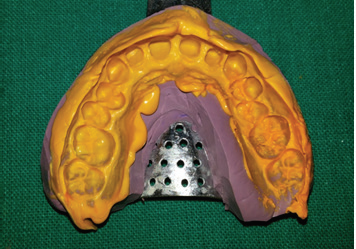
Fig. 5: Two stage impression

Fig. 6: Post-operative view
DISCUSSION
The rationale for selection of treatment for grossly decayed tooth is to restore function, form and esthetics, while maintaining integrity of tooth with adjacent structures. In the presented case, cast metal post system was used because of its custom fitting to root configuration, strength and support.6 Cast post and cores can be fabricated either by direct or indirect technique. But in this case, direct technique of pattern fabrication is used as it is more advantageous due to fewer laboratory procedures, which reduce possibility of distortion and in turn better fitting castings.
REFERENCES
- Tang W, Wu Y, Smales RJ. Identifying and reducing risks for potential fractures in endodontically treated teeth. J Endod 2010; 36: 609-17
- Assif D, Bitenski A, Pilo R, Oren E. Effect of post design on resistance to fracture of endodontically treated teeth with complete crowns. J Prosthet Dent 1993; 69: 36-40
- Morgano SM, Hashem AF, Fotoohi K, Rose L. A nation wide survey of contemporary philosophies and techniques of restoring endodontically treated teeth. J Prosthet Dent 1994; 72(3): 259-67.
- Bergman B, Lundquist P, Sjogren U, Sundquist G. Restorative and endodontic results after treatment with cast post and cores. J Prosthet Dent 1989; 61:10-15
- Bada NZ (2013) Contemporary restoration of endodontically treated teeth. Quintessence publishing. Hanover park III
- Cohen S, Hirshfield KM (2006). Pathways of pulp 9th ed. Missouri: Mosby
Disclaimer from Guident
The views and opinions expressed in articles published in Guident are solely those of the authors and do not necessarily reflect the views of the editors, the editorial board or the publisher, Ivory India. Guident does not endorse any product, technique or treatment described. Clinical content is intended for qualified dental and medical professionals and is not a substitute for individual clinical judgement. Guident, its editors and the publisher accept no liability for any consequence arising from the use of information published in the journal.
How to cite this article
Dr. Reena Sirohi, Dr. Renu Gupta. Rehabilitation of Severely Mutilated Anterior Teeth Using Custom - Made Post and Core. Guident. 2019 Aug;12(9). Available from: https://guident.net/articles/prosthodontics/rehabilitation-of-severely-mutilated-anterior-teeth-using-custom-made-post-and-core.html