A Snapshot of the Perceptions of Healthcare Professionals Towards Thalaikoothal a Cross Sectional Study
Department of Public Health Dentistry, A. J. Institute of Dental Sciences, Kuntikana, Mangalore 575004
INTRODUCTION
“Respect your elders”, this has been one of the most basic values that we are thought as we grow up. Our elders are people who have helped us mould into who we are and we owe them a huge amount of respect irrespective of which race, colour, ethnicity, culture or country an individual belongs to.
Senicide or Geronticide refers to the abandonment to death, suicide, or killing of the elderly. It is perceived in different ways by different cultures. It has been practiced behind closed doors in one part of the world and as an outright festivity in another.
SENICIDE THROUGH THE AGES
Senicide has been practiced in different ways by people throughout history:A Germanic tribe called the Heruli during the Migration Period (about 400 to 800 CE) placed the sick and elderly on a tall stack of wood and stabbed them to death before setting the pyre alight.
The Inuit, a group of culturally similar indigenous peoples inhabiting the Arctic regions of Greenland, Canada, and Alaska would leave their elderly on the ice to die, this was practised during famines.
Ubasute was a custom allegedly performed in Japan in the distant past, whereby an infirm or elderly relative was carried to a mountain, or some other remote, desolate place, and left there to die.1
Lapot is a mythical practice of Senicide in Serbia which involves killing one’s parents, or other elderly family members, once they become a financial burden on the family, the killing was carried out with an axe or stick, and the entire village was invited to attend.2
In Sweden, according to Nordic folklore, the ättestupa is a cliff where elderly people were said to leap, or be thrown, to death.3
In India, Senicide is practised in the different states like Rajasthan, Uttar Pradesh and in the south Indian state of Tamil Nadu as an illegal practice named Thalaikoothal.
Thalaikoothal, which is loosely translated as a “leisurely oil bath” is a form of illegal and sometimes forced euthanasia. It is said to have started before the British Empire when a prince helped his ailing mother-in-law die peacefully. Others suspect it began as recently as the 1950s, a response to a rising population and poor local economy.
It is traditionally performed on those 50 years and older who are incapacitated, but younger individuals who become very ill are also targeted. It is mostly considered as a phase of life by the ones who follow it. Thalaikoothal is performed in 26 different ways and the method to be used for an individual is determined by the livelihood and demographic factors involved, for example an agriculturist would be killed using a pesticide; demographically Thalaikoothal is prominently practiced inmore than 50 villages of the districts of Virudhunagar, Mandabasalai, Madurai, Thoothukudi, Sivakasi, Kariapatti, Ennam Reddiapatti, Vellore and Theni in the Tamil Nadu State.4
Thalaikoothal is carried out in a number of different ways, The elderly individual is given an oil bath and then made to drink litres of coconut water which results in renal failure and painful death within 2 days.Head massage is done using cold water which results in a sudden drop in body temperature, cardiac arrest and death.
Individual is force fed a mixture of mud and water or a savoury called Muruku, both of which are hard to swallow leading to suffocation and death.The entire body is massaged with coconut, castor and sesame oils usually at dawn, given a cold bath and put to bed which also results in a sudden drop of body temperature. After 15 minutes, they are made to drink a few glasses of tender coconut and a glass of milk resulting in major renal failure and in a day or two, leading to uncontrollable fever and death.
Recently with scientific advancements, newer methods have been employed to make the ritual less conspicuous, these involve the employment of local quacks called “Vettiar” who claim to be Siddhans (indigenous medical practitioners) that specialise in the administration of Thalaikoothal when the family members don’t have it in them to go through with the act. Some of the newer ways to perform Thalaikoothal include:
- Overdose on sleeping pills.
- Lethal injection of a particular poison
- Pesticides like Thimet or Kurunamarunthu as called by the village folk is mixed with tea/water and given.
- High doses of valium tablets
- Combination of poisons and fatal dose of drugs
- Highly toxic tablet used to kill pigs called Quickphos or Cephos which cost INR 10 is mixed with tea and given, administering either ofthese results in profound shock, myocarditis and multi organ failure.4,5
In recent times, one of the main motives behind most of the acts of Thalaikoothal is the passing of property, reluctance of parents to sell ancestral property or to move to a different village or to the city, or merely the inconvenience of taking care of them.
Elderly men are most commonly targeted because of the notion that old women can still help with the household chores and take care of children, but old men can’t do any of those activities and don’t bring any money to the house as well.
This led us to explore the perceptions of Health professionals towards Thalaikoothal, a senicide practice which is followed in South Indian state of Tamil Nadu.
METHODOLOGY
A cross sectional study was conducted among Medical and Dental health professionals working in a tertiary health care hospitalof Mangalore, Karnataka, India.
A pilot study was conducted and sample size was estimated to be 150. A closed ended questionnaire consisting of 11 questions was developed and was checked for face validity.Ethical clearance was obtained from the Institutional Ethics Committee. Convenience sampling was followed. Informed consent was obtained from the participants. Data was collected for a period of 2 months by conducting one to one interview with the study participants.A total of 170 Medical and Dental health professionals participated in the study.
RESULTS
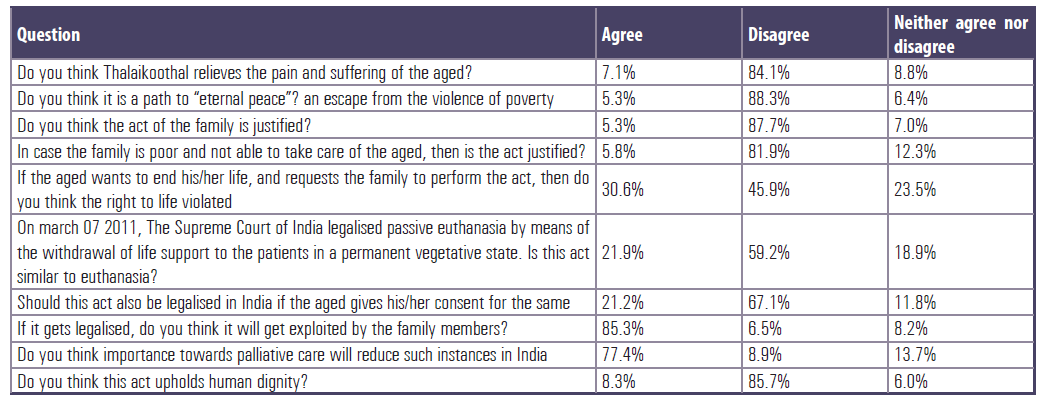
The following 10 questions were used to evaluate the attitude of the study participants towards the act of Thalaikoothal:
One question was included which was used to evaluate the knowledge of the study participants with regard to the different principles of ethics.
Pic A: Pre-Operative OPG
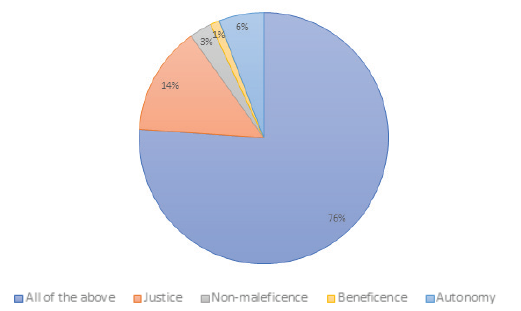
Which Principle of Ethics according to you is violated by this act?
Among the study participants, 84.1% disagree with the notion that Thalaikoothal is a way to reduce pain and suffering of the aged. A majority of 88.3% disagree that Thalaikoothal is a path to “Eternal Peace”. 87.7% of the study participants disagree that the family is justified to consider this practice. Of the study participants, 81.9% disagree with the notion that the act is justified if the family is poor and unable to take care of the elderly. 45.9% of them disagree that when an elderly person requests to perform the act on them, the right to life is violated. Of the study participants 59.2% disagree that the act is similar to passive euthanasia of patients in a permanent vegetative state which was legalized in India on March 7th 2011. 67.1% of the participants disagree with question of the act being legalized if the elderly consent to it. 85.3% of them agree that the act of Thalaikoothal can possibly be exploited by family members. 77.4% agree that increase in importance towards palliative care will reduce the occurrence of such acts. 85.7% of all study participants disagree with the question of this act upholding human dignity. Among the study participants, 76% agree that this practice violates multiple ethical principles like Autonomy, Beneficence, Non-Maleficence and justice.
DISCUSSION
Thalaikoothal is a ritualistic practice practised in the state of Tamil Naduwhich can be considered as a form of Senicide. The act is carried out in different ways which varies from person to person depending on the occupation or the place where the patient resides. There have been documented cases of elderly people becoming aware of what their family members have in store for them and attempting to escape this cruel fate by running away from their own houses to seek safe refuge elsewhere.
In India, the notion of respecting your elders and placing them above everyone else is a belief engrained into us from childhood because of our culture and the surroundings we have been brought up in. Our parents have helped us grow from our most vulnerable to make us able men and women and it is our duty to make their transition to old age as comfortable as possible, which seems like the right and just way to look at it.
But to consider it to be easy for every family to take care of their elderly members would be very naive, there are families in our country that struggle to get a proper meal a day, the state of poverty in the country should not be underestimated. The different reasons that have been given for this practice include the struggles of poverty the families of the elderly face, the family members not wanting the elderly to suffer during old age and when there is no improvement in the physical or mental health of the elderly.5,6
A study by Priyamvadha M, shows that the decision to perform Thalaikoothal is taken by the sons in 33% of the cases followed by other members of the family and that the main reason for taking the decision is because the respondents did not want their parents to suffer during old age.7 The legal implications of Thalaikoothal have been considered along the same lines as suicide wherein the Right to life does not include Right to die or Right to be killed hence making the suicide a punishable offense under section 309 of the Indian penal code, 1860 and is not unconstitutional to the Indian Constitution Article 21.1
When an elderly person in a family dies, there should be an extensive police investigation to discover the cause of death before providing a death certificate in cases where the death can be used to procure monetary or property gains. Thalaikoothal is a practice that can be abolished with proper education and providing the elderly with a means to empower themselves and not be a burden on their families, pensions can be provided to the elderly members of families in the lower socioeconomic status, to stop the family members from contemplating such a heinous act. The elderly population are already made to suffer through a lot of hardship by society already without being needed to be threatened by this kind of custom.8,9
A limitation of this study would be the lack of awareness and knowledge among the Health professionals regarding this act of senicide called Thalaikoothal which made a face to face interview a necessity for the study and also the lack of available literature on the act. A recommendation to reduce this practice would involve increased awareness and education of the masses with regard to the various government schemes and programmes for the elderly and the empowerment of the elderly masses by provision of pensions.
CONCLUSION
According to the results of the study, the perception of the study participants towards the act of Thalaikoothal was found to be negative. Majority of the study participants agree with the notion that such an act is unethical. This act has also been deemed unlawful by the Indian constitution. Strict regulations should be put in place to safeguard the elderly population of the country.
REFERENCES
- Chatterjee Pyali. The Customary Practice of Senicide. With Special Reference to India | Publish your master’s thesis, bachelor’s thesis, essay or term paper [Internet]. 2017 [cited 2019 May 23]. Available from: https://www.grin.com/document/372138
- Nobel Justin. Death Panels refuted, but not in Serbia, Japan or the Arctic [Internet]. 2009 [cited 2019 May 24]. Available from: https://www.funeralwise.com/digital-dying/death-panels-refuted-but-not-in-serbia-japan-or-the-arctic/
- Ättestupa - tove edlund dreiman [Internet]. [cited 2019 Jul 13]. Available from: https://tovedreiman.se/Attestupa
- Pastor Paul. Thalaikoothal: The crude ritual killing of the elderly in India — Bibles for Mideast [Internet]. 2016 [cited 2019 May 23]. Available from: https://www.bibles4mideast.com/home-1/2016/07/02/thalaikkoothal-a-crude-ritual-practice-of-killing-elderly-in-india
- Priyanka Saggu. Thalaikoothal-A dreadful act of killing elderly in India [Internet]. 2018 [cited 2019 May 23]. Available from: https://www.procaffenation.com/thalaikoothal-a-dreadful-act-of-killing-elderly/
- Seedhom AE, Kamal NN. The Palliative Performance Scale Predicts Survival among. 2017;368–72.
- Mohansingh Priyamvadha. The Withering Trees, Bearing No Fruits: A Study on Geronticide, the Killing of Eldelry in India in a Criminological Perspective [Internet]. [cited 2019 May 23]. Available from: http://j13.cgpublisher.com/proposals/241/index_html
- Esipila L. Geronticide: The Various Ways Society Kills the Elderly [Internet]. [cited 2019 May 23]. Available from: https://www.academia.edu/7401465/Geronticide_The_Various_Ways_Society_Kills_the_Elderly
- Chokkanathan S, Lee AEY. Elder mistreatment in urban India: a community based study. J Elder Abuse Negl. 2005;17(2):45–61.
Disclaimer from Guident
The views and opinions expressed in articles published in Guident are solely those of the authors and do not necessarily reflect the views of the editors, the editorial board or the publisher, Ivory India. Guident does not endorse any product, technique or treatment described. Clinical content is intended for qualified dental and medical professionals and is not a substitute for individual clinical judgement. Guident, its editors and the publisher accept no liability for any consequence arising from the use of information published in the journal.
How to cite this article
Dr. Shreshtha Shetty, Dr. Vijaya Hegde, Dr. Rasheed Minhaz. A Snapshot of the Perceptions of Healthcare Professionals Towards Thalaikoothal a Cross Sectional Study. Guident. 2020 Jan;13(2). Available from: https://guident.net/articles/research/a-snapshot-of-the-perceptions-of-healthcare-professionals-towards-thalaikoothal-a-cross-sectional-study.html