Treatment of Gummy Smile Using Botox a Non Invasive Technique
India, Santosh Dental College & Hospital, Ghaziabad, India
ABSTRACT
The smile itself and the aesthetics of the smile are influenced by 3 components: teeth, gums, and lips. An attractive smile depends on the proper proportion and arrangement of these 3 elements. The exposure of more than 3 mm of the gum during the smile is known as gingival or gummy smile. For some patients, gummy smile represents an aesthetic disorder. Botulinum toxins are a boon to our dental field. This therapy is not only conservative, but also a minimally invasive treatment approach that can expand our therapeutic and treatment options for the benefit of our patients. Injection with Botox-A at preselected sites is a novel, cosmetically effective, minimally invasive alternative for temporary improvement of gummy smiles caused by hyperfunctional upper labial muscle activity.
Key words:
Botulinum toxin, Botox, Gummy smile, Non invasive
Smile plays a pivotal role in conveying the emotion of a person. According to Hulsey, A smile is one of the most effective means by which people convey their emotions. smile aesthetics is considered to be an important part of any orthodontic treatment objective. The best orthodontically treated subjects may not be satisfied by the treatment, if soft tissue problem is not corrected. Patients desire to look good not only in a static pose but also during dynamic facial expression. Gummy smile is a term used to describe excessive display of gingival tissue in the maxilla upon smiling. The gingival smile is known by a variety of terms including ―gummy smile, high lip line, short upper lip, and full denture smile.This can cause undue psychological hindrance as the individual with excessive gingival display will be self-conscious and at unease regarding the same and thus seek treatment.1,2 Gummy smiles range from mild, moderate, and advanced, to severe. Rosemarie Mazzuco et al., classified gummy smile into anterior, posterior, mixed, or asymmetric, based on the excessive contraction of muscles involved. Goldstein classified the smile line (consisting of the lower edge of the upper lip during the smile) according to the degree of exposure of the teeth and gums into 3 types: high, medium, or low.
Since the discovery of botulinum toxin, it has been rapidly incorporated into the effective treatments for the improvement of unaesthetic facial conditions in the last few years. It is widely used in the prevention and correction of changes caused by muscle contraction in the middle and lower thirds of the face and neck, including gummy smile. Botulinum is derived from the Latin word botulus, meaning sausage, and botulism was originally called ―sausage poisoning‖ because it occurred after ingestion of poorly prepared blood sausage. Justinus Kerner (1786-1862) was the first to describe the features of botulism.
Clostridium botulinum is an anaerobic bacterium responsible for its production. Among the 8 different serotypes of Botulinum toxin that exists, Type A (BTX-A) is the most potent and the most commonly used clinically. Fermentation of Clostridium botulinum leads to a formation of purified BTX-A which is a stable, sterile, vacuum-dried powder that is diluted with saline solution without preservatives.3 This favours the weakening of skeletal muscles by cleaving the synaptosomal-associated protein SNAP-25, thus inhibiting the release of acetylcholine from the motor-neuron and enabling the repolarization of the postsynaptic term.4
The shape of the mouth and the posture of the lips are controlled by various muscles. All the muscles functionally involved in raising the upper lip have a role in tooth and gum display during smiling, these include levator labii superioris, zygomaticus minor, levator anguli oris , orbicularis oris, and risorius
Effect of Botox is seen within 5-10 days and lasts about 6 months, with a range of 4 to 8 months, at which time the patient can return to repeat the process.
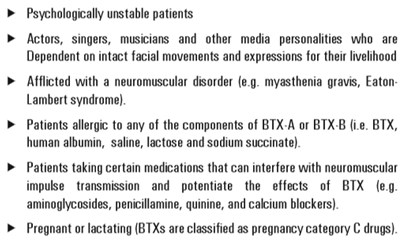
Patients should not be treated or treated with extreme caution who are:
Adverse effects of limited duration that are common, localized and not of a serious nature: Common with any percutaneous injection Technique dependent

DISCUSSION
The cause for gummy smiles can be of skeletal, dentoalveolar or soft tissue in origin. For the patient whose gummy smile was mainly caused due to hyperactive lip muscles, treatment with Botox was considered as an alternative treatment approach. Muscles of facial expression responsible for upper lip elevation and lateral retraction upon smiling are LLSAN, LLS, Zm, zygomaticus major (ZM), risorius, and, to a lesser degree, the depressor septi nasi muscle. All of these muscles interact with the orbicularis oris muscle in the production of a smile.
Botulinum toxin type-A aids to inhibit the release of acetylcholine by blocking the neuromuscular transmission and binding to acceptor sites on motor or sympathetic nerve terminals. This inhibition occurs as the neurotoxin cleaves SNAP- 25, a protein integral to the successful docking and release of acetylcholine from vesicles in nerve endings. 10 When injected intramuscularly at therapeutic doses, it produces partial chemical denervation of the muscle, resulting in localized reduction in muscle activity. The use of Botulinum toxin type-A has been extensively described in literature, especially for various cosmetic procedures.
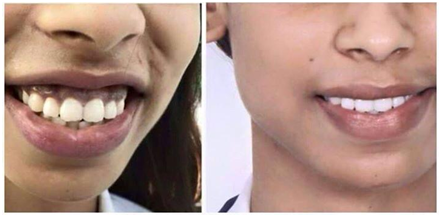
Fig 1

Fig 2
CONCLUSION
Use of Botox in dentistry is relatively a new discovery, so probably its acceptance will take some time among Indian dental professionals.The Botulinum toxin type-A injection used for the correction of excessive gingival display caused by hyperactive upper lip elevator muscles is seen to be highly effective. The results are extremely satisfactory for both the patient and the Dentist. Therefore, depending on the cause and the needs of the patient, this treatment approach could well be used as an alternative procedure for faster and minimally invasive treatment of gummy smile.
REFERENCES
- C Flanary. The psychology of appearance and the psychological impact of surgical alteration of the face. Philadelphia:WB Saunders. 1992:2–21.
- Hulsey CM. An esthetic evaluation of lip-teeth relationships present in the smile. Am J Orthod. Dentofacial Orthop.1970; 57
- R Ananthanarayanan, CK Panicker. Textbook of microbiology, 7th ed. Hyderabad, India:Orient Longman. 2005
- GW Jaspers, J Pijpe, J Jansma. The use of botulinum toxin type A in cosmetic facial procedures. Int J Oral Maxillofac Surg. 2011;40:127–133. [PubMed]
- WR Proffit, HW Fields, DM Sarver. Contemporary orthodontics. St Louis:Mosby Year Book. 2007
- JW Robbins. Differential diagnosis and treatment of excess gingival display. Pract Periodont Aesthet Dent. 1999;11:265–272. [PubMed]
- LR Rubin. The anatomy of a smile: its importance in the treatment of facial paralysis. Plast Reconstr Surg. 1974;53:384–387. [PubMed]
- MF Brin, M Hallett, J Jankovic. Scientific and therapeutic aspects of botulinum toxin. Philadelphia:Lippincott Williams and Wilkins. 2002:v–vi.
- AV Benedetto. The cosmetic uses of botulinum toxin type A. Int J Dermatol. 1999;38:641–655. [PubMed]
- WJ Binder, A Blitzer, MF Brin. Treatment of hyperfunctional lines of the face with botulinum toxin A. Dermatol Surg. 1998;24:1198–1205. [PubMed]
Disclaimer from Guident
The views and opinions expressed in articles published in Guident are solely those of the authors and do not necessarily reflect the views of the editors, the editorial board or the publisher, Ivory India. Guident does not endorse any product, technique or treatment described. Clinical content is intended for qualified dental and medical professionals and is not a substitute for individual clinical judgement. Guident, its editors and the publisher accept no liability for any consequence arising from the use of information published in the journal.
How to cite this article
Dr. Shourya Sharma New Delhi, Dr. Natasha Department of Pedodontics and preventive Dentistry. Treatment of Gummy Smile Using Botox a Non Invasive Technique. Guident. 2017 Nov;10(12). Available from: https://guident.net/articles/aesthetic-dentistry/treatment-of-gummy-smile-using-botox-a-non-invasive-technique.html