Let,S Unravel Biofilms in Complete Denture
Seema Dental College and Hospital Rishikesh, Uttrakhand, India
ABSTRACT
Oral health being a major concern in geriatric patients.Improper cleaning of dentures promotes the formation and adhesion of biofilm, which is one of the main causes for the failure of theseprostheses. This biofilm is similarto that of the dental biofilm and is a source of opportunistic microorganisms that may cause local infections like denture stomatitis to systemic infections like aspiration pneumonia, COPD, Bacterial Endocarditis and gastrointestinal infections. Thus adoption of a proper oral hygiene measure is required.
KEYWORDS: Complete denture, Biofilm, denture cleansers, brushing, microorganisms, Candida sp., Streptococcus Mutans.
INTRODUCTION
Oral health in geriatric patients is a major concern due to their poor oral hygiene practices mostly due to poor function ability and lack of proper knowledge. Thus lesions associated with poor oral hygiene are commonly found. These are not just local infections but systemic too like Aspiration Pneumonia, COPD, Bacterial Endocarditis etc. The root cause being Biofilm formation and adhesion.
Denture biofilm is defined as a layer of several microbial communities and their metabolites, and it is known to contain more than 1000 types of microorganisms. The composition of the denture biofilm microbial community is similar to that of dental biofilm with the exception of an increase in Candida species. Now, known that the denture biofilm acts as a storehouse for opportunistic microorganisms that can cause local infections, mostly Candida-related denture stomatitis, or even systemic diseaseslike Aspiration Pneumonia, COPD, Bacterial Endocarditis, Gastrointestinal disorders etc.
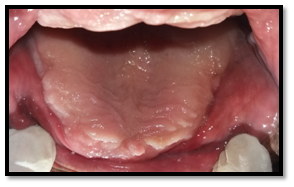
Denture stomatitis is the most common form of oral candidal infections found on the palate of denture wearers (11 to 70%) .About 93% of individuals with clinical signs of denture stomatitis presentwith fungal infections with Candida albicans being the most prevalent.1
The microorganisms in the biofilm produce polysaccharides from sugar metabolism that have a favor for their adhesion and that of yeasts to the oral mucosa and denture surfaces2.Candidal species interact with other microorganisms in the host oral cavity, especially with Streptococcus and Staphylococcus species, forming a complex and mixed biofilm formation with organized structure that is difficult to remove.
Bacteria in acrylic biofilms resulted in higher virulence and pathogenicity of Candida biofilms . Apart A denture’s close proximity to the respiratory tract, denture wearers are potentially at an increased risk of aspirating opportunistic pathogens from the denture into their lungs. These authors showed a high prevalence of respiratory pathogens on the dentures of ambulatory adults, a finding that could explain the source of infection in some cases of aspiration pneumonia. Besides aspiration pneumonia, oral pathogens have found to play a role in bacterial endocarditis, gastrointestinal infection and chronic obstructive pulmonary disease.Dentures offering a store house for microorganisms associated with these infections.4
Therefore, it is crucial that careful daily removal of the biofilm present in the oral cavity and on complete dentures is performed with adequate denture cleansing in order to prevent associated oral and systemic diseases.
Adequate biofilm removal decreases the growth of the bacteria such as Mutans Streptococci and the yeasts as they are the cause for bad breath5, staining of the acrylic resins and the development of chronic atrophic candidiasis6,2
Two methods that are chemical and mechanical are available for denture cleansing. The Chemical methods use Hypochlorites, peroxides, other acids,enzymes,crude drugs and denture mouth rinses.Mechanical methods may be 1.Manualbrushing or 2. Using Ultrasonic devices
Though mostlypatients clean their dentures by manual brushing, this method when used alone has been known to be the least efficient for biofilm control.The brushing method requires manual dexterity and visual acuityboth of which are usually compromised in geriatric patients .

Moreover, the microorganisms embedded in the biofilm become partially protected by the forces oftoothbrush. The irregularities and porosities of acrylic bases also favor the penetration of microorganisms, which raise difficulties in cleaning them by brushing alone, and thus the prostheses can become a source of infection and re-infection for supporting tissues.1
So forbiofilm control, daily immersion in cleaning solutions has been suggested for better denture hygiene and this combination has shown greater results when compared to brushing alone.7
Many commercially available denture cleansers are present with different active agents such as hypochlorites, peroxides etc. Even some patients use and prefer homemade bleaches for cost efficiency.
Sodium hypochlorite is a chemical solution that is routinely recommended for cleaning dentures and has the ability to dissolve mucin and other organic components being highly effective at removing light stains. Also, sodium hypochlorite solution has bactericidal and fungicide action but it corrodes the metallic components and degrades the acrylic component of the prostheses causing lightening of the color and surface roughness.8Chlorhexidine is also used as a method of prevention and treatment of oral infections. Chlorhexidine Gluconate provides a broad spectrum action against gram positive and negative bacteria and fungi too present in the denture biofilm9

Alkaline peroxides are also used by many as denture cleansers. They produceeffervescence, containing active oxygen, when in contact with water. The effervescence presents a mechanical action for removing debris, and the oxygen has antimicrobial and stain-removal. New alternatives such as oil of castor bean known as Ricinus communisproviding bothbiocompatibility and bactericidal and fungicidal effects. It is colorless and does not have an unpleasant smell. These characteristics along with detergent action make its use in denture cleaning possible.10
There is a great acceptance for mouthwashes due to its pleasant smell, acceptable taste and freshness. Although the antimicrobial action against the biofilm microorganisms has been known but no studies have yet been conducted to know their effectiveness as the denture cleansers.11
For those dentures already infected by Candida Microwave disinfection is known to be one of the best treatment modalities.12

CONCLUSION
The use of proper oral hygiene measures i.e. the use of manual cleaning along with immersion in denture cleansers is essential to ensure the careful daily removal of oral and denture biofilms. This is to maintain good oral hygiene and secure systemic wellness whilemaintaining the esthetics of the prosthesis and also prevention of malodor. So the clinician should advise the patient to use denture cleansers with proper instructions forthe removal of biofilm.
REFERENCES
- Journal of Applied Oral Science courtesy of Bauru School of Dentistry [PubReader]
- André RF, Andrade IM, Silva-Lovato CH, Paranhos HF, Pimenta FC, Ito IY. Prevalence of mutans streptococci isolated from complete dentures and their susceptibility to mouthrinses. Braz Dent J. 2011;22(1):62–67. [PubMed]
- Pellizzaro D, Polyzois G, Machado AL, Giampaolo ET, Sanitá PV, Vergani CE. Effectiveness of mechanical brushing with different denture cleansing agents in reducing in vitro Candida albicans biofilm viability. Braz Dent J. 2012;23(5):547–554. [PubMed]
- . Coulthwaite L, Verran J. Potential pathogenic aspects of denture plaque. Br J Biomed Sci. 2007;64(:180–189. [PubMed]
- Verran J, Whitehead K. Factors affecting microbial adhesion to stainless steel and other materials used in medical devices.
- AkpanA ,Morgan R. Oral Candidiasis – Review. Postgrad Med J, 2002;78:455-459
- Lucena-Ferreira SC, Ricomini AP, Filho, Silva WJ, Cury JA, Cury AA. Influence of daily immersion in denture cleanser on multispecies biofilm. Clin Oral Investig. 2014;18(9):2179–2185. [PubMed]
- Neppelenbroek KH, Kurokawa LA, Procópio AL, Pegoraro TA, Hotta J, Mello Lima JF, et al. Hardness and surface roughness of enamel and base layers of resin denture teeth after long-term repeated chemical disinfection. J Contemp Dent Pract. 2015;16(1):54–60. [PubMed]
- . Hennessey TS. Some antibacterial properties of chlorhexidine. J Periodontal Res. 1973;12(Suppl):61–67. [PubMed]
- . Salles MM, Badaró MM, Arruda CNF, Leite VMF, Silva CHL, Watanabe E, et al. Antimicrobial activity of complete denture cleanser solutions based on sodium hypochlorite and Ricinuscommunis – a randomized clinical study. J Appl Oral Sci. 2015;23(6):637–642.
- UludamarA,Kulak-ozkanY,KadirT,Ceyhan I. In Vivo efficacy of alkaline peroxide tablets and mouthwashes on candida albacans in patients with denture stomatis.
- . Banting DW, Hill SA. Microwave disinfection of dentures for the treatment of oral candidiasis. Spec Care Dentist. 2001;21(1):4–8. [PubMed]
Disclaimer from Guident
The views and opinions expressed in articles published in Guident are solely those of the authors and do not necessarily reflect the views of the editors, the editorial board or the publisher, Ivory India. Guident does not endorse any product, technique or treatment described. Clinical content is intended for qualified dental and medical professionals and is not a substitute for individual clinical judgement. Guident, its editors and the publisher accept no liability for any consequence arising from the use of information published in the journal.
How to cite this article
Dr. Yogeshwari Krishnan Dr. Lakshay Vishnoi Dr. Jyotsana Seth Department of Prosthodontics. Let,S Unravel Biofilms in Complete Denture. Guident. 2017 Nov;10(12). Available from: https://guident.net/articles/prosthodontics/let-s-unravel-biofilms-in-complete-denture.html