Anterior Aesthetic Restorations: A Case Series
Department of Conservative Dentistry and Endodontics, Seema Dental College And Hospital, Rishikesh
ABSTRACT
Accidents involving the anterior teeth in children and young people frequently result in their visit to the dentist. Choosing the best course of therapy when only one tooth is harmed is difficult in many cases. Either direct or indirect procedures can be used to restore the maxillary anterior dentition cosmetically. Direct resin composite restoration is a predictable, conservative, and dependable chairside treatment that might be regarded as a lifelike definitive restoration. This article outlines a simple procedure for using composite resin to improve a patient's appearance using a putty index.
Keyworsds: Anterior Teeth; Composite Resin; Diagnostic Wax-Up; Direct Restorations; Layering Technique; Silicone Index
INTRODUCTION
Patients are becoming more concerned with aesthetics, especially with regard to anterior teeth, and doctors are being asked to deliver highly aesthetic results without raising prices or clinical workload.1 The primary causes of face and smile asymmetry and disharmony, as well as the presence of diastemas and discolorations in the anterior region, are to blame for aesthetic complaints among patients.2,3 The current strategy for treating these symptoms involves a range of therapeutic approaches, including direct restorations, orthodontic treatment, and prosthodontic rehabilitation.1,3,4,5
Symmetry is the first variable that any person notices in the context of restorative dentistry and smile. It speaks of the equilibrium along the dental meridian and is crucial to direct restorations of anterior teeth. Perfect symmetry, which is the ultimate goal in aesthetic rehabilitation, is placed far from the midline in a natural appealing smile, where optimal and pleasant symmetry is found. This makes the anterior region more difficult to treat.8,9,10
This article aims to present two clinical cases that featured reshaping the maxillary incisors using resin-based composites with the help of a silicone index. All the clinical steps from color choice to restorative, finishing, and polishing procedures, as well as the final esthetic outcomes will be described as well.
CASE I
A 17 years old male patient reported to the department of Conservative dentistry and Endodontics with the chief complaint of broken tooth in the upper front tooth region since 5 weeks. He felt very inferior because of his broken tooth and this was effecting his self esteem as well. Patient gave history of falling from the bed and hitting himself from the sharp corner of the bed. During Clinical examination it was revealed that there was an Ellis Class II fracture w.r.t 21 involving enamel and dentin. The same tooth was a little sensitive to cold, no other association with hard or soft tissue injury. Tooth was not tender on percussion. Vitality tests were performed to check the tooth’s vitality using an Electric pulp tester , on which the tooth gave normal response as compared to the contra lateral teeth. After all evaluations, treatment plan was made of a direct composite restoration using a putty index.Treatment procedure was explained to the patient and informed consent was taken as well.
On the first appointment, a pre-operative impression was recorded using a hydropilic material, and a cast model was made using dai stone. On this study model a wax build up was done w.r.t 21 using blue inlay wax, very precisely once the tooth was carved ,polished and given the correct anatomy , A putty impression was recorded using polyvinyl siloxane material and a putty index was created. This index was then cut into two halves using a BP blade very carefully in the mesio-distal direction to obtain palatal and labial halves respectively, the palatal half was then checked intraorally for the proper fit, this palatal shelf will later serve as the reference guide and it will act as a rigid template to reconstruct the broken palatal surface of the tooth . A modification at this stage was carried out i.e the placement of a mylar strip on the adjacent tooth so as to prevent composite material adhering to the adjacent tooth surface. Minimal Tooth preparation was done on the labial aspect of the tooth to remove any unsupported enamel margin and also to increase the surface area. Shade selection of the direct composite material (DENTSPLY, Spectrum) and Isolation was carried out.
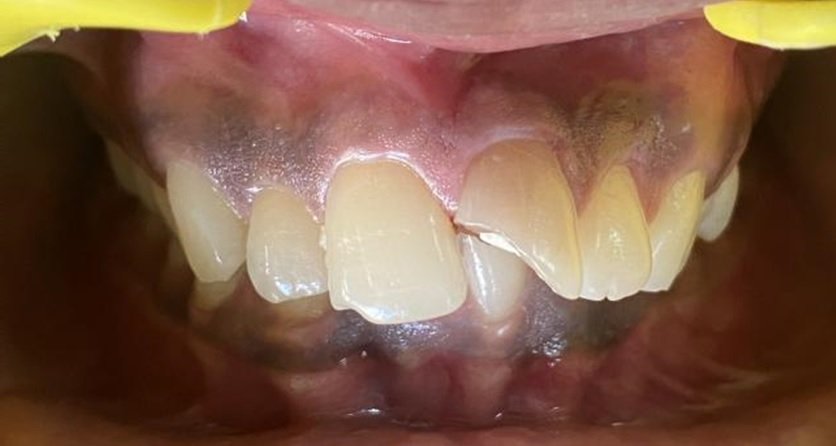
PRE OPERATIVE

PRE OPERATIVE IMPRESSON

CAST MODEL

WAX BUILD UP

MYLAR STRIP

MODIFIED PUTTY INDEX

PUTTY INDEX PLACED IN MOUTH TO CHECK FOR THE FIT

SHADE SELECTION

MINIMAL CAVITY PRPARATION

ACID ETCHING

BONDING AGENT APPLICATION

PALATAL SHELF WAS CREATED

POST OPERATIVE IMAGE
The affected tooth was etched using 37% phosphoric acid for 15 seconds followed by application of bonding agent (DENTSPLY, Spectrum) .And then was cured for 30 secs. Putty index with the mylar strip was then placed in the mouth to check for proper fit. Composite was placed when the putty index and mylar strip are in the place, and a palatal wall/shelf is created and by not extending it labially beyond the middle of the contact point and cured for 30 seconds. The putty index was then carefully removed leaving behind a rigid layer of composite bonded to the teeth which acts as a reference guide for further placement of composite material was done step wise.
CASE 2
A 22 year old patient came to the department of conservative dentistry and endodontics with the chief complaint of broken teeth in upper front tooth region since 5 months .clinical examination showed ellis class 2 fracture involving only enamel and dentin. Vitality of the teeth were checked with electric pulp tester and gave normal response as compared to contralateral tooth. Based on all these evaluation a direct composite restoration was planned using putty index.
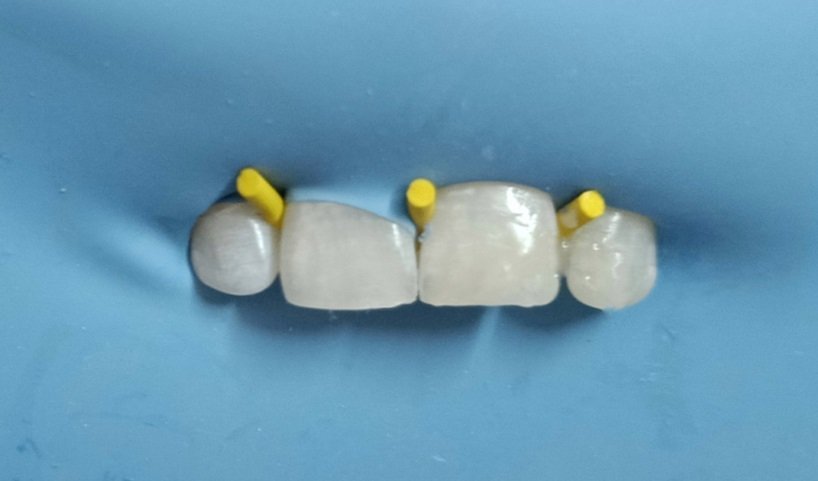
A putty index was made followed by diagnostic wax up from diagnostic cast.putty index will act as rigid template to reconstruct palatal surface. After isolation shade selection was done. Bevels were given on labial surface to remove unsupported margin.the exposed facial and lingual surface were etched with 37 ortho phosphoric acid followed by bonding agent application.Putty index was placed and palatal shelf was created followed by increamental build up with composite .Finishing and polishing was done after 24 hours.

PRE OPERATIVE IMAGE

SHADE SELECTION

PUTTY INDEX

BEVELLING

ACID ETCHING

BONDING AGENT APPLICATON

PUTTY INDEX

PALATAL SHELF
POST OPERATVE IMAGE

POST OPERATIVE IMAGE
DISCUSSION
When performing direct anterior restorative treatments with composite resins, the diagnostic assessment of each case is based on the evaluation of the clinical crown dimensions, gingival display and architecture, tooth position, wear factors, occlusion, and anterior guidance.4,5,11 Additionally, periodontal tissues must be stable and healthy before beginning any restorative treatment.5, which was the situation in both of the clinical examples mentioned. To provide consistent and long-lasting aesthetic results, all these factors should be taken into account while designing these situations.11
Even if the idea of aesthetics is very individualised, there are some criteria related to smile symmetry that the clinician should take into account, including the smile arc, buccal corridors, the presence or absence of diastemas, as well as dental and gingival asymmetries.12 Both patients wanted the most symmetrical grin possible, so all these characteristics were carefully considered in both clinical instances.
The duration of the restorations and the aesthetic outcomes, which are the primary concerns when restoring anterior teeth, can be affected by the type of composite resin, adhesive systems, and the overall restorative procedure.14 For the rehabilitation of anterior teeth, ceramic materials are a great choice.15 This is a more expensive treatment option, but it has several benefits since it can produce an aesthetic result that is better, more durable, and more predictable.15 However, composite resins have become more popular as restorative materials, mostly because they allow for the maximal conservation of dental tissue and have outstanding cosmetic properties.6
They are also an useful substitute for ceramics in situations when money and time are limited, they are simple to replace or repair, and they can produce outstanding aesthetic effects when done properly.7 The main drawbacks of dealing with dental composite materials are their colour stability and potential resin chipping16, as well as the need for a trained and skilled restorative dentist to get the best outcomes.1 Actually, anterior restoration failure behaviour differs from posterior restoration failure behaviour, showing less secondary caries and more restorations needing to be replaced due to other issues such chipping and colour mismatch, which are frequently resolved by repairing and polishing Therefore, it is imperative to schedule frequent maintenance appointments in order to catch any problems early and do a quick polishing.13
Even when dentists employ the best restorative materials and layering procedures, colour matching is still one of the trickiest parts of direct anterior restorations in aesthetic dentistry.17 Dental colour can be determined visually or with tools like the spectrophotometer, which allows for a more objective assessment.17 The colour of identically shaded aesthetic restorative products is typically not uniform across different types of materials, even when employing a more objective measuring tool.18 The use of personalised shade guides that are stacked in various colours and thicknesses and constructed from the same material as the upcoming repair is therefore preferred.17 As an alternative, the "button try" method can also be a great choice. The procedure entails applying small amounts of various resin composite shades that will be used in the restoration process to the vestibular surface of the tooth to be restored. After photopolymerization, the clinician can carefully examine the various shades and select the composite that will blend in with the natural tooth the best.17 To precisely select the ideal hue for each distinct dental location, it also entails studying each cervical, medium, and incisal third.17This method is utilised in Cases 1 and 2 to get the best possible colour match in both circumstances.
REFERENCES
- Rosales, A.B.; Carvacho, D.N.; Cacciutolo, R.S.; Guineo, M.G.; Fuentes, C.G. Conservative Approach for the Esthetic Management of Multiple Interdental Spaces: A Systematic Approach. J. Esthet. Restor. Dent. 2015, 27, 344–354. [CrossRef]
- Ergin, E.; Kutuk, Z.B.; Cakir, F.Y.; Gurgan, S. Comparison of two different composite resins used for tooth reshaping and diastema closure in a 4-year follow-up. Niger. J. Clin. Pract. 2018, 21, 1098–1106. [CrossRef]
- Dietschi, D. Optimizing smile composition and esthetics with resin composites and other conservative esthetic procedures. Eur. J. Esthet. Dent. 2008, 3, 14–29.
- Goyal, A.; Nikhil, V.; Singh, R. Diastema Closure in Anterior Teeth Using a Posterior Matrix. Case Rep. Dent. 2016, 2016, 2538526. [CrossRef]
- Korkut, B.; Yanikoglu, F.; Tagtekin, D. Direct Midline Diastema Closure with Composite Layering Technique: A One-Year Follow-Up. Case Rep. Dent. 2016, 2016, 6810984. [CrossRef] [PubMed]
- Demarco, F.F.; Collares, K.; Coelho-de-Souza, F.H.; Correa, M.B.; Cenci, M.S.; Moraes, R.R.; Opdam, N.J. Anterior composite restorations: A systematic review on long-term survival and reasons for failure. Dent. Mater. 2015, 31, 1214–1224. [CrossRef] [PubMed]
- Demirci, M.; Tuncer, S.; Özta¸s, E.; Tekçe, N.; Uysal, Ö. A 4-year clinical evaluation of direct composite build-ups for space closure after orthodontic treatment. Clin. Oral Investig. 2015, 19, 2187–2199. [CrossRef]
- Dietschi, D. Layering concepts in anterior compositerestorations. J. Adhes. Dent. 2001, 3, 71–80. [PubMed]
- Paolone, G. Direct composite restorations in anterior teeth. Managing symmetry in central incisors. Int. J. Esthet. Dent. 2014, 9, 12–25. [PubMed]
- Ormianer, Z.; Solodukhin, A.L.; Lauritano, D.; Segal, P.; Lavi, D.; Carinci, F.; Block, J. Bilateral symmetry of anterior maxillary incisors: Evaluation of a community-based population. J. Biol. Regul. Homeost. Agents 2017, 31, 37–43. [PubMed]
- Pena, C.E.; Viotti, R.G.; Dias, W.R.; Santucci, E.; Rodrigues, J.A.; Reis, A.F. Esthetic rehabilitation of anterior conoid teeth: Comprehensive approach for improved and predictable results. Eur. J. Esthet. Dent. 2009, 4, 210–224.
- Ribeiro, J.B.; Figueiredo, B.A.; Machado, A.W. Does the presence of unilateral maxillary incisor edge asymmetries influence the perception of smile esthetics? J. Esthet. Restor. Dent. 2017, 8, 291–297. [CrossRef] [PubMed]
- Simon, H.; Magne, P. Clinically based diagnostic wax-up for optimal esthetics: The diagnostic mock-up. J. Calif. Dent. Assoc. 2008, 36, 355–362. [PubMed]
- Heintze, S.D.; Rousson, V.; Hickel, R. Clinical effectiveness of direct anterior restorations—A meta-analysis. Dent. Mater. 2015, 31, 481–495. [CrossRef] [PubMed]
- Alothman, Y.; Bamasoud, M.S. The Success of Dental Veneers According to Preparation Design and Material Type. J. Med. Sci. 2018, 6, 2402–2408. [CrossRef] [PubMed]
- Kabbach, W.; Sampaio, C.S.; Hirata, R. Diastema closures: A novel technique to ensure dental proportion. J. Esthet. Restor. Dent. 2018, 30, 275–280. [CrossRef] [PubMed]
- Varvar?, E.B.; Mesaros, , A. ¸S.; Culic, b.; Varvar?, A.M.; Dudea, D. Resin composite layering technique for direct anterior teeth Restorations. Palestrica Third Millenn. Civiliz. Sport 2018, 19, 234–238. [CrossRef]
- Lee, Y.-K.; Yu, B.; Lee, S.-H.; Cho, M.-S.; Lee, C.-Y.; Lim, H.-N. Shade compatibility of esthetic restorative materials–A review. Dent. Mater. 2010, 26, 1119–1126. [CrossRef] [PubMed]
Disclaimer from Guident
The views and opinions expressed in articles published in Guident are solely those of the authors and do not necessarily reflect the views of the editors, the editorial board or the publisher, Ivory India. Guident does not endorse any product, technique or treatment described. Clinical content is intended for qualified dental and medical professionals and is not a substitute for individual clinical judgement. Guident, its editors and the publisher accept no liability for any consequence arising from the use of information published in the journal.
How to cite this article
Dr. Ayushi Bangari, Dr. Sugandha Sati, Dr. Anil Dhingra. Anterior Aesthetic Restorations: A Case Series. Guident. 2022 Oct;15(11-12). Available from: https://guident.net/articles/endodontics/anterior-aesthetic-restorations-a-case-series.html