Endodontic Management of Multirooted Teeth Having Distal Root Caries with Hemisection: A Case Report
Department of Conservative Dentistry & Endodontics, K.D. Dental College & Hospital, Mathura
INTRODUCTION
The decision to extract or to retain grossly decayed tooth is not always a straightforward task. In the past decades, compromised teeth were more likely to be extracted and replaced with a bridge or dental implants; thus, dental implants gains more popularity among dentists.1-3
Many people would prefer to keep their natural teeth and this is a good thing for several reasons. First off it is your natural tooth. Secondly, the cost of replacing a tooth either with a bridge or dental implant can be expensive and they run the chance of failure.
Hemisection is the surgical separation of a multirooted tooth, especially a mandibular molar through the furcation in such a way that a root and the associated portion of the crown may be removed4. The treatment goal is the preservation of remaining tooth structure and restoration of the function.
Various resection procedures described are: root amputation, hemisection, radisection and bisection. Root amputation refers to removal of one or more roots of multirooted tooth while other roots are retained. Radisection is a newer terminology for removal of roots of maxillary molars. Bisection or bicuspidization is the separation of mesial and distal roots of mandibular molars along with its crown portion, where both segments are then retained individualiy.
Weine has listed the following indications for tooth resection4
Endodontic and Restorative Indications
- Prosthetic failure of abutments within a splint: If a single or multirooted tooth is periodontally involved within a fixed bridge, instead of removing the entire bridge, if the remaining abutment support is sufficient, the root of the involved tooth is extracted.
- Endodontic failure: Hemisection is useful in cases in which there is perforation through the floor of the pulp chamber, or pulp canal of one of the roots of an endodontically involved tooth which cannot be instrumented.
- Vertical fracture of one root: The prognosis of vertical fracture is hopeless. If vertical fracture traverses one root while the other roots are unaffected, the offending root may be amputed.
- Severe destructive process: This may occur as a result of furcation or sub. gingival caries, traumatic injury, and large root perforation during endodontic therapy
Contraindications
- Strong adjacent teeth available for bridge abutments as alternatives to hemisection.
- Inoperable canals in root to be retained.
- Root fusion-making separation impossible.
This case report presents a case where mesial half of the root was preserved after presence of root caries in distal root of mandibular molar through hemisection.
CASE REPORT
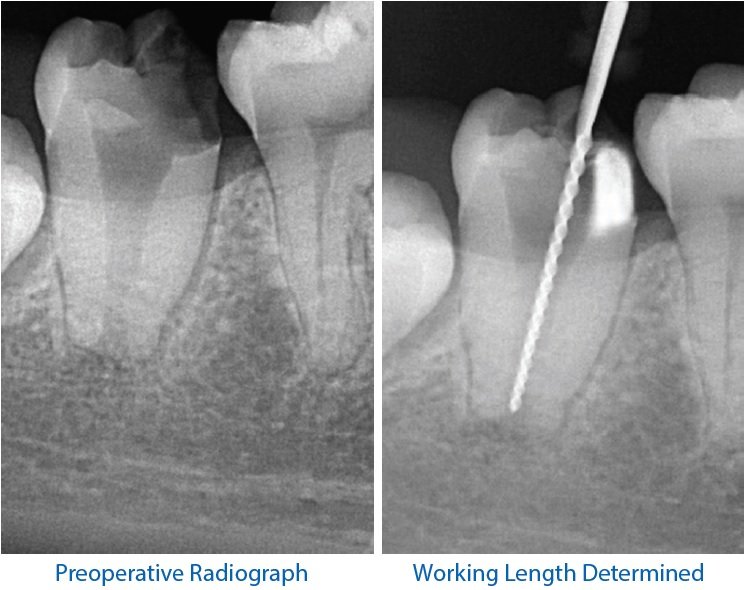
A 35-year-old male patient came to the Conservative Dentistry Department, KD Dental college and hospital, Mathura, with a chief complaint of a frequent food impaction and pain in the region of left mandibular molar since 10 days. Pain was mild and intermittent in nature, which aggravated on mastication. Clinical examination revealed deep caries involving the distal root of the tooth with no other detectable abnormality. General medical history was non-contributory. On intraoral examination, tooth was tender on percussion and deep caries was present in relation to lower left first and second molar teeth with a deep periodontal pocket on the distal surface of the first molar. Radiographic examination revealed a large distal carious lesion extending to furcal area of 36 [Figure 1a].The offending tooth number 36 presented with an extensive carious lesion distally, with a subgingival margin. Endodontic treatment of mandibular left second molar [figure 2a,2b] . Hemisection of mesial root was decided before the completion of endodontic treatment for the mesial root. Hemisection of mesial root was done [Figure 3a,3b,3c]. Endodontic treatment for the mesial root was performed [Figure 4a,4b] . Post-endodontic restoration was performed with light cure Glass ionomer cement (GC Fuji, LC). At 1 month recall visit, healing was uneventful with the absence of mobility. Tooth preparation of the mesial portion of 36 and 37 was performed followed by PFM bridge restoration [Figure 5a,5b]. Radiographic success observed at 6 months of recall visit indicated the absence of the periodontal ligament widening [Figure 6a]. Healing of treated tooth was uneventful at recall visits.

Figure 1a

Figure 2a

Figure 2b

Figure 3a

Figure 3b

Figure 4a

Figure 4b

Figure 5a

Figure 5b

Figure 6a
DISCUSSION
The hemisection is a useful alternative treatment to extraction to save the multi-rooted teeth by endodontic approach, which includes the root canal treatment of the remaining roots and restoring them with suitable restorative material followed by a fixed prosthodontic prosthesis to maintain the occlusal balance.5 The literature on distal root resection is limited as compared to mesial root in mandibular molars because of its anatomical structure.5,6 Nevertheless hemisection is a viable option to be considered before the extraction of molars7 specially in the presence of conditions such as severe vertical bone loss, furcation destruction (one root of a multi-rooted tooth), unfavorable proximity of roots of adjacent teeth, preventing adequate hygiene in maintenance of proximal areas and severe root exposure due to dehiscence. Endodontic/restorative conditions which requires hemisection are prosthetic failure of piers or abutments within a splint, endodontic failures, vertical fracture of one root, non-restorable portion of a multi-rooted tooth.8
Buhler (1988) observed 32% failure rate in hemisection cases attributed to endodontic pathology and root fracture while other authors (0-9%) have shown a greater success in hemisection cases in the long-term studies.8,7,9 In the present case, good prognosis was observed with proper occlusion, absence of mobility and healthy periodontal condition up to 6 months of follow-up. Concurring with previous reports, hemisection is a valid treatment option for the molar teeth's in young children, which otherwise have to be extracted due to extensive caries.9 Thus, conservative management of extensive carious molar tooth in patients can not only preserve the tooth but also reduce the financial burden, psychological trauma and occlusal dysfunction.
CONCLUSION
Hemisection is an alternative, effective, and conservative treatment modality over conventional procedure or extraction of periodontally and endodontic affected teeth.
REFERENCES
- Mokbel N, Kassir AR, Naaman N, Megarbane JM. Root Resection and Hemisection Revisited. Part I: A Systematic Review. Int J Periodontics Restorative Dent. 2019; 39: 11-31.
- Kurian B, Swapna D V, Nadig RR, Vedawathi B. Hemisection-Survival of fittest. Int J Appl Dent Sci. 2016; 2: 71–73.
- Sharma S, Sharma R, Ahad A, Gupta ND, Mishra SK. Hemisection as a Conservative Management of Grossly Carious Permanent Mandibular First Molar. J Nat Sci Biol Med. 2018; 9: 97–99.
- Weine FS. Endodontic Therapy, 5th Edition
- Saad MN, Moreno J, Crawford C. Hemisection as an alternative treatment for decayed multirooted terminal abutment: A case report. J Can Dent Assoc. 2009;75:387–90.
- Shafiq MK, Javaid A, Asaad S. Hemisection: an option to treat apically fractured and dislodged part of a mesial root of a molar. J Pak Dent Assoc. 2011;20:183–6.
- Shah S, Modi B, Desai K, Duseja S. Hemisection – A conservative approach for a periodontally compromised tooth – A case report. J Adv Oral Res. 2012;3:31–5.
- Radke U, Kubde R, Paldiwal A. Hemisection: A window of hope for freezing tooth. Case Rep Dent 2012. 2012 390874.
- Weine FS, editor. Endodontic Therapy. 6th ed. Osaka: Mosby-Year Book, Inc; 2004. Root amputation; pp. 606–39.
- Behl AB. Hemisection of a multirooted tooth - A case report. Open Access Sci Rep. 2012;1:1–3.
- Saini R, Saini S, Sharma S. Oral sex, oral health and orogenital infections. J Glob Infect Dis. 2010;2:57–62.
Disclaimer from Guident
The views and opinions expressed in articles published in Guident are solely those of the authors and do not necessarily reflect the views of the editors, the editorial board or the publisher, Ivory India. Guident does not endorse any product, technique or treatment described. Clinical content is intended for qualified dental and medical professionals and is not a substitute for individual clinical judgement. Guident, its editors and the publisher accept no liability for any consequence arising from the use of information published in the journal.
How to cite this article
Dr. Dipshi Ranjan, Dr. Ajay Kumar Nagpal, Dr. Muhammad M. Rahman. Endodontic Management of Multirooted Teeth Having Distal Root Caries with Hemisection: A Case Report. Guident. 2023 Jan;16(2). Available from: https://guident.net/articles/endodontics/endodontic-management-of-multirooted-teeth-having-distal-root-caries-with-hemisection-a-case-report.html