Esthetic Rehabilitation of Fractured Anterior Tooth Using Direct Composite Restoration: A Case Report
Department of Conservative Dentistry and Endodontics, Seema Dental College And Hospital, Rishikesh
INTRODUCTION
In daily practice, composites are the materials most commonly used for restorative dentistry. They are used for preventive seals, microinvasive restorations, build-ups and complex direct and indirect restorations in posterior sections. Indeed, it is in the anterior sections that composites have traditionally been used to the greatest effect, enabling clinicians to carry out complex restorations using direct techniques with notable esthetic and clinical results.
Initially, the materials were seen as nothing more than an esthetically agreeable way of filling cavities. Only later did clinicians begin to layer predetermined thicknesses of dentin and enamel to build up a natural looking restoration.This technique, known as stratification, has its origins in the way ceramicists operate and has led to the development of composites especially designed for this purpose.
Not only have composites replaced materials of the past, but they have also provided, due to there unique characteristics, additional value to clinical practice.
Clinicians require both technical and artistic skill to provide composite restorations that restore function and aesthetics to blend seamlessly with the residual dentition. This case reports emphasize on the aesthetic considerations involved in the restoration of anterior tooth with directly placed composite.
CASE REPORT
A 21 yr old male patient reported to the department, with a complaint of fracture in upper front tooth (Figure 1). Dental history revealed that he had a fall while playing football 2 days back resulting in an injury. Extraoral examination revealed no significant findings. During the intra-oral examination, a class II Ellis fracture of left maxillary central incisor was diagnosed. There was no other pathology associated with the injury. Mild calculus deposits were present but dental caries was not found. Intraoral periapical radiograph clearly shows enamel and dentin fracture without involvement of pulp in the tooth 21.

Figure 1
Instead of a conventional approach of using VITA shade guide, small buttons of different shades of composite (Figure 2) (1 to 1.5 mm) were placed (without etching or bonding) on the cervical and middle thirds of the tooth; to have a better chance of shade selection.

Figure 2
Shade matching was done and A2 shade was selected for the case. After getting proper isolation on tooth (Figure 3), 21 was thoroughly cleaned and scrubbed.
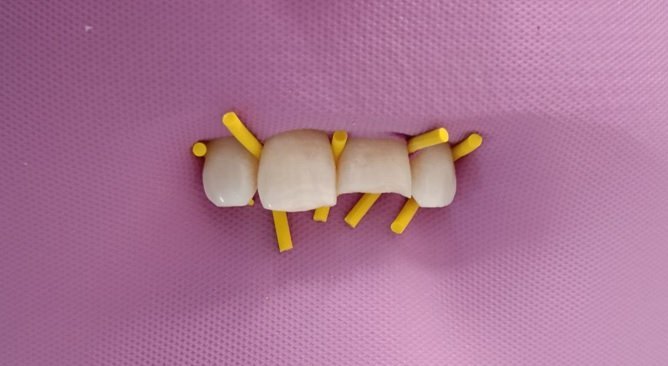
Figure 3
The tooth surface was then etched for 40 seconds(Figure 4). Again the tooth was washed and dried using air-water syringe. The bonding agent was then applied to the prepared surface and light cured for 20 seconds(Figure 5).

Figure 4
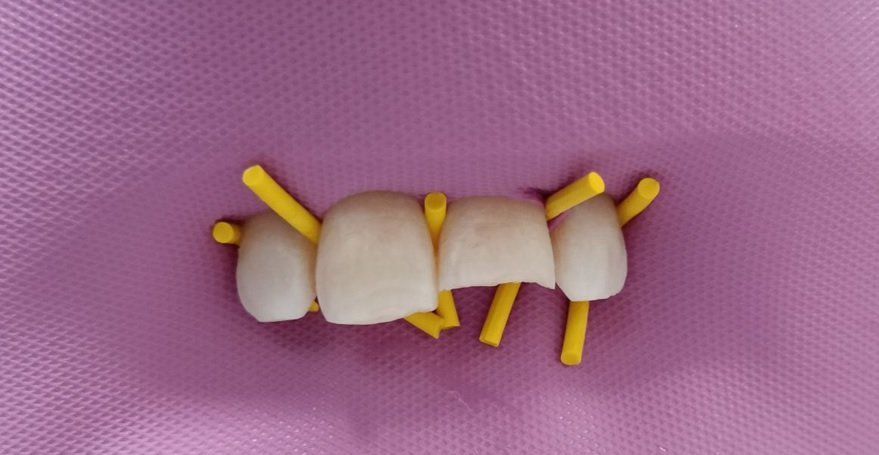
Figure 5
A thin layer of composite not more than 1mm in thickness was placed on the left central incisor which covers from facial to lingual preparation. Once the composite placement process was done in accurate and precise position the material was cured for 40 seconds on each surface(Figure 6).

Figure 6
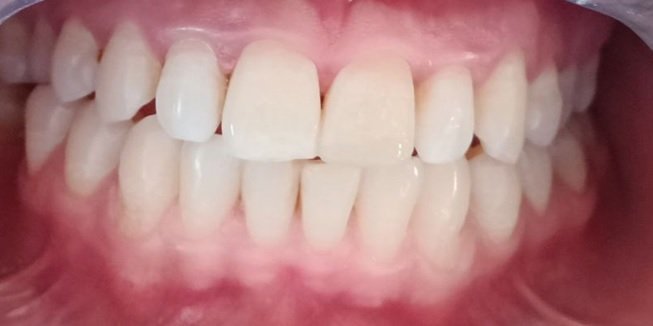
After 1 week, during the finishing stage the contouring and gross reduction of the composite resin was performed with the help of variety of burs and diamond points A composite finishing and polishing kit was also used for this purpose. In this case incisal edge was established with ultrafine polishing disc. Once the restoration was refined a final polishing was done with the polishing points.

PREOPERATIVE IMAGE
POST OPERATIVE IMAGE
DISCUSSION
Composite restoration offers a cost-effective alternative for esthetic regions. Improved bonding chemistry and introduction of nano-composites are speculated to improve further the success of composite longevity and performance in demanding situations.
The button try-in method made sure a better colour matching as compared to the VITA shade guide. The VITA shade guides should be avoided for matching the shade because they are meant to match the shade for ceramics and not composites as they are polymerized, not processed. Further can also lead to cross-infection.
The composite resins provide satisfactory treatments results for even young and adult patients, but it is indicated to adults when the volume, length or number of composite restorations is limited.Initial planning is essential for the best esthetic and functional results from restorative procedures. The use of some planning strategies enables greater dental structure preservation and result predictability. The choice of resin composite should be focused on aspects related to the strength and aesthetics. Within this context, the composite layering is the key to obtaining esthetically successful restorations. Limitations of the adhesives restoration techniques can be attributed to detachment of the restoration by a new trauma or the restoration does not recover its original colour.
CONCLUSION
Successful anterior composites are satisfying for both patients and clinicians Composite resins remain one of the most important tools in the clinician’s armament. Such systems can provide reliable strength and a realistic aesthetic result. The advantage of this technique is closely associated with satisfactory results, combined with the dexterity, skill and mastery of technique employed by the professional.
REFERENCES
- Lee YK, Yu B, Lee SH, Cho MS, Lee CY, Lim HN, et al. Shade compatibility of esthetic restorative materials–A review. Dent Mater. 2010;26(12):1119–26.
- Goyal R, Mittal R, Goyal N, Gupta S, Bogra P. Restorative technique for class IV direct composite restoration. IP Ann Prosthodont Restor Dent 2021;7(1):59-63.
- Devoto W, Saracinelli M, Manauta J. Composite in everyday practice: how to choose the right material and simplify application techniques in the anterior teeth. Eur J Esthet Dent. 2010 Spring;5(1):102-24. PMID: 20305875.
- Mackenzie L, Parmar D, Shortall AC, Burke FJ. Direct anterior composites: a practical guide. Dent Update. 2013 May;40(4):297-9, 301-2, 305-8 passim. doi: 10.12968/denu.2013.40.4.297. PMID: 23829012.
- Shah, Yashkumar Rajendra et al. “Long-term survival and reasons for failure in direct anterior composite restorations: A systematic review.” Journal of conservative dentistry : JCD vol. 24,5 (2021): 415-420. doi:10.4103/jcd.jcd_527_21
- Muhamad, Abu-Hussein & Abdulgani, Azzaldeen & Watted, Nezar. (2019). Anterior Esthetic Restorations Using Direct Composite Restoration; a Case Report.
- Nahsan, Flavia Pardo Salata et al. “Clinical strategies for esthetic excellence in anterior tooth restorations: understanding color and composite resin selection.” Journal of applied oral science : revista FOB vol. 20,2 (2012): 151-6. doi:10.1590/s1678-77572012000200005
Disclaimer from Guident
The views and opinions expressed in articles published in Guident are solely those of the authors and do not necessarily reflect the views of the editors, the editorial board or the publisher, Ivory India. Guident does not endorse any product, technique or treatment described. Clinical content is intended for qualified dental and medical professionals and is not a substitute for individual clinical judgement. Guident, its editors and the publisher accept no liability for any consequence arising from the use of information published in the journal.
How to cite this article
Dr. Akanksha Bhatt, Dr. Anil Dhingra. Esthetic Rehabilitation of Fractured Anterior Tooth Using Direct Composite Restoration: A Case Report. Guident. 2023 Feb;16(3). Available from: https://guident.net/articles/endodontics/esthetic-rehabilitation-of-fractured-anterior-tooth-using-direct-composite-restoration-a-case-report.html