Fiber Up Your Core: Fibers Reinforcing Restoration: A Case Report
Department of Conservative Dentistry and Endodontics, Seema Dental College And Hospital, Rishikesh
This case series presents a successful application of Ribbond fibers for core build-up in a patient with extensive dental caries. Ribbond fibers, known for their superior mechanical properties and biocompatibility, were employed to restore the structural integrity of the affected tooth. The patient experienced satisfactory outcomes in terms of function, aesthetics, and longevity following the treatment, highlighting the efficacy of Ribbond fibers in restorative dentistry.
INTRODUCTION
Restorative dentistry faces a constant challenge in preserving and reconstructing damaged tooth structures. Among the most common procedures is core build-up, essential for providing structural support to teeth with extensive damage due to caries, trauma, or previous restorations.1
While traditional materials like amalgam and composite resin have been the mainstays for core build-up, they often exhibit limitations such as inadequate strength and durability. Ribbond fibers-a promising alternative that offers superior mechanical properties and biocompatibility.2
This article presents a case report demonstrating the use of ribbond fibers for core build up and further treatment outcome.
CASE REPORT
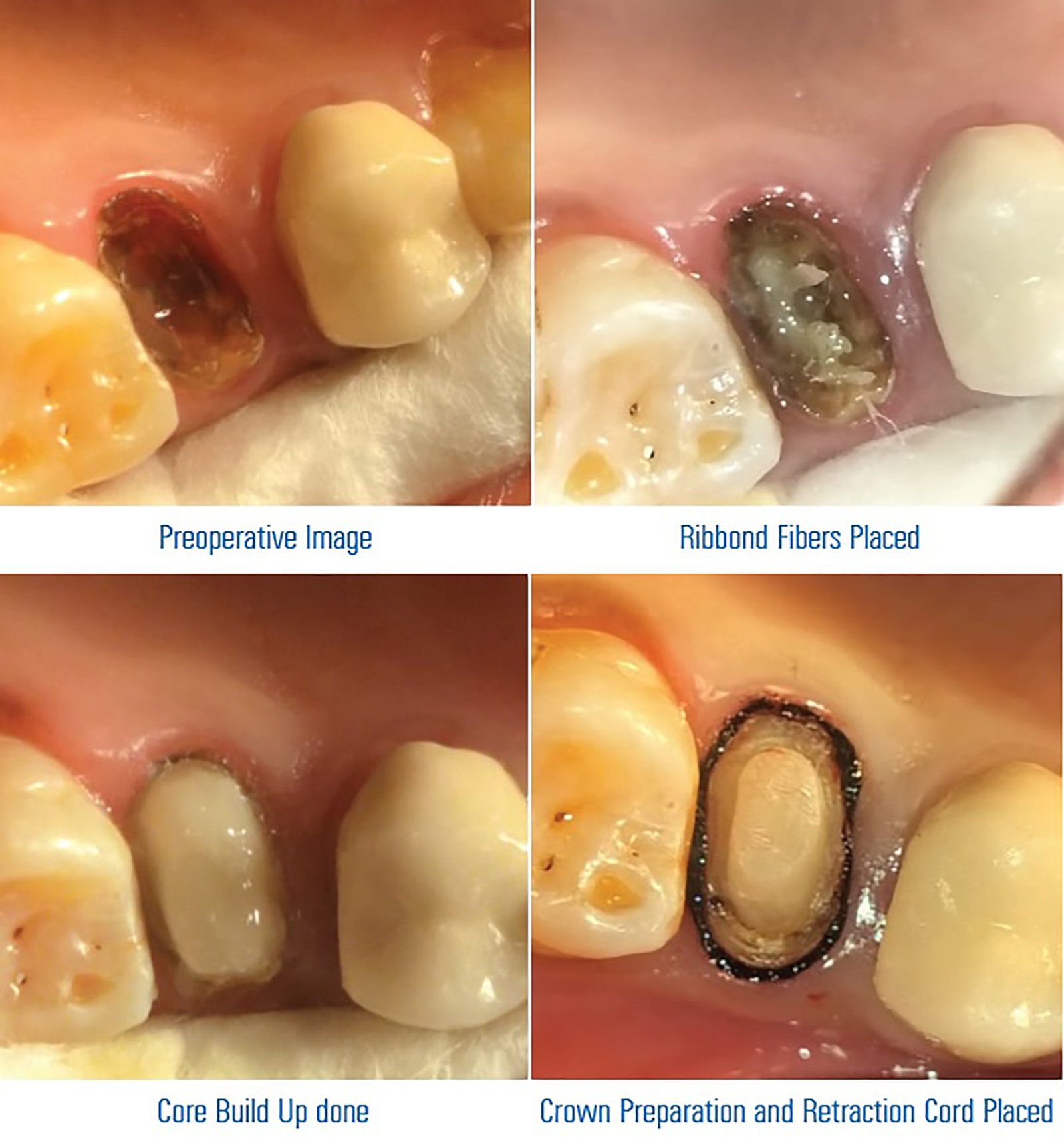
A 45-year-old female presented with pain in the upper right back tooth. The patient gave a history of dislodgement of prosthesis 1 week back.
Clinical examination revealed extensive caries affecting upper right second premolar. Radiographic investigation revealed previous endodontic treatment with poorly obturated canal. A diagnosis of previously endodontic treated with infected root canal system was made.
Tooth exhibited significant coronal loss, necessitating core build-up before crown placement. Ribbond fibers were chosen for their superior mechanical properties and biocompatibility.
Revision of root canal treatment was performed followed by use of posterior rebind fibers for core build up. Crown preparation was done followed by impression making using polyvinyl siloxane. A PFM prosthesis was fabricated and luted with Type-I glass ionomer cement.


Impression Recorded
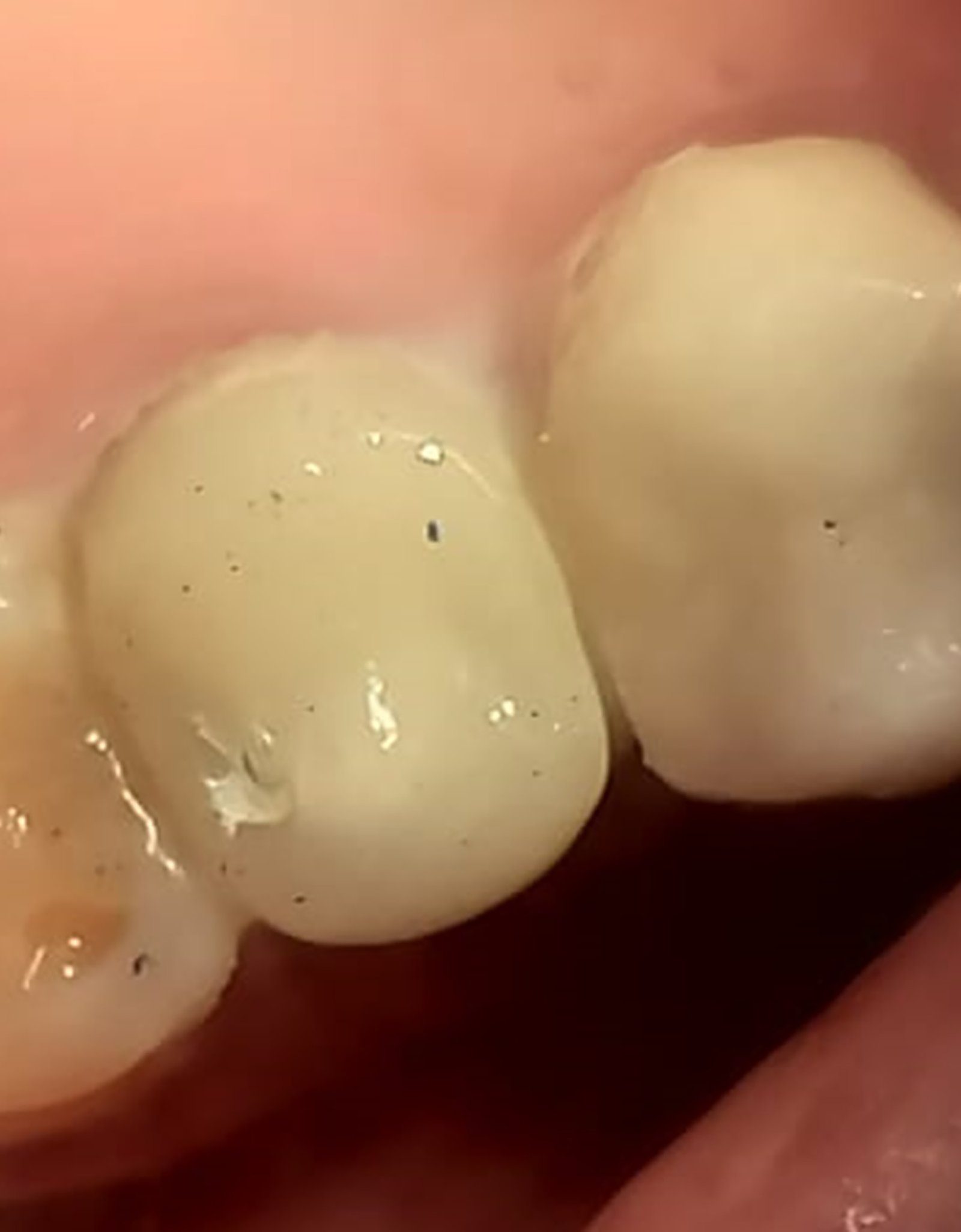
Cementation of Prosthesis
DISCUSSION
Ribbond fibers are composite materials composed of high-strength fibers embedded within a resin matrix. These fibers, often made of materials like glass or carbon, provide reinforcement to the composite, enhancing its mechanical properties.3
Glass fibers are favoured for their excellent aesthetic properties, including translucency and color matching, which are critical for achieving natural-looking dental restorations. Polyethylene fibers, known for their high tensile strength and flexibility, are particularly useful in applications requiring robust mechanical support. Carbon fibers, though less commonly used, offer exceptional strength and stiffness, making them suitable for high-load-bearing applications.4
Ribbond fibers are available in various forms, including pre-impregnated tapes, braids, and woven fabrics, allowing for versatile applications in restorative dentistry.5
It has been demonstrated that fiber reinforcement enhances the flexural strength, fracture toughness, and fatigue resistance of dental materials. This is particularly important for restorations in high-stress areas, such as posterior teeth, where the risk of fracture and failure is higher. The integration of fibers helps to distribute stress more evenly across the restoration, thereby reducing the likelihood of catastrophic failure.6
Clinical studies have reported minimal inflammatory responses and excellent tissue compatibility, making these materials safe for long-term use in dental restorations.7
Core build-up is a critical step in restoring teeth with extensive coronal damage. It involves the reconstruction of the tooth's core to provide support for subsequent restorations such as crowns or bridges.8
Ribbond fibers offer several advantages such as enhanced biocompatibility, improved esthetics, minimal preparation and improved strength.9
Technique sensitivity is a significant issue, as the proper placement and handling of fibers are critical to achieving optimal results. Some studies have highlighted potential concerns regarding wear and degradation over extended periods, which could impact the longevity of restorations.10
CONCLUSION
This case report highlights the successful application of Ribbond fibers for core build-up in a patient with extensive dental caries. The patient experienced favorable outcomes in terms of function, aesthetics, and longevity. Ribbond fibers show promise as a reliable altemative to traditional core build-up materials.
REFERENCES
- Nagas E, Uyanik MO, Eymirli A, Cehrell ZC. Effect of different fibre types on the mechanical properties of a denture base resin. J Oral Rehabil. 2003 Nov;30(11):1119- 25.
- Naumann M, Sterzenbach G, Rosentritt M, Beuer F. The effect of fiber architecture on the failure load and fracture mode of endodontically treated premolars. J Endod. 2010 ???;36(4):661-4.
- Samran A, El Bahra S, Kern M. Influence of coronal restorations and root canal filling quality on stress distribution in roots with and without endodontic post: a finite element analysis. J Endod. 2013 Jun;39(6):759-63.
- Smith, R. et al. "The Composition of Glass Fibers in Dental Applications." Journal of Dental Research, 2020.
- Lee IB, An W, Chang J, Um CM. Effects of fiber reinforcement on the flexural properties of composite resins. J Prosthet Dent. 2001 Dec;86(6):608-15.
- Gupta, S. et al. "Mechanical Properties of Fiber-Reinforced Composites." International Journal of Dental Materials, 2018.
- Kim, H. et al. "Biocompatibility of Polyethylene Fibers in Dental Applications." Clinical Oral Investigations, 2019.
- Dietschi D, Duc O, Krejci I, Sadan A. Biomechanical considerations for the restoration of endodontically treated teeth: a systematic review of the literature--Part 1. Composition and micro- and macrostructure alterations. Quintessence Int. 2007 Jan;38(9):733-43
- Clark, G. et al. "Reinforcement of Composite Fillings with Fibers." Journal of Restorative Dentistry, 2020.
- Robinson, P. et al. "Inflammatory Response to Fiber-Reinforced Composites."Journal of Clinical Dentistry, 2021.
Disclaimer from Guident
The views and opinions expressed in articles published in Guident are solely those of the authors and do not necessarily reflect the views of the editors, the editorial board or the publisher, Ivory India. Guident does not endorse any product, technique or treatment described. Clinical content is intended for qualified dental and medical professionals and is not a substitute for individual clinical judgement. Guident, its editors and the publisher accept no liability for any consequence arising from the use of information published in the journal.
How to cite this article
Dr. Siddhi Goyal, Dr. Anil Dhingra. Fiber Up Your Core: Fibers Reinforcing Restoration: A Case Report. Guident. 2024 Jun;17(7). Available from: https://guident.net/articles/endodontics/fiber-up-your-core-fibers-reinforcing-restoration-a-case-report.html