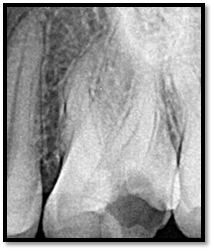
Importance of Apical Third Management
Seema Dental College & Hospital Rishikesh Uttrakhand, India
The minor constriction of the apical foramen should ideally be maintained at its initial size and position after bio mechanical cleaning and shaping procedures. Best endodontic results can be obtained if the minor constriction of the apical foramen is maintained at its original size and position. Mature apex is the land mark where, the clinician shapes, obturates .Failure to completely clean apical foramen results in debris and leads to failure.
If the minor constriction is bypassed due to over instrumentation or due to obturation then the chances of failure increases. Therefore, achieving all the steps in the entire process of endodontic procedures allow achievement of a preparation that treats the apical foramen appropriately and allows the success of treatment.
HOW TO MANAGE APICAL THIRD
During instrumentation the clinician should follow the Basic Principles :
(1) Maintain the apical foramen at its original size and position.
(2) Maintain the canal in its original position (ie, the canal is only enlarged circumferentially, and its position not moved).
(3) Keep the apical foramen as small as is practical.
(4) The final preparation should resemble a tapered funnel.
(5) Facilitate obturation, yet keep the canal as small as is practical.
It is a valuable but important aside to note what instrumentation to a size 50, 70, etc really means relative to the apical foramen. In the most concrete terms, instrumentation of a canal to a given size means that the largest diameter noted (50, 70, etc) is the diameter created in the canal at or to the minor constriction of the apical foramen, and not beyond it.
Whatever the file brand or technique used to shape canals, the goals of instrumentation are the same. Maintaining the constriction at its original size and position, it provides a natural barrier to the movement of obturation material.
The teeth may have multiple apical foramen, and these foramen may or may not have a typical anatomic configuration. The apical foramen can be regular or singular. A minor constriction may not actually be present in some cases either naturally or through resorption. The average diameter of the minor constriction is approximately 0.20 to 0.30 mm, and the average distance from the minor diameter to the major diameter of the apical foramen is approximately 0.50 to 1.0 mm. The foramen is does not necessarily coincident with the anatomic root end (ie, the anatomic apex). The apical foramen can also be located up to 4 mm from the anatomic apex, with an average distance of approximately 0.5 to 1.0 mm.
These variations in anatomy provides challenges present in cleaning and shaping the apical third of root canal systems. Maintaining the apical constriction in biomechanical preparations is important as placement, control, and efficiency of irrigation in part depends on maintenance of the apical foramen at its original position and size. By contrast, an apical constriction that is transported and enlarged may bleed profusely as well as lose its ability as a natural barrier to the movement of irrigants and obturation materials.
Therefore to avoid mistakes during bio mechanical preparation always estimate the true working length before access cavity preparation begins. An idea the tooth length is before beginning can helps clinician in negotiation of rotary files and glide path creation, especially in the apical third. Also , this prevents the clinician from using too much force in the apical third that might otherwise push files beyond the constriction, possibly leading to transportation.
Modern methods of canal preparation, crown-down techniques shapes the apical third in the last. The crown down method allows the optimal irrigation at all steps during the instrumentation procedures. It also provides a tactile sense and greater degree of control over the apical third. Instrumentation sequence provided by various manufacturers allows for negotiation of the canal with small hand files to learn the canal Ãs diameter and curvature, achievement of patency, glide path creation, rotary Ni-Ti file use, irrigation, recapitulation, and a repetition of this given sequence. This allows for maximum efficiency and safety of the treatment .Therefore creation of glide path is important to prevent fracture of rotary instruments. Further it is necessary to maintain control of rotary nickel titanium files in the apical third. Hence, maintaining the apical constriction at its original position and size has great value for the prevention of iatrogenic events, facilitating excellence in irrigation, instrumentation, and obturation, and providing the best possible clinical result.
Disclaimer from Guident
The views and opinions expressed in articles published in Guident are solely those of the authors and do not necessarily reflect the views of the editors, the editorial board or the publisher, Ivory India. Guident does not endorse any product, technique or treatment described. Clinical content is intended for qualified dental and medical professionals and is not a substitute for individual clinical judgement. Guident, its editors and the publisher accept no liability for any consequence arising from the use of information published in the journal.
How to cite this article
Dr. Annil Dhingra Department of Conservative Dentistry and Endodontics. Importance of Apical Third Management. Guident. 2016 Jun;9(7). Available from: https://guident.net/articles/endodontics/importance-of-apical-third-management.html