What Does the Digital Future Holds
Department of Endodontics & Conservative Dentistry, Maitri College of Dentistry & Research Center, Durg Chhattisgarh (India)
Replacing a broken tooth is a cumbersome and arduous task. Not only is the tooth replacement painful, but the process of replacement is often lengthy, more painful and traumatic than the medical procedures in itself. As a result, X% of people do not replace their broken tooth within Y months of breakage. The average time to complete a replacement is 10-15 days. Total Market size: As of now more than 90% dentists in the world use traditional methods to get the tooth caps made, which is cumbersome process, takes long time and may not be perfect. Digital scanning is quite common in developed markets and is also gaining ground in developing economies like India; 3 d printing can add value to digital scanning and can provide immediate treatment. The problem is even larger for people with mobility issues and unique needs - disability issues, old age etc.
Digital dentistry has now becoming an indispensable part of diagnosis and treatment planning in the dental practice leading to leaps and bounds in the quality of treatment. The digital workflow can improve practice efficiency and predictability regardless of the level of integration, from intraoral scanners, CAD design to CAM manufacture and 3D printing. The development of chair side digital impression making is akin to the development of digital intraoral photography, both offer accuracy and speed, as well as the ability to indefinitely store the information captured without any material constraints and to quickly and easily transfer the digital images from dental office to laboratory and vice versa. Digitalization is inevitable and it is extremely important to be up to date.
Mission – is to create beautiful smile with quick and convenient method.
HOW IT IS DONE?
A dentist holds a scanning wand which is connected to a digital camera. This uses blue wavelength light to record images of the teeth to make a 3D computer model. A 3D model created by the scanning wand is displayed on a computer screen. A milling machine located inside the dental office carves a restoration from a block of ceramic material. A computer model showing how the final restorations will look is sent to the milling machine for fabrication. The final prosthesis placed the same day & provide a long term and predictable result.
Disadvantages of conventional impression include –
- Some patients find inopportune and messy i.e. discomfort to patient.
- Some patients hate the taste and smell.
- Multiple visits it takes 2-3 weeks( adjustments that need to be made to the final cap again sent back to the lab for changes)
- An impression can deform or break at certain levels of stress from the moment it is taken, properties change through time due to temperature and humidity mechanical distortion can be considered which may jeopardize the final quality of the restorations and their adaptation on the prosthetic field.
- Difficult mixing process.
- Casting errors
- Might cause allergic reactions because of the composition of material.
- Traces of material makes a lot of “dirt “on skin, teeth of patients and should be removed.
- Traces of material can spread around the cabinet, the gloves on the floor, instruments.
- Errors due to incorporation of bubbles can cause inaccuracies on the model.
There are many advantages of digital impression scanning –
- Eliminates discomfort associated with traditional impression procedure in case of a patient who is gagger or cannot tolerate impression material in mouth for several minutes.
- Increases patient acceptance.
- Need for only one administration of anesthetic.
- No need of temporary cap.
- 3D plan betters understanding & consent.
- Dentist can visualize the preparation multiple times and retake the scan if necessary. Software helps to find the lack of adaptation and shows when the impression is ideal.
- Technique will provide better, good longevity (more than 10 years) and clinically acceptable accuracy of fit, facilitating and improving the communication among dentist, technician and patient, allows patients to visualize the expected final result, besides facilitating the presentation of the current condition of patient’s oral health
- Can be saved online (information is saved on a computerized workstation; it doesn’t change its fidelity through time, can reorganize data & magnify and annotate the image).
- It can serve as a guide (template) if anybody’s teeth or jaw are broken in accident for treatment.
- Dentist can do more patients as they need to spend less time on one patient as multiple visits will be reduced and dentist can earn more money
- Allows improved esthetic manipulation, chair side technique eliminates a second visit for the patient.
- Reduces patient treatment time.
- Scanning the patient is quick and design is completed with current software in minutes.
- Reduced storage requirements
- Decrease in the risk of microorganism colonization on impression surface and consequent infection.
- No need of stone models.
- Reduced labor and reduce the total work effort and time involved, it took 4 minutes for the measurement, 1 minute for the design, 2 minutes for the conversion processing and 90 minutes for the ceramic processing, compared to almost double this for a traditional impression technique.
- Verbal and visual prompts on scanner positioning and sequencing may also shorten the learning curve.
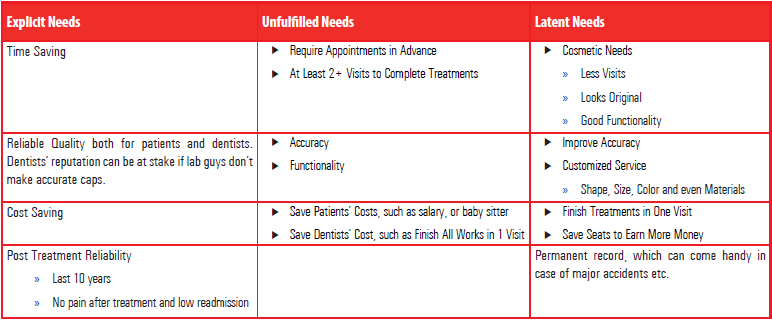
- Can be used for full denture also New need can be- best prosthesis with the use of latest technology Unfulfilled need can be – visiting again and again and if lab guy doesn’t make proper cap Latent or hidden need can be – immediate full treatment rather multiple visits
Disadvantages of digital impression includes-
- Lack of in familiarity among dentist, takes training and practice to acquire the technique.
- Cost of equipment is high, but after depreciation it becomes cheaper than conventional technique.
- Good & up-to-date laboratory support is required.
- The optical laser is sensitive to any movement - if the patient is not perfectly still, it can compromise the data capturing process.
- Metal cap can’t be prepared with 3D technique
WHAT DOES THE FUTURE HOLD?
Dentists must be precise in creating the initial tooth preparation, both dentists and lab technicians must be accurate when taking digital impression and drawing the restoration. Team training – while a dentist can achieve an initial level of competence after a two day training session. Most dentist and assistants increase their skills by continuing to an intermediate training level & then studying with advanced trainers. One of the main factors that affect the cost of any dental crown is the material (metal, ceramic & zirconia). There is no additional cost or fee to have a restoration placed in one visit as opposed to two. Insurance reimbursement is similar for in office, same day dentistry or lab fabricated restorations.
Disclaimer from Guident
The views and opinions expressed in articles published in Guident are solely those of the authors and do not necessarily reflect the views of the editors, the editorial board or the publisher, Ivory India. Guident does not endorse any product, technique or treatment described. Clinical content is intended for qualified dental and medical professionals and is not a substitute for individual clinical judgement. Guident, its editors and the publisher accept no liability for any consequence arising from the use of information published in the journal.
How to cite this article
Dr. Aditi Jain. What Does the Digital Future Holds. Guident. 2019 Jun;12(7). Available from: https://guident.net/articles/general/what-does-the-digital-future-holds.html