Oral Implications of Anemia
Department of Pedodontics and Preventive Dentistry, K.D. Dental College & Hospital Mathura, U.P. India
Anemia is defined as insufficient blood cells to adequately transport the oxygen to the peripheral tissues. It is characterized by decrease in red blood cells (RBCs). Hence, World Health Organization (WHO) defines anemia in terms of Hb. According to WHO, hemoglobin less than 13% in adult males, less than 12% in adult females and less than 11% in pregnant women is considered as evidence of anemia.
Types
IRON DEFICIENCY ANEMIA
Iron deficiency anemia is the most common type due to nutritional deficiency worldwide. It can affect normal mental and physical growth in the children and adolescents. It may also affect visual and auditory functioning along with reduced work capacity. The deficiency is more prevalent in people belonging to low socioeconomic group because of their imbalanced diet.
ORAL MANIFESTATIONS
- General pallor of lips mucosa
- Burning mouth syndrome
- Angular stomatitis
- Erythematous mucositis
- Atrophic glossitis can be described as flattening of tongue papillae leading to smooth red tongue appearance resembling migratory glossitis (figure 1)
- Tongue appears to be erythematous, atrophic, non-indurated and big in size,lesions they do not change their position.
- Glossitis is more common in anemic children specially when they are also deficient in Vit B12
- Iron deficiency glossitis has been typically described as diffuse atrophy of dorsal tongue along with burning sensation, such findings are also evident in oral candidiasis as it predisposes the patient to candidial infection thereby causing changes at the corner of the mouth as well
- Plummer–Vinson syndrome [dysphagic + atrophic glossitis + angular cheilitis].
This is otherwise called the Patterson-Brown-Kelly syndrome or sideropenic dysphagia. This syndrome manifests as atrophic glossitis, or angular cheilitis, and, occasionally, hyperkeratotic lesions are seen in the oral mucosa. It is also associated with koilonychias (or spoon nails), pagophagia and dysphagia due to pharyngoesophageal ulcerations and esophageal webs.

Figure 1: Clinical representation of Atrophic Glossitis
Management
- Treatment should be focussed on correcting the underlying nutritional deficiencies
- Oral iron therapy is the first line of treatment. Hb level of 1g/dL should increase every 2–3 weeks on iron therapy; however, it may take up to 4 months for iron stores to become normal
- Iron sulfate 300 mg provides 60 mg of element iron, whereas 325 mg of iron gluconate provides 36 mg of element iron. Gastrointestinal absorption of element iron is increased with acidic environment, which is achieved by giving ascorbic acid in conjunction of iron therapy. Focus on antifungal therapy for cheilosis making mouth opening a comfortable experience during dental treatment
- Protein fluids and nutrition should become a part of supportive therapy to promote healing.
MEGALOBLASTIC ANEMIA
Megaloblastic anemia by definition is the type of anemia that is caused by disorders of DNA synthesis of erythrocyte precursors in bone marrow. Megaloblastic anemia is most commonly due to a deficiency of folate or cobalamin (vitamin B12). Folate deficiency is usually nutritional in origin and may be seen in commonly in children in the form of malnutrition. Megaloblastic red blood cells are larger than the normal red blood cells and contain more cytoplasm in relation to the nucleus Vitamin B12 deficiency manifests in the oral cavity as part of megaloblastic changes in the entire gastrointestinal tract, which are so well demonstrated morphologically in the bone marrow.
Oral Manifestations
- Painful atrophic changes of entire oral mucosa
- Glossitis
- Stomatitis
- Recurrent aphthous ulcer (in case of long standing vit B12 & folate deficiency)
- Burning mouth syndrome
- Bleeding gingivae
- Ulcerative gingivitis
- Denuded tongue
- Glossodynia
- Magenta Tongue (B12 deficiency)
- Delayed wound healing
- Oral paraesthesia
- Detachment of periodontal fibers
- Loss of taste
- Xerostomia
- Folate deficiency can also lead to serious neural tube defects such as cleft lip palate.
MANAGEMENT
Folate and Vitamin B12 therapy
Folate is usually given orally at 1 to 5 mg daily, although 1 mg is usually enough. At this dose, anemia is usually corrected even in patients with malabsorption. A parenteral preparation containing 5 mg/ml of folate is also available.
The megaloblastic component of a mixed iron-deficiency anemia can sometimes be overlooked, and the patient may be treated only with iron. In this case the anemia will respond only partly to therapy, and megaloblastic features will emerge as iron stores fill.
Incomplete Megaloblastic Anemia
Treatment consists of parenteral cyanocobalamin (vitamin B12) or hydroxocobalamin to replace daily losses and refill storage pools, which normally contain 2 to 5 mg of cobalamin. Toxicity is nil, but doses exceeding 100 μg saturate the transcobalamin, and the excess is lost in the urine.
SICKLE CELL ANEMIA
Sickle cell anemia is the most common and most severe form of sickle cell disease. Sickle cell disease is generically used to describe a group of disorders characterized by the production of abnormal hemoglobin S (HBS).The entities include sickle cell anemia (HbSS), sickle cell Hb C disease (HbSC) and sickle cell-β thalassaemia.
Henrick in 1910 published about sickle cell anemia for the first time. Sickle cell anemia (HbSS) is the most common type and represents the homozygous form where the individuals inherit a double dose of the abnormal gene that codes for hemoglobin S.
The hallmark features of sickle cell disease are chronic hemolytic anemia and vaso occlusion resulting in ischemic tissue injury
Oral Manifestations
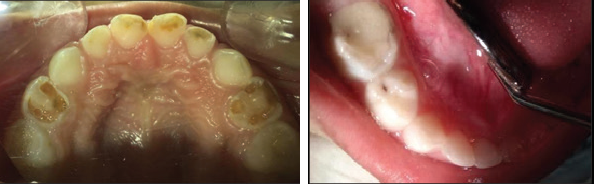
- Mucosa pallor( Figure 2)
- Developmental defects due to hypomineralization of enamel ( Figure 3)
- Delayed eruption of teeth
- Accentuated incremental line
- Pulpal pain may be due to tissue infarction and thrombosis
- Dental caries ( Figure 4)
- Mandibular painful crises*
- Paraesthesia of mental nerve
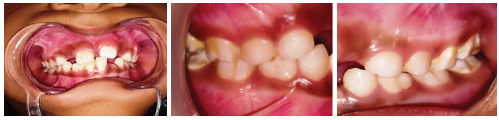
- Malocclusion & Midline diastema **( Figure 5)
- Orofacial pain
- Dentofacial deformities.

Figure 2-5: Showing clinical manifestation of sicke cell anemia
*Mandibular osteomyelitis is an oral complication commonly observed in patients with sickle cell anemia, which is rarely manifested with other complications, making both its diagnosis and treatment easy. The mandible is the most affected part of the face because the blood supply is relatively insufficient when compared with the maxilla. Intravascular impairment can result in both ischemic infarct and osteonecrosis thus allowing bacterial proliferation.
**The increased number of malocclusions in patients with sickle cell disease can be related to muscular imbalance, absence of labial sealing or changes in the osseous base thus leading to increased orthodontic intervention.
Radiographic Features
- Midfacial overgrowth due to marrow hyperplasia
- Thickening of skull
- Presence of interglobular dentin
- Increased radiolucency of the jaw
- Coarse trabecular pattern and decreased number of trabecular
- Thin inferior border of the mandible
- Distinct areas of osteoporosis
- Enlarged medullary spaces of bone
- Step ladder effect due to horizontal rows of trabeculation
- Retrusive maxilla
- Dense lamina dura due to hyperplastic marrow
- Hypercementosis
- Hair on end appearance in skull (Fig 6).

Figure 6– Hair on end appearance
Oral Health Considerations
- Early establishment of diagnosis and delayed evaluation of the patient should be avoided
- Local anaesthetic is the preferred anesthetic for these patients as according to Malamed, these patients belong to ASA-III categories.
- The use of local anesthetic does not affect the oxygenation of the blood molecule
- Oral sedation can also be used as an anxiolytic agent.
- For cases to be considered under general anesthesia:
- Proper/adequate hemoglobin levels to be activated 15 days prior to the procedure through transfusion to prevent sickle cell anemia crisis.
- Optimum level to be maintained for children is 10– 12 g/dL
- Prophylactic antibiotic to be given before the procedure in order to avoid infection.
Management
- Keep the dental management conservative and stress free for the patient
- Prevention of dental disease and infections are of paramount importance
- Talk and explain to your patient about the disease
- Maintaining excellent oral health to decrease the possibility of oral infections will ensure the best care for these patients.

Disclaimer from Guident
The views and opinions expressed in articles published in Guident are solely those of the authors and do not necessarily reflect the views of the editors, the editorial board or the publisher, Ivory India. Guident does not endorse any product, technique or treatment described. Clinical content is intended for qualified dental and medical professionals and is not a substitute for individual clinical judgement. Guident, its editors and the publisher accept no liability for any consequence arising from the use of information published in the journal.
How to cite this article
Dr. Priya Verma. Oral Implications of Anemia. Guident. 2019 Jun;12(7). Available from: https://guident.net/articles/pedodontics/oral-implications-of-anemia.html