Correction of Anterior Open Bite and Tongue Thrusting Using Zygomatic Miniplates-a Case Report
Pediatric and Preventive Dentistry, A.B Shetty Memorial Institute of Dental Sciences Nitte (deemed to be) University, Derlakatte, Mangalore, Karnataka
ABSTRACT
Anterior open bite is a multifaceted malocclusion which is caused by the interplay of various factors. Although there are several conventional treatment options for open bite, newer minimally invasive methods like using skeletal anchorage have been deemed to have many advantages. In the present study the aim was to assess the effectiveness of using zygomatic miniplates for intrusion of maxillary molars in a fourteen year old. L shaped titanium miniplates were surgically placed in the zygomatic buttress. Three months after the placement of miniplates, a significant change was seen in the open bite. Thus skeletal anchorage has a positive prognosis in treatment of anterior open bite.
INTRODUCTION
The over complex nature of the multifaceted open bite malocclusion is attributed to a combination of multiple factors like skeletal, functional and habit related. Open bite correction is indispensible as it can lead to problems like dysphonia, functional imbalance, esthetic issues, alteration of incisor guidance, reduction of normal functional activity.
Open bite can be considered as a deviation in the vertical relationship of maxilla and mandible. There is a wide array of treatment options for open bite, some of them being posterior bite blocks, bite blocks augmented with magnets or springs, multi-loop edgewise archwire techniques, high-pull headgear and headgear with a posterior bite block1,vertical elastics, facemask therapy.
Presence of excessive height in the posterior dentoalveolar region especially in cases where completion of eruption of permanent molars is seen, these conventional treatment options might not lead to satisfactory molar intrusion. When orthodontic or surgical intrusion of the overerupted maxillary teeth is performed, the mandible rotates in counter clockwise direction, resulting in open bite closure.2
Although orthognathic surgery delivers adequate and acceptable results, the complexity, risks, and costs of surgery have initiated a search for alternative treatments3 such as use of temporary anchorage devices for molar intrusion.
Specially-designed implants, miniscrews, and miniplates have been used recently to obtain a stationary anchorage source. Several studies have reported the successful treatment of anterior open bite by intruding the mandibular or maxillary molars with miniplate anchorage.4 Studies have shown that the zygomatic buttress area could be a valuable anchorage site to get effective intrusion of the maxillary posterior segment.1,5,6,7 Hence in the present case the skeletal open bite correction was initiated using miniplates placed at the zygomatic buttress area.
CASE REPORT
A 14 year old boy reported to the dental hospital with the chief complaint of forwardly placed anterior teeth. A skeletal anterior open bite along with tongue thrusting and mouth breathing was observed. Extra oral examination (fig 1) revealed that the patient had a convex profile along with absence of passive lip seal and hyperactive lower lip. Intra oral examination (fig 2) revealed that the patient had a good oral hygiene and no abnormality with respect soft tissues or gingiva. Class I molar and canine relation was observed bilaterally. Slight crowding was seen associated with the upper and lower anterior teeth with an overjet of 3-4mm. An anterior open bite of 2-3mm and 4-5mm was seen on the right and left side respectively.


Fig 1
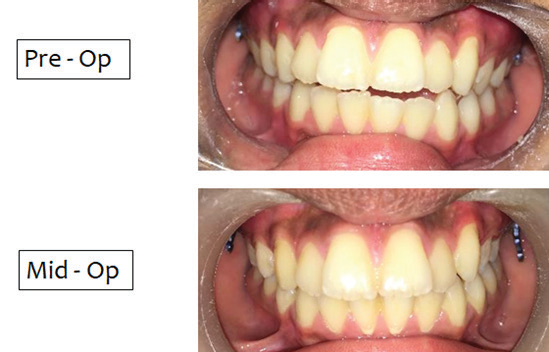

Fig 2
Cephalometric analysis (fig 3 A) revealed that the patient had a retrognathic mandible, the SNB and ANB angles were observed to be 76 and 7 degrees respectively. The interincisal angle was found to be 103 degrees. Soft tissue analysis revealed prominent and protrusive upper and lower lip (fig 3 B)

Fig 3A

Fig 3B
The treatment objectives were closure of open bite, rectification of oral habits, forward movement of the mandible and correction of anterior crowding.
The treatment plan was divided in three phases:
Phase I: Corrective Phase
Phase II: Retentive Phase
Phase III: Fixed Orthodontic Treatment
The goal of phase I was to achieve closure of open bite and rectification of oral habits. Phase II will aim at retention and stabilization of Phase I. Phase III will aim at minor orthodontic tooth movements followed by frequent recalls and checkups.
In order to achieve the goals of Phase I, L- shaped titanium miniplates and monocortical screws were placed bilaterally at the zygomatic buttress area to achieve molar intrusion for the closure of open bite and the patient was asked to practice myofunctional exercise for termination of mouth breathing. A tongue crib was incorporated in the splint which was placed after the surgical placement of miniplates for termination of tongue thrusting habit.
The miniplates were placed bilaterally under local anesthesia. A long horizontal incision extending from the first premolar to first molar was made in the mucogingival junction in order to expose the zygomatic buttress
(fig 4). L shaped titanium miniplates (fig 5) were adjusted to fit the contour of the buttress. A pilot hole was drilled followed by which the first of the three monocortical screws were placed. After the placement of miniplates, the incision sites were sutured thereby exposing the arm and head of the miniplate in the oral cavity in the first molar region (fig 6). Suture removal was done a week post the surgery. A splint incorporating a tongue crib for habit breaking was fabricated to aid in intrusion (fig 7). The head of the miniplate was used to engage elastics for intrusion. The splint comprised of three metal hooks extending from bite blocks on the either side in order to engage elastics. The splint was cemented and closed E chains were immediately engaged in a shape of an equilateral triangle, the tip of the triangle being the tip of the miniplate and the base of the triangle extending from the metal hooks of the splint. This was done to make sure that uniform force was exerted on the premolars and the molars (fig 8).The elastics were changed in every twenty days for three months. Myofunctional exercise was supplemented along with the surgical treatment for the rectification of mouth breathing habit (fig 9)

Fig 4

Fig 5

FIG 6
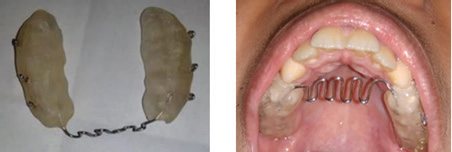
FIG 7
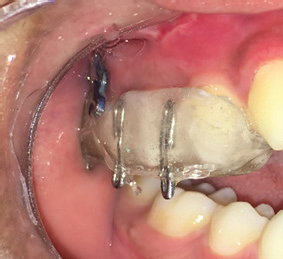

FIG 8

FIG 9

FIG 10
A significant closure in the open bite of 3-4 mm along with correction of oral habits was observed in a short period of three months of splint cementation (fig 1, 2). A prominent change was observed in the profile. Cephalometric analysis showed an increase in the SNB angle by two degrees and decrease in ANB angle by two degrees. Intrusion of maxillary posterior teeth was achieved. The interincial angle increased by 3.5 degrees. (fig 11)

FIG 11
DISCUSSION
The present case report assesses the effectiveness of zygomatic miniplates for molar intrusion. This is an ongoing case approaching the conclusion of Phase I. The advantages of using zygomatic miniplates as an alternative over the use of conventional intra oral and extra oral appliances are appreciable. Minimal patient cooperation was required, except for good oral hygiene and practicing of the myofunctional exercise. A minimally invasive and simple technique facilitated the surgical procedure and reduced the operation time.8
Notable extra-oral and skeletal changes were seen along with a remarkable decrease of the open bite. The fabrication of a customized splint for intrusion and uniform force application is one of the highlights of this case. The incorporation of tongue crib in the splint and practicing of myofunctional exercise by the patient rendered in correction of oral habits.
The present study showed that 3-4 mm of open bite was corrected with maxillary molar intrusion and counterclockwise rotation of the mandible along with the termination of oral habits. The patient was comfortable with the splint cementation and showed good compliance.
However the long term prognosis will be established only once the stabilization of the bite and minor tooth movements which will be undertaken in Phase II and III respectively is complete. The patient will be recalled for regular follow ups for assessing the prognosis of the treatment plan.
REFERENCES
- Sherwood KH, Burch JG, Thompson WJ. Closing anterior open bites by intruding molars with titanium miniplate anchorage. Am J Orthod Dentofacial Orthop. 2002;122:593– 600.
- Bell W H 1980 Surgical correction of dentofacial deformities . Saunders , Philadelphia
- Erverdi N ,Usumez S, Solak A .New generation open-bite treatment with zygomatic anchorage . Angle Orthod 2006 ; 76 ( 3 ): 519 – 26
- Chunlei Xuna; Xianglong Zengb; Xing Wang, Microscrew Anchorage in Skeletal Anterior Open-bite Treatment, Angle Orthodontist, Vol 77, No 1, 2007, 47-56
- Melsen B, Petersen JK, Costa A. Zygoma ligatures: an alternative form of maxillary anchorage. J Clin Orthod. 1998;32:154–158.
- De Clerck H, Geerinckx V, Siciliano S. The Zygoma Anchorage System. J Clin Orthod. 2002;36:455–459.
- Erverdi N, Tosun T, Keles A. A new anchorage site for the treatment of anterior open bite: zygomatic anchorage case report. World J Orthod. 2002;43:147–153
- Erverdi N, Keles A, Nanda R. The Use of Skeletal Anchorage in Open Bite Treatment: A Cephalometric Evaluation. Angle Orthodontist ,Vol 74, No 3, 2004.381-390
Disclaimer from Guident
The views and opinions expressed in articles published in Guident are solely those of the authors and do not necessarily reflect the views of the editors, the editorial board or the publisher, Ivory India. Guident does not endorse any product, technique or treatment described. Clinical content is intended for qualified dental and medical professionals and is not a substitute for individual clinical judgement. Guident, its editors and the publisher accept no liability for any consequence arising from the use of information published in the journal.
How to cite this article
Dr. Rajmohan Shetty, Dr. Amitha M Hegde, Dr. Sonali Sodhi. Correction of Anterior Open Bite and Tongue Thrusting Using Zygomatic Miniplates-a Case Report. Guident. 2020 Feb;13(3). Available from: https://guident.net/articles/pedodontics/correction-of-anterior-open-bite-and-tongue-thrusting-using-zygomatic-miniplates-a-case-report.html