Long Term Effects of Gastro Esophageal Reflux Disease and Overzealous Toothbrushing on the Dentition-a Case Report
Department of Periodontics, Manipal College of Dental Sciences, Manipal Academy of Higher Education, Mangalore, Karnataka
Aim
The aim of this article is to describe a case report on the effects of long-standing Gastroesophageal (GERD) reflux disease and long-term overzealous tooth brushing on the dentition.
BACKGROUND
Gastric reflux is a relatively common disorder and long-standing GERD can cause tooth surface loss in the form of dental erosion. Overzealous tooth brushing can also cause deleterious effects on the dental hard tissues. When the above are seen together a combined or synergistic effect on the dentition can be seen. A proper case history including medical and dental history should be taken to diagnose the causes of extensive tooth surface loss and to provide timely interventional therapy.
CASE DESCRIPTION
This article describes a case of chronic long-standing gastroesophageal reflux disease and long-term overzealous tooth brushing on the dentition. A synergistic effect of erosion and abrasion caused extensive tooth surface loss on different surfaces of the dentition. The diagnosis was made based on a thorough medical, dental and personal history.
CONCLUSION
Since tooth surface loss is commonly seen nowadays it is absolutely necessary for the dental practitioner to determine and eliminate the underlying causes of tooth wear and to take appropriate steps for intervention.
Significance
The case described here shows us the importance of timely detection of tooth wear due to chronic systemic conditions and habits.
BACKGROUND
Gastroesophageal reflux disease (GERD), is as an involuntary muscle relaxing of the upper esophageal sphincter allowing the refluxed acid to move upward through the esophagus into the oral cavity1
The association between GERD and dental erosion was reported by Howden in 1971. Several authors have also stated that, an important diagnostic sign of acid reflex is dental erosion. Gastric reflex without other symptoms like heartburn, belching and unexplained sour taste is known as “Silent GERD”. Patient who have undiagnosed silent GERD may present with unexplained enamel erosion and sensitivity in posterior teeth.2,3,4
In a systematic review by F. Pace et al in 2008, median prevalence for GERD in adult patients was 32.5% and median prevalence for tooth erosion was 24% in GERD patients.
They concluded that a dentist may play a pivotal role in diagnosing patients with GERD.5
Refluxed acid most commonly affects the palatal surface of upper incisors, occlusal and labial surface of posteriors in both maxillary and mandibular arches.1,6
GERD is not only associated with dental erosion but can also cause laryngeal, pharyngeal, respiratory, ENT problems and can also increase the chances of adeno carcinoma and Barretts esophagus.7 (Table-1)
Dental erosion is defined as “the loss of tooth structure by chemical action in the continued presence of demineralizing agents”.1 This is commonly seen in patients with habits such as constant citrus ingestion, continuous exposure to airborne acids or gastrointestinal problems that cause repeated exposure of the dentition to gastric acids.8,9,10,11 Prevalence of dental erosion may be as high as 42% in adult population.12 Tooth wear can also be seen in patients with overzealous and improper tooth brushing habits leading to gingival recession and cervical tooth surface loss. Attrition, erosion and abrasion can be classified under tooth surface loss (TSL). On many occasions all the three can be simultaneously happening in the oral cavity. Increased frequency of tooth brushing in the presence of acidic environment can lead to increased tooth surface loss.13

TABLE-1 Clinical symptoms of GERD
CASE DESCRIPTION
A male patient aged 54 years was referred to the Department of Periodontology for routine checkup. The patient had never undergone oral prophylaxis till date. A thorough medical history was taken. The patient stated that he was diagnosed of gastroesophageal reflux disease 25 years back and was on Nexpro, a proton pump inhibitor. He said he had frequent belching/gastric reflux and could feel a bitter taste in the mouth. He also mentioned that he was an asthmatic for the past 20 years and was on Wysolone (Prednisolone). He had frequent asthmatic attacks. Though a known hypertensive, his blood pressure was under control. He also was on medication for increased cholesterol levels. The patient had previously visited the dentist for restorations. In his personal history he stated that he brushed his teeth 6 times daily with a medium toothbrush and paste using horizontal strokes. He had this habit for more than 20 years. He also stated that he felt slight dryness in his mouth at least once a day. On oral examination there was generalized recession and tooth surface loss, mostly on the facial and buccal surfaces (Fig 1a, 1b & 1c). Mandibular anterior lingual surfaces also showed recession and tooth wear. (Fig 2). Tooth wear of the occlusal surfaces of posterior teeth was also very evident (Fig 3). The palatal aspect of the upper anterior teeth was relatively unaffected. Oral prophylaxis was carried though the deposits were very mild. Further treatment for the gingival recession was discussed with the patient. The patient was advised on ill effects of overzealous brushing on the dentition. He was told to brush twice daily instead of six times with a proper technique using a soft tooth brush and to rinse his mouth after eating any food stuff.
Figure-1a
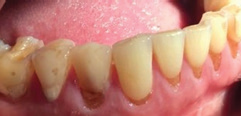
Figure 1b

Figure 1c

Figure 2
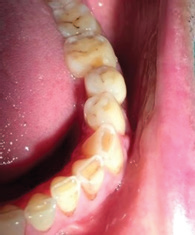
Figure 3
DISCUSSION
GERD is fairly common in the general population. It occurs when the gastric contents involuntarily pass through the esophagus into the oral cavity. GERD has several symptoms including belching and heart burn although some ‘silent GERD’ patients have no symptoms. Oral symptoms of GERD include burning mouth, sour taste, erosion of teeth and loss of esthetics. Long term GERD can result in dental erosion especially of the posterior teeth.14 (Table 2)

TABLE- 2 Oral manifestations of GERD
Dental erosion is an “irreversible process characterized by mineral loss unrelated to microbial involvement”15. It occurs at a pH of about 5.5. Dental erosion can be caused due to various factors. These can be divided into endogenous and exogenous factors16 (Table 3). In a patient with GERD dental erosion can be present bilaterally and localized to the occlusal surfaces of molar teeth, palatal of upper anterior teeth as well as teeth with low plaque levels.17,18

TABLE-3 Causes of dental erosion
In the present case the occlusal surfaces of posterior and anterior teeth and the facial and buccal aspects were affected. This may be due to the overzealous tooth brushing of these areas. It can be said that a combined tooth surface loss due to erosion and abrasion was taking place simultaneously.
In the present case the patients brushing frequency was 6 times a day. A study conducted by Kofoworla et al 2018 showed that tooth wear was directly related to the brushing frequency.19 Tooth wear is multifactorial and is rarely seen in isolation.20 Mostly combined lesions of erosion and abrasion are most common TSL, which is also evident in the present case. They are caused by synergistic action of erosive agents and abrasive factors. It has been shown that enamel exposed regularly to acidic agents have a greater susceptibility to abrasion and attrition as compared to intact enamel,21 which is also seen in the present case. The teeth exposed to gastric reflux were subjected to more TSL due to the patients overzealous brushing habit. This can be characterized by atleast 50 percent increase in the influence of abrasive factors on the dentition which was previously reported.22 Hence in our case we can say that there was an erosive-abrasive synergistic effect. Jaeggi and Lussi also found that eroded enamel loss after tooth brushing is 10 times greater than intact enamel.21
Symptoms like asthma and oral dryness (due to proton pump inhibitors) have also been noted in patients with GERD. These symptoms were also observed in the present case.22,23
CONCLUSION
TSL due to physical and chemical wear is relatively common. Clinical practitioners should be aware of the predisposing risk factors for GERD and its classical esophageal & extraesophageal signs and symptoms. Nevertheless, not all affected individuals will have the classical symptoms of gastric regurgitation. Hence, Dentists can play a major role in diagnosing patients with “silent GERD” by detecting unexplained tooth erosion.
It can also be stated that erosion, abrasion or attrition may be taking place simultaneously to cause tooth surface loss. So, it is mandatory for the clinician to take a thorough dental, medical and personal history.
Correcting advanced TSL is more complex than initial stages. For this the etiologic factors must be determined and eliminated, and the progression can be stopped by preventive and minimally invasive treatment modalities. The patient has been explained about the various treatment modalities and the proper brushing technique is being reinforced. Patient is kept under regular maintenance therapy until the he exhibits a proper brushing technique.
CLINICAL SIGNIFICANCE
From a clinical point of view, it is necessary to ascertain and determine the underlying causes of tooth wear. As tooth surface loss mostly happens as a combination of abrasion, erosion and attrition, a thorough medical, dental and personal history needs to be taken at the time of initial dental examination. This will ultimately help the dental practitioner in the timely management of such clinical cases with lesser interventional treatment modalities.
REFERENCES
- Bartlett DW, Evans DF, Smith BG: Oral regurgitation after reflux provoking meals: a possible cause of dental erosion? J Oral Rehabil 1997, 24:102-108.
- Howden GF. Erosion as representing symptoms in hiatus hernia: a case report. Br Dent J 1971; 131:455-6.
- Ajagbe O, Brown RS, Krakow AM, Choksi S. Dental erosion caused by gastric reflux: a report of two cases. Am Dent Inst Continuing Education 1998; 66:9-14.
- Myllarniemi H, Saario I. A new type of sliding hiatus hernia. Ann Surg 1985; 202:159-61.
- F. Pace, S. Pallotta, M. Tonini, N. Vakil, and G. Bianchi Porro,“Systematic review: gastro-oesophageal reflux disease and dental lesions,” Alimentary Pharmacology and Therapeutics, vol. 27, no. 12, pp. 1179–1186, 2008.
- Spigset O: Oral symptoms in bulimia nervosa. A survey of 34 cases. Acta Odontol Scand 1991, 49:335-339
- Sarath Kumar et al. Journal of Indian Society of Pedodontics and Preventive Dentistry Official journal of the Indian Society of Pedodontics and Preventive Dentistry Year: 2018 : Volume : 36 , Issue : 2 , Page : 125—129
- Grippo JO. Abfractions: a new classification of hard dental tissue lesions of teeth. J Esthet Dent 1991; 3:14-19.
- Järvinen V, Meurman JH, Hyvärinen H, Rytömaa I, Murtomaa H. Dental erosion and upper gastrointestinal disorders. Oral Surg Oral Med Oral Pathol 1988; 65:298-303.
- Knewitz JL, Drisko CL. Anorexia nervosa and bulimia: a review. Compendium 1988;9:244-247.
- Levitch LC, Bader JD, Shugars DA, Heymann HO. Noncarious cervical lesions. J Dent 1994; 22:195-207.
- Gregory-Head BL, Curtis DA, Kim L, Cello J: Evaluation of dental erosion in patients with gastroesophageal reflux disease. J Prosthet Dent 2000, 83:675-680.
- M. Kelleher and K. Bishop, British Dental Journal, Vol 186, No. 2, Jan 23 1999
- Su JM, Tsamtsouris A, Laskou M. Gastroesophageal reflux in children with cerebral palsy and its relationship to erosion of primary and permanent teeth. J Mass Dent Soc 2003; 52:20–24
- Ali DA, Brown RS, Rodriguez LO, Moody EL, Nasr MF. Dental erosion caused by silent gastroesophageal reflux disease. J Am Dent Assoc 2002; 133:734–737.
- SAC Liberali, Australian Dental Journal 2008; 53: 176–179 Oral impact of gastro-esophageal reflux disease: a case report
- Erosion. Detecting and managing dental erosion. Special Topic No. 2. Colgate Dental Education Programs. A joint program by Colgate Oral Care and The University of Adelaide. 2006.
- Journal of Indian Society of Pedodontics and Preventive Dentistry. Year: 2018 Volume: 36 |Issue : 2 : 125—129 Oral manifestations of gastroesophageal reflux disease in children: A preliminary observational study.
- Kofoworola et al. European Journal of Dentistry Australian Dental Journal 2008; 53: 176–179.
- Morozova et al. IOSR Journal of Dental and Medical Sciences, Volume 14, Issue 6 Ver. VIII (May. 2016), PP 84-91.
- H.K. Yip, R.J. Smales, and J.A. Kaidonis, Tooth erosion prevention and treatment (New Delhi: Jaypee Brothers, 2-nd printing, 2009.
- http://www.xylitol.org/
- C. Scully. Drug effects on salivary glands: dry mouth. Oral Diseases (2003) 9, 165–176.
Disclaimer from Guident
The views and opinions expressed in articles published in Guident are solely those of the authors and do not necessarily reflect the views of the editors, the editorial board or the publisher, Ivory India. Guident does not endorse any product, technique or treatment described. Clinical content is intended for qualified dental and medical professionals and is not a substitute for individual clinical judgement. Guident, its editors and the publisher accept no liability for any consequence arising from the use of information published in the journal.
How to cite this article
Dr. Razia Haidrus, Dr. David Kadakampally. Long Term Effects of Gastro Esophageal Reflux Disease and Overzealous Toothbrushing on the Dentition-a Case Report. Guident. 2020 Feb;13(3). Available from: https://guident.net/articles/periodontics/long-term-effects-of-gastro-esophageal-reflux-disease-and-overzealous-toothbrushing-on-the-dentition-a-case.html