Digital Space Maintainers in Pediatric Dentistry: From Conventional Appliances to CAD-CAM and 3D-Printed Solutions-a Narrative Review
Department of Pediatric and Preventive Dentistry, College of Dental Sciences, Davangere, Karnataka, India
ABSTRACT
Premature loss of primary teeth can cause mesial migration and tipping of adjacent teeth, loss of arch length, and disturbance of the eruption pathway of permanent successors. Space maintainers therefore remain an important component of preventive and interceptive pediatric dentistry. Conventional appliances such as band-and-loop, distal shoe, lingual arch, transpalatal arch, Nance palatal arch, and removable acrylic appliances are clinically established but may require conventional impressions, manual laboratory procedures, multiple appointments, and chairside adjustment. The emergence of digital dentistry has introduced intraoral scanning, computer-aided design and manufacturing (CAD/CAM), and three-dimensional (3D) printing for customized space maintainer fabrication. Digital workflows permit accurate acquisition of dental anatomy, virtual appliance design, rapid manufacturing, digital storage, and reproduction. Materials including polyetheretherketone (PEEK), PMMA, photopolymer resins, and other polymers have been investigated. Current evidence suggests potential advantages in fit, comfort, esthetics, fabrication efficiency, and patient acceptance, although material selection, equipment cost, training, regulatory requirements, and limited long-term clinical evidence remain important considerations. This narrative review summarizes the evolution, workflow, materials, clinical applications, comparative evidence, limitations, and future directions of digital space maintainers in pediatric dentistry.
Keywords: digital dentistry; space maintainer; pediatric dentistry; CAD/CAM; 3D printing; intraoral scanner; PEEK; additive manufacturing
INTRODUCTION
Space maintenance is an important preventive strategy after premature loss of primary teeth. Primary teeth contribute to arch integrity, normal eruption and occlusal development; their early loss can permit drifting or tipping of adjacent teeth and alter the eruption path of permanent successors.1,2
Conventional space maintainers include band-and-loop, crown-and-loop, distal shoe, lingual arch, transpalatal arch, Nance palatal arch and removable acrylic appliances. Selection depends on the number and location of missing teeth, dental age, eruption status of the successor, abutment-tooth condition, oral hygiene, cooperation and treatment objectives.1,3
Digital dentistry has introduced intraoral scanning, CAD/CAM and additive manufacturing into this field. The concept of digitally fabricated space maintainers, or “digitainers,” aims to reduce manual fabrication steps while improving customization, reproducibility and the pediatric treatment experience.3,4
AIM OF THE REVIEW
To summarize the current evidence and clinical considerations related to digitally designed and manufactured space maintainers in pediatric dentistry, with emphasis on workflow, materials, clinical performance, patient acceptance, limitations and future directions.
Digital Workflow
A digital workflow generally begins with clinical case selection and intraoral scanning, followed by generation of a three-dimensional digital model, CAD design, optional biomechanical analysis, and fabrication by milling or 3D printing. Digital files can be archived and reproduced when necessary.3,4,5
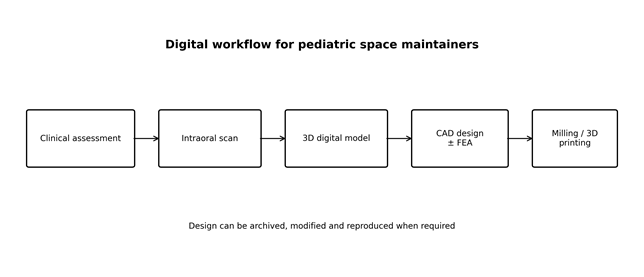
Figure 1. Schematic representation of a digital workflow for pediatric space maintainers. Original schematic prepared for this manuscript.
Intraoral scanning can avoid tray-based impression procedures and provides a digital record of the dentition. CAD software permits individualized design according to tooth position, arch morphology, tissue contours, retention and eruption requirements. The completed design can then be manufactured and clinically evaluated for fit, retention, tissue adaptation and occlusion.3,4,5
CAD/CAM AND THREE-DIMENSIONAL PRINTING
CAD/CAM permits controlled digital design followed by either subtractive milling or additive manufacturing. Digital design can reduce dependence on manual wire adaptation and may decrease the need for repeated adjustment. Finite element analysis (FEA) can additionally be used to evaluate stress distribution before fabrication, while generative design is an emerging approach for optimizing appliance geometry.4,5
Three-dimensional printing produces appliances layer by layer from a digital file. SLA and DLP are commonly used for high-resolution resin printing, while other additive technologies may be selected according to material and mechanical requirements. A fully digitized workflow has been demonstrated for customized pediatric space maintainers, including computer-generated design and additive manufacturing.5,6
Materials Used in Digital Space Maintainers
Material selection should be based on mechanical requirements, biocompatibility, dimensional stability, esthetics, manufacturability and the intended duration of use. PEEK has attracted interest because of its strength-to-weight characteristics, biocompatibility and tooth-colored appearance. PMMA and printable photopolymers are also used in digital workflows, while nylon/polyamide and hybrid materials have been explored for selected applications.3,4,7,8

Figure 2. Overview of commonly discussed material classes and their principal considerations in digital space maintainer fabrication. Original schematic prepared for this manuscript.
|
Material |
Potential advantages |
Important considerations |
|
PEEK |
Lightweight, tooth-colored, durable |
Higher cost; specialized fabrication; bonding considerations |
|
Photopolymer resin |
High-resolution 3D printing; complex geometries |
Material-specific intraoral validation and post-processing |
|
PMMA |
Established dental polymer; digitally millable |
Fracture/wear considerations depending on design |
|
Nylon/polyamide |
Flexible and resilient |
Surface characteristics and indication must be considered |
|
Hybrid materials |
Potential balance of strength and esthetics |
Clinical evidence is still developing |
CLINICAL SELECTION AND APPLICATIONS
Digital fabrication does not replace conventional clinical principles. Case selection should consider dental age, location and number of missing teeth, space status, eruption of the permanent successor, abutment-tooth integrity, oral hygiene, patient cooperation, esthetic expectations and expected duration of treatment.1,3
Digital workflows may be especially useful when customized adaptation, esthetics, rapid fabrication or reproducibility is desirable. However, poor oral hygiene, uncontrolled caries, significant periodontal or soft-tissue problems, severe non-cooperation, or an expected eruption interval that is very short may limit the indication for a space maintainer.1
Conventional Versus Digital Space Maintainers
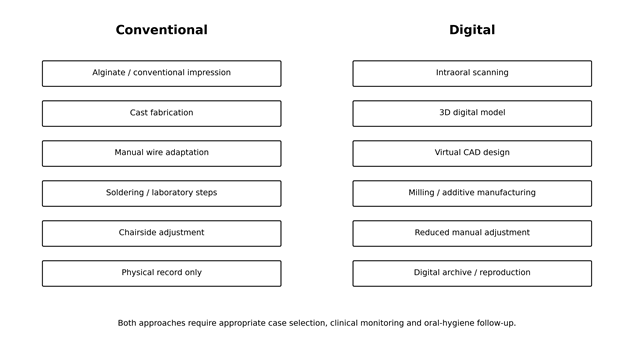
Figure 3. Comparison of major steps in conventional and digital space maintainer workflows. Original schematic prepared for this manuscript.
The principal differences concern impression acquisition, design and fabrication. Conventional appliances are familiar, relatively accessible and based on established materials, but may involve impression discomfort, manual adaptation, soldering and laboratory dependence. Digital approaches can provide individualized design, digital archiving and potentially fewer manual fabrication steps.
Evidence comparing digital and conventional appliances is emerging. In a 2024 randomized clinical trial involving 62 children aged 6–12 years, 3D-printed band-and-loop space maintainers showed higher 9-month retention than conventional band-and-loop appliances (77.4% vs 51.6%), although both groups demonstrated an increase in gingival index, emphasizing the importance of oral hygiene.9
A 2023 study described a digitized workflow combining intraoral scanning, generative design, FEA and DLP additive manufacturing for a customized pediatric space maintainer, demonstrating the feasibility of integrating digital design and biomechanical assessment.6
A 2025 systematic review and meta-analysis evaluated the effectiveness and survival of different space-maintainer categories in children and highlights the importance of considering appliance type and clinical context when interpreting survival outcomes.10
PATIENT AND PARENTAL ACCEPTANCE
The pediatric treatment experience is an important consideration. Digital impressions avoid conventional impression trays and may reduce gagging and anxiety in some children. The literature on digitainers describes potential benefits in comfort, precision and time efficiency, although patient-reported outcomes remain less extensively studied than technical outcomes.3,4
Improved esthetics from tooth-colored materials may also influence acceptance. Nevertheless, parental counseling should address hygiene, appliance care, follow-up, possible complications, cost and the expected duration of treatment.
ADVANTAGES AND LIMITATIONS
|
Potential advantages |
Current limitations |
|
Customized design and reproducibility |
Initial investment in scanner/CAD/printing equipment |
|
Reduced dependence on conventional impressions |
Learning curve for clinicians and technicians |
|
Digital storage and rapid reproduction |
Material-specific limitations and post-processing |
|
Potentially improved comfort and esthetics |
Limited long-term clinical evidence for some materials/designs |
|
Potential reduction in manual laboratory steps |
Access and regulatory considerations |
|
Integration with FEA/generative design |
Not every clinical case requires or benefits from digital fabrication |
FUTURE DIRECTIONS
Future development is likely to involve greater integration of AI-assisted design, generative algorithms, FEA, improved intraoral scanners, validated printable biomaterials and cloud-based digital records. These technologies may facilitate automated design, stress optimization, remote laboratory collaboration and rapid remanufacturing.4,5
Future studies should prioritize randomized clinical trials with standardized definitions of success and failure, longer follow-up, material-specific safety evaluation, cost-effectiveness analysis and patient-reported outcomes. Comparative evidence should distinguish between different appliance designs and manufacturing technologies rather than treating all digital space maintainers as a single category.
CONCLUSION
Digital space maintainers represent a significant development in pediatric preventive and interceptive dentistry. Intraoral scanning, CAD/CAM and 3D printing can provide customized, reproducible appliances with potential advantages in fit, comfort, esthetics and workflow efficiency. Current evidence supports their clinical feasibility, but digital appliances should not be considered universally superior to conventional appliances. Appropriate case selection, material validation, clinical follow-up and oral-hygiene maintenance remain essential. With stronger long-term evidence and continued technological development, digital workflows are likely to assume an increasingly important role in pediatric space maintenance.
REFERENCES
- American Academy of Pediatric Dentistry. Management of the developing dentition and occlusion in pediatric dentistry. In: The Reference Manual of Pediatric Dentistry. Chicago, IL: AAPD; 2024.
- Casaña-Ruiz M, Aura-Tormos JI, Marques-Martinez L, Garcia-Miralles E, Perez-Bermejo M. Effectiveness of space maintainers in pediatric patients: a systematic review and meta-analysis. Dent J (Basel). 2025;13(1):32. doi:10.3390/dj13010032.
- Dhanotra KGS, Bhatia R. Digitainers—Digital Space Maintainers: A Review. Int J Clin Pediatr Dent. 2021;14(Suppl 1):S69-S75. doi:10.5005/jp-journals-10005-2040.
- Soni HK, Saluja H, Goyal A, Jindal R. Application of CAD-CAM for fabrication of metal-free band and loop space maintainer. J Clin Diagn Res. 2017;11(2):ZL02-ZL03.
- Zarean P, Sendi P, Neuhaus KW. Advances in the manufacturing process of space maintainers in pediatric dentistry: a systematic review from traditional methods to 3D-printing. Appl Sci. 2023;13(12):6998.
- Tamburrino F, Chiocca A, Aruanno B, Barone S. A novel digitized method for the design and additive manufacturing of orthodontic space maintainers. Appl Sci. 2023;13(14):8320. doi:10.3390/app13148320.
- Essawy R, El-Ela MA, El-Shabrawy SM. Clinical performance of CAD/CAM fixed functional space maintainer made of polyetheretherketone. Minia J Med Res. 2021;32(4):7-12.
- Kun K, Li Z, Wang Y, Zhang X. Application of CAD/CAM technology in fabrication of space maintainers with polyetheretherketone for children. Shanghai Kou Qiang Yi Xue. 2019;28(6):641-645.
- Thakur B, Bhardwaj A, Luke AM, Wahjuningrum DA. Effectiveness of traditional band and loop space maintainer vs 3D-printed space maintainer following the loss of primary teeth: a randomized clinical trial. Sci Rep. 2024;14:14081. doi:10.1038/s41598-024-61743-7.
- Casaña-Ruiz M, Aura-Tormos JI, Marques-Martinez L, Garcia-Miralles E, Perez-Bermejo M. Effectiveness of space maintainers in pediatric patients: a systematic review and meta-analysis. Dent J (Basel). 2025;13(1):32. doi:10.3390/dj13010032.
Disclaimer from Guident
The views and opinions expressed in articles published in Guident are solely those of the authors and do not necessarily reflect the views of the editors, the editorial board or the publisher, Ivory India. Guident does not endorse any product, technique or treatment described. Clinical content is intended for qualified dental and medical professionals and is not a substitute for individual clinical judgement. Guident, its editors and the publisher accept no liability for any consequence arising from the use of information published in the journal.
How to cite this article
Dr. Vaishnavi K Naik, Dr. Mallikarjuna K. Digital Space Maintainers in Pediatric Dentistry: From Conventional Appliances to CAD-CAM and 3D-Printed Solutions-a Narrative Review. Guident. 2026 Sep;19(10). Available from: https://guident.net/articles/pedodontics/digital-space-maintainers-in-pediatric-dentistry-from-conventional-appliances-to-cad-cam-and-3d-printed.html