Incisal Abnormalities and the Misarticulation of Dentoalveolar Consonants in Children with Unilateral Cleft Palate
Department of Pedodontics & Preventive Dentistry, A.B.S.M.I.D.S, Nitte University Mangalore, India, Nitte University Mangalore, India, Nitte Institute of Speech & Hearing, Mangalore University, India
Abstract
The objective of the present study was to evaluate the incidence of incisal abnormalities or anomalies, to the consonant mis-articulations in children with unilateral cleft palate with the involvement of lip, before and after surgical correction.75 Non-syndromic children with unilateral cleft palate belonging to various experimental groups between the age group of 7-12 years were selected for the study. Dental abnormalities were identified on the dental casts & the selected consonants were evaluated from all the three groups, by 3 qualified speech pathologists and then statistically analyzed. The incorrect production of the consonants /tha/, /dha/, /na/ in the untreated CP group, improved after surgical correction which further improved on speech therapy. The consonant /sa/ did not show any improvement post surgery. Conclusion: No significant relationship could be established between the error in the consonants and the incisal abnormalities observed.
Keywords: Cleft palate, Dento alveolar Consonants, Speech
Running Title: Incisal abnormalities and Dento alveolar Consonants
INTRODUCTION
Clefting of the palate are associated with severe dental anomalies resulting from the disturbances occurring during the development of dentition1. The congenital lack of one or more permanent teeth is most common congenital deformity found in humans affecting approximately 20% of population worldwide of which individuals with oral clefts exhibit a higher incidence of dental development disturbances in comparison with the general population2, 3. During embryogenesis, primary palate develops from the fusion of the medial nasal process with the maxillary process between 4-7 weeks of intrauterine life. This primarily includes the central portion of the upper lip, alveolus bearing four incisors and palate anterior to the incisive foramen. Non fusion of median nasal process and maxillary process can result in the higher incidence of dental developmental disturbances in cleft children especially in the maxillary anterior region. Bhaskar in 1976 stated that tooth anomalies occur during different phases of dental development, i,e., numerical anomalies occur during the initial formation of dental germs, shape anomalies during morpho-differenciation, and position anomalies during tooth eruption4. Bohn (1950) has stated that these anomalies mainly occur at the level of the lateral incisors in both deciduous and permanent dentition5.
During the mixed dentition period, absence of incisors from the developmental processes has been attributed to articulatory speech disorders which are resolved with the eruption of permanent incisors6. In children with oral clefts absence or congenital malformation of teeth in the maxillary anterior region can invariably affect speech sound development contributing to the difficulty to produce high pressure consonants7, with the reduced hard palate surface area being one of the contributing factors for misarticulation in these children7. Hence the aim of the study is to evaluate the incidence of maxillary anterior tooth anomalies and their correlation to the misarticulation of the selected consonants.
METHODOLOGY:
75 non-syndromic children with unilateral cleft palate with the involvement of lip between the age group of 7-12 years were selected for the study.
The patient’s records were reviewed for cleft type and extent, associated syndromes and anomalies and speech analysis. Only patients with normal hearing and without any syndrome or psychomotor problems were included in the study group. In this study group palatal surgery was done at the mean age of 4.5 years and no other interceptive orthodontic procedure was carried out.
The selected children were categorized into 3 groups:
GROUP I: 25 untreated children with unilateral cleft palate with the
involvement of lip.
GROUP II: 25 surgically treated children with unilateral cleft
palate with the involvement of lip.
GROUP III: 25 surgically treated children with unilateral cleft
palate with the involvement of lip and ongoing speech therapy.
STUDY MODEL PREPARATION
Impressions were made and casts were prepared of these patients. Study models for all the three groups of children were made based on the proper duplication and anatomical landmarks for the assessment of dental abnormalities.
In case of untreated cleft palate patients, the impressions were made by placing a layer of gauze or wax sheet over the alginate loaded tray, in order to prevent the alginate flowing into the cleft defect8.
The maxillary dental arches of all the patients were assessed for the clinical presence of incisal abnormalities which included agenesis and/or rotation of the tooth.
CONSONANT SELECTION
The anatomical variables considered/selected in the present study were the incisors of the maxillary arch. Hence, the dentoalveolar consonants /tha/, /dha/, /na/ & /sa/ were selected9.
Audiological evaluation of all the children was done by the audiologist to rule out any hearing problems. The speech samples of the cleft children were recorded using a tape recorder with an external mike in a sound treated room. The recorded speech samples were later analyzed by 3 speech pathologists in a sound treated room. The production of the consonants /tha/, /dha/, /na/ and /sa/ were checked for errors of distortion, omission and substitution. To ensure that the interpretations by the 3 audiologists were identical, inter-judge agreement was assessed by having each patient’s consonant production values checked at the same time by all the 3 speech pathologists. The categorizing of distortions, substitutions and omissions was based on 100% consensus between them.
Standard materials: are specific standardized articulation tests specific to a particular language which analyzes all the sounds of that language in all the positions they occur in a word i.e., at the initial, medial and/or the final positions. The languages used here were Kannada, Malayalam and English.
The data gathered was subjected to statistical analysis. Chi-square test was applied for consonant analysis as the data represents a qualitative nature. The data gathered for incisal abnormalities is quantitative in nature facilitating the application of ANNOVA. Turkeys test was done for inter comparison between groups.
RESULTS
Incisal abnormalities
The prevalence of missing lateral incisors was 56% , followed by rotated central incisors with missing lateral incisors which were seen in 20%, followed by the rotated lateral incisor which was seen in 14% and finally rotated central incisors with rotated lateral incisors seen in 16% of the cleft group respectively.
Consonant analysis
The evaluation of the selected consonants /tha/, /dha/, /na/ & /sa/ individually revealed that, the production was mostly incorrect in the untreated cleft palate group. The consonants /tha/, /dha/, /na/ & /sa/ which showed total incorrect production before surgery showed definite improvement after surgery ranging from 16 %( /sa/) to as high as 80% (/tha/). The speech sound production of the consonant /tha/,/ dha/ &/na/ improved further with speech therapy. [Graph I, II & III ]


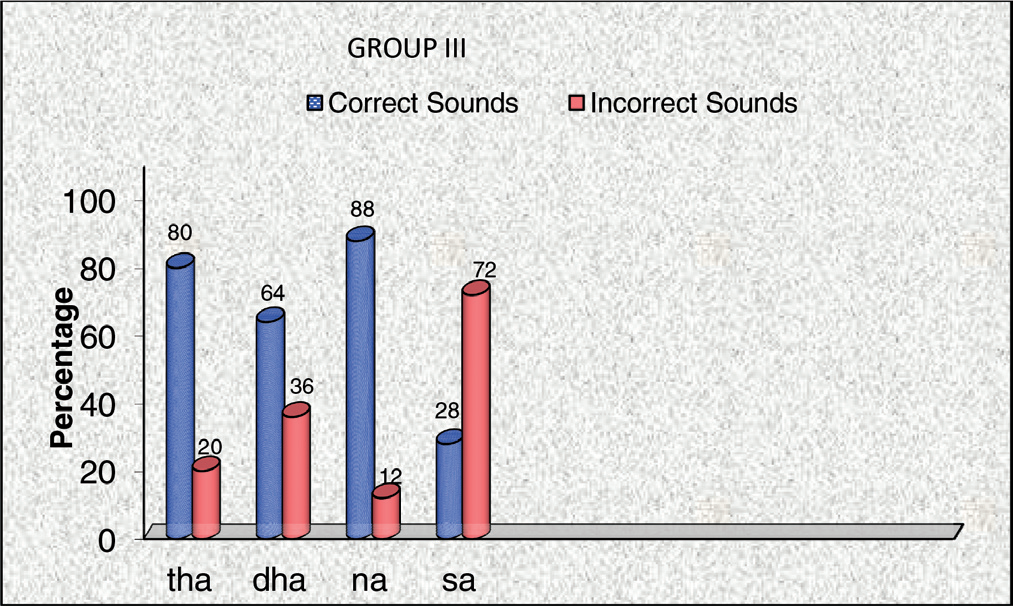
The percentage of distorted sounds which was higher in untreated CP patients, decreased in surgically treated CP patients. Substituted sounds were found to be absent in untreated cleft palate patients, but they were observed in children who had undergone surgical correction of the palate. .
The production of consonants /tha/, /dha/ & /na/ showed improvement after surgical correction, whereas, the production of consonant /sa/ was observed to be weak in spite of surgical correction.[Graph II]. But in any of the dentoalveolar consonants no significant relationship could be established between the error in the consonants and the incisal abnormalities observed
DISCUSSION
Clefts of all types are associated with dental and occlusal abnormalities, the prevalence increasing with the severity of clefts10.The abnormal development of the alveolar process in the cleft area causes alterations in the number, size and eruption of teeth11, 12. Most of the dental abnormalities occur in the lateral incisor region of the cleft side and are commonly found missing or demonstrate delayed development 5, 13-16
The high prevealence of missing lateral incisors was confirmed in the present study which was observed to be in 56% of the cases. Various authors have suggested the absence of fusion between the maxillary and medial nasal process in cleft lip and palate population to be the reason that leads to anomalies affecting the lateral incisors. The present study has observed the rotated central incisors with missing lateral incisors which were seen in 20%, followed by rotated lateral incisors which was seen in 14% and finally rotated central incisors with rotated lateral incisors which were seen in 16% of the selected cleft groups respectively. This finding is in accordance to the investigative reports of various studies which have stated that, the central incisors adjacent to the cleft may be missing, rotated or hypoplastic. The central incisors erupt in an abnormal position, rotated or severely deviated from the supposedly normal inclination17, 18.
The structural issues involved with cleft population such as velopharyngeal function, middle ear disease and hearing loss and the associated dental and occlusal anatomical abnormalities represent hazards to precise articulation of speech19.The dentition associated with alveolar clefting could influence the production of sibilants during childhood20. Children with clefts of the palate have difficulty producing high pressure consonants, the reduced hard palate surface being one of the many contributing factors for defective speech sounds with alveolar or palatal place of articulation7, 21.
The comparative evaluation of the dentoalveolar consonants in the present study has shown marked improvement in the production of consonants /tha/ and /dha/ post surgical intervention which improved further with speech therapy. Whereas, the consonant /na/ did not show any improvement following Speech therapy. The speech sound production of the consonant /s/ did not improve in spite of surgical correction. Previous studies have highlighted a significant relationship between the absence of the incisor teeth and incorrect /s/ sound production22, 23. Incisal spacing is also one of the causative factors for lisping in the non cleft population22. These findings highlight the importance of anterior dentition for the proper articulation of consonants.
The speech sound production is estimated to mature by the age of 5 years, but some spontaneous correction of the speech sound production occurs with the maturing of the articulators with age and with eruption of some permanent teeth in the mixed dentition phase of development7. We have to remember that speech is a learned behavior and the disorders associated are multifactorial and can vary from child to child. Children with oral clefts employ various strategies to compensate for the cleft and acquisition of speech but the speech in these patients remains distorted. Weinberg23 has noted that to achieve normal /s/ production the children with missing incisors compensate their anterior dental loss by retruding the mandible and maintaining the tongue tip behind and below the mandibular incisors. Similarly, children with oral clefts utilize a range of maladaptive articulation placements in an effort to compensate for inadequate velopharyngeal closure mechanism or oral nasal fistulae associated with clefts
It has been stated that, abnormalities in the hard palate, including an unrepaired cleft or maxillary collapse after repair , affect the tongue placement and the posturing as well as airflow through the oral cavity .If the hard palate is abnormally low and flat, the precise contact between the tongue and the palate may be compromised, causing distortion of the lingual-palatal sounds7.Jaana Laitenen et al24 had also stated that narrow and shorter maxillary arches and as well as shallower palates were related to the problems of misaticulations of /r/, /s/ & /l/ consonants. Similarly, in the present study the misarticulations that persisted in relation to the consonants in the treated cleft patients may be attributed to reduced hard palate surface, the incisal abnormalities associated being only a secondary causative factor. However, in the present study no significant relationship could be established between the error in the consonants and the incisal abnormalities observed.
The current study has concluded that the consonanat abnormalities were evident in all the three groups. A regular follow up with prolonged speech therapy and analysis will be helpful.
REFERENCES
- Stahl F, Grabowski R, Wigger K. Epidemiology of Hoffmeister’s “genetically determined predisposition to disturbed development of the dentition” in patients with cleft lip and palate. Cleft palate Craniofac.J.2006; 43:457-65.
- Vastardis H. The Genetics of human toot agenesis: new discoveries for understanding dental anomalies. Am.J.Orthod Dentofacial Orthop 2000;117:650-656.
- Bhaskar SN: Patologia bucal. Artes Medicas, Sao Paulo, 144-157,1976.
- Bohn A: Anomalies of the lateral incisor in cases of hare lip and cleft palate. Acta Odont Scand 9: 41-59, 1950.
- Tellervo Laine. Associations between articulatory disorders in speech and occlusal anomalies. European J of Orthodontics, 9, 1987: 144-50
- Courtney E. Jones, Kathy L. Chapman, Mary A Hardin Jones. Speech development of children with cleft palate before and after palatal surgery. Cleft palate craniofacial surgery. 40(1), January 2003: 19-31.
- John Beumer III, Thomas A Curtis, David N Firtell. Maxillofacial Rehabilitation. Prosthodontic and surgical consideration.1979.
- Curtis E Weiss, Mary E Gordon, Herold S Lillywhite. Clinical management of Articulatory and Phonologic Disorders. Second edition. 1987. Williams & Wilkins Publishers. Baltimore, London.
- . Ranta R. A review of tooth formation in children with cleft lip/palate. Am .J. Orthod Dentofacial Orthop. 90(1), July 1986; 11-8
- .Lopes LD, Mattos BS, Andre M. Anomalies in number of teeth in patients with lip and/or palate clefts. Braz Dent J. 1991;2:9-17.
- Tsai TP, Huang CS,Huang CC,See LC. Distribution patterns of primary and permanent dentition in children with unilateral cleft lip and palate. Cleft Palate Craniofac J. 1998;35:154-160.
- Dixon DA. Abnormalities of the teeth and supporting structures in children with clefts of lip and palate. In: Drillien CM, Ingram TTS,Wilkinson EM, eds. The Causes and Natural History of Cleft Lip and Palate. London: E. & S. Livingstone LTD; 1966:178–205.
- .Menius JA, Largent MD, Vincent CJ. Skeletal development of cleft palate children as determined by hand-wrist roentgenographs: a preliminary study. Cleft Palate J. 1966; 3:67–75.
- Akira suzuki,Mieko watanabe,Masayuki nakano, Yasuhide takahama, Maxillary lateral incisor of subjects with Cleft Lip and/or Palate: Part II.. Cleft palate- Craniofacial Journal, July 1992, Vol. 29 No. 4. 380-384
- .Dewinter G, Quirymen M, Heidbuchel K, Verdonck A, Willems G, Carels C. Dental abnormalities, bone graft quality and periodontal conditions in patients with unilateral cleft lip and palate at different phases of orthodontic treatment. Cleft palate Craniofac.J. 2003; 40:343-350.
- Bohn A. Dental anomalies in harelip and cleft palate. Acta Odont Scand 1963;21(Suppl 38):1–109.
- Vichi M, Franchi L. Abnormalities of the maxillary incisors in children with cleft lip and palate. J Dent Child. 1995;Nov–Dec:412–417.
- David P. Kuehn, Karlind T. Moller. Speech and Language Issues in the Cleft Palate Population: The State of the Art Cleft Palate–Craniofacial Journal, July 2000, Vol. 37 No. 4
- Mary A.H-Jones,Carl K.Brown,Duane R.Van Denmark, Huglett L. Morris. Long-term speech results of cleft palate patients with Primary palatoplasty. Cleft palate- Craniofacial J,1993(30)1: 55-63
- S.Amarshree, R.Kavitha, H. Amitha, Dattatreya.T. The relationship between dental arch dimensions and dental abnormalities to the misarticulations of consonants in children with oral clefts. NUJHS December 2012,(2)4:28-34.
- Snowk. Articulation proficiency in relation to certain dental abnormalities. J Speech Hear Disord. 26, 1961: 209-212.
- Weinberg B, A cephalometric study of normal and defective articulation and variations in incisor dentition. J Speech Hear Res. 11, 1968: 288-300.
- Jaana Laitenen, Reijo Ranta Joonas Pulkkinen and Marja-Leena Haapanen.The association between dental arch dimensions and occurrence of finish dental consonant misarticulations in cleft lip/palate children. Acta Odontol Scand. 56, 1998; 308-312.
ACKNOWLEDGEMENT
I would like to thank Prof T. Dattatreya, Principal, Nitte Institute of Speech & Hearing, Mangalore University and the Nitte Meenakshi Craniofacial Centre for Clefts for all the support extended throughout the study.
Disclaimer from Guident
The views and opinions expressed in articles published in Guident are solely those of the authors and do not necessarily reflect the views of the editors, the editorial board or the publisher, Ivory India. Guident does not endorse any product, technique or treatment described. Clinical content is intended for qualified dental and medical professionals and is not a substitute for individual clinical judgement. Guident, its editors and the publisher accept no liability for any consequence arising from the use of information published in the journal.
How to cite this article
Dr Amarshree Shetty, Dr.Kavita Rai, Dr. Prof. T. Dattatreya. Incisal Abnormalities and the Misarticulation of Dentoalveolar Consonants in Children with Unilateral Cleft Palate. Guident. 2013 Jun;6(8). Available from: https://guident.net/articles/pedodontics/incisal-abnormalities-and-the-misarticulation-of-dentoalveolar-consonants-in-children-with-unilateral-cleft.html