Piezosurgery in Periodontics: A New Paragon for Traditional Approaches
Department of Periodontology, K.D. Dental College and Hospital, Mathura, Uttar Pradesh, India
ABSTRACT
Piezosurgery is a new therapeutic modality that can be used to replace traditional surgical procedures in Periodontology and Implantology. Piezosurgery uses piezoelectric ultrasonic vibrations to perform precise and safe osteotomies. This article thus aims to review Piezosurgery in Periodontics its mechanism of action, the indications, contraindications, its applications, advantages, disadvantages, and limitations.
Keywords: Piezosurgery, Ultrasonic frequency, Periodontics, Bone Harvesting, osseous surgeries, Implants
INTRODUCTION
Dentistry has experienced numerous advancements in various dental surgical procedures, thereby entering into a world of effortless dentistry. Traditional surgical methods for the treatment of periodontitis had quite a lot of downsides which includes the time-consuming procedure, overheating of adjacent tissue, multiple instrumentations, delayed healing process, and difficulty in maintaining a sterile surgical field.1 Localized bone necrosis occurs when a temperature of more than 47 degree Celsius was applied to the bone by the rotary instrument which is a major complication of the conventional method. To overcome this, lately a new surgical approach has been introduced in the field of periodontology and oral implantology based on ultrasonic micro vibrations for precise and selective cut on the bone without injuring the surrounding tissues. This new technique including properties of ultrasonic is PIEZOSURGERY in which an internal irrigation system is the piezoelectric device.13 The term “piezo” originates from the Greek word piezein, and means “to press tight, squeeze”. French physicists Pierre Curie and Marie Curie, in 1880 described the instrument used for ultrasonic cutting of bone by the piezoelectric effect. In 1999, Dr. Thomas Vercelloti discovered piezoelectric bone surgery in collaboration with Mectron Spa. Piezosurgery® was introduced in 2001, a tool that combines the ultrasound and the piezo effect.1,2
COMPONENTS OF PIEZOSURGICAL DEVICE
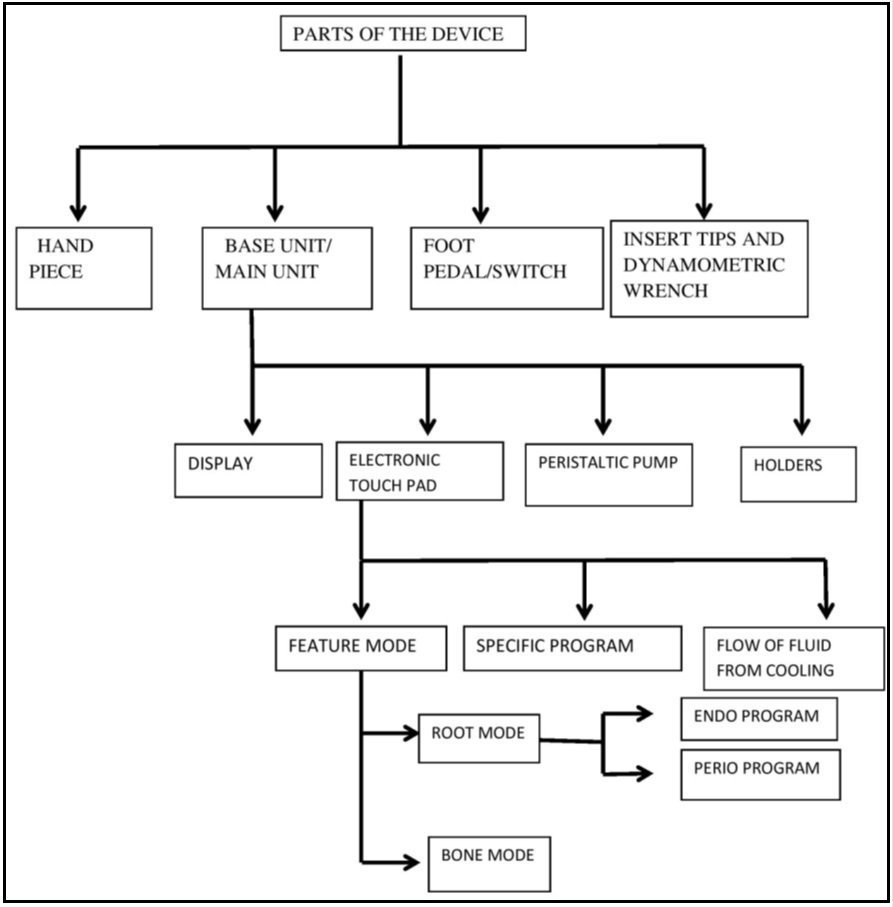
The piezosurgery unit is composed of the main body, activated with a pedal, a handle, and number of inserts with different shapes depending on the surgical need.3

Piezosurgery hand piece

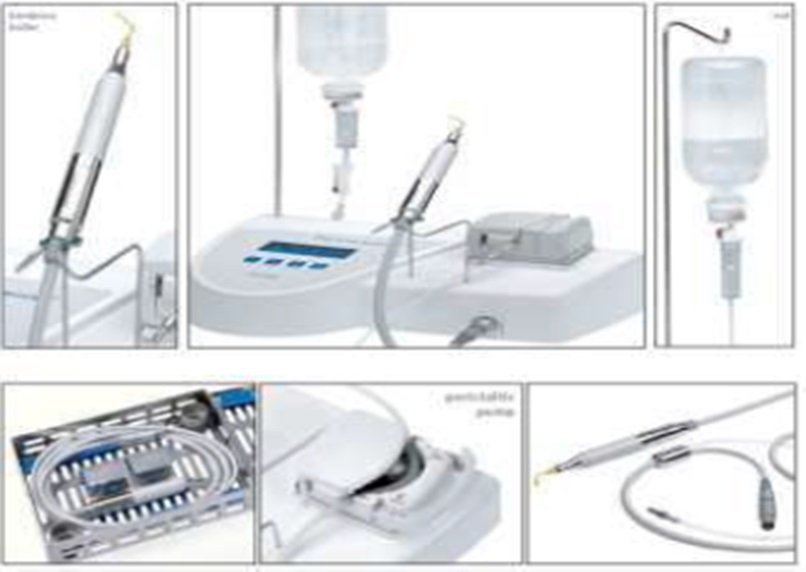
Piezosurgery device and its various parts
Indications
- Supra and subgingival scaling and root planing
- Smoothening of the root surface
- Bone grafting
- Sinus lift preparation
- Implant site preparation
- Retrograde root canal preparation
- Apicoectomy
- Orthodontic surgeries.
Contraindications
- Increased operating time
- Expense
- Learning curve
- Pacemakers and defibrillators.4
APPLICATIONS IN DENTISTRY
In dentistry, piezosurgery has certain advantages over traditional instruments for tooth extraction, ridge expansion, sinus lifting, bone grafting, and clinical crown lengthening.12
Periodontology 14,15
The use of Piezosurgery in periodontal surgery simplifies and improves both soft and hard tissue management.5
The dental applications of piezosurgery can be categorized owing to different specialties.
Routine scaling and root planning: Piezosurgery can be used efficiently for the removal of supra and subgingival calculus deposits and stains from teeth, periodontal pocket lavage with simultaneous ultrasonic tip movement, scaling, and root planning. The piezosurgery device can be used for soft-tissue debridement to remove the secondary flap after incision through retained periosteum.6
Piezosurgery also permits planning of the root surfaces and the removal of inflammatory tissues in periodontal operations.
Curettage: by debriding epithelial lining of the pocket wall1
Osteoplasty and osteotomy: Sherman et al (2000) described the use of piezosurgery devices to develop the positive,physiologic architecture of bone for pocket removal surgery. The device enables for the specific removal of bone, with minimal risk of injury to underlying root surfaces.7
Crown lengthening procedure: Piezosurgery helps in achieving better bone architecture with the precise cutting of bone during crown lengthening procedures.4 The crown lengthening technique performed with Piezosurgery using appropriate inserts makes it possible to reduce bone effectively while preserving root surface integrity.5
Resective and regenerative surgery:8 The piezosurgery device is used in bone grafting of an infrabony periodontal defect.Autogenous bone can be readily harvested from adjacent sites with minimal trauma and therefore minimal postoperative effects.
Harvesting of autogenously bone grafts: The bone harvesting technique using Piezosurgery is effective for harvesting bone fragments and for removing blocks of monocortical-cancellous bone. Dong Seok Sohn (2007) used a piezosurgical unit to harvest autogenous bone chips from intra-oral sources.9
Dental Implantology
Piezosurgery is a new and modern technique in bone surgery in implantology. Implant site preparation, implant bone removal, and grafting, sinus lifts can be done with much ease and less trauma.6 Sortino in (2008) concluded that the application of Piezosurgery is efficient at preparing implant site osteotomies due to its selective cut, micro-streaming, and cavitational effects, which preserve and maintain the soft tissue-essential for the overall healing and esthetics of the implant.10,16
Recent Advances 11
- Piezosurgery-Assisted, Flapless Split Crest Surgery for Implant Site Preparation: Resorption of the alveolar ridge can, at times, be surgically corrected at the time of implant placement. Recently,flapless approach have become popular and aim to reduce post treatment side effects,improved healing and avoid bone resorption caused by flap elevation.
- Peizoincision-minimally invasive technique: in 2009,Dibart described a new minimally invasive procedure that he called Piezocision. Advantages of this procedure include decreased chairside time, minimallyinvasive, less traumatic to the patient and It allowed for soft-tissue grafting at the time of surgery to correct mucogingival defects if needed, as well as bone grafting in selected areas by using localized tunneling. Disadvantages are increased risk of tooth damage and tunnelling is invasive and difficult procedure
- MIRO technique; minimally invasive rapid orthodontics: Jofre in 2013 proposed a technique that uses metal markers as radiographic references or guides for accurate corticotomy by means of intraoral periapical radiographies. Moreover, a minimally invasive flapless procedure is described. Due to its atraumatic nature, this procedure promotes healing without oedema or patient discomfort.
Advantages 6
- Micrometric cutting action
- Cavitation effect:Maximum intra-operative visibility and surgery is performed in bloodless field. Enhanced visibility of surgical site, because of the cavitation effect created by the interaction between the irrigant solution and the oscillating tip.
- Surgical stress: The cutting action is less invasive, producing less collateral tissue damage, which results in excellent tissue healing.
- Asepsis: Sterile coolant provides an aseptic environment (free from contamination).
- Selective cutting and minimal operative invasion
- Controlled movement of the surgical devices
- Bleeding-free surgery site
- Enhanced visibility of surgical site
- Faster bone regeneration and healing process
- Reduced sensitivity and faster recovery
Disadvantages 4
Piezosurgery has certain disadvantages
- Increased operation time that is required for bone preparation.
- Adequate dexterity and gentle touch is required for this type of procedure with a different learning curve. More practice time might be required for clinicians.
- The difficulty or impossibility to perform the deeper osteotomies (eg: maxillo-pterygoid disjunction), due to lack of inserts of the appropriate length.
- Piezosurgery inserts get worn away very rapidly.
- Purchase of a device may initially be a financial burden.
LIMITATIONS OF PIEZOELECTRIC SURGERY
Just like how a coin has two sides, piezo surgery has its own share of boon and bane. So piezosurgery has certain limitations and the application of this technique is still in infancy.
- A definitive learning curve is necessary. The clinician should be familiar with handling of the surgical procedures. It is important to acquire both adequate dexterity and a gentle touch.
- With piezoelectric surgery, increasing the working pressure above a certain limit impedes the vibrations of the insert, and the energy is transformed into heat.
- The increase in the operating time, in comparison to traditional cutting instruments.
- Difficulty or impossibility to perform the deeper osteotomies.
- Expensive equipment
- Piezosurgery inserts get worn away very rapidly.
CONCLUSION
Piezosurgery is a relatively new surgical technique for periodontology and implantology that can be used to complement traditional oral surgical procedures, and in some cases, replace traditional procedures. Useful in a variety of surgical procedures, piezosurgery has therapeutic features that include a micrometric cut (precise and secure action to limit tissue damage, especially to osteocytes), a selective cut (affecting mineralized tissues, but not surrounding soft tissues), and a clear surgical site (the result of the cavitation effect created by an irrigation/cooling solution and oscillating tip).Piezosurgery ensures the 3‘P’s, that is Predictability, less postoperative pain and increased patient’s compliance.2
With their variable frequency and variable power, multipurpose piezosurgery units are a platform for a range of applications in Periodontology, Implantology and various oral surgical procedures, making such a unit a highly effective tool in clinical practice.1
REFERENCES
- Thomas M, Akula U, Ealla KK, Gajjada N., Piezosurgery: A boon for modern periodontics. J Int Soc Prevent Communit Dent 2017; 7:1-7.
- Agarwal E. et al. Escalating Role of Piezosurgery in Dental Therapeutics Journal of Clinical and Diagnostic Research. 2014 Oct, Vol-8(10): ZE08-ZE11.
- Vercellotti T. Essentials in piezosurgery: Clinical advantages in dentistry;1st Edition 2009 ISBN 978-1-85097-190-0;1-136.
- Kshirsagar J.T., Kumar K.P. et al. Piezosurgery: Ultrasonic bone surgery in periodontics and oral implantology- Review International Jour of App Den Sci 2015;
- Vercellotti T, Paoli SD, Nevins M., The Piezoelectric Bony Window Osteotomy and Sinus Membrane Elevation: Introduction of a New Technique for Simplification of the Sinus Augmentation Procedure. Int J Perio Rest Dent. 2001; 21:5:61–67.1(5): 19-22.
- Jain Gupta S., Gautam V., Gupta A. piezosurgery –a revolutionary approach in periodontal surgeries Int J Dent Health Sci 2015; 2(5):1205-1221.
- Sherman J.A., Davies H.T. Ultracision®: the harmonic scalpel and its possible uses in maxillofacial Surgery British Journal of Oral and Maxillofacial Surgery (2000)38, 530–532.
- Martí-Bowen E., Peñarrocha-Diago M., García-Mira B., Periapical surgery using the ultrasound technique and silver amalgam retrograde filling. A study of 71 teeth with100 canals. Med Oral Patol Oral Cir Bucal. 2005;10: E 67-73.
- Sohn D.S. et al Piezoelectric osteotomy for intraoral harvesting of bone blocks.Int J Periodontics Restorative Dent. 2007 Apr;27(2):127-31
- Sortino F., Pedullà E., and Masoli V., The Piezoelectric and Rotatory Osteotomy Technique in Impacted Third Molar Surgery: Comparison of Postoperative Recovery; J Oral Maxillofac Surg 2008 Dec;66(12):2444-2448.
- Gayathri S. et al, Peizosurgery- A Minimally Invasive Surgical Tool: In Periodontology and Implantology, IJMSIR: A Medica International Journal of Medical Science and Innovative Research (IJMSIR) Volume – 2, Issue – 3, May –June - 2017, Page No.12-21.
- Seshan H., Konuganti K., Zope S., Piezosurgery in periodontology and oral implantology Journal of Ind Soc of Perio, Sep-Dec 2009 Vol 13, Issue 3:155-156.
- Rahnama M. et al. The use of piezosurgery as an alternative method of minimally invasive surgery in the authors’ experience Videosurgery Miniinv 2013; 8 (4): 321–326.
- Niranjani K. and Ramamurthy J., Piezosurgery and its Clinical Applications in Periodontics Journal of Pharma Res & Clini Prac, Jan-March 2014; 4(1):84-88.
- Newman Takei, Klokkevold Carranza; Carranza’s clinical periodontology; South East Asia 11th edition.
- Chopra P. and Chopra P., Piezosurgery and its applications in Periodontology and Implantology (2011) Int. Journal of contemporary dentistry; Vol. 2, Issue 4:1-2.
Disclaimer from Guident
The views and opinions expressed in articles published in Guident are solely those of the authors and do not necessarily reflect the views of the editors, the editorial board or the publisher, Ivory India. Guident does not endorse any product, technique or treatment described. Clinical content is intended for qualified dental and medical professionals and is not a substitute for individual clinical judgement. Guident, its editors and the publisher accept no liability for any consequence arising from the use of information published in the journal.
How to cite this article
Dr. Ankita Garg, Dr. Shailendra S. Chauhan, Dr. Aditya Sinha. Piezosurgery in Periodontics: A New Paragon for Traditional Approaches. Guident. 2023 Mar;16(4). Available from: https://guident.net/articles/periodontics/piezosurgery-in-periodontics-a-new-paragon-for-traditional-approaches.html