A Graftless Approach for Rehabilitation of Severely Resorbed Ridges of a Geriartic Patient- a Case Report
Department of Prosthodontics, Vyas Dental College and Hospital, Jodhpur, RAJ. India
ABSTRACT
Severely atrophied maxilla and mandible presents limitations for conventional implant placement due to compromised bone and keratinised tissues. In order to carry out the the conventional protocol extensive surgical procedures for augmentation like sinus floor elevations, grafts, distraction osteogenesis, le fort I osteotomy is required. Alternatives like short implants, Nerve repositioning can be used to optimally utilise the remaining bone. However many of the given viable options may yield unpredictable result in geriatric patients. This case report describes a graftless method of rehabilitating a geriatric maxilla and mandible with immediately loading basal implants and all on four protocols.
Keywords:all on four, basal implants, geriatric, graftless, metal acrylic fixed prosthesis.
INTRODUCTION
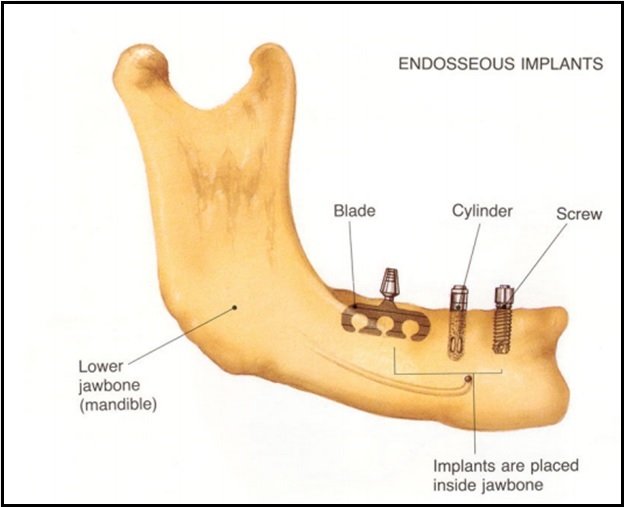
Implant placement in severely atrophic jaws of geriatric patients is especially challenging because of the poor quality and quantity of future implant bed.1 Increase in life expectancy of elderly in the past decade has lead to increase demand to regain maximum oral function with minimal surgical effort. Extensive surgical interventions may not be the best choice for geriatric patients and are best avoided. Basal implants are the dental implants that employ the basal cortical portion of the jaws for implant retention. The basal bone provides excellent quality cortical bone for implant and is not subjected to resorption or infections unlike the crestal bone that is less dense and exposed to infections from tooth borne pathologies, injuries and iatrogenic factors.2 Load bearing capacity of the basal bone too is many times higher than that offered by the spongy crestal bone. This rationale stems from the orthopaedic surgery as a result basal implants are also called “orthopaedic implants”3
Malo et al introduced the all on four treatment concept in 2003 where utilisation of multiple abutments of different angulations two straight 90 degrees anteriors and two greater than 35 degrees but less than 45 degrees were used. This provided satisfactory mandibular anchorage without interfering with the mental foramen or inferior alveolar nerve. When compared to extensive surgical approaches this technique provides short treatment time, less invasive procedure, low morbidity favourable prognosis and immediately improved quality of life.4
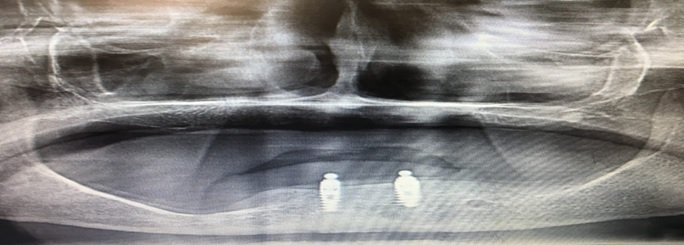
Fig-1
CASE REPORT
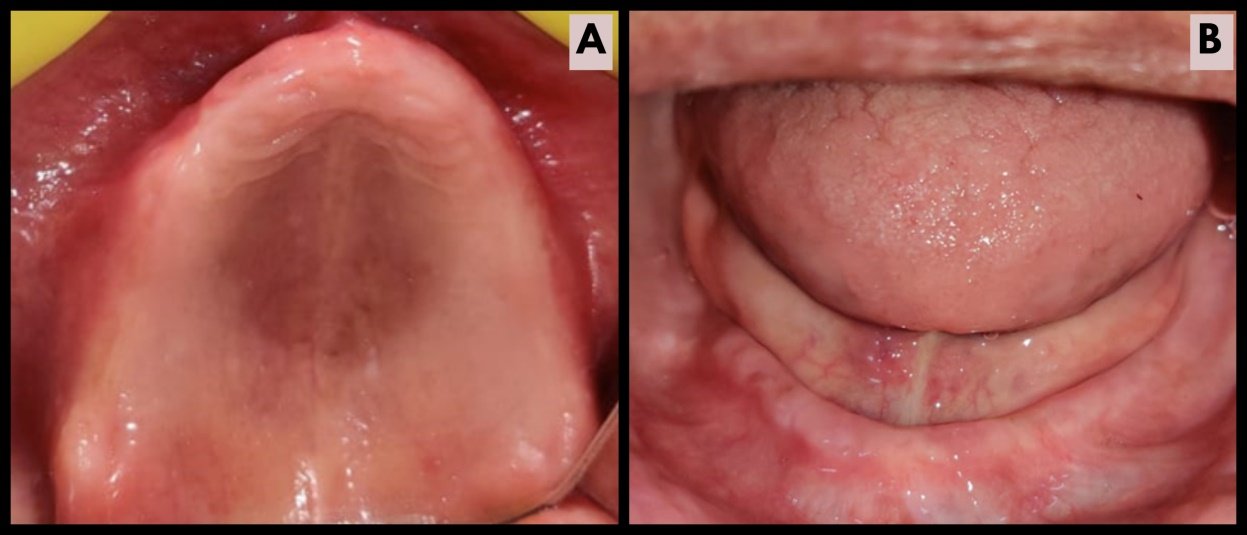
85 year old healthy female patients reported with a chief complain of an unsatisfactory upper denture leading to chewing and speech difficulties. She desired for fixed replacement of her teeth. On clinical examination she was found to have an upper denture which was minimally retentive and a lower implant supported over denture with which she was partially satisfied .Her maxillary and mandibular ridges were knife edged .Implants supporting the over denture seemed to have good primary stability and showed no signs of bone loss or perimplantitis. A detailed medical history was obtained. Patient had no relevant medical history and was not on any medications. Patient was advised an OPG which revealed an extremely resorbed maxillary residual ridge with wide sinus cavities almost reaching up to the floor of maxilla. In the lower ridge two implants with ball attachments were seen. The implants showed minimal bone loss around them and seemed suitable to be included in the plan for a completely fixed restoration of lower ridge. Patient was given various options of ridge augmentation by grafts and Sinus lift for the maxilla which were rejected by her. The patient accepted basal implants for the upper arch and an all on four utilising her previous implants for the lower arch as these two options required minimal surgical interventions. A signed consent was obtained from the patient and a treatment plan was formulated. The treatment plan was than divided into two halves, the first halve involved rehabilitation of maxilla followed by rehabilitation of mandible and conversion of implant over denture to all on four.
PRE-TREATMENT EVALUATION FOR FIXED PROSTHESIS
Fixed implant supported treatment options provide minimal acrylic support to the lip in form of flanges so if patient needs excessive lip support to correct the profile this treatment option cannot be given. Hence it is imperative to evaluate the lip support of the patient. Sufficient amount of prosthetic space is needed to allow thicker acrylic and metal framework to resist fracture and other complications. A minimum recommended crown height space of 15 mm is needed.5 Lastly smile line should be evaluated, higher maxillary lip line and lower mandibular lip line would require surgical contouring of the ridges so that the gingival prosthetic “transistional line” is not visible. After thorough evaluation we started with the surgical phase 1 of the treatment plan.
SURGICAL PHASE ONE
Local infiltration(Xicaine,2 % lignocaine hydrochloride with adrenaline), was given and flaplessly using a single pathfinder drill 10 Bicortical screw implants(BCS, Simpladent,Switzerland) were placed engaging the basal bone.BCS implants are single piece implants. They have a smooth surface and have aggressive threads. The wide diameter cutting screws help- in engaging the buccal and palatal lingual cortical plates and initially provide primary stability and load bearing capacity and later on act as load bearing and distributing components. With greater number of implants being placed they also account for cross arch stabilisation and help in avoiding cantilevers. An OPG was done to evaluate the position of the implants post operatively. An impression was made of the implants and models were poured which were then sent to the laboratory. Patient was prescribed Cap Amoxiclav 625 mg, tab Metrogyl 400mg, tab Zerodol SP , and multivitamins and was recalled the next day.
SURGICAL PHASE TWO
On the next day, patient was given local anaesthetic irt to the lower arch and midcrestal incisons were made to raise a full thickness flap a 2mm osteotomy was done in the midline position and the all on four guide was placed . Using copious irrigation two conventional implants(ADIN, 3.5mm x 13mm) were placed at the position of the diagonal of the rectangle on the guide and at an angle of 30 degrees mesially to the mental foramina , the shoulder of the implants 1-1.5 mm below the crestal bone . The intraforaminal position was chosen for the implants as the posterior areas showed excessive resorption and extreme proximity to the mandibular canal. The final torque of 45 Ncm was confirmed. Edges of the flaps were then reapproximated and sutured using a nylon thread. Straight and angulated abutments were placed in the implants and multiunit impression copings were attached and splinted. Silicone impressions were made. Patient was relieved and advised to continue the prescribed medicines, additionaly 0.12 chlorhex tds was prescribed for 5 days.
PROSTHETIC REHABILITATION
Upper and lower jig trials were done and bars made were checked for passive fit. Metal frame trial was done. Teeth were set in wax over the metal frame and a wax trial was done in the patient’s mouth to check all parameters. Definitive immediately loaded metal acrylic prosthesis was given to the patient and cemented over the implants with luting cement within 4 days. The occlusal corrections were done for equitable force distribution and group function.
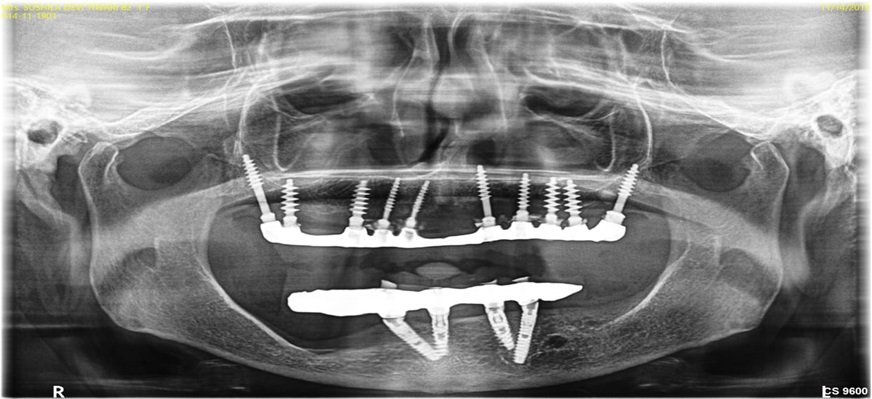
Fig-2

Fig-3 & Fig-4
DISCUSSION
A recent shift in treatment paradigm has been to minimize patient morbidity while providing a satisfying patient- centred outcomes. In geriatric patients alternative options to conventional implantology like basal implants have been prescribed with a high success rate, less severe complications, lower cost and number of surgeries.6 these implants integrate into the basal bone and provide the strongest anchorage and stable occlusal units leading to good chewing function. They allow for immediate loading that decreases patient discomfort and omits the need for transitional or temporary restorations. This minimises the cost and time required, offering a more conservative approach than grafting procedures. A study by Awadalkareem et al 7concludes that basal implant-supported prostheses (BCS®) in edentulous and partially edentulous patients have a positive impact on patient satisfaction and hence enhance their quality of life. There were marked improvements in patients’ overall satisfaction and specific satisfaction with comfort, aesthetics, mastication, and speech.
“All on four” treatment option is another straight forward predictable treatment option to rehabilitate patients with a high outcome of quality of life.8 n this technique, the placement of the two posterior implants in front of mental foramina and tilted with a distal direction avoids to injure the inferior alveolar nerve and decreases the cantilevers, allowing the in-crease of the polygonal area for a full fixed prosthesis and providing satisfactory molar support.9 The “All-on Four” procedure also improves cortical anchorage and primary stability, allowing the use of longer im-plants. In a three-dimensional finite element analysis about load transmission using different implant incli-nations and cantilever lengths, Bevilacqua et al. re-ported a reduction of stress around anterior implants in a full fixed prosthesis design, when tilted implants were compared to straight implants.10
CONCLUSION
Geriatric patients have certain specific treatment requirements which must be catered to by a combination of or individual contemporary techniques, if need be so. The aim should be to minimise the extensive surgical reconstructions and provide long term patient compliance and compatibility. Our patient was very satisfied with her new smile which not only gave her a good masticatory function and speech but also a dental face lift.Patient consent
Authors declare that the patient had given her signed consent on sharing her pictures and other relevant data.
financial support and sponsorship
Nil.
Conflicts of interest
There were no conflicts of interest among the authors.
REFERENCES
- Spencer KR. Implant based rehabilitation options for the atrophic edentulous jaw. Australian Dental Journal. 2018 Mar;63:S100-7.
- Gupta AD, Verma A, Dubey T, Thakur S. Basal osseointegrated implants: classification and review. International Journal of Contemporary Medical Research. 2017;4(11):2329-35.
- Ghalaut P, Shekhawat H, Meena B. Full-mouth rehabilitation with immediate loading basal implants: A case report. National journal of maxillofacial surgery. 2019 Jan;10(1):91.
- Marripudi M, Vadlamudi A, Saikrishna B, Gongura H, Dev SP, Mukta S. Single piece basal implants. Journal of Advanced Medical and Dental Sciences Research. 2020 Jun 1;8(6):97-100.
- Sadowsky SJ. Treatment considerations for maxillary implant overdentures: a systematic review. J Prosthet Dent. 2007;97(6):340-348.
- Emami E, Michaud PL, Sallaleh I, Feine JS. Implant-assisted complete prostheses. Periodontol 2000. 2014;66(1):119-131.
- Awadalkreem F, Khalifa N, Satti A, Suleiman AM. The influence of immediately loaded basal implant treatment on patient satisfaction. International journal of dentistry. 2020 Apr 14;2020.
- Maló P, Rangert B, Nobre M. “Allâ€Âonâ€ÂFour” immediateâ€Âfunction concept with Brånemark System® implants for completely edentulous mandibles: a retrospective clinical study. Clinical implant dentistry and related research. 2003 Mar;5:2-9.
- Sertgöz A, Güvener S. Finite element analysis of the effect of cantilever and implant length on stress distribution in an implant-supp orted fixed prosthesis. J Prosthet Dent.1996;76:165-169.
- Bevilacqua M, Tealdo T, Menini M, Pera F, Mossolov A, Drago C, Pera P. The influence of cantilever length and implant inclination on stress distribution in maxillary implant-supported fixed dentures. The Journal of prosthetic dentistry. 2011 Jan 1;105(1):5-13.
Disclaimer from Guident
The views and opinions expressed in articles published in Guident are solely those of the authors and do not necessarily reflect the views of the editors, the editorial board or the publisher, Ivory India. Guident does not endorse any product, technique or treatment described. Clinical content is intended for qualified dental and medical professionals and is not a substitute for individual clinical judgement. Guident, its editors and the publisher accept no liability for any consequence arising from the use of information published in the journal.
How to cite this article
Dr. Dushyant Soni, Dr. Sheen Singh Mehta, Dr. Akshay S Upmanue. A Graftless Approach for Rehabilitation of Severely Resorbed Ridges of a Geriartic Patient- a Case Report. Guident. 2021 Jun;14(7). Available from: https://guident.net/articles/prosthodontics/a-graftless-approach-for-rehabilitation-of-severely-resorbed-ridges-of-a-geriartic-patient-a-case-report.html