PEEK: A Neoteric Alternative in Prosthetic Dentistry
Department of Prosthodontics & Implantology, K.D. Dental College & Hospital, Mathura (U.P) India
ABSTRACT
Polyetheretherketone (PEEK) material is a semi-crystalline polymer having polycyclic, aromatic and a linear structure. PEEK shows high biocompatibility due to which it is increasingly employed as biomaterial in orthopedic and trauma cases. In addition, it has good mechanical and electrical properties such as resistance to high temperature and resistance to hydrolysis. The most characteristic property of PEEK material is its low elasticity modulus (close to that of bone) leading to lesser stress shielding. Due to its favorable chemical, mechanical and physical properties it is used in producing fixed and removable prostheses and also in implant prosthodontics.
INTRODUCTION
The long term success of dental implant depends majorly on reducing the amount of marginal bone loss around implant on functional loading. Titanium (Ti) and its alloys have been used as dental implants since it was introduced around 1960s by Brånemark. Due to advances in field of dental sciences and innovations in technologies improved materials are introduced. Biocompatibility, esthetics, low affinity towards plaque and debris and properties close to teeth are some of the important properties of materials used in dentistry today.
WHAT IS PEEK?
PEEK is a part of poly-aryl-ether-ketone (PAEK) polymer family. PEEK is an element which is tan-colored in its pure form. It is a polycyclic, aromatic, thermoplastic polymer that is semi-crystalline having a linear structure. Its structure consists of two ketone (–CO–) and one ether (–O–) groups between the aryl rings (Fig. 1). A common synthesis route for PEEK is the reaction between 4,4- difluorobenzophenone and the disodium salt of hydroquinone in a polar solvent such as diphenyl sulphone at 300°C (Fig.2)
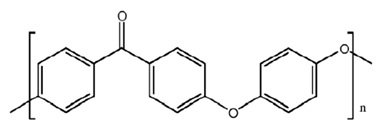
Fig. 1 Chemical structure of PEEK

Fig.2 Synthesis of PEEK
Properties of PEEK
- It is a radiolucent, white and rigid material which shows great thermal stability up to temperature of 335.8° C.
- Flexural modulus is 140-170 MPa, density – 1300 kg/m3 and thermal conductivity 0.29 W/mK.
- It can be produced by casting under heat and pressure with CAD-Cam technology and the wax waste management method.
- It is a biologically inert material.
- It shows resistance to deterioration during various sterilization procedures. Melting point is >280°C. Thus, it can be processed with hot sterilization methods.
- It has low plaque affinity and non-allergic to oral mucosa.
- There is no evidence of cytotoxicity, mutagenicity, carcinogenicity or immunogenicity in the toxic form.
- The most important property of this material is that its elastic modulus is 3.6 GPa, and by incorporating carbon fibers, the elastic modulus can be improved to 18 GPa which is close to that of cortical bone, i.e., 15GPa.
- PEEK exhibits stable chemical properties i.e. resistance to most substances apart from concentrated sulfuric acid.
- It can be easily modified within the oral cavity.
- Being radiolucent, PEEK has reduced magnetic resonance imaging artifacts.
- It does not attrite the opposing natural teeth.
PEEK v/s Titanium
PEEK, when used as a dental implant material shows some advantages clinically as compared to Ti. First, the PEEK polymer exhibit lesser stress shielding when compared to titanium. Second, it causes fewer hypersensitive and allergic reactions. Third, it does not have a metallic color; it is beige with a touch of gray thus, has a more aesthetic appearance than Ti. Fourth, it is radiolucent and causes fewer artifacts on magnetic resonance imaging. Fifth, PEEK is a versatile foundation material that can be manipulated to a particular purpose by changing its bulk or surface.
PEEK Reinforcement
The Modulus of Elasticity of PEEK is less in comparison to that of cortical bone, Titanium (Ti), and ceramic materials. The greater elasticity modulus of PEEK is required for dental implant materials, especially those used for abutments and superstructures. Various reinforced PEEK composites have been developed, such as carbon fiber-reinforced PEEK (CFR-PEEK) having elastic modulus of 18GPa and glass fiber-reinforced PEEK (GFR-PEEK) with elastic modulus of 12GPa. CFR-PEEK has been of interest to the medical implant community due to its versatility, compatibility with modern imaging technologies, excellent mechanical properties, and biocompatibility.
Surface Modification of PEEK for Osseo-integration
In recent years, PEEK has been modified at the nano-level in order to improve its bioactivity and osseoconductive properties. The nanoparticles such as Titanium dioxide (TiO2), Hydroxy fluorapatite (HAF) and Hydroxyapatite (HAP) can be combined with PEEK by the process of melt-blending to improve its bioactivity as shown in figure 3. First, the PEEK powder and nanofillers are codispersed in a suitable solvent to form a uniform suspension. The solvent is then removed by drying in an oven and the powder mixture is placed in suitable molds in the shape of the implants. The molds are preheated to a temperature of about 150°C at 35 MPa pressure followed by heating at temperature of 350°C–400°C at 15 MPa. When the melting point of PEEK is reached, the polymer melts but the bioactive filler particles remain solid. The temperature is maintained for 10 min after which the composite implants are air-cooled to 150°C.
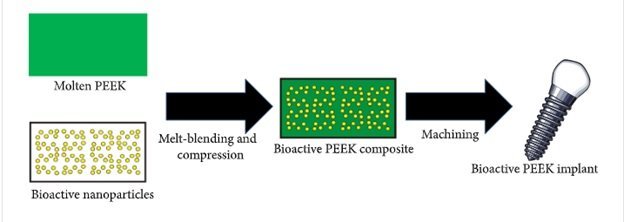
Fig. 3 A schematic diagram of the process of melt-blending to produce bioactive PEEK composites.
Conventionally, PEEK has been coated using bioactive materials by means of plasma-spraying in which particles are sprayed onto the surface of an implant through a plasma torch. The plasma melts the particles to deposit on the implant surface and producing a rough surface layer. Spin-coating is another method for coating a thin layer of nanoscale calcium hydroxyapatite on PEEK surface. In this process apatite dissolved in organic solvents is slowly dropped onto the surface of an implant rotating at high speeds. Upon heat-treatment a thin layer of HAp is formed on the implants.
Alternatively, nanoscale surface modifications of PEEK can be produced using plasma-gas etching in which low-pressure gases are used to introduce nano-level surface roughness and functional group on the surface of PEEK implants. Electron-beam (e-beam) deposition is another way which involves decomposing and depositing a very thin, nano-rough layer of a material on a substrate by exposing the material to a beam of electrons. Sulfonation can also be used to increase the hydrophilicity of PEEK by introducing charged sulfonate (−SO3−) groups into the polymer by etching with sulfuric acid (sulfonation) and rinsing with distilled water. All these nano- modifications of PEEK are summarized in figure 4.

Fig.4 Nano-modification of PEEK to increase its bioactivity
Applications of PEEK in Prosthodontics
PEEK was introduced to dental applications in 1992, first in the form of esthetic abutments and later as implants. Since then it has been successfully used as a material in a number of applications including dental implants, healing caps, temporary abutments as well as implant supported prosthesis. Uses of PEEK in prosthetic dentistry is depicted in figure 5.

Fig. 5 Major applications of PEEK in prosthetic dentistry
PEEK as Implant material
In accordance with Wolff’s Law, the bone remodels according to the load that has been applied to it. Stress shielding is the reduction in volume of the bone around an implant due to the shielding of normal loads by the implant. Fixed component exploration of carbon-fiber reinforced PEEK implants recommended that there should be induction of small shielding stress in comparison to titanium. The iso elasticity of PEEK composites confirms that PEEK exhibits similar properties to bone and thus, lead to similar distribution of stress along the implant bone interface. Studies have been done to evaluate increase cell attachment in the PEEK implant surface coated with hydroxyapatite (HA). Promising results have been obtained from PEEK implants coated with HA in comparison with non-coated PEEK implants.
PEEK as Implant Abutments
Materials such as titanium, ceramics and zirconium are being used for production of abutments. However, no satisfactory results are obtained in terms of esthetics. Considering adequate biocompatibility, implant healing abutments can be constructed using PEEK. Studies have reported that there is no significant difference in the bone resorption and soft tissue inflammation around PEEK and Ti abutments. Additionally, elastic modulus of bone is close to that of PEEK surface therefore, reduces the stress shielding effects and encourage bone remodeling. When the difficulties like screw breakage for implant are reflected, screws prepared from PEEK can be detached comfortably. Hence, PEEK could prove to be a viable alternative to titanium in constructing implant abutments.
In removable prosthesis
PEEK is used in removable prosthodontics as an alternative to metal braces and hooks in removable partial prostheses. In comparison with chrome-cobalt-based partial prostheses, PEEK hooks have been shown to have lower retentive strength. The patients who are allergic to metals, or who dislike the metallic taste, the weight, and metal display of framework and clasps, this material can be used safely. The modified PEEK i.e. BioHPP, is non-allergic, rigid biomaterial with flexibility comparable to bone. Another application of PEEK is the construction of a removable obturator. Nevertheless, more studies are needed to evaluate the efficacy of PEEK obturators compared to conventional acrylic prostheses. To date, no clinical studies or systematic reviews focusing on the use of PEEK dentures have been published. However, owing to the superior mechanical and biological properties of PEEK, it will not be surprising if dentures constructed from the polymer are routinely constructed in near future
In fixed prosthesis
In implant supported prosthetic systems the upper structure is formed of crown materials. Metal supported ceramics have been used for many years in dentistry and the results obtained have shown them to be successful. However, there are some disadvantages. Metal alloys can undergo corrosion and have the potential to cause allergies. Furthermore, the lack of light permeability is one of the negative properties of metal alloys.
The biocompatibility of PEEK material is higher than that of metal-based ceramics.
PEEK is lighter, it may be a suitable alternative to chromecobalt ceramics. Furthermore, it does not corrode when in contact with other metals in the mouth . PEEK is not soluble in water and has a low reactivity with other materials, so could, therefore, be a suitable alternative for patients with a metal allergy or who are sensitive to metallic taste.
As PEEK material can be more easily repaired than ceramics, does not wear down within the mouth and no deterioration is seen in the material properties during processing, this increases the possibility of its use as crown material. Moreover, despite the low elasticity modulus and hardness, the high resistance to wear makes this a material that can compete with metallic alloys.
Bonding Of PEEK Material To Composites
One of the major advantages of PEEK material is that it can bind to indirect composites polymerized with light. To meet aesthetic requirements, this material which shows low half lucency can be coated with composite resins. In resin-bonded bridges produced from PEEK material, there is a minimal need for holding elements and retentive abrasions as in metal ceramic resinbonded prostheses.
In the use of PEEK material as a temporary abutment, high bonding is required between composite resins in the formation of the gingival tissue emergence profile and the gingiva shaping.
To achieve good bonding between PEEK and composite, cleaning and roughening of the surface is generally recommended. In most cases, the application of opaque material is known to increase resistance to shear forces. Successful bonding on PEEK surfaces is provided as a result of surface activation with roughening followed by processing with acetone, phosphate-based methacrylate linings or tribochemicals.
CONCLUSION
PEEK material is a modern material attracting interest for use in dentistry. Due to the high elasticity modulus close to that of bone and dentin, there is increasing use of the material in implantology. It can be considered that increasing the bonding of the material with acrylic and composite resins and developing the osteointegration properties will further increase dental applications.
Due to the superior mechanical and biological properties of PEEK material, it can be considered that in the future, prostheses made from polymer will have a place in routine applications and PEEK material will be used in dental post structures and the field of endodontics.
REFERENCES
- Quinn JB, Sundar V, Lloyd IK. Influence of microstructure and chemistry on the fracture toughness of dental ceramics. Dental Materials 2003;19:603-611
- Green S, & Schlegel J. A polyaryletherketone biomaterial for use in medical implant applications. Polym for the Med Ind Proc, Brussels, 2001;14-15
- Eschbach L. Nonresorbable polymers in bone surgery. Injury, 2000;31(4):22-27
- Brånemark, P.I.; Adell, R.; Breine, U.; Hansson, B.O.; Lindstrom, J.; Ohlsson, A. Intraosseous anchorage of dental prostheses. I. Experimental studies. Scand. J. Plast. Reconstr. Surg. 1969, 3, 81–100
- Lautenschlager, E.P.; Monaghan, P. Titanium and titanium alloys as dental materials. Int. Dent. J.1993, 43, 245–253
- Wenz LM, Merritt K, Brown SA, et al. In vitro biocompatibility of polyetheretherketone and polysulfone composites. J Biomed Mater Res. 1990;24: 207–215
- Kurz SM, Devine JN. Peek Biomaterials in Trauma, Orthopedic and Spinal Ä°mplants. Biomaterials 2007;28(2):4845-4869
- Siewert B, Parra M. A new group of maretial in dentistry. PEEK as a framework material for 12-piece implant-supported bridges. Zahnarztl Implantol
- Lee, W.T.; Koak, J.Y.; Lim, Y.J.; Kim, S.K.; Kwon, H.B.; Kim, M.J. Stress shielding and fatigue limits of poly-ether-ether-ketone dental implants. J. Biomed. Mater. Res. B Appl. Biomater. 2012, 100, 1044–1052
- Huiskes,R.;Ruimerman,R.;VanLenthe,G.H.; Janssen,J.D.Effectsofmechanicalforcesonmaintenanceand adaptation of form in trabecular bone. Nature 2000, 405, 704–706
Disclaimer from Guident
The views and opinions expressed in articles published in Guident are solely those of the authors and do not necessarily reflect the views of the editors, the editorial board or the publisher, Ivory India. Guident does not endorse any product, technique or treatment described. Clinical content is intended for qualified dental and medical professionals and is not a substitute for individual clinical judgement. Guident, its editors and the publisher accept no liability for any consequence arising from the use of information published in the journal.
How to cite this article
Dr. Adil Khursheed Sheikh, Dr. Yashi Garg, Dr. Manesh Lahori. PEEK: A Neoteric Alternative in Prosthetic Dentistry. Guident. 2020 Jun;13(7). Available from: https://guident.net/articles/prosthodontics/peek-a-neoteric-alternative-in-prosthetic-dentistry.html