Semi-Customized Ocular Prosthesis: A Case Report
Department of Prosthodontics and Crown-Bridge, College of Dental Surgery, B.P. Koirala Institute of Health Sciences, Dharan, Nepal
ABSTRACT
Background: Facial appearance is very important part of person’s personality where eyes being most striking feature. When trauma or disease cause loss of an eye, it has a far-reaching impact on an individual’s psychology and an immediate replacement is necessary to promote the physical and psychological healing of the patient.
Case description: A 51 year old male patient referred to Department of Prosthodontics with chief complain of missing left eye which was eviscerated 12 weeks ago following severe injury from chemical burn. Socket revealed healthy conjunctiva showing synchronous movements and no signs of inflammation. A semi-customized ocular prosthesis with stock iris and custom made sclera was planned, the procedure was explained to the patient and consent was taken before the commencement of treatment.
Conclusion: Custom fabricated ocular prosthesis has been a boon to patients. Although the patient cannot see with this prosthesis, it will definitely restore patient’s self-esteem.
Keywords: evisceration; semi-customised ocular prosthesis; ocular prosthesis.
INTRODUCTION
Loss or absence of a part of the face especially eye can cause severe physical and emotional problems.1 Loss of eye could be because of malignancies, congenital defect, irreparable trauma, painful blind eye or sympathetic ophthalmia.2 Depending on the severity of the involvement, the surgical management may include one of three approaches: evisceration, enucleation or exenteration.3 Psychological distress associated with the loss of eye can be significantly improved by an ocular prosthesis, simulating the natural eye.
There are several techniques documented in the literature for fitting and fabricating the artificial eye. It includes fitting a stock eye, modifying a stock eye on the positive replica of the ocular defect and the fabrication of the custom eye prosthesis. In custom ocular prosthesis, both sclera and iris are custom made. First two techniques are less time-consuming but often have the disadvantages like compromised esthetics and unreliable fit. Custom ocular prosthesis provides improved esthetics, and fit but usually more time-consuming and complicated.4-8
This clinical report demonstrates a technique for fabricating ocular prosthesis with stock iris and custom made sclera to provide functionally and esthetically satisfactory result.
CASE DESCRIPTION
A male patient aged 51 years, reported to Department of Prosthodontics, CODS, BPKIHS with missing left eye which was eviscerated (Fig. 1) 12 weeks ago following severe injury due to chemical burn from lime. On Examination eye socket revealed a healthy conjunctiva covering the posterior wall of the ophthalmic socket showing synchronous movements and no signs of infection or inflammation. A semi-customized ocular prosthesis with stock iris and custom made sclera was planned for the patient, and the treatment procedure was explained to the patient and consent was taken before the commencement of treatment.

Figure 1: Extra-oral view
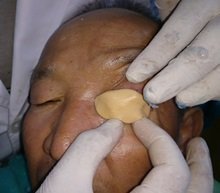
Figure 2: Primary Impression
PROCEDURE
Fabrication of special tray was done by making primary impression of the socket using putty impression material (Putty consistency polyvinyl siloxane, Coltene) (Fig. 2) and primary cast was poured. (Fig. 3). The ocular impression of the ophthalmic socket was made by using the special tray (Fig. 4) in the shape of ocular prosthesis. Thin mix of irreversible hydrocolloid (Algitex, dental products of India, Mumbai, India) was injected into the socket through the hollow stem of the impression tray to obtain the impression of the socket (Fig. 5). The impression was poured with die stone (Kalastone, Kalabhai Pvt., Ltd., Mumbai, India) in two sections to obtain two piece mold (Fig. 6, 7). Wax conformer was fabricated by using base plate wax (Modeling wax, Dental products of India Ltd.) (Fig. 8) on the two piece mold and inserted in ocular cavity and checked for stability and esthetics (Fig. 9). After satisfactory fit, contour, and support of the pattern, it was flasked (Fig. 10) and processed with appropriate shade of scleral resin (tooth colored acrylic resin). After processing, the scleral blank achieved (Fig. 11) was polished and checked into the socket for fit and comfort. Adjustments required were carried out until the patient could close his eyelid comfortably with the scleral blank in position. The size, shade and position of the iris was selected keeping the natural eye as a guide. The position of the iris was determined by asking the patient to look ahead at a distant object. In the natural eye, the distance of iris from the medial canthus and lateral canthus was measured and then transferred to the leucoplast stuck to the patient’s forehead. From the midpoint the distance of iris of the natural eye was measured and transferred to the opposite defect site in the leucoplast. These markings were then transferred to the scleral blank to get the exact position of the iris while the patient looked at distant object.

Figure 3: Primary cast pouring

Figure 4: Fabrication of special tray
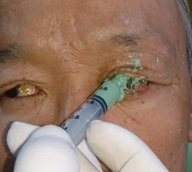


Figure 5: Secondary impression made by light body with special tray

Figure 6: Final cast pouring
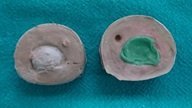

Figure 7: Cast fabricated with two pour technique

Figure 8: Wax scleral blank pattern

Figure 9: Wax scleral blank try in Patient
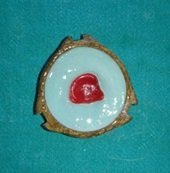
Figure. 10: Flasking of scleral blank

Figure. 11: Scleral blank
The area marked for iris was then reduced with an acrylic trimming bur to create a space for iris. The iris was chosen from the most matching shade and color of the stock eye and fitted to the space created with wax. It was then tried in (Fig. 12). The patient was asked to perform various movements like looking to the left and right, upwards and downwards. The harmony of movements between the natural eye and the scleral-iris assembly was examined and verified (Fig. 13). Here we attached the iris to the processed scleral blank since we had to fabricate a thin shell of prosthesis as the case was of evisceration rather than enucleation and attaching the iris to wax pattern would lead to distortion of wax.
An abrasive stone was used to reduce 1 mm of the anterior surface of the scleral blank over which the wax was coated to make space for the clear acrylic layer. An acrylic sprue was attached to the iris for proper positioning of it during dewaxing and processing. (Fig. 14) Then the assembly was flasked and dewaxing was done (Fig. 15). The space left by the wax was now filled with clear acrylic resin.
Fine red threads were placed on the scleral portion to mimic the blood vessels. The entire scleral portion was coated with a thin layer of clear acrylic syrup to keep the blood vessel fibers and the painting in place. Once it was set, the scleral blank was replaced on to the flask and the processing was done with clear acrylic. After completion of the processing, it was polished using sandpaper followed by polishing cake and buff. Final ocular prosthesis (Fig. 16) was inserted into the socket and evaluated for fit, esthetics, and the coordinated movements with the contralateral eye. (Fig. 17). Post insertion instructions were given to the patient, regarding the usage, limitation, and the maintenance of the prosthesis.4

Figure. 12: Try in patient

Figure. 13: Iris disk attached to the assembly

Figure. 14: Acrylic sprue attached to the Iris disk assembly

Figure. 15: Laboratory processing

Figure. 16: Finished ocular prosthesis

Figure. 17: Placement of prosthesis in patient
DISCUSSION
Customized ocular prosthesis has the advantages over stock eyes like, better contouring, color matching, and coordinated movements with the contralateral eye.5-9 Customizing the iris demands extra skill and time from the operator.10,11 This can be avoided if stock iris matching with the contralateral natural eye is available. Semi-customizing the prosthesis using the stock iris and customized sclera will have advantages of both stock and custom prosthesis. This technique is not advised when the color, contour, and configuration of the stock iris is not satisfactorily matching with the contralateral natural eye of the patient.
CONCLUSION
Semi-customized ocular prosthesis is of use for masking the compromised artistic skill of the operator. This technique reduces the laboratory and clinical time and provides a satisfactory result in indicated patients. Attaching the stock iris to the processed scleral blank rather than wax pattern eliminated the chance of distortion of wax pattern since the final prosthesis is a shell rather than bulk in case of evisceration as compared to enucleation.
REFERENCES
- Lubkin V, Sloan S. Enucleation and psychic trauma. Adv Ophthalmic Plast Reconstr Surg 1990;8:259-62.
- Raflo GT. Enucleation and evisceration. In: Tasmun W, Jaeger E, (Editors). Duane’s Clinical Ophthalmology, Revised edition. Vol. 5. Phildelphia: Lippincott-Raven; 1995. p. 1-25.
- Parr GR, Goldman BM, Rahn AO. Surgical considerations in the prosthetic treatment of ocular and orbital defects. J Prosthet Dent 1983;49: 379-85.
- Parr GR, Goldman BM, Rahn AO. Postinsertion care of the ocular prosthesis. J Prosthet Dent 1983;49(2):220-4.
- Benson P. The fitting and fabrication of a custom resin artificial eye. J Prosthet Dent 1977;38(5):532-8.
- Murphey PI, Schlossberg L. Eye replacement by acrylic maxillofacial prosthesis. Naval Med Bull 1944;43:1085.
- Dyer NA. The artificial eye. Aust J Ophthalmol 1980;8(4):325-7.
- Allen L, Webster HE. Modified impression method of artificial eye fitting. Am J Ophthalmol 1969;67(2):189-218.
- Taicher S, Steinberg HM, Tubiana I, Sela M. Modified stock-eye ocular prosthesis. J Prosthet Dent 1985;54(1):95-8.
- Sykes LM. Custom made ocular prostheses: A clinical report. J Prosthet Dent 1996;75(1):1-3.
- Sykes LM, Essop AR, Veres EM. Use of custom-made conformers in the treatment of ocular defects. J Prosthet Dent 1999;82(3):362-5.
Disclaimer from Guident
The views and opinions expressed in articles published in Guident are solely those of the authors and do not necessarily reflect the views of the editors, the editorial board or the publisher, Ivory India. Guident does not endorse any product, technique or treatment described. Clinical content is intended for qualified dental and medical professionals and is not a substitute for individual clinical judgement. Guident, its editors and the publisher accept no liability for any consequence arising from the use of information published in the journal.
How to cite this article
Dr. Hema Agrawal, Dr. Raj Kumar Singh, Dr. Pramita Suwal. Semi-Customized Ocular Prosthesis: A Case Report. Guident. 2020 Jun;13(7). Available from: https://guident.net/articles/prosthodontics/semi-customized-ocular-prosthesis-a-case-report.html