Prosthodontic Management of Compromised Ridges: A Prevailing Barricade
Department of Prosthodontics and Crown & Bridge, Seema Dental College & Hospital, Rishikesh, Uttarakhand, India.
ABSTRACT
Resorbed and flabby ridges is the most common finding in patients for long span edentulism and long span denture wearers. Residual Ridge Resorption is a major consequence of tooth loss and denture wearing. It results in increase inter-arch distance, horizontal discrepancy between edentulous ridges, occurrence of flabby tissues in denture bearing areas which results in denture soreness, loss of retention, stability and support. Prosthodontic management of such patients becomes very difficult. So, fabrication of dentures over such abused tissues becomes challenging for the prosthodontist. A denture or a prosthesis mainly depends on the accuracy of impression. Therefore, it is very important for the clinician to select an appropriate impression technique. This case series describes various materials and methods in managing compromised ridges prosthodontically.
Key words: Flabby ridges, residual ridge resorption, window technique, neutral zone, admixed technique.
INTRODUCTION
Fabrication of successful prosthesis on an atrophic ridge is very challenging. Extreme resorption of the maxillary and mandibular denture bearing areas leads to sunken appearance of cheeks. These dentures become unstable and non-retentive associated with pain and discomfort to the patient. The rate of residual ridge resorption is more in mandible than maxilla and the ratio of rate of resorption from anterior maxilla to anterior mandible is found to be 1:4. Resorbed ridges are classified into 6 orders by D.A. Atwood.1
Flabby ridge is a mobile soft tissue present on the superficial aspect of alveolar ridge which is commonly seen in maxillary anterior region and is associated with features of combination syndrome. As per studies, prevalence of flabby ridges is 24% in maxilla and 5% in mandible.2 Various special impression techniques and balancing of occlusal loads are commonly employed for the management of dentures with flabby ridges.
Three clinical cases are described in this article in which two cases describe the management of resorbed mandibular ridges and one describes the management of flabby tissues. The techniques depicted are Cocktail impression technique along with recording of neutral zone record3 and Winkler technique for resorbed ridges and Tunnel technique for flabby mandibular ridge.
CASE SERIES
CASE 1
A female patient aged 62 years came to the department of Prosthodontics with the chief complaint of ill-fitting complete denture for past 3 months, which she has been wearing for 4 years. Intra-oral examination revealed order VI resorbed mandibular ridge (Fig 1). In order to record accurate impression Cocktail impression technique4 was performed and to provide stability, teeth were arranged in the neutral zone.
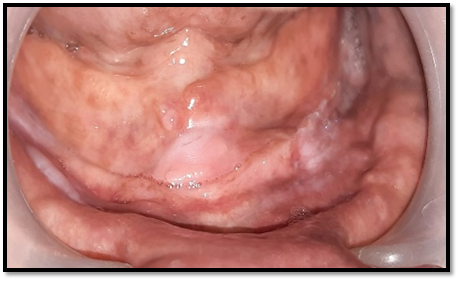
Fig 1. Resorbed mandibular ridge order VI
- Primary impression of maxilla and mandible was made using high fusing impression compound (Fig 2).
- A full spacer with tissue stops was adapted onto the maxillary and mandibular cast followed by custom tray fabrication (Fig 3).
- Maxillary final impression was made using ZOE paste (Fig 4).
- Mandibular custom tray was fabricated such that cylindrical rests were formed at an increased vertical height to support the maxillary ridge (Fig 3).
- Over the mandibular rests, high fusing impression compound was placed and inserted in the mouth of patient to support the maxillary ridge and stabilize the tray.
- These rests prevent the anteroposterior and mediolateral displacement of the tray.
- For recording the final impression, high fusing and low fusing impression compound are mixed in the ratio of 3:7 by weight in a hot water and mixed to a homogenous mass. Wax spacer was removed and homogenous mass was loaded in the tray and patient was guided to close the mouth on mandibular rests.
- Impression was recorded in the functional state (Fig 4). Various movements were performed by the patient till the material was hardened.
- The master casts were poured and neutral zone was recorded (Fig 5) in the mandibular arch after which a plaster index was formed (Fig 6).
- The jaw relation was recorded and teeth were arranged in the neutral zone (Fig 7) followed by wax trial and denture insertion (Fig 8).
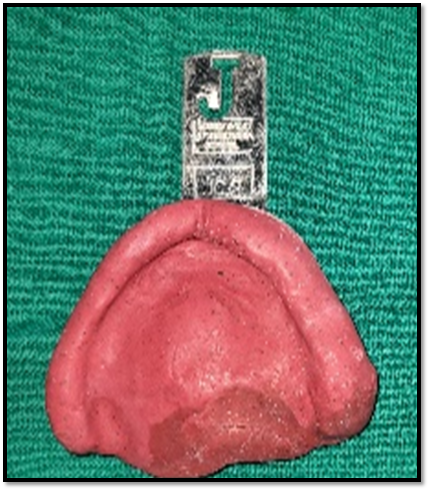

Fig 2. Maxillary and mandibular primary impressions
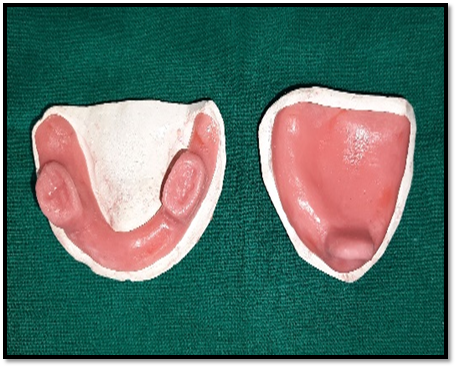
Fig 3. Maxillary and mandibular custom trays
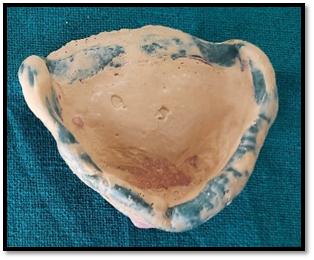

Fig 4. Maxillary and mandibular final impressions.
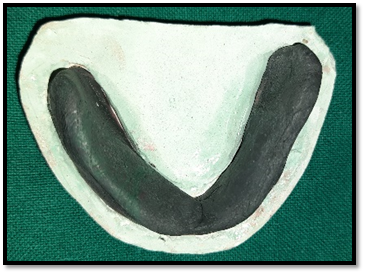
Fig 5. Neutral zone record
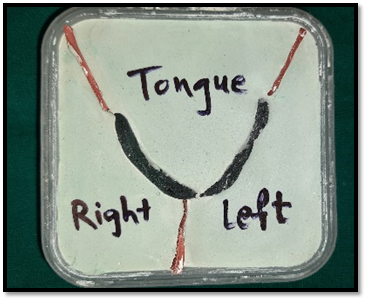
Fig 6. Plaster index
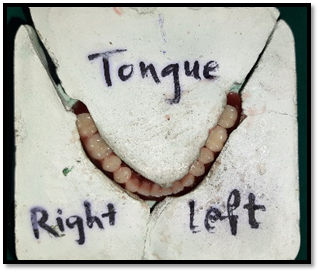
Fig 7. Teeth arrangement in neutral zone

Fig 8. Post operative frontal view
The patient was recalled for follow up, the dentures were stable and no post-insertion complications were reported.
CASE 2
A 75-year-old female patient came to the department of Prosthodontics with the chief complaint of ill-fitting complete denture for 6 months, which she has been wearing for 8 years. Intra-oral examination revealed order V resorbed mandibular ridge. In order to record accurate impression, Winkler impression technique5 was performed in which final impression was made using tissue conditioner.
- Primary impression of maxilla was made using high fusing impression compound (Fig 1) and that of mandible was made using irreversible hydrocolloid (Fig 1).
- A full spacer with tissue stops was adapted onto the maxillary cast followed by custom tray fabrication. Mandibular denture base and rim was fabricated on mandibular diagnostic cast.
- Border moulding of maxillary arch was done using low fusing impression compound and final impression was made using light body (Fig 3). Master cast was poured, denture base was fabricated along with wax occlusal rim.
- Tray adhesive was applied on the mandibular denture base, tissue conditioner was loaded onto it (Fig 4).
- Both the denture bases along with wax occlusal rims were inserted into the patient’s mouth and functional movements were done.
- Later, mandibular tray was loaded with light body and impression was made (Fig 5).
- Master cast was poured, jaw relation was recorded and teeth arrangement along with wax trial was done (Fig 6).
- Later wax-up denture was processed and denture insertion was done (Fig 7).
- Periodic recalls were done and patient was satisfied with the denture.
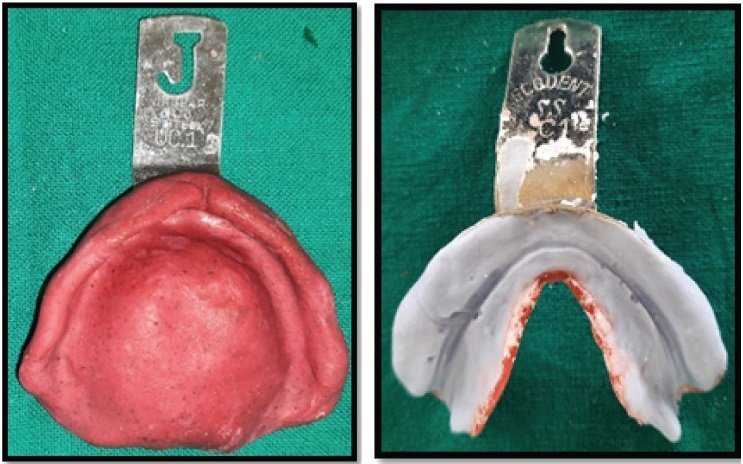
Fig 1. Maxillary and mandibular primary impressions.

Fig 2. Soft tissue conditioner

Fig 3. Maxillary final impression using light body
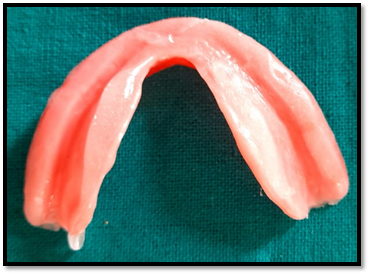
Fig 4. Mandibular final impression using tissue conditioner

Fig 5. Mandibular final impression using light body
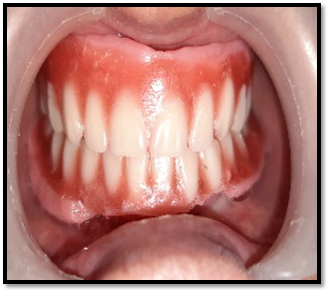
Fig 6. Try-in phase
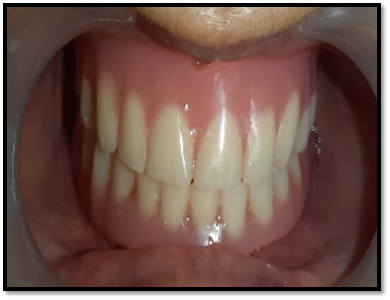
Fig 7. Denture insertion
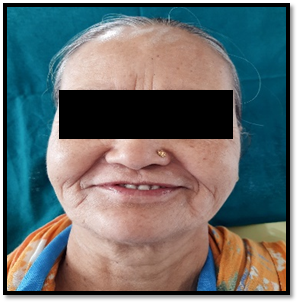
Fig 8. Post operative frontal view
CASE 3
A 62-year-old male patient came to the department of Prosthodontics with the chief complaint of broken complete denture for 1 month, which he has been wearing for 6 years. Intra-oral examination revealed flabby tissue on mandibular ridge from pre-molar region on one side to pre-molar region on the other (Fig 1). Therefore, tunnel technique2 was planned in which window was formed in the mandibular custom tray to record the flabby tissue with impression plaster.
- Primary impression of maxilla was made using impression compound and that of mandible with irreversible hydrocolloid (Fig 2). Diagnostic casts were poured.
- Border moulding of maxillary arch was performed with green stick and final impression was made using zinc oxide eugenol paste (Fig 3).
- Following border moulding of mandibular arch, a window was formed in the tray over the flabby tissue (Fig 4). Using zinc oxide eugenol paste, final impression was made and tray is not removed from the mandibular arch.
- Impression plaster was mixed and loaded into the syringe. It was then syringed on the flabby tissue area (Fig 6). When the plaster and impression is set, tray was taken out from the mouth and master cast was poured (Fig 7).
- Jaw relation was recorded (Fig 8), wax trial (Fig 9) was done and denture insertion (Fig 10) was done.
Patient was satisfied with the fit of the denture and periodic recalls were done.
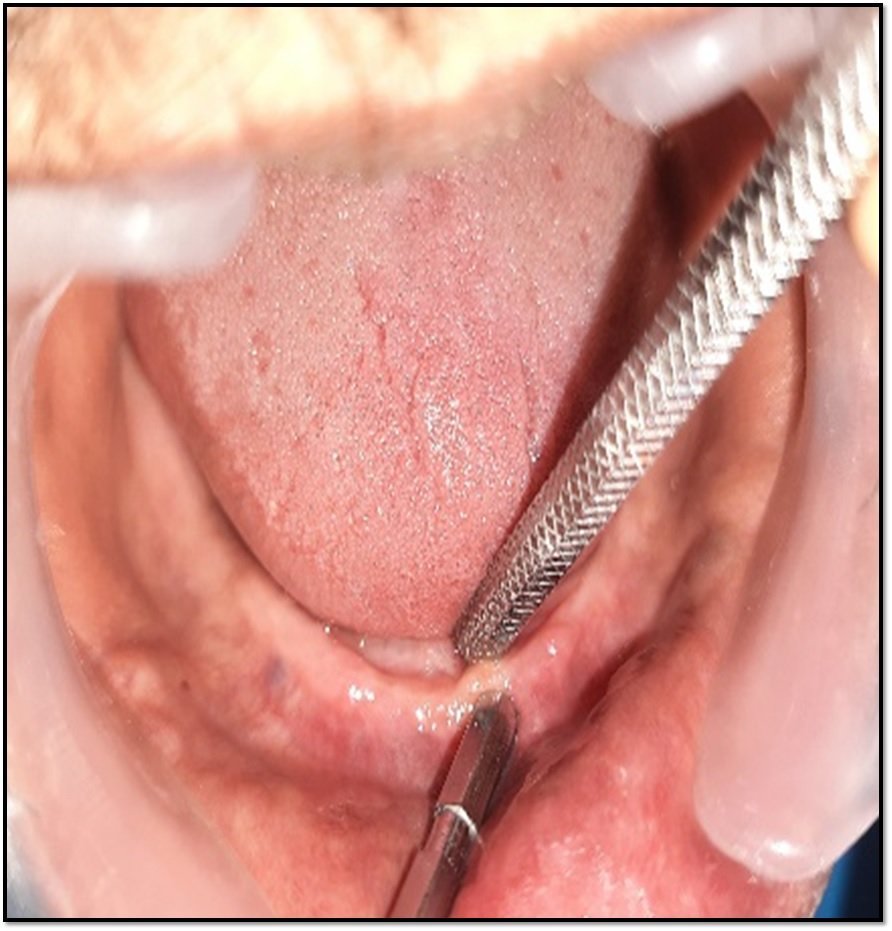
Fig 1. Intraoral examination revealing flabby tissue


Fig 2. Maxillary and mandibular primary impressions

Fig 3. Maxillary final impression using ZOE paste

Fig 4. Mandibular custom tray with window

Fig 5. Mandibular border moulded Tray

Fig 6. Injecting plaster on flabby tissue

Fig 7. Mandibular final impression

Fig 8. Jaw relation recorded

Fig 9. Try-in phase

Fig 10. Denture insertion
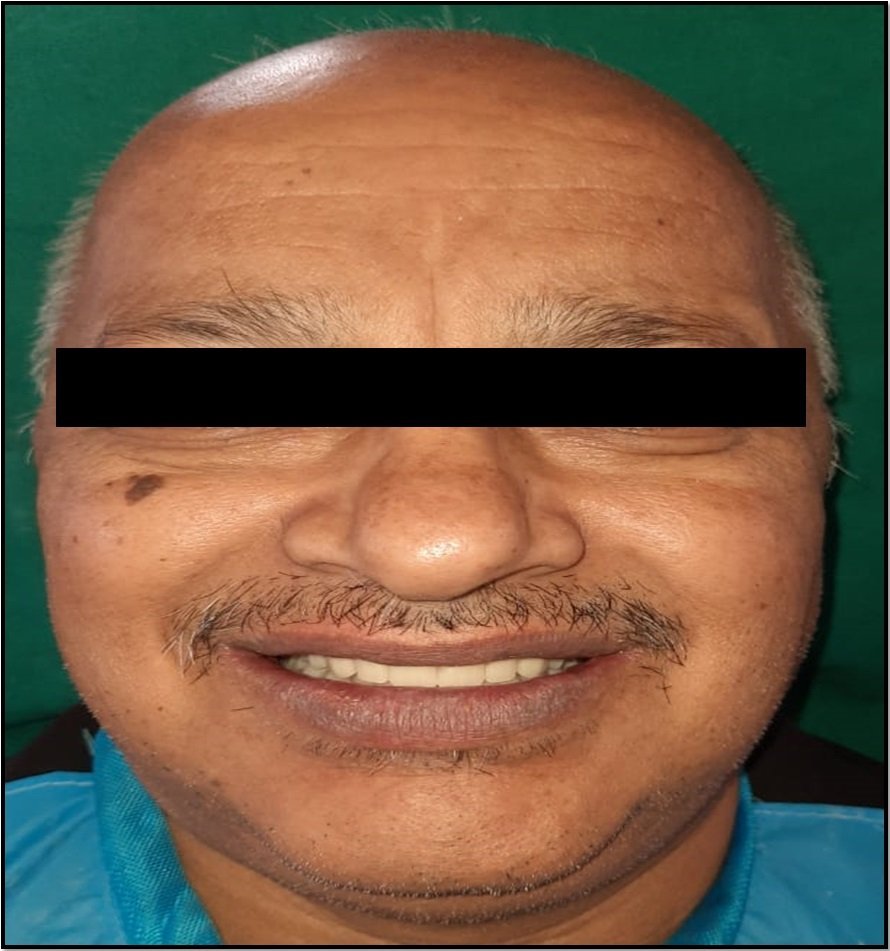
Fig 11. Post operative frontal view
DISCUSSION
Compromised edentulous ridges result in negative effects such as increased inter-arch space, unstable and non-retentive dentures. Such clinical scenarios can be dealt either surgically or conservatively. Though surgical therapy is the definitive treatment modality in such compromised ridges, it may not be always possible. Here comes the role of a Prosthodontist to deal such situations conservatively. An accurate impression will help us to ensure that the denture is stable and provides not only physiological, but also psychological comfort to the patient.
In atrophic mandible, the inability of residual ridge and its overlying tissues to withstand masticatory forces result in unstable dentures. Due to the severe ridge resorption, the muscle attachments become more evident near the crest of the ridge thus with greater dislodging effect on the dentures. This necessitates accurate denture extension within the range of muscle action. Such impressions are obtained by dynamic methods.
Various modified impression techniques for resorbed mandibular ridges have been proposed by various authors such as admixed, functional, all green and cocktail technique. Flabby tissues need to be recorded in a muco-static state. For this, various materials have been incorporated to handle such tissues like light body, impression plaster, etc.
In present case series, Case 1 showed Cocktail impression technique4 in which closed mouth functional impression was made and teeth were arranged in neutral zone to provide stable denture. Case 2 showed Winkler technique5 where impression was made with a tissue conditioner which acts as a cushion which helps in distribution of stresses. Case 3 showed Tunnel technique2 for flabby tissues in which impression was made with plaster. All the impression techniques mentioned in the literature are special in their own way. Though they appear to have certain limitations, a specific technique which is most advantageous for that particular scenario is selected.
CONCLUSION
Rehabilitation of a patient prosthodontically with resorbed ridges in a conventional manner is a difficult task to overcome. Therefore, modifications in treatment procedures and impression techniques should be considered to fulfil the functional and aesthetic demands of the patient. Therefore, dentures made using modified impression techniques exhibit better retention and overall satisfaction of the patient.
REFERENCES
- Jain V, Prakash P, Udayshankar V. Impressing for excellence: Special impression techniques for compromised ridges: Case report. Int J Contemp Med. 2019;6(7):18-21.
- Pai UY, Reddy VS, Hosi RN. A single step impression technique of flabby ridges using monophase polyvinylsiloxane material: A case report. Case Rep Dent. 2014;1-6.
- Manoj SS, Chitre V, Aras M. Management of compromised ridges: A case report. J Ind Prosthodont Soc. 2011;11(2):125–29.
- Praveen G, Gupta S, Agarwal S, Agarwal SK. Cocktail impression technique: A new approach to Atwood’s order VI mandibular ridge deformity. J Ind Prosthodont Soc. 2011;11(1):32-35.
- Krishnameera N et al. Anatomic and functional approach for residual resorbed ridge management using soft liners- A clinical report. IOSR-JDMS. 2015;14(10):73-76.
Disclaimer from Guident
The views and opinions expressed in articles published in Guident are solely those of the authors and do not necessarily reflect the views of the editors, the editorial board or the publisher, Ivory India. Guident does not endorse any product, technique or treatment described. Clinical content is intended for qualified dental and medical professionals and is not a substitute for individual clinical judgement. Guident, its editors and the publisher accept no liability for any consequence arising from the use of information published in the journal.
How to cite this article
Dr. Himanshu Aeran, Dr. Varun Kumar, Dr. Shubham Talele. Prosthodontic Management of Compromised Ridges: A Prevailing Barricade. Guident. 2022 Dec;16(1). Available from: https://guident.net/articles/prosthodontics/prosthodontic-management-of-compromised-ridges-a-prevailing-barricade.html