Restoring Esthetics by Procuring Patients Demand
Raichur, India
ABSTRACT
Complete loss of all permanent teeth can substantially reduce quality of life; self-image and daily functioning.so immediate denture can be an alternative approach and is a valuable and reliable treatment option and challenging for both dentist and patient.
INTRODUCTION
An immediate denture is a complete denture or removable partial denture fabricated for placement immediately after the removable of natural teeth-GPT. Immediate denture can be a either single immediate denture or upper and lower immediate denture1.Immediate denture fulfil an important role in today’s treatment modality byproviding instant aesthetics , function to the patient after the extraction of natural teeth and more importantly provide psychological support to the patient. Immediate denture protects the extraction site from trauma and also prevents bleeding and reduces residual ridge resorption.
There are Two 2 types of immediate denture.
- Conventional immediate denture (or classic).
- Interim (or transitional or non-traditional).
Conventional immediate denture is a type of denture in which refitting and relining of the prosthesis is done after healing is completed. Conventional immediate denture is a definitive or long term prosthesis and is usually indicated when only anterior teeth are present or few posterior teeth remain ,but that do not support an existing removable prosthesis .Patient requires 2 surgical visit for conventional immediate denture treatment.
An interim immediate denture is a type of denture once placed and after healing is completed a second new denture is fabricated to serve as long term prosthesis. An abbreviated type of IID has been called the jiffy denture.The interim immediate denture or short term prosthesis is indicted when there are multiple anterior and posterior teeth remaining or full arch extraction and or these teeth support a removable partial denture that the patient desires to retain until insertion. It is a single surgical visit procedure in which all the anterior and
posterior teeth are extracted at a time followed by insertion of prosthesis on the same day immediately, but prior to extraction impression must be made and completed up to fabrication of the prosthesis.
Advantages of immediate denture:1) maintenance of patience appearance is the primary advantage2.2)vertical dimension, facial height, muscle tone, circumoral support is maintained. 3) patient psychological status is not hampered.4) lesspost-operative pain3 .5) nutrition can be maintained with speech and mastication rarely compromised.6)the denture acts as a protective splint4.
Disadvantages: 1) anterior try in not possible5 .2) natural teeth with varying numbers, location and inaccurate centric and vertical records are possible when jaw relation are recorded.3) requires more chair side time, additional appointment and cost.4) bone resorption and shrinkage of soft tissues is faster and greater
A CASE REPORT
A 42 year male patient named Tirumurthy reported to our department with chief complain of difficulty in mastication and loosening of teeth in the right and left mandibular posterior region of jaw since 6 months.
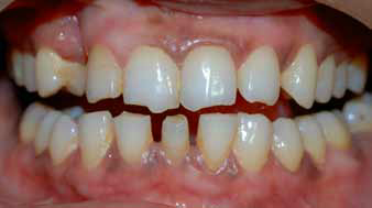
On examination there were multiple missing teeth with faulty prosthesis and remaining natural teeth present with poor periodontal condition(figure-1) The patient’ s demand was aesthetics and unwilling to stay without anterior teeth and wants immediate replacement. So without hampering the patient’s social psychological and professional status an conventional immediate denture was planned and explained to the patient.
Other Treatment option were:
Tooth supported overdenture
Implant supported overdenture.
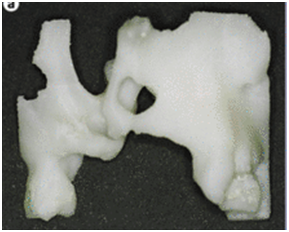
Diagnostic cast was made before the onset of treatment, posterior faulty prosthesis was removed and haematological examination was carried out prior to surgical phase (figure-2). With the patient well maintained physic all the
posterior teeth were extracted at 1st surgicalvisit excluding the premolar to serve as a vertical stop that preserves the vertical dimension (figure-3, 4).
Once the socket has healed 3-4 weeks later preliminary impression are made and custom tray is fabricated, border moulding of the entire border is performed followed by dual impression technique (figure-5). Record bases are made on the obtained master cast with fabrication of occlusal rims for the edentulous posterior region. Jaw relation was recorded with static centric record at vertical dimension of occlusion followed by mounting (figure-6).The teeth are selected using the existing teeth as guide for size and shape.A posterior tooth arrangement were arranged and try- in was done(figure 7).
Prior to the second surgical visit the anterior teeth are arranged with anterior teeth knocked out from the master cast (figure-8). The teeth are knocked out upto the gingival level with round off over the labial and lingual aspects and sandsmooth it.A surgical guide is prepared on the master cast after the tooth is knocked out(figure-9) .This guide duplicates the knocked out edentulous area and serve the purpose ofosteoplasty immediately after extraction .On the master cast extension of the record base is done with occlusal rims and anterior teeth are arranged followed by fabrication of the prosthesis.
On 2nd surgical visit all the remaining teeth are extracted, suturing is done followed by immediate placement of final prosthesis which is kept ready prior to extraction (figure -10, 11, 12). Patient is instructed with all the postoperative instructions .Postoperative recall is done for occlusal corrections and improve patients comfort.
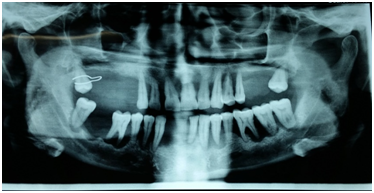
Figure-1Pre-operative radiographic view
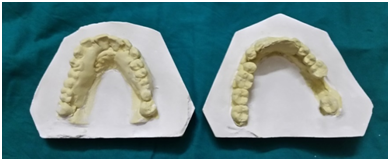
Figure-2 Diagnostic cast.
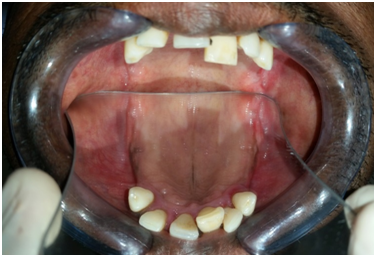
figure-3

Figure-4 Posterior edentulous condition after extaction

Figure-5 Dual impression
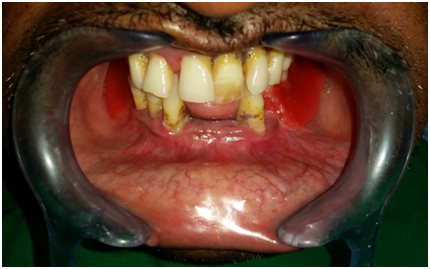
Figure -6 Jaw relation
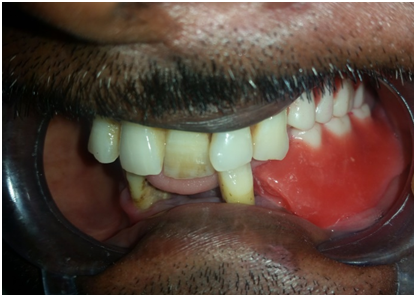
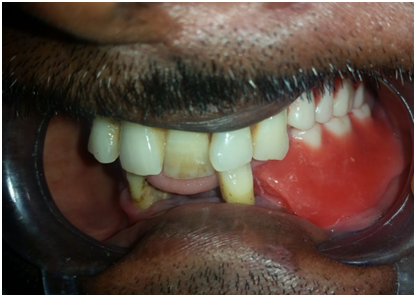
Figure-7 Posterior try-in


Figure-8Preparation of anterior site


Figure-9 Surgical guide
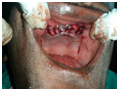
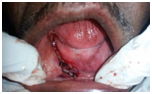
Fgure-10 Extraction
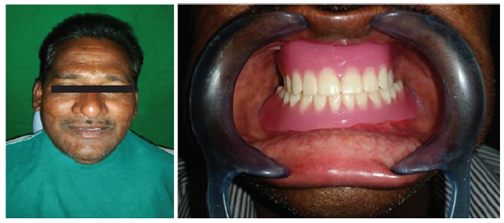
Figure-11 prosthesis insertion
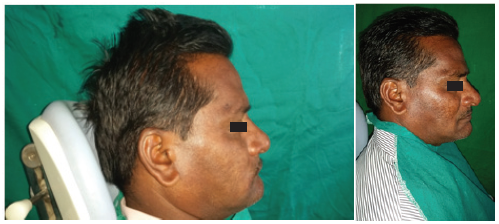
Figure-12. Preoperative and post operative view.
POSTOPRATIVE INSTRUCTION
1) Do not remove your denture during the first 24 hours.On the day ofextraction after the denture are inserted insist the patient to sit reclined or lie down for rest of the day.2) Take medications as prescribed by your dentist.3)First 2 -3 days it is normal for some bleeding to occur. When bleeding occurs closeyourteeth tightly for 10 minutes pressure from denture will slow down the bleeding. 4) During first 24 hours avoid mouthwash.6) Remaining natural teeth and rest of mouth maintain hygiene as usual.
DAY AFTER SURGERY
1)The dentist will remove and clean the denture and make any needed adjustment at your postoperative recall.2)Be careful not to disturb blood clot the next day and gently rinse the mouth with water, warm salt water or dilute mouth wash.
CONCLUSION
Immediate denture is one of the alternative approachand allows the patient to continue their social and professional activities without being in a edentulous state. The preparatory process is very important in order to get a fine results with satisfactory aesthetics .This procedure is demanding and challenging to the dentist as the anterior try in not possible. It is important for both the dentist and the patient to understand the limitations of the procedure and relining will improve the fit of denture and philosophical patients are the best candidates for these types of treatment procedure6, 7, 8. As a wise man once said‘Patience is virtue”
REFERENCES
- Gooya A,Ejlali M,Adli AR.Fabricating an immediate partial denture in one appointment(a modified Jiffy denture) a clinical report .Journal of prosthodont june-2013 :22(4);330-333.
- Arbree NS. Immediate dentures. In: ZarbGA, Bolender CL, Eckert SE, Fenton AH, Jacob RF, Merickske-Stern R. Prosthodontic treatment for edentulous patients: Complete dentures and implantsupported prostheses. 12th ed. St Louis: Mosby; 2005. P.123-59.
- Sharry JJ. Immediate dentures. In: Complete denture prosthodontics. St Louis: McGraw-Hill; 1974.p. 295-309
- Immediate partial denture prosthesis - A Case report.NUJHS Vol. 3, No.4, December 2013, ISSN 2249-7110
- Prosthetic rehabilitation of patient using immediate complete denture– A case report. IJRID Volume 1 Issue 2 Nov.-Dec 2011
- mer WJ. Minimizing problems in placement of immediate dentures.J Prosthet Dent 1972; 3: 275-84.
- Kelly KE. Follow- up treatment for immediate denture patients.JProsthet Dent 1967; 1: 16-19.
- Heartwell CM, Salisbury FW. Immediate complete dentures: Anevaluation. J Prosthet Dent 1965; 4: 615-623
Disclaimer from Guident
The views and opinions expressed in articles published in Guident are solely those of the authors and do not necessarily reflect the views of the editors, the editorial board or the publisher, Ivory India. Guident does not endorse any product, technique or treatment described. Clinical content is intended for qualified dental and medical professionals and is not a substitute for individual clinical judgement. Guident, its editors and the publisher accept no liability for any consequence arising from the use of information published in the journal.
How to cite this article
Dr. Subashani, Dr. Sunil Dhaded, Dr. Kavita Patil Department of Prosthodontics AME Dental College and Hospital. Restoring Esthetics by Procuring Patients Demand. Guident. 2018 May;11(6). Available from: https://guident.net/articles/prosthodontics/restoring-esthetics-by-procuring-patients-demand.html