Effect of Different Water-to-Powder Ratio on the Solubility and Microhardness of a Bioactive Material an in-Vitro Study
Dept. of Conservative Dentistry & Endodontics, SDM College of Dental Sciences & Hospital, Sattur, Dharwad, Karnataka, India
ABSTRACT
CONTEXT (BACKGROUND): Insolubility and good microhardness are important criteria for an ideal bioactive material to prevent any microleakage between the root canal and the periradicular space and provide sealing ability when used as root-end filling, root perforation repair, orthograde obturation and apical plug formation material.
AIM: To evaluate the effect of changes in the ratio of liquid to powder on the solubility and weight changes in synthetic tissue fluid/ Phosphate buffer solution and microhardness of OrthoMTA.
MATERIALS AND METHOD: One gram of OrthoMTA powder was mixed with 0.5 mL, 0.4 mL and 0.33 mL of distilled water. For solubility, a total of 60 specimens were prepared (n=20 per each ratio) in the disk- shaped polycarbonate moulds with a height of 2 mm and internal diameter of 4 mm. The specimens of each water-to-powder ratio were randomly divided into two subgroups: half (n=10) were immersed for 7 days and the other half (n=10), were immersed for 28 days in Synthetic tissue fluid/ Phosphate buffer solution. The weight change in the specimens were calculated. To measure microhardness, a total of 30 specimens were prepared (10 per each ratio, n=10). The mixtures were transferred to two-part split polycarbonate moulds with an internal diameter of 4 mm and height of 6 mm. After 4 days the samples were subjected to Vicker's test. The data were analysed using ANOVA, Paired t test and post-hoc Bonferroni tests at a significance level of 0.05.
RESULT: The 0.33 water-to-powder ratio showed significantly greater mean microhardness value (23.42±1.24) compared to 0.4 and 0.5 ratios (18.63±0.89, 13.62±1.29 respectively). Statistical analysis revealed that there were no significant differences in the weight changes and percentage weight changes between the experimental groups. However, Group III showed highest weight gain after immersion in synthetic tissue fluid for 28 days.
CONCLUSION: Higher WP ratios result in lower microhardness and lower the amount of weight gain in OrthoMTA. Therefore, the 0.33 water-to-powder ratio would be the ideal proportion.
KEYWORDS: OrthoMTA, Solubility, Microhardness, Water-to-powder ratio, Phosphate buffer solution
INTRODUCTION
MTA, regarded as an ideal material for perforation repair, pulp capping, apexification, resorptions, obturation & root-end filling material was introduced in 1993 by Torabinejad.1 In spite of various advantages, MTA exhibits some limitations such as prolonged setting time, difficult handling properties & discoloration of hard tissues.2,3 In order to overcome these drawbacks, recently, a new tricalcium silicate based restorative material was introduced by BioMTA in Seoul, South Korea. OrthoMTA is composed of 76.3% of tricalcium silicate, 11.8% of dicalcium silicate, 8% of tricalcium aluminate, 0.8% of tetracalcium aluminoferrite and 0.7% of free calcium oxide. Manufacturers claim that OrthoMTA is the first orthograde root canal grafting material. The main advantage of OrthoMTA over MTA is their reduced setting time & better sealing ability.
Root-end filling materials are used to provide good apical seal and prevent apical microleakage of irritants into the periradicular tissue.4 The characteristics of an ideal root-end filling material would include biocompatibility,.5 sealing ability.6, osteogenic and cementogenic activity.7 One of the most important characteristics of an ideal root-end filling material is its insolubility in various acids, enzymes, and fluids in the oral cavity, to provide sealing ability and block the migration of bacteria & their by-products into the periradicular tissues.8 Therefore, due to the permanent contact with tissue fluids such as serum and blood in the oral environment, the insolubility of materials used in the oral cavity is an important concern.9
Few previous studies on the mineral trioxide aggregate (MTA), have shown that changes in the powder-to-liquid ratios will affect the solubility of bioactive restorative material. Friedland et al.9, reported that increasing the ratio of liquid to powder leads to rise in solubility and thereby porosity of MTA. Moreover, Cavenago et al.10 examined the effect of various water-to-powder (WP) ratios on different physical properties of MTA, and confirmed that increasing the amount of water results in higher solubility of the cement.
Liquid-to-powder ratio may also influence the microhardness of hydraulic cements because this property is a reflection of hydration process and an indicator of the setting process.11,12 Several physical and mechanical properties of a bioactive material such as tensile strength, modulus of elasticity, the stability of its crystal structure.13, and the amount of porosity.14 will affect its surface microhardness.
The OrthoMTA manufacturer has not provided precise instructions regarding the accurate proportion of liquid to powder required in achieving optimal physical properties, and also there are no published researches available in the literature on the effect of various liquid-to-powder ratios on the water solubility and microhardness of this cement. Therefore, the purposes of this study were to determine the effect of changes in the ratio of liquid to powder on the solubility and weight changes in synthetic tissue fluid/ Phosphate buffer solution and microhardness of OrthoMTA. The study was begun by considering the first null hypothesis stating that there are no significant differences between any groups on the solubility and weight changes when immersed in phosphate buffer solution at two different time periods. Whereas second null hypothesis was that there are no significant differences between any groups on the microhardness of the set OrthoMTA.
MATERIALS AND METHOD
Ethical clearance was obtained from the Institutional Review Board of our institution (IRB NO. 2020/P/CONS/73).
SOLUBILITY TEST
The solubility of material was evaluated in accordance with the International Standard Organization (ISO) 6876: 2012 method.15 and by the measurement of changes in the sample weight after immersion in synthetic tissue fluid (STF)/phosphate buffer solution. A total of 60 polycarbonate ring moulds with internal diameter of 4 mm and height of 2 mm were selected for sample preparation and cleaned in an ultrasonic bath containing acetone for 15 min to remove grinding chips. All the rings were weighed and each mould was identified with a code. Each ring was weighed thrice on a precision scale with 0.01g accuracy before and after filling the moulds and their weights were recorded by the predetermined codes. The samples were divided into three experimental groups based on the different water-to-powder ratios as follows –
Group I – One gm of OrthoMTA powder was mixed with 0.5 mL of distilled water (n=20).
Group II - One gm of OrthoMTA powder was mixed with 0.4 mL of distilled water (n=20).
Group III - One gm of OrthoMTA powder was mixed with 0.33 mL of distilled water (n=20).
OrthoMTA was manipulated by a single operator according to the manufacturer’s instructions and care was taken to prevent air bubble entrapment.
The cement was condensed using a spatula and then allowed to cure in the polycarbonate moulds. Flat glass plates with dimensions larger than the ring moulds were used to flatten the surface of the specimens and remove cement flushes.
Wet gauze was put on the upper and lower surfaces of the samples to produce 95% humidity and all specimens were placed in the incubator at 37° C for a time period 50% longer than the complete setting time stated by the manufacturer to being set completely (i.e. 10 hours). The set samples were divided into 2 separate subgroups and immersed in STF for 2 different time periods.
Subgroup A – immersed in STF for 7 days
Subgroup B – immersed in STF for 28 days
The STF is a phosphate buffer saline solution with pH = 7.2 and composed of 11.80 gm Na2HPO4, 80.0 gm NaCl and 2.0 gm KCl in 10 L of H2O. The specimens were immersed in a closed container with 100 ml of STF and placed in the incubator at 37°C. The STF was refreshed every 3 days.
The samples were removed from the incubator after the specified time periods. Each sample was washed carefully with distilled water, dried with filter paper, placed in the oven (at 105°C with no humidity) for 24 hours and then cooled down in the same desiccator. The weight of the specimens was then measured thrice and average reading was recorded. The difference between the initial weight of the sample and its final weight was recorded at 0.0001 g. The percentage of weight changes was calculated as a percentage of the difference in the sample weight to the initial weight of the sample with a precision of 0.001%.
VICKERS MICROHARDNESS TEST
A total of 30 custom-made two-part split polycarbonate moulds measuring an internal diameter of 4 mm and height of 6 mm were selected for sample preparation. Before the moulds were filled with OrthoMTA, they were randomly divided into three groups.
Group I - One gm of OrthoMTA powder was mixed with 0.5 mL of distilled water(n=10).
Group II - One gm of OrthoMTA powder was mixed with 0.4 mL of distilled water(n=10).
Group III - One gm of OrthoMTA powder was mixed with 0.33 mL of distilled water(n=10).
The cement was condensed using a spatula with light force and then allowed to cure in the polycarbonate moulds. Flat glass plates with dimensions larger than the ring moulds were used to flatten the surface of the samples and remove cement flushes. The samples were then wrapped with wet gauze on the top and bottom of the moulds and incubated at 37° C in 100% humidity. After 4 days, the set specimens were polished using silicon carbide paper; then subjected to the microhardness test using a Vickers Testing Machine (Bareiss Prufgeratebau GmbH, Oberdischingen, Germany). Set samples were loaded with a diamond indenter of 50 gm load for 10 sec. This force was applied on the polished surface of each specimen at three separate points in accordance with the ASTM E384 standard for the Vickers microhardness test.
Then the Vickers microhardness was calculated using the following formula:
HV=0.102 F/A≈0.1891F/d2
A=d2/2sin (136°/2)
Where, F is load in Newtons
0.1891 is Vickers constant
d is arithmetic mean of the two diagonals
A is impression surface in mm2
HV is Vickers hardness
STATISTICAL ANALYSIS
Data were analysed using SPSS software (SPSS, version 22.0, Chicago, IL, USA). Data was subjected to normalcy test (Shapiro-wilk test). Data showed normal distribution. Hence parametric tests (ANOVA, Paired t test) were applied. The level of significance was set at 0.05.
RESULT
The mean values and standard deviations of the weight changes and percentage of weight changes of different experimental groups in both designated time intervals are presented in Table 1. It shows that among the two predetermined time intervals, 28 days had higher weight gain than compared to 7 days. Also, Group III had significantly higher weight gain than compared to other groups at both the predetermined time intervals. Table 2 shows that when the comparison of the solubility was done before and after immersion in STF using Paired t test, it was found that there were statistically significant differences. Table 3 shows that when the comparison of the difference in solubility was done among the groups using ANOVA, it was found that there were statistically significant differences among the groups at 28 days. Table 4 shows the further comparison between the groups using Post-hoc Bonferroni test and it was found that there were statistically significant differences between the Group I and Group III at 28 days.

Table-1

Table-2

Table-3

Table-4
The mean values and standard deviations of the microhardness among different experimental groups are presented in Table 5 and shows that Group III had higher microhardness values when compared to other groups. Table 6 shows that when the comparison of the microhardness was done among the groups using ANOVA, it was found that there were statistically significant differences. Table 7 shows that when further comparison was done between the groups using Post-hoc Bonferroni test, it was found that there were statistically significant differences between Group I with Group II, Group I with Group III as well as Group II with Group III.

Table-5

Table-6
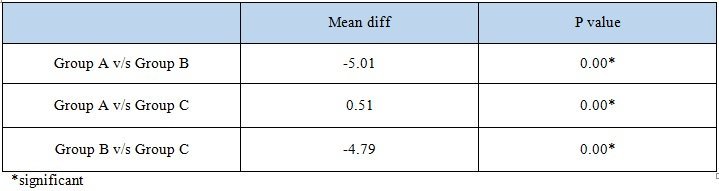
Table-7
DISCUSSION
Solubility is a very important factor in assessing the suitability of materials and lack of solubility is a desired characteristic property for bioactive materials16 because endodontic and restorative materials should provide a long-term seal and avoid leakage from the oral cavity and/or the periapical tissue. Since OrthoMTA is recommended for use as a root-end filling material, root perforation repair material and orthograde obturation material, assessment of its solubility & microhardness is important for the long-term survival of restoration.
In this study, the effect of changes in the ratio of liquid to powder on the solubility and weight changes in synthetic tissue fluid/ Phosphate buffer solution at two predetermined time intervals (7 days and 28 days) and microhardness of OrthoMTA were assessed. We found that the mean percentage of weight changes ranged from 18% to 54%. The lowest weight change value was obtained for Group I Subgroup A & highest value was obtained to Group III Subgroup B. The negative values given in Table 1 mean an increase in weight. Thus, it may be concluded that nearly all the OrthoMTA samples absorbed mass from the PBS buffer. Whereas, the lowest mean microhardness value was noted in Group I with 13.62 HV and highest mean microhardness value was noted in Group III with 23.42 HV.
The OrthoMTA manufacturer does not provide meticulous instructions with regard to the exact ratio of powder to liquid; merely stating to add distilled water 3 mm above the level of powder, hydrate the OrthoMTA powder using sterile mixing stick, after which the excess water should be removed using sterilized cotton swab until putty-like consistency is achieved.
A study by Shojaee NS et al., had demonstrated that WP ratios of bioactive materials lower than 0.33 and higher than 0.50 are not suitable for practical uses, as they may affect the preservation of material’s dimensional stability.17 Therefore, in the present study, three different water-to-powder ratios considered for evaluation are 0.33, 0.4 and 0.5.
It has to be noted that with regard to the strict definition of the physicochemical term solubility, the test used in the present study measured the elution of water-soluble material, but not the solubility. Solubility of a solid is the situation where a pure chemical compound is in thermodynamic equilibrium with its solution.18 Moreover, it has to be taken into account, that measuring the weight differences of the cement specimens may also record disintegration processes that may not be the result of dissolution. Factors such as the immersion time, amount of unreacted substrate, the chemical composition and size of elutable material, as well as the chemistry of the solvent affects solubility.19
Saghiri et al.8 compared the solubility of MTA in different media in an in-vitro study. By Considering the lower solubility of MTA in PBS, Saghiri et al., suggested that PBS was a better media than distilled water for evaluating the solubility of dental materials.
In the present study, the solubility of OrthoMTA was assessed in STF for better understanding of the advantages of bioactive components to be released from calcium silicate cements. OrthoMTA is a bioactive material; therefore, in an oral environment or in contact with STF, it dissolves and releases its major cationic components. This reaction leads to the production of hydroxyapatite (HA) on its surface and thereby causes expansion and an increase in weight.20 Sarkar et al.20 showed that calcium (Ca2+) is the most dominant ion released from MTA in contact with STF, as this ion is sparingly soluble in STF, thereby causing the HA to precipitate. Since STF is a phosphate buffer solution, it contains major cationic constituents such as phosphate ions.
The main constituent in MTA is tricalcium silicate, which is used as an endodontic material & bone cement. Tricalcium silicate cement has been found to have shorter setting time, good injectability and bioactivity. One such formulation is OrthoMTA (BioMTA) which was recently developed as dentin replacement material.21 There are no studies evaluating the solubility and microhardness with different water-to-powder ratios of OrthoMTA for the purpose of outcome comparison. However, the main component of MTA is tricalcium silicate; the outcomes of this study could be compared with earlier studies about various bioactive materials.
A previous study by Mousavi SA et al., showed that OrthoMTA exhibited similar sealing properties when compared with ProRoot MTA and Biodentine.22 As previously mentioned, this can be explained by the dissolution of OrthoMTA in contact with STF that leads to HA precipitation in the same manner as MTA.
In the present study, powder of OrthoMTA mixed with different water-to-powder ratios, gained weight when they were in contact with STF during the experimental time periods. We used STF that has a similar composition to the natural aqueous environment in dentin, perhaps leading to more chemical reactions and an increase in the production of HA. Thus, the material’s weight would increase in contact with this liquid when compared with distilled water. This was in accordance with the previous study by Shojaee NS et al.,23 who reported no weight loss, but increase in the weight of CEM cement and MTA after 7 and 27 days. This was supported by another study by Kaup et al.24 who reported weight loss in distilled water but weight gain in PBS for Biodentine and MTA when comparing the solubility of these materials. This difference can be explained by the different media used in each study.
In contrast, Bodanezi et al.25 in an in-vitro study by showed that both MTA and Portland cement had weight gain in the first hour, followed by some weight loss thereafter, but here they had used distilled water as the media. A study by Shojaee NS et al.26, evaluated the effect of different water-to-powder ratios on the solubility of CEM cement when immersed in distilled water. It was demonstrated that percentage of weight loss of all ratios after 24 h was below 3% which was within the acceptable range (≤3%) according to modified ADA guidelines. However, another previous study reported that the weight loss of hydrated and dehydrated specimens of CEM cement was more than 3%27 when immersed in distilled water.
Vickers microhardness (HV) can be defined as the resistance to plastic deformation of the surface of a material after indentation or penetration. The reported microhardness values for sound dentine were in the range of 60–90 HV.24 It would be optimal if the surface hardness of a bioactive material could reach the same range as dentine.
The measurement of the Vickers microhardness was undertaken with 6 mm thick samples to simulate clinical application. Matt et al. recommended 5 mm thickness of ProRoot MTA as an apical barrier, which was significantly harder than an apical barrier of 2 mm. In addition, the minimal thickness for ProRoot MTA given in the literature as root-end filling material is 3 mm, whereas for apical plug formation is 4 mm.24
In the present study the effect of different water to powder ratio was also evaluated on the microhardness of OrthoMTA. Since Vickers Microhardness test is based on evaluating the resistance of materials to deformation.28 Hence, when the microhardness of cements decreases, they can be removed more easily.29 Our results showed that the surface microhardness of OrthoMTA increases with reducing WP ratio. These outcomes reflect the adverse effect of an increased volume of liquid on the hydration process of OrthoMTA. This finding could be attributed to the increase in porosity, which occurs subsequent to a higher amount of liquid. Hence, it should be mentioned that microhardness has an inverse relationship with porosity14 and a previous study by Fridland M and Rosado R reported that higher amount of water caused increased in the porosity of MTA.9
The limitation of this study is that the experimental samples should have been evaluated under scanning electron microscopy to evaluate surface characteristics and effects of STF on the surface of OrthoMTA.
CONCLUSION
The null hypothesis of this study was rejected as higher the water-to-powder ratio, higher was the amount of weight gain of the samples when immersed in STF for both the specified time intervals and the microhardness of the set OrthoMTA. Therefore, water-to-powder ratio of 0.33 can be considered as an ideal ratio for OrthoMTA, when used as dentin replacement material.
REFERENCES
- Lee SJ, Torabinejad M. Sealing ability of a mineral trioxide aggregate for repair of lateral root perforations. Journal of Endodontics 1993;19:541–544.
- Parirokh M, Torabinejad M. Mineral trioxide aggregate: a comprehensive literature review- part I: chemical, physical, and antibacterial properties. Journal of Endodontics 2010;36:16–27.
- Dammaschke T, Gerth HU, Zuchner H, Schafer E. Chemical and physical surface and bulk material characterization of white ProRoot MTA and two Portland cements. Dental Materials 2005;21:731–738
- Aqrabawi J. Sealing ability of amalgam, super EBA cement, and MTA when used as retrogradefilling materials. Br Dent J. 2000; 188: 266–268.
- Moghaddame-Jafari S, Mantellini MG, Botero TM, McDonald NJ, Nör JE. Effect of ProRoot MTA on pulp cell apoptosis and proliferation in vitro. J Endod. 2005; 31: 387–391.
- Bortoluzzi EA, Broon NJ, Bramante CM, Garcia RB, de Moraes IG, Bernardineli N. Sealing ability of MTA and radiopaque Portland cement with or without calcium chloride for root-end filling. J Endod. 2006; 32: 897–900.
- Hakki SS, Bozkurt SB, Hakki EE, Belli S. Effects of mineral trioxide aggregate on cell survival, gene expres-sion associated with mineralized tissues, and biomineralization of cementoblasts. J Endod. 2009; 35: 513–519.
- Saghiri MA, Ricci J, Daliri Joupari M, Aeinehchi M, Ahmadi K, Bahramian N. A Comparative Study of MTA Solubility in Various Media. Iran Endod J. 2011; 6: 21–24.
- Fridland M, Rosado R. Mineral trioxide aggregate (MTA) solubility and porosity with different water-to-powder ratios. J Endod. 2003; 29: 814–817.
- Cavenago B, Pereira T, Duarte M, Ordinolaâ€ÂÂZapata R, Marciano M, Bramante C, Bernardineli N. Influence of powderâ€ÂÂtoâ€ÂÂwater ratio on radiopacity, setting time, pH, calcium ion release and a microâ€ÂÂCT volumetric solubility of white mineral trioxide aggregate. Int Endod J. 2014;47(2):120-6.
- Lee Y-L, Lee B-S, Lin F-H, Lin AY, Lan W-H, Lin C-P. Effects of physiological environments on the hydration behavior of mineral trioxide aggregate. Biomaterials. 2004;25(5):787-93.
- Namazikhah M, Nekoofar MH, Sheykhrezae M, Salariyeh S, Hayes SJ, Bryant ST, Mohammadi M, Dummer PMH. The effect of pH on surface hardness and microstructure of mineral trioxide aggregate. Int Endod J. 2008;41(2):108-16.
- Chandler H. Introduction to hardness testing. Hardness testing. USA: ASM International. 1999:1-13.
- Saghiri MA, Lotfi M, Joupari MD, Aeinehchi M, Saghiri AM. Effects of storage temperature on surface hardness, microstructure, and phase formation of white mineral trioxide aggregate. J Endod. 2010;36(8):1414-8.
- ISO 6876: 2012.International Organization for Standardization. Dental root canal sealing materials.
- Torabinejad M, Hong CU, McDonald F, Pitt Ford TR. Physical and chemical properties of a new root-end filling material. J Endod. 1995;21:349–53.
- Shojaee NS, Adl A, Jafarpur D, Sobhnamayan F. Effect of Different Water-to-Powder Ratios on the Compressive Strength of Calcium-enriched Mixture Cement. Iran Endod J. 2018;13(3):395.
- Wilson AD. Specification test for the solubility and disintegration of dental cements: A critical evaluation of its meaning. J Dent Res. 1976;55:721–9.
- Yanikoglu N, Duymus ZY. Evaluation of the solubility of dental cements in artificial saliva of different pH values. Dent Mater J. 2007;26(1):62-7.
- Sarkar NK, Caicedo R, Ritwik P, Moiseyeva R, Kawashima I. Physicochemical basis of the biologic properties of mineral trioxide aggregate. J Endod. 2005; 31: 97–100.
- Rai AV, Naik BD. The comparative evaluation of shear bond strength of a bioactive material to different universal bonding agents – An in-vitro study. J Conserv Dent 2019;22:470-4.
- Mousavi SA, Khademi A, Soltani P, Shahnaseri S, Poorghorban M. Comparison of sealing ability of ProRoot mineral trioxide aggregate, biodentine, and ortho mineral trioxide aggregate for canal obturation by the fluid infiltration technique. Dent Res J 2018;15:307-12.
- Shojaee NS, Sahebi S, Karami E, Sobhnamayan F. Solubility of two root-end filling materials over different time periods in synthetic tissue fluid: a comparative study. J Dent. 2015;16(3):189.
- Kaup M, Schäfer E, Dammaschke T. An in vitro study of different material properties of Biodentine compared to ProRoot MTA. Head Face Med. 2015;11(1):16.
- Bodanezi A, Carvalho N, Silva D, Bernardineli N, Bramante CM, Garcia RB, et al. Immediate and delayed solubility of mineral trioxide aggregate and Portland cement. J Appl Oral Sci. 2008; 16: 127– 131.
- Sadat Shojaee N, Adl A, Jafarpour D, Sobhnamayan F. Effect of Different Water-to-Powder Ratios on the Solubility and Microhardness of Calcium-Enriched Mixture Cement. Iran Endod J. 2019;14(3): 185-9.
- Abbas zadegan A, Sedigh Shams M, Jamshidi Y, Parashos P, Bagheri R. Effect of calcium chloride on physical properties of calciumâ€Â enriched mixture cement. Aust Endod J. 2015;41(3):117-21.
- Chandler H. Hardness testing: ASM international; 1999.
- Shojaee NS, Adl A, Sobhnamayan F, Khademi A, Hamedi M. In Vitro Evaluation of Different Solvents for Retrieval of Mineral Trioxide Aggregate and Calcium-Enriched Mixture. Iran Endod J. 2016;11(3):223.
Disclaimer from Guident
The views and opinions expressed in articles published in Guident are solely those of the authors and do not necessarily reflect the views of the editors, the editorial board or the publisher, Ivory India. Guident does not endorse any product, technique or treatment described. Clinical content is intended for qualified dental and medical professionals and is not a substitute for individual clinical judgement. Guident, its editors and the publisher accept no liability for any consequence arising from the use of information published in the journal.
How to cite this article
DR. AMULYA VITTAL RAI, DR. BALARAM DAMODAR NAIK. Effect of Different Water-to-Powder Ratio on the Solubility and Microhardness of a Bioactive Material an in-Vitro Study. Guident. 2020 Dec;14(1). Available from: https://guident.net/articles/research/effect-of-different-water-to-powder-ratio-on-the-solubility-and-microhardness-of-a-bioactive-material-an-in.html