Evaluating the Effect of Adding Calendula Officinalis on Mechanical Strength of Glass Ionomer Cement: An Invitro Study
Department of Orthodontics, Mahatma Gandhi Dental College and Hospital, Jaipur, Rajasthan, India
ABSTRACT
Plaque accumulation is major problem which a practitioner faces during the orthodontic treatment, mainly nearby the brackets as well as coronaledges of bands as patient experiences certain discomfort as far as cleanliness in these areas is concerned. Band materials are fixed to tooth surfaces using variety of luting cements. One common unfavorable property present in most of the cements is more dissolubility in liquid intakes and inadequate bond strength, are major factors for demineralization beneath bands. Among most commonly used dental cements, GIC is most preferable cement for band cementation. The present analysis focuses on how to check the mechanical properties in glass ionomer cement by incorporating Calendula officinalis. This invitro study was conducted to check mechanical features of glass ionomer cement in following groups- Group (A) Banded teeth, treated using Calendula officinalis.10%, Group (B) Banded teeth using Calendula officinalis.25%, Group (C) Banded teeth using Calendula officinalis.50% and Group (D) GIC only (Control group).
Keywords: Calendula officinalis, glass ionomer cement, luting.
INTRODUCTION
Plaque accumulation is major problem which a practitioner faces during the orthodontic treatment, mainly nearby the brackets as well as coronal edges of bands as patient experiences certain discomfort as far as cleanliness in these areas is concerned.1 Accumulation of debris and food material around brackets and bands leads to development of ecosystem very favorable for the development of myriad of problems like enamel demineralization, caries and hyper plastic gingivitis.
Band materials are fixed to tooth surfaces using variety of luting cements. One common unfavorable property present in most of the cements is more dissolubility in liquid intakes and inadequate bond strength, are major factors for demineralization beneath bands.2-4
Among most commonly used dental cements, GIC is most preferable cement for band cementation. One of the main properties of GIC cement is absorption of fluoride& constant release, which provides certain anti-bacterial activities.5-7
Streptococcus mutans is the major fertile organism involved in caries development.
Hence, it becomes really very important to have a complete knowledge about the influence of the cement that is used in orthodontics on the various microorganisms (bacteria, etc.). This may include impact on bacterial existence, adhesion and biofilm formation.
So, it is necessary to check the interaction of orthodontic cement with these bacteria along with their effect on bacterial viability, adhesion and biofilm formation.9,10
Calendula officinalis
Family of Plant- Asteraceae
Duration of its peak growth- May to October
Part of Plant used- Flowers
Significance from the point of Dentistry- Mouthwash having Calendula officinalis are remarkable in controlling gingival bleeding.
OBJECTIVES
The present analysis focuses on how to check the mechanical properties in glass ionomer cement by incorporating Calendula officinalis.
OBJECTIVES OF THE STUDY
This invitro study will be conducted to check some mechanical features of glass ionomer cement in following groups-
Group (A) Banded teeth, treated using Calendula officinalis.10%, Group (B) Banded teeth using Calendula officinalis.25%, Group (C) Banded teeth using Calendula officinalis.50% and Group (D) GIC only (Control group).
MATERIAL AND METHOD
This study was conducted to investigate whether adding Calendula officinalis might influence the Shear-peel band strength of the Glass Ionomer Cement (GIC) utilized for cementation of denture bands. Mechanical tests were conducted in tribiology lab (mechanical department) MNIT, Jaipur.
Total 10 samples of each concentration were prepared.
- Group A 10% Calendula officinalis in GIC
- Group B 25% Calendula officinalis in GIC
- Group C 50% Calendula officinalis in GIC
- Group D 0% Calendula officinalis in GIC
Total 40 samples were premolar were collected which were recently extracted human teeth with periodontal involvement or extracted for therapeutic purpose in the oral surgery department, Mahatma Gandhi Dental College and Hospital Jaipur.
Statistical Analysis
The statistical analysis was carried out using SPSS. The data obtained were represented as a median value i.e. between the minimum and the maximum. The four categories of groups that were used for comparison was executed using the Kruskal-Wallis Test. The level of significance was decided to be at P, .05. Another important analysis which would assure the genuine distribution of statistics was carried out by the Kolmogorov-Smirnov test.
Determination of size of the sample
Numerical values involved were:
Mean Deviation
Standard Deviation
Formula used in Calculation-
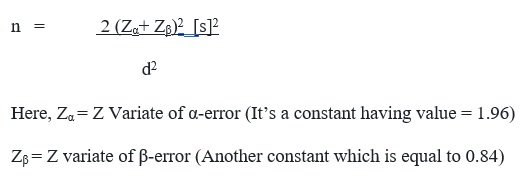
Approximately the following estimates were obtained
- Powder to be Eighty percent
- Only 5 % of the Type I Error
- Percentage of Type II error came out to be 20
- There was an accurate difference of 0.15 unite among all of the groups.
- 0.12 was the value for Pooled standard deviation.
Now, when all the above obtained values were substituted in the above formula, then the results obtained were as shown under:

Around 10 samples per group should complete this study.
It is advisable to make more number of samples so that even after some errors in processing, we would be able to achieve the required minimum sample size. Also to reduce the total cost, you may consider removal of groups rather than reducing the sample size per group
- Band Material (Stainless steel material, dimension 0.004 x 0.150)
- Weighing balance (RADWAG) – AS 220.R2
- Instruments used for band placement ( Hoe plier, contouring plier, scissor, Band Material)
Stainless steel band was used as band material; it was adapted around premolar tooth surface and welded with help of welding machine. Dimension of band was 0.004 x 0.150.
Weighing balance was used to measure weight of GIC every time to measure shear peal bond strength with different percentage of Calendula in GIC.
METHOD FOR MECHANICAL TESTING
MECHANICAL ASSAY
This research was performed in Department of Tribiology, Mechanical department, MNIT, Jaipur. Research was designed to analyze and compare the bond strength.
The count of the premolars extracted was 40 from the Oral Surgery Clinical department, Mahatma Gandhi medical University. Teeth selected were based on following criteria. No caries, surface defects, restorations or cracks were present on tooth surfaces.
Exterior surface of all teeth were thoroughly cleaned of blood and scaled with ultrasonic scaler to remove tissue tags and plaque. Teeth were kept in distilled water after extraction till further experiments.
CRITERIA FOR SAMPLE SELECTION
INCLUSION STANDARDS
- Teeth with no cracks
- Teeth with no surface defects
- Teeth with no decay or restoration
EXCLUSION MEASURES
- Teeth with fluorosis
- Teeth with enamel Hypoplasia
- Fractured teeth
MOUNTING OF PREMOLARS
In the process of mounting, plastic moulds were taken and then premolars were set down, thereafter cold-cure resin made of acrylic was poured upto the height of usual bone.
Once the mounting was done, the resinous substance was permitted to set, and a special precaution was taken to ensure that a few mm coronal portion of tooth should be visible between the resin and the band. It was ensured that the plane of the axis of each tooth is in parallel orientation with the plunger part of the machine that was used in the testing.
With the configuration thus obtained, the available forces were focused to be in a parallel orientation to the longer axis of the dentures during the process of debanding. After this they were cleaned with water and for this procedure brushes were used at a gradual rate of 15 seconds, followed by air drying for 10 seconds. Bands made of alloy of iron with buccal and lingual attachments were used to hold the teeth in position.
COMPOSITION OF GIC
- A homogenous mixture composed of:
- Liquid portion comprising of:
- Polyacrylic acid
- itaconic acid
- maleic acid
- tartaric acid
- Family of Plant- Asteraceae
- Duration of its peak growth- May to October
- Part of Plant used-Flowers
- Significance from the point of Dentistry- Mouthwash having Calendula officinalis are quite effective in controlling gingival bleeding.
- Mizrahi E. Enamel demineralization following orthodontic treatment. Am J Orthod. 1982; 82:62–67.
- Ogaard B. Prevalence of white spot lesions in 19-year-olds: a study on untreated and orthodontically treated persons 5 years after treatment. Am J Orthod Dentofacial Orthop.1989; 96:423–427.
- Mizrahi E. Surface distribution of enamel opacities following orthodontic treatment. Am J Orthod. 1983; 84:323–331.
- Artun J, Brobakken BO. Prevalence of carious white spots after orthodontic treatment with multibonded appliances. Eur J Orthod. 1986; 8:229–234.
- Millett DT, Doubleday B, Alatsaris M, et al. Chlorhexidine modified glass ionomer for band cementation? An in vitro study. J Orthod. 2005; 32:36–42.
- Farret MM, de Lima EM, Mota EG, Oshima HM, Barth V, de Oliveira SD. Can we add chlorhexidine into glass ionomer cements for band cementation? Angle Orthod. 2011;81: 496–502.
- Millett DT, Duff S, Morrison L, Cummings A, Gilmour WH. In vitro comparison of orthodontic band cements. Am J Orthod Dentofacial Orthop. 2003; 123:15–20.
- Hoszek A, Ericson D. In vitro fluoride release and the antibacterial effect of glass ionomers containing chlorhexidine gluconate. Oper Dent. 2008;33:696–701.
- Matalon S, Slutzky H, Weiss EI. Antibacterial properties of 4 orthodontic cements. Am J Orthod Dentofacial Orthop. 2005;127:56–63.
- DeSchepper EJ, White RR, von der Lehr W. Antibacterial effects of glass ionomers. Am J Dent. 1989;2:51–56.
- Duailibe SA, Goncalves AG, Ahid FJ. Effect of a propolis extract on Streptococcus mutans counts in vivo. J Appl Oral Sci. 2007; 15:420–423.
- Hegde D., Suprabha B.S., Rao A., Organic antibacterial modifications of high-viscosity glass ionomer cement for atraumatic restorative treatment: A review, Japanese Dental Science Review, 60, 2024, 22-31
a. Calcium fluroaluminosilicate glass
b. Sand 41.9%
c. Al2O328.6%
d. Aluminium Fluoridee 1.6%
e. Sodium fluoride 9.3%
f. Al2(PO)4 3.8%
The fluoride part played the vital role of ceramic flux whereas radio opacity was given by Strontium, Barium or Zinc oxide.
a. Copolymer of:
Purpose- Enhancing work time and usage properties
b. Water which plays a universal role of acting as a medium for a variety of reactions and even helps in providing moisture to the various products formed in the process.
Plant extraction used- Calendula officinalis
FOUR CATEGORIES CREATED WERE:
1. T-10 (Ten percent of the sample of complete weight of powder plus ratio of Glass Ionomer Cement taken)
2. T-25 (Quarter percent of sample of total weight of homogenous powder and liquid ration of GIC mixed with it)
3. T-50 (Half of C. officinalisof the entire weight of powder added to the desired ratio of Glass Ionomer cement.)
4. T-0 (Nil amounts of Calendula officinalis). This one was referred to as the Control Group.
BANDING IN ALL FOUR GROUPS
Prophylaxis was done using rotatory instrument with rubber cup and plain pumice on the enamel surface to be bonded. Teeth were rinsed thoroughly and dried in compressed air that was free from oily content or water. GIC powder is mixed with liquid and Calendula officinalis 10%, 25%, 50% and 0% respectively for the four groups, of total weight of this mix. And this mix is used to fix stainless steel band on coronal portion.
So as to ensure the proper adaptation of the margin with a bandseater, the premolars were fitted all around using bands which were made of stainless steel. Whatever portion of the cement was found to be extra was eliminated so that there was no interference of the same when the conclusions were made.
In order to conduct the SPBS test the instrument used was the Instron Testing Machine. It moved at a crosshead velocity of one millimeter per minute. A wire made of stainless steel with 0.9 millimeter diameter was used to apply a force on the buccal surface of the bands and the lingual surface of the same. Maximum capacity of load that was mandatory was noted down. These steps were sequentially repeated for all the four groups created, i.e., T-10, T-25, T-50 and T-0 respectively.
The GIC samples having various concentrations of Calendula officinalis were made by addition of one unit of powdered GIC to one drop of liquid having the various concentrations, one at a time. Then they were allowed to mix thoroughly and dried. Finally, they were placed in groups along with the 3 variable concentrations of the Glass Ionomer Cement with Calendula officinalis .
OVERALL DISTRIBUTION OF STUDY SAMPLES
Table l -1 shows the distribution of samples across the groups. In each of the four groups 10 sample were taken making a total sample of 40.

DISTRIBUTION OF SPBS VALUES IN STUDY SAMPLES IN GROUP(A)

DISTRIBUTION OF SPBS VALUES IN STUDY SAMPLES IN GROUP(B)

DISTRIBUTION OF SPBS VALUES IN STUDY SAMPLES IN GROUP(C)

DISTRIBUTION OF SPBS VALUES IN STUDY SAMPLES IN GROUP(D)

MEAN SPBS BETWEEN THE GROUPS
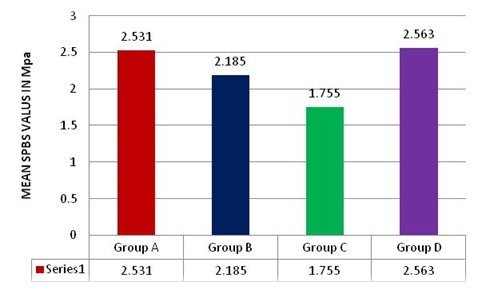
The mean SPBS in the Group A (10%) was 2.531 with standard deviation of 0.530. The average SPBS in the Group B (25%) was 2.185 with standard deviation of 0.428. The mean SPBS in the Group C (50%) was 1.755 with standard deviation of 0.320.The average SPBS in the Group D (0%) was 2.563 with standard deviation of 0.732. The mean SPBS was maximum in the Group D followed by Group A, Group B and least in the Group C. The intergroup comparison of mean SBPS between the four groups was statistically non-significant with p value of 0.085 when analyzed using the Kruskal Wallis test. The post intergroup comparison was done using the Mann Whitney U test. The intergroup comparison between each of the two groups was statistically non-significant with p value of more than 0.05



DISCUSSION
The various systems of Medicine that have gained popularity and importance in the recent years include Ayurveda, Siddha and Traditional Chinese Medicinal Systems. Researchers have proved that more than seven hundred herbal medicines and preparations whether in the form of Capsules, tablets or syrups are being used all over the world wherein a variety of more than one hundred plants are categorized as Medicinal Plants.
Calendula officinalis, is better known by the name Pot Marigold, is considered to be a valuable medicinal plant that has been an integral part of our rich cultural and traditional system of medicine. Several types of diseases have been reported to be cured by its involvement.
Fever and Cancer, are just a few of the many names that find their treatment in Ayurvedic System of Medicine using Calendula. A number of biological activities like, anti-bacterial, anti-inflammatory, diuretic, anti-spasmodic, anti-mutagenic
have been associated with several parts of Calendula. Not only these, Calendulais also remedial in Ophthalmological diseases, Dermatological issues, Gynecological problems and in some areas of burns.
The objective of study was to evaluate the Shear Bond peel Strength of Band cemented with GIC, modified by varying concentrations of Calendula. It was found out although the control group in which no Calendula was added gave highest SBPS values but adding Calendula to GIC reduced SBPS only insignificantly.
Studies and reports claim that Calendula officinalis is a natural material with bactericidal activity and several studies have shown its effective use in the bacterial disease related treatments. Several studies have demonstrated Calendula officinalis effect against various bacteria and its anti- microbial activity on oral flora and microorganisms. So, the main idea behind this study was to evaluate the mechanical properties of GIC with Calendula officinalis.
CONCLUSION
Plaque accumulation around the bands pose serious threat with regards to development of dental caries and marginal gingivitis. So the efforts have continually been made to improve the anti microbial property of luting cements by addition of certain chemicals.
In our study we tested the SBPS of bands luted with GIC modified by varied concentrations of Calendula. The mean SPBS in theControl group (0%) GIC was found to be 2.563with standard deviation of 0.73, which was maximum amongst all groups tested. Group A (10%) was 2.531 with standard deviation of 0.530. The average SPBS in the Group B (25%) was 2.185 with standard deviation of 0.428. The mean SPBS in the Group C (50%) was 1.755 with standard deviation of 0.320. The mean SPBS was maximum in the Group D followed by Group A, Group B and least in the Group C. The intergroup comparison of mean SBPS between the four groups was statistically non-significant with p value of 0.085 when analyzed using the Kruskal Wallis test. Control group has maximum strength and there is insignificant decrease in bond strength with adition of various concentrations of Calendula.
So, we can conclude that there was no detrimental effect in bond strength on adding of calendula to GIC (Glass Ionomer Cement).
Although the results of our study seem promising with regards to significant improvement in terms of anti microbial efficacy improvement and insignificant reduction in SPBS, but in Vitro study with a larger sample size and clinical studies using the products in patients will go a long way in understanding the true efficacy of using Calendula as a constituent of Luting Caments.
BIBLIOGRAPHY
Disclaimer from Guident
The views and opinions expressed in articles published in Guident are solely those of the authors and do not necessarily reflect the views of the editors, the editorial board or the publisher, Ivory India. Guident does not endorse any product, technique or treatment described. Clinical content is intended for qualified dental and medical professionals and is not a substitute for individual clinical judgement. Guident, its editors and the publisher accept no liability for any consequence arising from the use of information published in the journal.
How to cite this article
Dr. Vivek Mishra, Dr. Kamal Bajaj, Dr. Vikas Jharwal. Evaluating the Effect of Adding Calendula Officinalis on Mechanical Strength of Glass Ionomer Cement: An Invitro Study. Guident. 2025 Jan;18(2). Available from: https://guident.net/articles/research/evaluating-the-effect-of-adding-calendula-officinalis-on-mechanical-strength-of-glass-ionomer-cement-an.html