Successful Management of Symptomatic Irreversible Pulpitis with Single-Visit Endodontics: A Case Series
Department of Conservative Dentistry and Endodontics, Seema Dental College And Hospital, Rishikesh
ABSTRACT
Single-visit endodontics has become a popular treatment option due to its efficiency and effectiveness in managing various endodontic pathologies. This case report presents the successful treatment of symptomatic irreversible pulpitis using single-visit endodontics. The case highlights the diagnostic approach and treatment procedures associated with single-visit endodontics in a real-world clinical scenario.
INTRODUCTION
Irreversible pulpitis is characterized by severe, spontaneous, and lingering pain, often requiring immediate endodontic intervention.1 Single-visit endodontics offers a convenient and efficient approach to alleviate symptoms and preserve the natural dentition in such cases. This case report illustrates the management of symptomatic irreversible pulpitis through single-visit endodontics, emphasizing its clinical efficacy and patient satisfaction.1
CASE 1
A 28-year-old female presented with a chief complaint of severe, throbbing pain in the lower right first molar for the past two days. The pain exacerbated upon thermal stimuli and was not relieved by analgesics. Clinical examination revealed deep caries involving the pulp chamber, localized tenderness to percussion, and a lingering response to cold and electric pulp testing. The diagnosis of irreversible pulpitis with periapical radiolucency associated with tooth was made.
TREATMENT PROCEDURE
After obtaining informed consent, the patient was prepared for single-visit endodontic therapy. Local anaesthesia (2% lidocaine with 1:100,000 epinephrine) was administered, and rubber dam isolation was achieved. Access cavity preparation was performed using high-speed diamond burs under copious water spray. Canal patency was established, and working length determination was done using an electronic apex locator and confirmed radiographically.
Root canal instrumentation was carried out in conjunction with copious irrigation using 5.25% sodium hypochlorite. After thorough cleaning and shaping, the canals were dried, and a single-cone obturation technique with gutta-percha and bioceramic sealer was employed. The access cavity was sealed with a composite restoration.
CASE 2
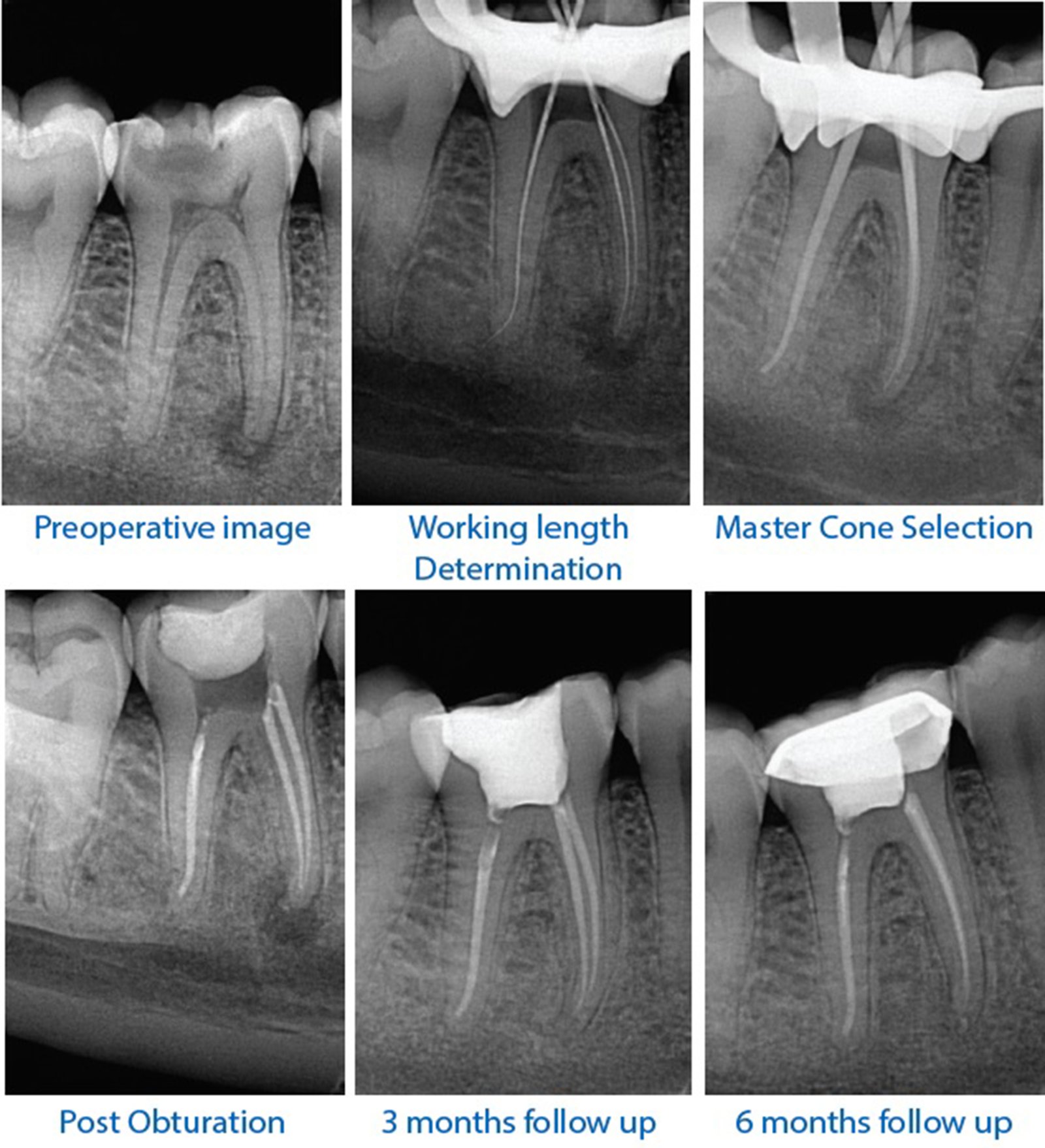
A 38-year-old male presented with a chief complaint of spontaneous pain in the lower right first molar for the past two weeks. The pain exacerbated upon thermal stimuli and chewing food. Clinical examination revealed deep caries involving the pulp, localized tenderness to percussion, and a lingering response to cold and electric pulp testing. The diagnosis of irreversible pulpitis with periapical radiolucency associated with tooth was made.
TREATMENT PROCEDURE
After obtaining informed consent, the patient was prepared for single-visit endodontic therapy. Local anaesthesia (2% lidocaine with 1:100,000 epinephrine) was administered, and rubber dam isolation was achieved. Access cavity preparation was performed using high-speed diamond burs under copious water spray. Canal patency was established, and working length determination was done using an electronic apex locator and confirmed radiographically.
Root canal instrumentation was carried out in conjunction with copious irrigation using 5.25% sodium hypochlorite. After thorough cleaning and shaping, the canals were dried, and a single-cone obturation technique with gutta-percha and bioceramic sealer was employed. The access cavity was sealed with a composite restoration.

DISCUSSION
Single-visit endodontics offers a convenient and effective treatment option for patients with symptomatic irreversible pulpitis. The expedited nature of single-visit endodontics enhances patient satisfaction and streamlines the treatment process, minimizing patient discomfort and reducing the risk of bacterial reinfection between appointments.2
Single-visit endodontics offers several advantages over traditional multiple-visit protocols These include reduced chair time for patients, fewer appointments, decreased risk of bacterial reinfection between visits, enhanced patient satisfaction, and potentially lower overall treatment costs, Additionally, single-visit endodontics eliminates the need for temporary restorations, thereby minimizing the risk of coronal leakage and subsequent treatment failure.3
While the literature suggests comparable success rates between single and multiple-visit approaches, factors such as case selection, operator skill, and adherence to strict disinfection protocols play pivotal roles in determining treatment success. Long-term follow-up studies are essential to assess the durability and sustainability of single-visit endodontic outcomes.4,5
CONCLUSION
Single-visit endodontics represents a viable treatment approach for patient presenting with symptomatic irreversible pulpitis. This case report underscores the efficacy and clinical success of single-visit endodontics in alleviating pain, preserving pulpal health, and restoring function in teeth with endodontic pathology.
REFERENCES
- Siqueira JF Jr, Rõças IN. Clinical implications and microbiology of bacterial persistence after treatment procedures. J Endod. 2008;34(11):1201-301.
- Vertucci Fl. Root canal anatomy of the human permanent teeth. Oral Surg Oral Med Oral Pathol 1984;58(5):589-99
- Ng YL, Mann V, Gulabivala K. A prospective study of the factors affecting outcomes of nonsurgical root canal treatment: part 1: periapical health. Int Endod J. 2011;44(7):583-609
- Trope M, Delano EO, Ørstavik D. Endodontic treatment of teeth with apical periodontitis: single vs. multivisit treatment. J Endod. 1999;25(5):345-50.
- Kishen A, Peters OA, Zehnder M, Diogenes AR, Nair MK. Advacnes in endodontics potential applications in clincal practice. J Conserv Dent 2016;19(3):199-206
Disclaimer from Guident
The views and opinions expressed in articles published in Guident are solely those of the authors and do not necessarily reflect the views of the editors, the editorial board or the publisher, Ivory India. Guident does not endorse any product, technique or treatment described. Clinical content is intended for qualified dental and medical professionals and is not a substitute for individual clinical judgement. Guident, its editors and the publisher accept no liability for any consequence arising from the use of information published in the journal.
How to cite this article
Dr. Siddhi Goyal, Dr. Anil Dhingra. Successful Management of Symptomatic Irreversible Pulpitis with Single-Visit Endodontics: A Case Series. Guident. 2024 Apr;17(5). Available from: https://guident.net/articles/endodontics/successful-management-of-symptomatic-irreversible-pulpitis-with-single-visit-endodontics-a-case-series.html