Healthcare Waste Management in Dental Practice
Dept. of Oral Medicine & Radiology, Department of Prosthodontics, K.D. Dental College & Hospital, Mathura
ABSTRACT
The healthcare sector is a major producer of waste. The common sources of major waste at dental clinics includes X-ray fixers and film, chemical disinfectants, dental amalgam, sharps and blood-soaked dressings, silver, lead, various solvent and other chemicals. Waste generated in dental practice if not managed properly, can create various health hazards to dental professionals, dental auxiliaries, patients and other dental health care service providers who work in dental office. Dental healthcare staff should be aware of the proper handling and the management of dental waste. The key to minimization and effective management of health care waste is segregation and identification of the waste. An attempt has been made in this article to create awareness in dental hospital and discuss different methods of handling and disposal of waste.
Keywords: Hazardous Dental waste, Infectious clinical waste, Amalgam scrap, segregation protocol, waste management
“Responsibility Today For A Better Tomorrow: Together We Can Make A Difference”
INTRODUCTION
According to the WHO (World Health Organization) worldwide about 15% of the total waste generated by healthcare activities is hazardous material that may be infectious, toxic or radioactive.1 The WHO has defined healthcare waste as “all waste produced by healthcare establishments, research facilities and laboratories including the waste originating from minor‘ or scattered‘ sources such as that produced in the course of healthcare undertaken in the home (such as dialysis and insulin injections)”.2 Infectious healthcare waste contains potentially harmful micro-organisms, which is a hazard to anyone who has contact with it until it is made safe. Clinical wastes from healthcare facilities can act as a reservoir of antibioticâ€Âresistant organisms, which if not managed correctly can contaminate the environment, affecting both soil and water supplies.One of the primary goals in waste management strategies is to manage waste safely and sustainably by:1
- Reducing the volume of waste produced per capita
- Limiting the number of landfill sites
- Protecting the environment from pollution by hazardous effluents.
Dental practices produce large as well as small amounts of healthcare waste which has to be given equal importance in management.3 Dentists have a duty of care to ensure that all the waste generated is managed and disposed off properly. All members of the dental team can make a contribution to protecting the environment by reducing the amount of unnecessary waste produced and recycling or recovering waste (e.g. metals) whenever possible.
On a practical level, each dental practice is required to prepare its own waste policy and to identify which member(s) of staff are responsible for overseeing the local management of healthcare waste, including:1
- Correctly segregating hazardous from non-hazardous waste
- Ensuring that waste is stored safely and securely on the dental premises
- Packaging waste appropriately for transport
- Describing waste accurately on documentation that accompanies the waste to an authorized waste site
- Retaining records and returns on waste management
- Undertaking a waste audit every two years
- Training staff so that they are aware of the waste procedures.
CLASSIFICATION OF TYPES OF WASTE
Several classifications of health-care waste have been put forward. One such classification divides hospital waste into hazardous and non-hazardous.4 There are various categories of hospital waste, but some are important for dental care workers. Dental practices generate both hazardous and non-hazardous healthcare waste that can be categorized into seven waste streams.1
Hazardous waste streams
1. Infectious clinical Waste
2. Amalgam Waste
3. Radiographic Waste
4. Electrical and electronic Wastes
Non-hazardouswaste streams
5. Medicines Waste
6. ‘Offensive Waste’ and gypsum
7. Domestic Waste
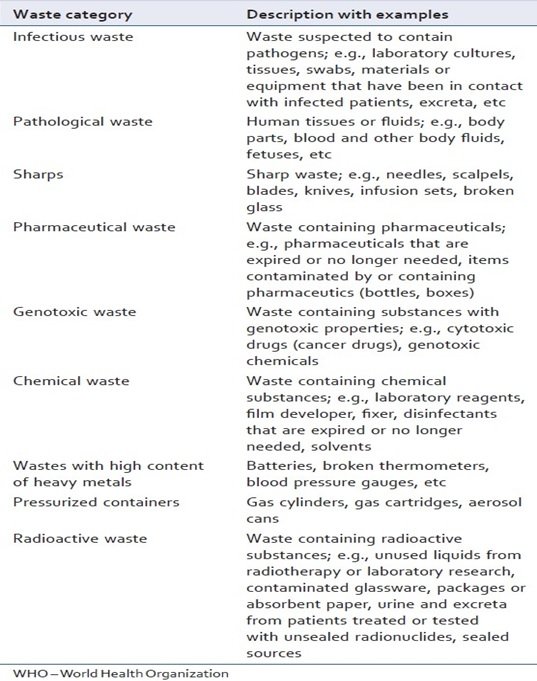
Waste categories and description as suggested by WHO, is given in the following table.4
Table 1: WHO classification of health care waste4
HAZARDOUS WASTE
The Waste Act defines ‘hazardous waste’ as those which contain organic or inorganic elements or compounds that may, owing to their inherent physical, chemical or toxicological characteristics have a detrimental impact on health and the environment5. Clinical waste generated by healthcare activities includes a broad range of materials, from used needles and syringes to soiled swabs and dressings, body parts, diagnostic samples, blood, amalgam, chemicals, pharmaceuticals, medical devices and radioactive materials.
For a waste to be defined as hazardous, it must have one or more properties that are hazardous to health or the environment:1
- explosive, oxidizing, highly flammable, flammable, irritant, infectious, toxic, carcinogenic, teratogenic, mutagenic, harmful, releases toxic gases, sensitizing, ecotoxic.
Prior to disposal in landfill sites, the traditional method for reducing the volume and mass of clinical waste and making it safe has been incineration. For instance, incineration of heavy metals or materials with high metal content (in particular lead, mercury and cadmium) can lead to the spread of toxic metals in the environment, which is why these substances are segregated into separate waste streams. Incinerated materials containing chlorine can generate dioxins and furans, which are human carcinogens and have been associated with a range of adverse health effects. However, state-of-the-art incinerators operating at 850–1100 °C that are fitted with specific gas-cleaning equipment are able to comply with the international emission standards for dioxins and furans.1
These and similar concerns have prompted the introduction of more reliable and environment-friendly methods that produce a lower carbon footprint. These technologies, which employ heat in the form of autoclaving, microwaving or chemical treatments, are referred to collectively as ‘alternative technology methods’. Heat processes can be divided into high and low-temperature methods. All of these processes are intended to render the waste non-hazardous, unrecognizable and acceptable for landfill. Incineration is reserved for sharps, medicines and anatomical wastes. Once a waste is rendered free of infection using either low-temperature technologies or incineration, then it is no longer considered to be hazardous and can go to landfill.1
INFECTIOUS CLINICAL WASTE
Infectious clinical waste is defined as “Substances containing viable micro-organisms or their toxins which are known or reliably believed to cause disease in man or other living organisms.”6 The organisms or toxins causing minor infections, such as dental caries or periodontal disease, are also included within the definition of infectious waste. Blood and body fluid contaminated cotton and gauze is a hazardous which should be collected in orange waste bag and labeled with a biohazard symbol (Figure 1).1,3 This should be kept in refrigerator if not disposed in four days. Inform certified biomedical waste carrier for disposal, once the waste gets collected.8 Wastes like cotton, gauze, suction tips, gloves, mask, tissue swabs and dental impressions must also be placed in leak-proof bags and labeled appropriately.3 Occasionally, PPE is worn but is not exposed to body fluids from splatter and this can be disposed of as nonâ€Âhazardous waste. Items such as disposable paper towels used for drying washed hands, which as the hands are clean after hand hygiene are considered as non-hazardous and can be segregated for recycling with other paper waste.1

Figure 1: Biohazard Symbol
They include any item having corners, edges, or projections capable of cutting or piercing the skin. The sharp waste in dentistry includes needles, syringes, scalpels, drills, blades, endodontic files, burs and orthodontic wires.5,8 These sharp wastes should be handled with care in order to prevent accidental injuries. Needles should be mutilated by needle destroyer/ cutter, before disposing off syringes. Mutilated needles and other sharp wastes may be kept in white colored, puncture proof containers, with 1% sodium hypochlorite solution for primary disinfection and the solution should be changed after every 2 days.1,3
ANATOMICAL WASTE
Anatomical wastes include human tissues or fluids; e.g., body parts, blood and other body fluids, fetuses, teeth, etc.4 Unwanted extracted teeth are disposed of as infectious sharps waste. Amalgam-containing teeth is considered hazardous and must never be incinerated or disposed of using alternative technology methods as toxic mercury compounds are released into the atmosphere by these processes.1 A yellow biomedical waste bag is used to collect the anatomical waste.3 The waste should be double bagged and tied tightly. It must be labeled with a bio-hazard symbol and then a certified waste carrier is contacted for disposal.3,9 Medical lab specimens like biopsy samples of suspected oral cancerous lesions that have to be transported outside for evaluation should be kept in leak proof bags and labeled correctly.3
GYPSUM WASTE
Study models or working models made of plaster contain gypsum. If models are disposed off in domestic landfill sites and mixed with food waste, the bacteria in the food break down the gypsum to release hydrogen sulphide gas, a common cause of ‘acid rain’. This is a toxic pollutant of soils, waters and forests that is harmful to trees, fish and other aquatic animals. For this reason, gypsum is prohibited from domestic landfill sites. Models should be segregated from other waste, and either sent for recycling as gypsum or for disposal in a specifically designated landfill site. If the model is contaminated with body fluids like saliva/bloods then it should be disposed off in an orange waste sack as an infectious waste.1
PHARMACEUTICAL WASTES
Pharmaceuticals waste include pharmaceuticals that are expired or no longer needed, items contaminated by or containing pharmaceutics (bottles, boxes) like anesthetics, sedatives, antibiotics and analgesics.4
The definition of medicinal waste is broad, it includes:1
- Expired, unused, spilt, contaminated pharmaceutical products, drugs, vaccines and sera
- Disposable items used in the handling of pharmaceuticals, such as packaging contaminated with drug residues, gloves, masks, connecting tubing, syringes and drug vials
- Fully or partially discharged local anaesthetic cartridges.
Pharmaceutical waste must be collected and transferred by a registered hauler to a licensed incinerator. Store pharmaceuticals in labeled, sealed and leak-proof containers in a secure location in such a manner that an accidental spill, will not result in chemicals entering any sanitary sewer or storm drain.9
RADIOGRAPHIC WASTE
Radiographic fixer and developer solutions are classified as hazardous. These hazardous wastes should be stored in a leak-proof, rigid container prior to collection by a suitably licensed waste contractor for either recovery or disposal1
Silver in radiographic fixer solutions
An in-office silver recovery unit must be used to remove silver from used fixer solutions. Used fixer solution should be sent to a silver reclaiming facility. Use of digital x-ray system and x-ray cleaner without chromium are another suggested safety alternative measures to minimize the radioactive waste. Undeveloped x-ray films have a high level of silver and should be treated as hazardous waste.3,8
Lead foil in intraoral radiograph film packets, lead aprons and lead collars
Excessive doses of lead intake give rise to neurotoxicity, carcinogenicity, hypertension, impaired renal function, immunology, toxicokinetics and reproductive problems.11 Lead containing materials must be collected and recycled through a licensed facility.3
AMALGAM WASTE
Dental amalgam is classified as a hazardous waste. Dental amalgam particles as a source of mercury which is said to be a neurotoxic, nephrotoxic, and bio-accumulative element. It can get into the environment through wastewater, scrap amalgam or vapors12
Amalgam released during the removal of old restorations must be prevented from entering the practice’s effluent water pipes via the spittoon and suction hoses. Amalgamation of mercury for dental restorations produces a stable compound that does not readily convert to methyl mercury, the form that enters the food chain with detrimental, toxic consequences to aquatic mammals, fish and other species and ultimately to human health. Any clinical waste contaminated with amalgam or amalgam capsules must never be disposed off with other types of clinical waste or poured down the sink. Solid amalgam waste awaiting collection should be stored in white lidded rigid containers under a mercury suppressant. Amalgam aspirated from the mouth is removed by an amalgam separator fitted in the waste line of the suction apparatus to stop amalgam entering the drains (effluent water system) or sewers.
Never use a vacuum cleaner or suction apparatus to clear up a mercury/ amalgam spillage as this will vaporize the mercury, causing toxic fumes to be vented into the surgery. A mercury spillage kit should be kept readily available for use in the event of an accident.1
Scrap amalgam waste management implicates
- Using suction traps and disposable amalgam separators on dental suction units, to prevent amalgam accumulation the trap should be changed weekly,
- Required amalgam amount only mixed or use premeasured amalgam capsules,
- Do not throw extracted teeth filled with amalgam in the regular garbage,
- Use mercury containers to store all scrap/old amalgam13,14
Sedimentation units are one of the basic types of amalgam separation technologies which decrease the speed of the flux of water with baffles or tanks to allow amalgam particles to settle. The water out to the sides of the unit is spin by Centrifuge units. These units offer good amalgam removal but cause some foaming with American vacuum systems. Ion Exchange units use polymers to capture small particles; these are often used in series with sedimentation units.13 Other wastewater treatment technologies such as electrolysis and chemical additions have been adapted for dental applications.15
Table 2: Color coding for dental hospital wastes and method of disposal1,5,10

- Waste survey: Quantification and differentiation of waste.
- Waste segregation: Placing different wastes in different containers.
- Waste accumulation and storage: Accumulation temporary holding and storage longer holding.
- Waste transportation: Wastes are carried in special containers in vehicles
- Waste treatment: A process that modified the waste to disinfect or decontaminate the waste so that they are no longer a source of pathogens and can be handled, transported and stored safely
- Waste disposal: Incineration, microwave irradiation, chemical disinfects, wet and dry thermal treatment, inertization and land disposal.
- Waste minimization: Following reduce, reuse and recycle methods.
Good practice guide: Handling of hazardous waste1
- Segregate waste according to the waste streams
- Best practice recommendation is to use nationally accepted color-coded waste sacks to distinguish between different types of waste streams
- Never use waste sacks to dispose off sharps or liquids; these should be disposed off in puncture and leak-proof receptacles (bins)
- Suspend waste sacks in a foot or sensor-operated pedal bin(Figure 2)
- Discard waste sacks when three-quarters full, and securely tie, label and date with name of practice and premises code prior to disposal. Figure 3 shows the swan neck method of securing the waste bag.
- Keep manual handling of waste sacks and sharps receptacles to a minimum. Ensure that waste containers are kept upright during use or when full.
- Use receptacles (bins) with appropriately colour-coded lids that are rigid, puncture proof
- The lid aperture should be in the closed position when not in use
- Keep sharps bins away from direct sources of heat.

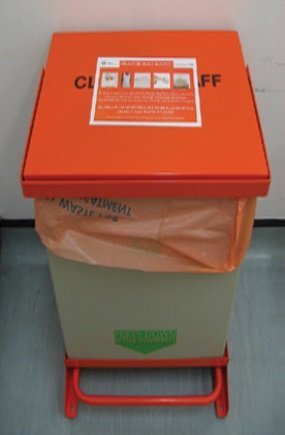
Figure 2: White and orange waste sacks/receptacles with food-operated pedal bin


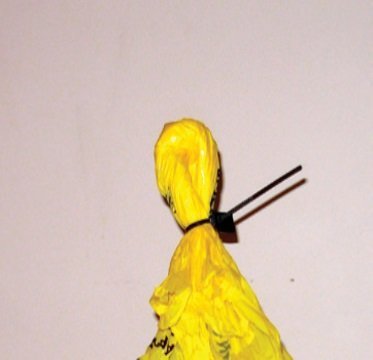
Figure 3: Three steps in making a ‘swan neck’ tie to close a hazardous waste sack.
Any person who handles waste in the dental practice must be immunized against hepatitis B (including cleaning staff). During disposal of clinical waste, healthcare personnel should don the appropriate personal protective equipment (e.g. heavyâ€Âduty gloves and plastic apron) to protect themselves and their clothes against spills and sharps injuries. Hands should be cleaned after handling waste. If there is a risk from exposure to aerosols and splatter then masks and protective eyewear should be worn.
BULK STORAGE OF WASTE 1
- Waste should be stored in a dedicated area prior to collection.
- Clinical waste sacks and bins awaiting collection should be stored in a rigid fire-retardant locked waste cart with a well-fitting lid.
- Waste storage areas should be clean, secure, well lit and inaccessible to unauthorized persons or pests.
- Waste should be stored on an impervious hard surface that can be washed down should there be a spillage.
- Waste should be collected at frequent intervals to prevent a build-up of waste sacks. The actual frequency will be dictated by the volume of waste generated.
- Waste can only be stored at the dental premises for a maximum of 12 months.
TRANSPORT OF HAZARDOUS WASTE
Every movement of hazardous waste must be accompanied by a completed multipart consignment note. This must be signed at each stage during the transfer of waste from the practice to the waste disposal site. A new consignment note must be completed for each individual collection of hazardous waste. Each consignment note consists of producer, carrier and consignee (waste disposal contractor) copies. There are two different types of documentation required for waste transfers.1
- Consignment notes, which are used for hazardous wastes
- Waste transfer notes, which are used for non-hazardous wastes
CONCLUSION
Dental waste comprises of most of Hazardous waste so it is crucial issue for its proper management that need efforts of team work of dental professionals, dental auxiliaries, patients and other dental health care service providers who work in dental office. Proper methods should be planned to collect waste at its point of generation, segregation, packaging, labeling, storing, treating and then transportation. Record should be maintained with details of quantity of waste generated, treated and disposed off. Training of staff handling waste management and other health care workers should be done. Measures should be taken by all dental practitioners to minimize the production of these wastes and their potential environmental effects. Safe and effective management of healthcare waste is not only a legal necessity but also a social responsibility.REFERENCES
- Caroline L. Pankhurst and Wilson A. Coulter. Healthcare waste management. Basic Guide to Infection Prevention and Control in Dentistry. Second Edition. Published by John Wiley & Sons Ltd;2017: 182-200
- Osamong LA, Gathece LW, Kisumbi BK, Mutave RJ. Management of Dental Waste by Practitioners in Nairobi, Kenya. Afr J Oral Health 2005;2(1&2):24-9.
- Veena B. Benakatti, Hema Kanathila. Biomedical Waste Management In Dental Office-A Review. World Journal Of Advance Healthcare Research 2018; 2(4): 177-181
- Om N. Baghele, Subodh Phadke, Ashish A. Deshpande, Jayant P. Deshpande, Mangala O. Baghele. A simplified model for biomedical waste management in dental practices ‑ A pilot project at Thane, India. European Journal of General Dentistry 2013;2(3):235-240
- Punkaj Govan. Waste management in dental practice. South African Dental Journal 2014;69(4):178 -181
- Finley RL, Collignon P, Joakim Larsson DG. The scourge of antibiotic resistance: the important role of the environment. Clinical Infectious Diseases. 2013; 57:704–710
- B Agarwal, M kumar, S Agarwal, A Singh, A Shekhar. Bio medical waste and dentistry. J oral health comm dent, 2011; 5(3): 153-55.
- A singh, R Gupta, A Tomer. Current concepts of biomedical waste management and dental practice. International research Journal of clinical medicine, 2016;1(3): 8-12.
- Biomedical Waste Management Protocol. Available from: https://www.ida.org.in/Membership/Details/BiomedicalWasteManagementProtocol
- Protocol for management and handling of dental hospital waste-color coding for waste disposal. Available from: https://www.juniordentist.com/management-and-handling-of-dental-hospital-waste-color-coding-for-waste-disposal.html
- D A Gidlow. Lead toxicity. Occup med, 2004;54(2): 76-81
- Singh H, Bhaskar DJ, Dalai DR, Rehman R, Khan M. Dental Biomedical Waste Management. Int J Sci Stud., July 2014; 2(4): 66-68.
- Hörsted-Bindslev P. Amalgam toxicity-environmental and occupational hazards. J Dent 2004;32(5):359-65.
- Clifton JC 2nd. Mercury exposure and public health. Pediatric Clinics of North America. 2007;54(2):237-e1.
- Rajaram Naik, Sureshchandra B., Srinidhi Hegde, Aftab Damda, Meeta Malik. Best management practices for hazardous dental waste disposal. http://medind.nic.in/eaa/t11/i2/eaat11i2p106.pdf
- Park K. Hospital Waste Management. Park’s Textbook of Preventive and Social Medicine. 22nd edition, Jabalpur, India: M/s Banarasidas Bhanot Publishers; 2009: 694-9.
Disclaimer from Guident
The views and opinions expressed in articles published in Guident are solely those of the authors and do not necessarily reflect the views of the editors, the editorial board or the publisher, Ivory India. Guident does not endorse any product, technique or treatment described. Clinical content is intended for qualified dental and medical professionals and is not a substitute for individual clinical judgement. Guident, its editors and the publisher accept no liability for any consequence arising from the use of information published in the journal.
How to cite this article
Dr. Jyoti Gupta Dept. of Prosthodontics, Dr. Kalpana Poudel, Dr. Varun Singla. Healthcare Waste Management in Dental Practice. Guident. 2020 Jul;13(8). Available from: https://guident.net/articles/general/healthcare-waste-management-in-dental-practice.html